Apple Intelligence in China: Qwen in Siri, Explained
Apple Intelligence in China arrives with iOS 27.3 in December, with Alibaba's Qwen in Siri. What's in, what's left out and what it means for app teams.
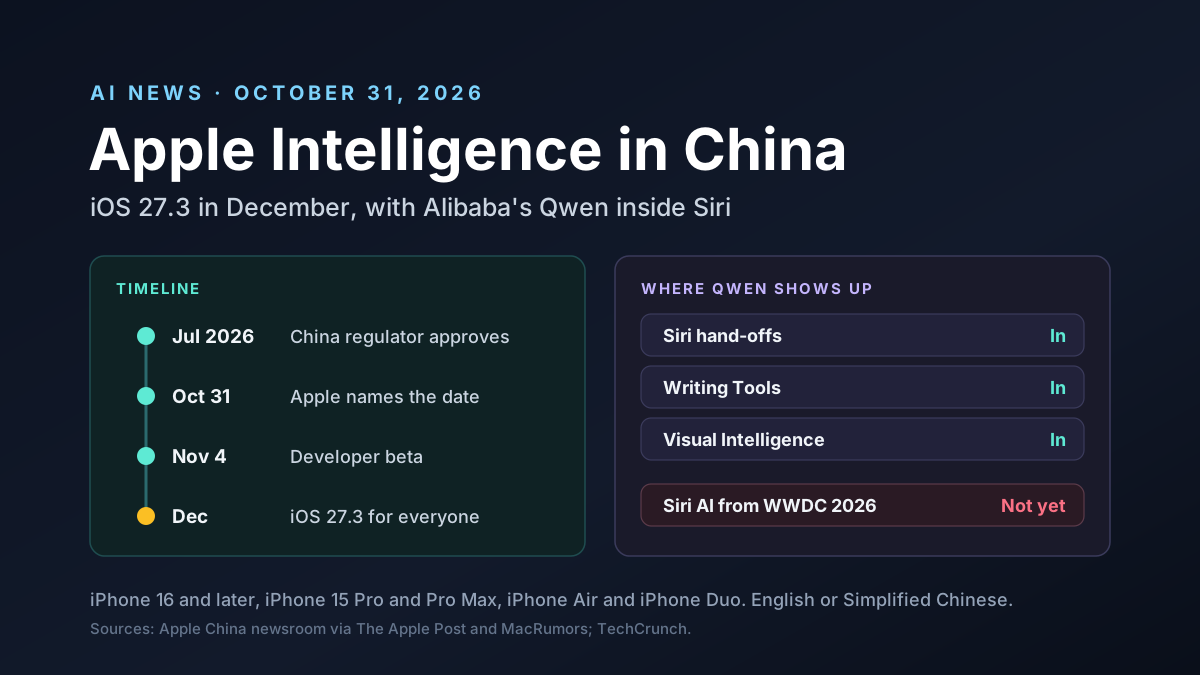
Apple Intelligence is finally coming to China, and it brings a Chinese partner with it. On October 31, 2026, Apple said its AI features will reach iPhones in mainland China in December with iOS 27.3. Alibaba's Qwen will work inside Siri, Writing Tools and Visual Intelligence.
Two years late. It's a big moment for Apple in one of its biggest markets, and for Alibaba. It's also a useful case study for any team that ships AI features in more than one country. Here's what Apple confirmed, what's left out, how the Qwen deal really works and what app and data teams should take from it.
Disclosure and scope: Van Data Team builds data and AI systems for clients. We use several model providers. We have no business ties to Apple or Alibaba, and we drafted this article with help from Claude, Anthropic's model.
Facts come from Apple's announcement as reported by The Apple Post and MacRumors, plus Apple's own financial statements. We label our own math as ours. Nothing here is legal or investment advice.
Key Takeaways
- What: Apple Intelligence launches in mainland China with iOS 27.3 in December 2026. The first developer beta lands on November 4, China time.
- Qwen's role: Alibaba's Qwen works in Siri, Writing Tools and Visual Intelligence, much like ChatGPT does in other countries.
- What's missing: Siri AI and the other new features from WWDC 2026 aren't part of this release.
- Which iPhones: iPhone 16 and later, iPhone 15 Pro and Pro Max, iPhone Air and iPhone Duo.
- Why it matters: Apple's Greater China sales grew 22% to 38% a year in each of the last three reported quarters, even without Apple Intelligence.
- For app teams: one product can need a different AI stack in each country. Build for that from the start.
Apple Intelligence in China at a Glance
| Item | What Apple has said |
|---|---|
| Announced | October 31, 2026, China time, on Apple's newsroom in China |
| Developer beta | November 4, 2026, China time |
| Public release | December 2026, with iOS 27.3 |
| Chinese AI partner | Alibaba's Qwen, in Siri, Writing Tools and Visual Intelligence |
| iPhones | iPhone 16 and later, iPhone 15 Pro and Pro Max, iPhone Air, iPhone Duo |
| Languages | English or Simplified Chinese, for both the iPhone and Siri |
| Not included | Siri AI and the other WWDC 2026 features |
| Mac, iPad and others | Later, after regulatory approval |
What Apple Announced on October 31
Apple posted the news on its newsroom site in China. In the US it was still October 30, so MacRumors reported it that afternoon, Pacific time.
The core facts are simple. The first developer beta with Apple Intelligence for China arrives on Wednesday, November 4, China time. That's likely Tuesday, November 3, in the US, because China is 13 to 16 hours ahead of US time zones, so developers in California will probably see it a day early.
The public release follows in December, as part of iOS 27.3. No exact date yet.
Apple also confirmed the Qwen deal in the same announcement, according to The Apple Post. Alibaba had first confirmed the partnership back in February 2025.
Where Qwen Shows Up in Siri
Qwen shows up in three places. Apple calls them "selected Apple Intelligence experiences."
- Siri: it can hand some requests to Qwen "for broader knowledge," when a question goes beyond what Apple's own models handle well.
- Writing Tools: Qwen can create new text from scratch, not just edit what you wrote.
- Visual Intelligence: you can ask Qwen about photos and documents, including PDFs and presentations.
Qwen understands both text and images. To use it, people sign in with a Qwen account or with Sign in with Apple.
If that sounds familiar, it should. It mirrors how Apple added ChatGPT to Siri and Writing Tools in other countries. Apple's own models do most of the work, and an outside model steps in for some requests.
Which Features Arrive in December
The first China release brings most of the AI features that other markets got in 2024 and 2025. According to The Apple Post's feature list and MacRumors, it includes:
- Writing and mail: Writing Tools, Smart Reply, Priority Mail and email summaries.
- Notifications: notification summaries, Priority Notifications and Reduce Interruptions.
- Photos: Clean Up, photo search in plain words and Memory Movies.
- Calls and audio: call summaries and audio transcription summaries.
- Other: Genmoji, Visual Intelligence, Type to Siri and Live Translation with AirPods.
| In the December release | Not in the December release |
|---|---|
| Writing Tools, with Qwen for new text | Siri AI, the rebuilt assistant |
| Visual Intelligence, with Qwen for photos and files | Deeper personal context |
| Siri hand-offs to Qwen | Onscreen awareness |
| Genmoji and Clean Up in Photos | Broader actions across apps |
| Notification and email summaries | Image Playground |
| Live Translation with AirPods | Mac, iPad and other devices |
What Apple Intelligence in China Leaves Out
The biggest gap is Siri AI. Apple said Siri AI and the other new Apple Intelligence features it announced at WWDC 2026 won't be available in China on iOS 27.3.
So there's no rebuilt Siri for now. That means no deeper personal context, no onscreen awareness and no new actions across apps, which are the headline parts of the new Siri that Apple showed at WWDC 2026.
MacRumors adds that Image Playground won't be available in China either. And the launch covers only iPhones. Mac, iPad and other Apple devices come later, once Apple gets the needed approvals.
So Chinese users get a solid first wave, but not the newest Siri that users elsewhere already have.
Which iPhones Get Apple Intelligence in China
The device list matches the hardware Apple needs for its on-device models elsewhere:
- iPhone 16 models and later
- iPhone 15 Pro and iPhone 15 Pro Max
- iPhone Air
- iPhone Duo, Apple's first foldable, which we covered in our iPhone Duo explainer
There's one catch. Both the iPhone language and the Siri language must be English or Simplified Chinese. Check both. A phone set to Traditional Chinese won't qualify at launch, based on Apple's wording.
What Changes for iPhone Users
For people in China with a recent iPhone, the change is easy to picture. After the December update, the phone gets the same helpers that users in other countries have had for a while.
- Busy inbox? Mail can put urgent emails first and sum up long threads.
- Too many alerts? Notification summaries boil a pile of alerts down to one short line, so you can see what matters without opening each app.
- Messy photo? Clean Up can remove a person or object in the background.
- A hard question? Siri can pass it to Qwen, once you sign in.
- Talking to a visitor? Live Translation with AirPods helps you follow a chat with someone who speaks another language, right in your ears.
None of this needs a new phone if yours is on the list. It needs the update and the right language setting. For Qwen, it also needs a sign-in.
Why Apple Intelligence in China Took Two Years
Apple Intelligence first launched in the US in late 2024. China, one of Apple's biggest markets, had to wait more than two years, and the reason was rules, not hardware.
In China, public AI chat services need a green light from the country's internet regulator, the Cyberspace Administration of China (CAC). ChatGPT isn't offered there. So Apple needed local partners and that green light.
The path was slow. Here's the timeline as reported:
- December 2024: Reuters reported that Apple was struggling to adapt AI models, including Baidu's, for Chinese users.
- February 2025: Alibaba confirmed it was working with Apple.
- July 15, 2026: Reuters reported that the CAC had approved Apple's AI services, tied to the Qwen deal, according to TechCrunch.
- August 2026: Apple briefly posted, then pulled, a support page on connecting Qwen to Siri on the Mac.
- October 31, 2026: Apple named the date.
Apple's Own China Model and the Baidu Question
Qwen isn't the whole story. In August, Reuters reported that Apple had trained its own large language model for China, with Alibaba's help, according to MacRumors.
That would make Apple the first foreign company approved to offer its own AI model in China, the report said. It also fits what Apple announced. Apple's models seem to run the core features, and Qwen handles the extra knowledge and writing tasks.
Baidu's role is less clear. In July, a Baidu spokesperson told TechCrunch it was working with Apple on AI features for Chinese users. Apple's October announcement, as reported, didn't mention Baidu, so we wouldn't assume any feature runs on it yet.
Is Qwen the First Chinese AI Model in iOS?
Some coverage calls this the first time a Chinese AI model has been built deep into the iPhone's software. That's fair in one sense. Qwen is now a named part of iOS features in China, which hasn't happened before.
But "deep" needs care. Based on Apple's description, Qwen works as a sign-in extension that Siri and other tools can call on, much like ChatGPT elsewhere. It doesn't replace Apple's own models, and it isn't the brain of Siri, so calling it a deep tie-in goes further than what Apple has actually described so far.
The difference matters for privacy too:
- Qwen hand-offs send the request to Alibaba's service.
- Apple's own models keep the request inside Apple's system.
- Privacy details for the Qwen hand-off in China haven't been published yet, so that's worth watching.
Why Apple Intelligence in China Matters: The Numbers
China is the world's largest smartphone market. Apple's sales there have been growing fast. Here are its Greater China sales for the last three reported quarters, from its March quarter statements and June quarter 10-Q.
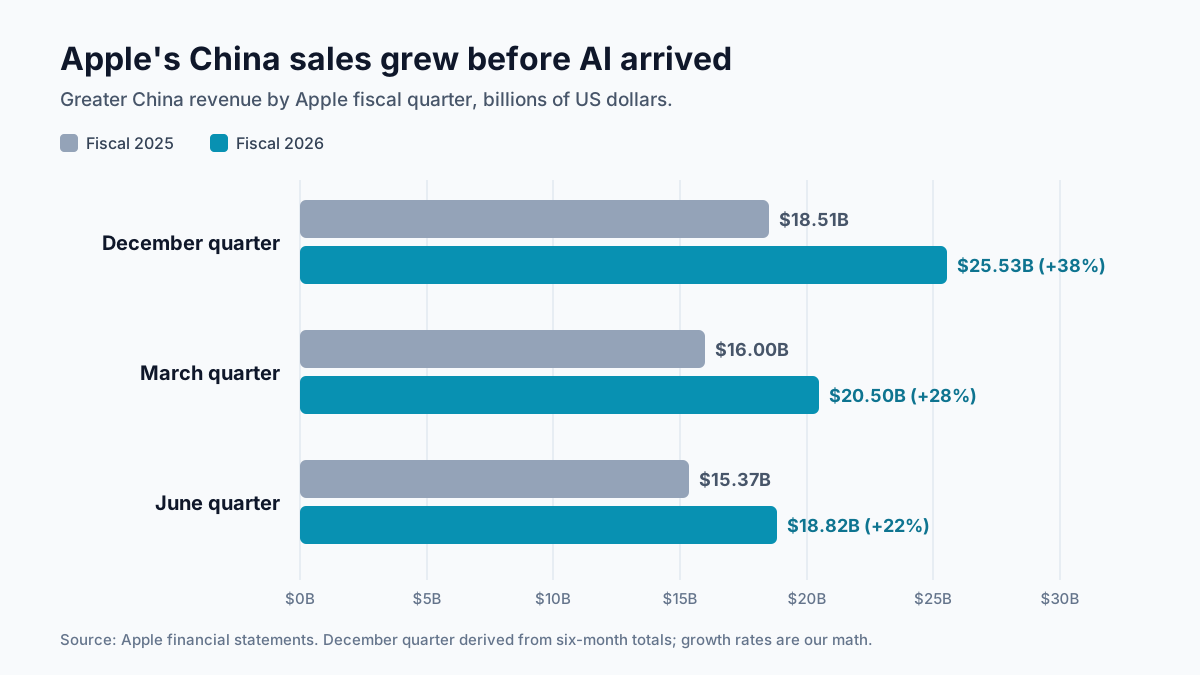
| Quarter (Apple fiscal) | Greater China, 2025 | Greater China, 2026 | Change (our math) |
|---|---|---|---|
| December quarter (Q1) | $18.51 billion | $25.53 billion | +38% |
| March quarter (Q2) | $16.00 billion | $20.50 billion | +28% |
| June quarter (Q3) | $15.37 billion | $18.82 billion | +22% |
Each quarter grew by double digits, by our math. And Apple did that without Apple Intelligence in China at all.
That's the interesting part. The AI launch isn't arriving to rescue weak sales. It's arriving to close a feature gap with Chinese rivals like Huawei, Xiaomi and Honor, which already ship phones with their own AI assistants, and to keep buyers moving to newer iPhones that can run it.
One Product, Two AI Stacks
Step back and look at what Apple built. Apple Intelligence is one product, but it runs on a different mix of models and partners in China than everywhere else.
| Layer | Most markets | China |
|---|---|---|
| On-device and server models | Apple's own models | Apple's own models, plus a China model built with Alibaba's help, per Reuters |
| Outside AI partner | ChatGPT, as an optional extension | Qwen, in Siri, Writing Tools and Visual Intelligence |
| Sign-in | ChatGPT account optional | Qwen account or Sign in with Apple |
| Regulator | Varies by country | Cyberspace Administration of China |
| Newest features | Siri AI from WWDC 2026 | Not yet |
Apple didn't pick this because it was neat. It picked it because the rules said so. And that's the lesson for every team that ships AI in more than one country.
What Apple Intelligence in China Means for App Teams
If your product sells in China and in other markets, you'll face the same split Apple did:
- Models: the model you use in the US may not be allowed in China.
- Data: the data you log in Europe may need to stay in Europe.
- Timing: a feature you launch in one place may need months of review in another.
The teams that handle this well make it a design choice early, while the teams that don't usually end up with two codebases that slowly drift apart and cost twice as much to run. The next four sections show how to avoid that.
Build a Region-Aware AI Stack
Don't hard-code one model provider. Put a small routing layer between your app and the models, and choose the provider by region.
| Setting | US build | China build |
|---|---|---|
| Model provider | Your current US provider | A provider approved for China, such as Qwen |
| Data storage | US region | Mainland China region |
| Prompt language | English | Simplified Chinese first, English second |
| Content rules | Your US policy | Your China policy, reviewed locally |
| Logs | Request, model, tokens, score | The same fields, stored in China |
This layer also holds your prompts, safety rules and backups. When a provider changes, or a new one gets the go-ahead, you change one file. You don't rewrite features. We explained this pattern in our piece on the model portability lesson.
Picking a Chinese model? Start with our Qwen vs DeepSeek vs Kimi comparison.
Keep Data Where the Rules Say
China's data privacy law, the Personal Information Protection Law, sets strict rules for moving personal data out of the country. So many teams keep Chinese users' data on servers in mainland China. They send only what they must across the border.
Plan your data flows with that in mind:
- Map what each AI call sends. Prompts often contain names, messages and photos.
- Keep logs local. Your request logs are personal data too, because they hold the same names, messages and photos that users typed or uploaded in the first place.
- Separate analytics. Send only rolled-up numbers to a global dashboard, not raw prompts.
Get local legal advice before launch. Rules change, and the details depend on your business.
Test in Simplified Chinese
Apple requires the iPhone and Siri language to be English or Simplified Chinese. Your tests should cover both, and they should cover the mix.
Real users switch languages in one sentence. They paste English product names into a Chinese message. They write dates and prices the local way.
Build a test set from real tasks in both languages, and score each model the same way. Our guide to AI agent evaluation walks through how. A model that scores well in English can still stumble on Chinese place names, slang or legal terms.
A Worked Example: A Shopping App in Two Markets
Picture a shopping app that sells in the US and China. It wants an AI feature that writes short product summaries from reviews.
In the US build, the app calls its usual model provider and stores logs in a US region. In the China build, it calls a model approved for China, stores logs in a mainland region and runs every prompt through a Chinese content policy first.
One codebase. Only the routing config differs between the two builds, and that file is short enough to review in a few minutes. The team runs one test set of 50 real products in both languages and compares quality, cost and speed before launch. Then it ships.
Three months later, the team's China provider ships a new model version. Because the app logs the model name on every call, the team spots the switch the same day. It reruns the test set, sees a small drop on product names and fixes the prompt before customers notice. We covered that logging habit in our look at silent model swaps.
What Not to Do
A few mistakes are easy to make when expanding AI features into China.
- Don't assume one model works everywhere. Apple couldn't make that work, even with its budget, its engineers and years of talks with regulators, so a smaller team shouldn't plan on it either.
- Don't fork your codebase. Keep one feature codebase and switch providers, storage and rules by config, so a fix in one market reaches the other market the same day.
- Don't send raw prompts to a global log. That can break data rules on day one.
- Don't test only in English. Chinese users will judge your feature in Chinese, often with English brand names mixed in, so a test set in one language misses the cases that matter most.
- Don't plan around unreleased features. Siri AI isn't in China yet, and Apple hasn't said when it will be.
What to Watch Next for Apple Intelligence in China
- The November 4 beta. Developers will see exactly how the Qwen hand-off works and what it asks users before sending data.
- The December release date. Apple only said December, so the exact day is still open.
- Siri AI timing. Whether China gets the rebuilt Siri in 2027, and which model powers it there.
- Mac and iPad approval. Apple said these need separate approvals, and it hasn't said who is reviewing them or how long that review might take.
- Baidu's part. Whether any feature ends up using Baidu's models.
- Sales. Whether Apple's next Greater China numbers show any lift once the features ship.
Apple Intelligence in China: Our Take
Apple Intelligence in China is a real milestone, two years late. Chinese iPhone users get most of the features the rest of the world has, plus Qwen in place of ChatGPT. They don't get the newest Siri yet.
For builders, the bigger story is the shape of the deal. Apple runs one product on two AI stacks, split by country and set by regulators. Most global apps will need the same thing sooner or later, so it's worth building the routing, data and test habits now.
How Van Data Team Helps Teams Ship AI Across Markets
We help teams build AI features that work in more than one country. That includes:
- Model routing by region, with one codebase and a config per market.
- Data pipelines that keep each region's data where the rules say.
- Test sets in every launch language, scored the same way each time.
- Request logging that shows which model handled each call.
Explore our AI agent development and data pipeline development services, or get in touch for a quick review of your plans.
AI Model Brief
The AI models worth knowing, once a week
What shipped, how it scores on independent benchmarks, what it costs per million tokens and what was deprecated, from the data behind our AI model benchmarks.
We use your address only to send the brief. See our privacy policy.
See this week’s brief
Founder of Van Data Team. Builds Vanaxity, the AI agent system for SEO, GEO, and AEO, and leads data engineering delivery for B2B teams.
About the authorArticle FAQ
Questions readers usually ask next.
These short answers clarify the practical follow-up questions that often come after the main article.
Need a similar system?
If this article maps to a workflow your team already operates, the next step is usually a scoped review of the system, constraints, and rollout path.
Consultation
Scope your next AI workflow.
Share the system and blockers. We will map fit, gaps, and the next step.