GPT-6.2 Astra and Fable 5.5 Leaks: What's Real So Far
GPT-6.2 Astra and Claude Fable 5.5 leaked in one night. We checked the screenshots, code and price lists: what holds up, and what data teams should do now.
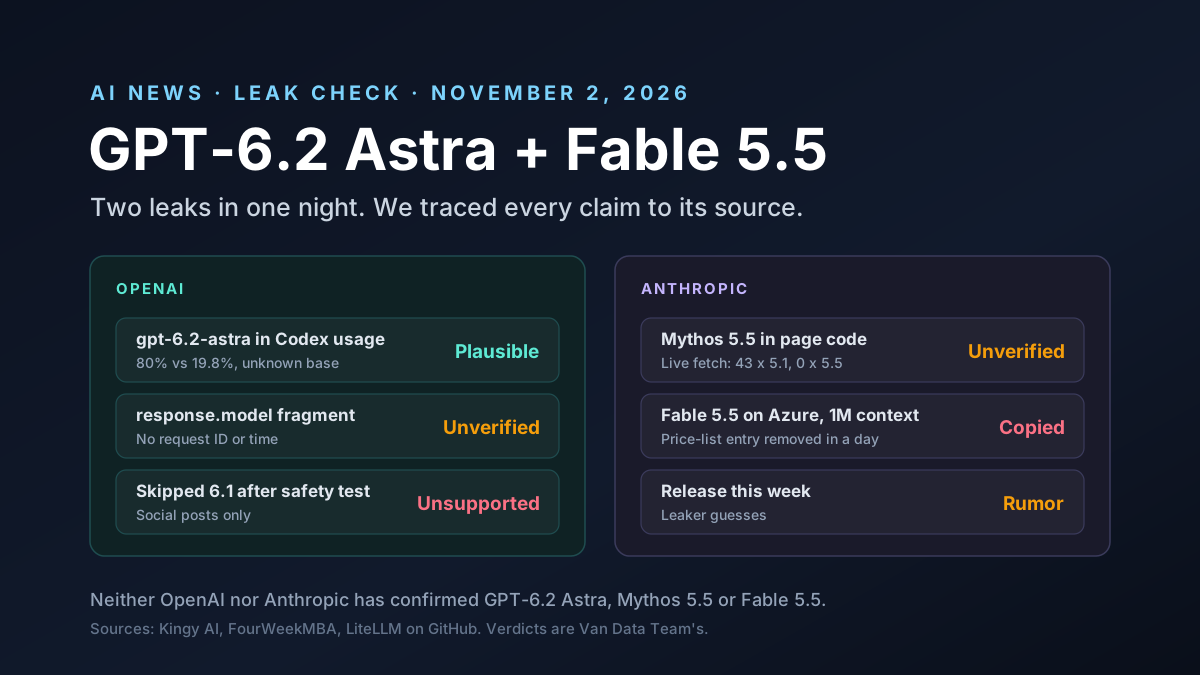
Two of the biggest AI labs appeared to leak their next models on the same night. On November 1, 2026, screenshots showed a model called GPT-6.2 Astra inside OpenAI's Codex. Hours later, another screenshot claimed Anthropic's website code named Claude Mythos 5.5.
Neither company has confirmed anything. Some of the evidence is decent, and some falls apart under a quick check. Here's what each leak actually shows, how we scored it and why the most useful lesson for data teams isn't about release dates at all. It's about knowing which model really answered your last API call.
Disclosure and scope: Van Data Team builds data and AI systems with several model providers, including OpenAI and Anthropic. We drafted this article with help from Claude, Anthropic's model, and Anthropic is one of the two companies in this story. We have no inside information from either lab.
Everything here is based on public posts and pages as of November 2, 2026. We label leaks as leaks and our own math as ours. Nothing here is investment advice.
Key Takeaways
- What leaked: a gpt-6.2-astra label in Codex usage data, and a screenshot of "Claude Mythos 5.5" in Anthropic's page code. Both surfaced on November 1, 2026.
- Not confirmed: OpenAI and Anthropic haven't announced GPT-6.2 Astra, Mythos 5.5 or Fable 5.5.
- Strongest evidence: the GPT-6.2 Astra usage screenshots. They fit a quiet test, but they can't be traced to a full request.
- Weakest evidence: the Fable 5.5 "specs." The 1M-token context and 128K-token output were copied from Fable 5.1 into a price list, then removed a day later.
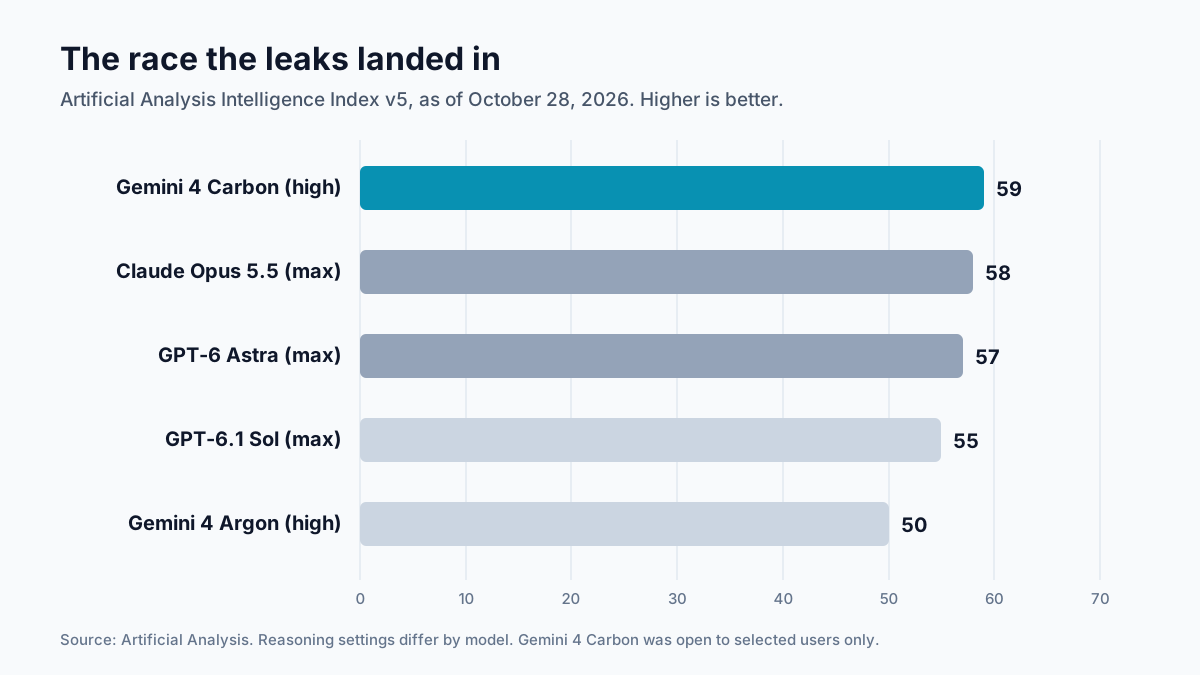
- Why now: Google's Gemini 4 Carbon took first place on the Artificial Analysis Intelligence Index v5 with 59 points on October 28, just ahead of Claude Opus 5.5 at 58 and GPT-6 Astra at 57.
- For data teams: log the model name each call returns, pin versions and keep a test set ready. That turns the next leak, or the next quiet swap, into a routine check.
GPT-6.2 Astra and Fable 5.5 at a Glance
| Item | GPT-6.2 Astra (OpenAI) | Mythos 5.5 and Fable 5.5 (Anthropic) |
|---|---|---|
| What surfaced | A gpt-6.2-astra label in Codex usage screenshots | "Claude Mythos 5.5" in a screenshot of page code |
| When | Posts on November 1, 2026 | Posts on November 1, 2026; a Fable 5.5 price entry in October |
| Main evidence | Usage shares of 80% and 19.8%, one JSON fragment | One screenshot; a LiteLLM entry removed after a day |
| Independent check | Posts reuse the same images | Live page showed 43 mentions of 5.1, zero of 5.5 |
| Official status | Not announced | Not announced |
| Our verdict | Plausible test, unconfirmed | Possible, weakly supported |
What Leaked on November 1
The two leaks came from different places, but they spread together. The story moved across X and then through Chinese tech media, including ifanr and a widely shared Xinzhiyuan report that ChainCatcher republished on November 2.
Here's what each side looked like:
- OpenAI: users posted screenshots of Codex usage data. The usage breakdown showed a model named gpt-6.2-astra, while the model picker still said GPT-6 Astra.
- Anthropic: an account posted a screenshot of code from Anthropic's Mythos page. The visible page said Claude Mythos 5.1, but the hidden code showed "Claude Mythos 5.5."
The timing made the story bigger. Each lab's current flagship is only about two months old. OpenAI launched GPT-6 Astra on September 3, 2026, and Anthropic released Mythos 5.1 and Fable 5.1 on September 1.
GPT-6.2 Astra: The Codex Usage Screenshots
The GPT-6.2 Astra story started with usage charts. According to a tracker by Kingy AI, an account called Mashiro posted three screenshots that it said came from three Codex users.
The first chart covered October 26 to November 1. It showed two model names:
- gpt-6-astra: 80% of usage.
- gpt-6.2-astra: 19.8% of usage.
The two numbers add up to 99.8%. The chart doesn't say what the last 0.2% was, or whether the shares count requests, tokens or time.
A second account, Token Gremlin, pointed out the gap between the picker and the usage label and suggested an A/B test. That's a common way to try a new model on a slice of real traffic before a launch. Token later said the image was Mashiro's. One source, really.
A third account, Salio, posted a JSON fragment that looked like part of an API response, the kind of event a developer sees when a request to OpenAI finishes. Its outer type was response.completed, and its nested response.model field said gpt-6.2-astra.
How Strong Is the GPT-6.2 Astra Evidence?
It's the better of the two leaks, but it's still thin, and three separate problems keep it from counting as proof that OpenAI is serving a new model to paying users.
- One image source. Several big accounts shared the same screenshots. More posts didn't mean more evidence.
- No trace. The JSON fragment shows no endpoint, request ID, headers or time stamp. Anyone could type that text.
- Unknown base. Without a denominator, "19.8% of traffic" could mean a lot of requests or very few.
Still, the story is easy to believe. AI labs often route a share of traffic to a new build before they name it. A usage label that doesn't match the picker is exactly what that would look like from the outside.
As of November 1, Kingy AI found no GPT-6.2 Astra entry in any of OpenAI's public docs:
- The model catalog lists GPT-6 Astra, not 6.2.
- The API changelog has no release note for it.
- The Codex models guide doesn't mention it.
So the fair summary is simple. GPT-6.2 Astra probably exists as a test. It isn't a product yet, and it has no public price, no spec sheet and no benchmark scores that anyone outside OpenAI can check or repeat in their own account.
What Happened to GPT-6.1?
Some posts claimed OpenAI skipped a "GPT-6.1 Astra" because it failed an internal safety test. We found no source for that beyond social posts, so we wouldn't repeat it as fact.
The naming isn't strange anyway. OpenAI already uses the 6.1 number for other models:
- GPT-6.1 Sol appears on the Artificial Analysis index.
- GPT-6.1 Terra launched in October, and we covered it here.
Jumping from GPT-6 Astra to GPT-6.2 Astra would simply keep the version numbers in step across the whole family, so the number alone would tell you which generation of models any given name belongs to.
The Xinzhiyuan report also says GPT-6.2 Astra could launch "next week." That's a guess from leakers, not a date from OpenAI.
Claude Mythos 5.5 in Anthropic's Page Code
The Anthropic leak rests on one image. Here's the timeline on November 1, as FourWeekMBA reconstructed it:
- 15:23 UTC: the account @kimmonismus posted the screenshot and credited an anonymous email tip. It showed "Claude Claude Mythos 5.5" in a hidden header and in the logo's alt text.
- 16:55 UTC: another account claimed the code named Mythos 5.5 six times. FourWeekMBA didn't verify that count.
- About 17:31 UTC: FourWeekMBA fetched Anthropic's Mythos page twice, once with a cache-busting setting. Both times it counted 43 mentions of "Mythos 5.1" and zero mentions of "Mythos 5.5."
Some users said Anthropic had quietly removed the text. That's possible. A staging page can go live for a few minutes. But nobody has shown an archived copy with the 5.5 text, so the screenshot remains the only proof.
The two names also fit Anthropic's current setup. Fable is the general model with stronger safety limits. Mythos is the version for approved security and research teams, which Anthropic widened through its Cyber Verification Program on October 6, according to Wikipedia's Claude Mythos entry.
The Fable 5.5 Azure Listing Was Copied Data
The Fable 5.5 claims are older than the Mythos screenshot. Reports said Fable 5.5 sat in Microsoft Azure and MLflow catalogs with a 1M-token input context and a 128K-token output limit.
We checked the source. On October 13, 2026, a bot added an entry named azure_ai/claude-fable-5-5 to LiteLLM's model price list. LiteLLM is an open-source tool that many teams use to route calls across AI providers.
The entry listed:
- Context: 1M input tokens.
- Output: up to 128K tokens.
- Price: $10 per million input tokens and $50 per million output tokens.
A day later, on October 14, a follow-up change removed it with the title "remove azure_ai/claude-fable-5-5, which Azure does not list."
Those numbers also match Fable 5.1 exactly. So the "leaked specs" tell us nothing new about Fable 5.5. They're Fable 5.1's settings with a new name. We found no public proof of the MLflow listing.
GPT-6.2 Astra and Fable 5.5 Evidence Scorecard
Here's how we rate each claim, from best supported to worst. We used one rule: a claim counts only as much as its best source.
| Claim | What backs it | Checked by others? | Our verdict |
|---|---|---|---|
| gpt-6.2-astra serves some Codex traffic | Usage screenshots from about three users | No; posts reuse one image | Plausible |
| It took 19.8% of real traffic | One usage chart, unknown denominator | No | Overstated |
| The API returned gpt-6.2-astra | One JSON fragment, no request ID or time | No | Unverified |
| OpenAI skipped 6.1 after a failed safety test | Social posts only | No | Unsupported |
| Anthropic's page named Mythos 5.5 six times | One screenshot from an anonymous tip | Live fetch found zero | Unverified |
| Fable 5.5 is in Azure with 1M context | A LiteLLM entry, removed the next day | Removal says Azure doesn't list it | Copied data |
| Gemini 4 Carbon leads at 59 | Artificial Analysis article | Yes, published by the tester | Confirmed |
The pattern is clear. The claims with numbers attached, like 19.8% and 1M tokens, look precise. They're also the weakest when you trace them back.
Why GPT-6.2 Astra Leaked Now: The Gemini 4 Carbon Race
The leaks landed four days after a change at the top of a well-known leaderboard. On October 28, Artificial Analysis said Google's Gemini 4 Carbon was the new number one on its Intelligence Index v5.
Carbon scored 59 at the high reasoning setting. Claude Opus 5.5 scored 58 and GPT-6 Astra scored 57, both at their max settings, per the index launch post. GPT-6.1 Sol scored 55 and Gemini 4 Argon scored 50.
| Model (setting) | Intelligence Index v5 | Access in late October |
|---|---|---|
| Gemini 4 Carbon (high) | 59 | Selected users only |
| Claude Opus 5.5 (max) | 58 | Generally available |
| GPT-6 Astra (max) | 57 | Generally available |
| GPT-6.1 Sol (max) | 55 | Generally available |
| Gemini 4 Argon (high) | 50 | Generally available |
A one-point lead is small. In v5, 60% of the index uses private test sets or held-back answers, so it's harder to train for the test, but a single point can still flip with the next release.
Carbon also had limits:
- Access: Artificial Analysis said it was only open to selected users.
- Hallucinations: its rate on the AA-Omniscience test, which checks how often a model makes up an answer instead of admitting it doesn't know, rose to 11%, from 4% for Gemini 4 Argon.
So the race is close, and each lab has a reason to ship soon. That makes leak season busier, and it makes rumors easier to believe.
What a Three-Way Race Means for Buyers
For teams that buy AI, a close race cuts both ways:
- Good news: prices keep falling, and no single vendor can lock in a big lead for long.
- More churn: a model you picked in September may be second or third by November.
- Little notice: a new version can arrive with almost no warning, as both GPT-6 Astra and Fable 5.1 did.
The answer isn't to chase every leader. It's to make switching cheap. We explained how in our piece on the model portability lesson: keep prompts, tests and routing in your own code, so a new model is a config change rather than a rebuild.
The Real Lesson From GPT-6.2 Astra: Silent Model Swaps
Look at the GPT-6.2 Astra screenshots again. If they're real, some Codex users got a different model than the one on their screen, and they only found out from a usage chart.
That's not a scandal. Testing a new build on a slice of traffic is normal. But it shows a real risk for anyone who builds on AI models, because the model behind a name can change and your outputs can shift without a single change in your own code or prompts.
What a swap can do depends on the job:
- Coding tools: slightly different code, which reviewers usually catch.
- Data pipelines that pull fields from invoices or tag support tickets: a quiet drop in accuracy.
- Reports and dashboards: numbers that drift for weeks before anyone asks why.
Nobody notices. Not until a report looks wrong.
The next sections show four habits that catch this early, and none of them needs a big budget, a new vendor or a dedicated machine learning team to set up.
Log the Model Field on Every Call
Most AI APIs tell you which model answered. OpenAI's Responses API returns a model field, and so does Anthropic's Messages API. Many teams never store it.
Store it. Next to it, keep a few more fields:
| Field | Why it matters |
|---|---|
| Requested model | What your code asked for, such as an alias |
| Returned model | What the provider says actually ran |
| Input and output tokens | Catches a model that writes longer answers |
| Latency | A new build often changes speed first |
| Prompt version | Rules out your own changes as the cause |
| Eval score | Shows whether quality moved, up or down |
Here's a short Python sketch of the idea for an OpenAI call. The same pattern works with any provider's SDK.
EXPECTED = {"gpt-6-astra"}

resp = client.responses.create(model="gpt-6-astra", input=prompt)
log.info({
    "requested": "gpt-6-astra",
    "served": resp.model,
    "input_tokens": resp.usage.input_tokens,
    "output_tokens": resp.usage.output_tokens,
})
if resp.model not in EXPECTED:
    alert(f"New model name served: {resp.model}")
With this in place, a new model name shows up in your logs within minutes, and you can compare output length, cost and quality before and after the change instead of guessing at what moved.
Pin Versions and Watch for New IDs
Many providers offer two kinds of model names:
- An alias points to the latest build. Use it only in a test lane, where a change is welcome.
- A dated or versioned name stays fixed. Use it in production when your provider offers one.
Then set an alert for any model name you haven't seen before, which takes about one line of code once the log above is in place. If gpt-6.2-astra or claude-fable-5-5 ever appears, you'll know the day it happens, from your own data rather than from a screenshot on X.
Keep a Small Eval Set Ready
Leaks are useful in one way: they often give you a few days of warning before a launch, which is just enough time to get a test set ready if you start right away.
- Pick 30 to 50 real tasks with known good answers. Use your own data, not public benchmarks.
- Score them the same way each time, with fixed rules or expert reviewers.
- Run them on a schedule, so you have a clean baseline before any new model lands.
- Track cost and speed too, not only accuracy.
When a new model ships, you can run it against the same tasks that afternoon. No waiting. Our guide to AI agent evaluation covers how to build that test set step by step.
Budget for the Next Price Change
A swap can change your bill even when the list price stays the same, because a newer model may think longer or write longer answers, and both of those count as output tokens that you pay for.
Here's a simple example, using GPT-6 Astra's list prices of $10 per million input tokens and $50 per million output tokens. The scenario is ours, and the 30% output increase is an assumption, not a measured number.
| Line item | Our math |
|---|---|
| Daily calls | 10,000 |
| Daily input tokens | 20 million, costing $200 |
| Daily output tokens | 8 million, costing $400 |
| Calls on the new build | 19.8%, about 1,980 calls |
| Extra output if it writes 30% more | 475,200 tokens a day |
| Extra cost | About $23.76 a day, or $713 over 30 days |
That's small for one workload. Across a dozen pipelines, it adds up, and you won't see it unless you track tokens per model. The fix is the same log as above. If output tokens per call jump, check the model field first.
A Worked Example: The Ticket Tagger
Picture a support team that uses an AI model to tag 10,000 tickets a day by topic. It calls a model alias, and nobody has checked the outputs by hand for a month.
One week, the share of tickets tagged "billing" drops from 18% to 12%. A third, gone. The dashboard looks fine at a glance, because the total count is unchanged. Two weeks later, the billing team asks why its queue looks so light.
With a model log, the cause takes minutes to find. The returned model name changed on the same day the billing tags dropped. The team pins the old version, runs its 40 test tickets on both models and sees the new one sorts refund requests into "account" instead. They fix the prompt, run the 40 tickets again on the new model and switch over on purpose once the billing share is back to normal, with a note in the log.
Without the log, that same hunt can take days, and most of that time goes into ruling out the team's own code, prompts and data before anyone thinks to suspect the model.
What Not to Do
A few mistakes are easy to make in leak season, when every hour brings a new screenshot and every team chat asks whether it's time to switch models.
- Don't plan a migration around a leak. There's no price, no spec sheet and no date for GPT-6.2 Astra or Fable 5.5.
- Don't trust precise numbers by default. The most exact figures in this story, like 1M tokens, came from copied data.
- Don't count reposts as proof. Ten accounts sharing one screenshot is still one screenshot.
- Don't hard-code model aliases in production. An alias can move under you at any time, and the first sign may be a quiet change in your outputs rather than any notice from the provider.
- Don't buy tools that promise early access to unreleased models. Treat those offers as likely scams.
We wrote about reading rumors with care in our look at an earlier unverified GPT-5.6 soft launch. The same rule applies here. Prepare, but don't commit.
What Would Confirm GPT-6.2 Astra and Fable 5.5
These signals would move each claim from rumor to fact:
- An official post, model page or system card from OpenAI or Anthropic.
- A model ID in the docs, with a price and context window on the official pricing page.
- A working API call that returns the new name, which teams can repeat in their own accounts.
- Cloud catalogs from Azure, AWS Bedrock or Google Vertex AI listing the model under the right vendor.
- Independent scores from testers like Artificial Analysis.
Blind testers have guessed at a Fable 5.5 window of November 3 or 4, according to the Xinzhiyuan report. We'll update this article when either lab says something on the record.
GPT-6.2 Astra and Fable 5.5: Our Take
GPT-6.2 Astra looks like a real test that leaked through a usage chart. Mythos 5.5 may be real too, but the only proof is one screenshot that a live check couldn't match. The Fable 5.5 specs are copied data and should be ignored.
The bigger story is the race. Gemini 4 Carbon, Claude Opus 5.5 and GPT-6 Astra sit within two points of each other, so the next release from any of them could change the order. For data teams, that's a strong reason to build for change rather than to bet on any single model, however good its latest score looks this week.
Three habits cover most of it:
- Log what runs, including the model name each call returns.
- Pin what matters, with fixed model versions in production.
- Keep tests ready, built from your own tasks.
Then a new model, leaked or official, becomes a routine check instead of a surprise. That's true for GPT-6.2 Astra, for Fable 5.5 and for whatever leaks next week.
How Van Data Team Helps Teams Stay Model-Ready
We help teams build AI systems that survive model churn. That includes:
- Request logging and cost tracking for every model call.
- Model routing that you control, instead of a vendor's moving alias.
- Test sets built from your real work, scored the same way every time.
- Alerts when a provider changes what it serves.
If you want to check how ready your pipelines are for the next model, start with our AI agent development and data pipeline development services, compare current models on our AI model benchmarks page, or get in touch for a quick review.
Sources: Xinzhiyuan report via ChainCatcher, Kingy AI GPT-6.2 Astra tracker, FourWeekMBA on the Mythos 5.5 screenshot, LiteLLM add entry, LiteLLM removal, Artificial Analysis on Gemini 4 Carbon, Artificial Analysis Intelligence Index v5, CNBC on GPT-6 Astra, Wikipedia: Claude Mythos, ifanr.
AI Model Brief
The AI models worth knowing, once a week
What shipped, how it scores on independent benchmarks, what it costs per million tokens and what was deprecated, from the data behind our AI model benchmarks.
We use your address only to send the brief. See our privacy policy.
See this week’s brief
Founder of Van Data Team. Builds Vanaxity, the AI agent system for SEO, GEO, and AEO, and leads data engineering delivery for B2B teams.
About the authorArticle FAQ
Questions readers usually ask next.
These short answers clarify the practical follow-up questions that often come after the main article.
Need a similar system?
If this article maps to a workflow your team already operates, the next step is usually a scoped review of the system, constraints, and rollout path.
Consultation
Scope your next AI workflow.
Share the system and blockers. We will map fit, gaps, and the next step.