Data Center Moratorium: What the Midterms Mean for AI Buyers
Voters backed data center limits in 40 of 41 local measures, and Texas elected a governor who wants a data center moratorium. What it means for AI buyers.
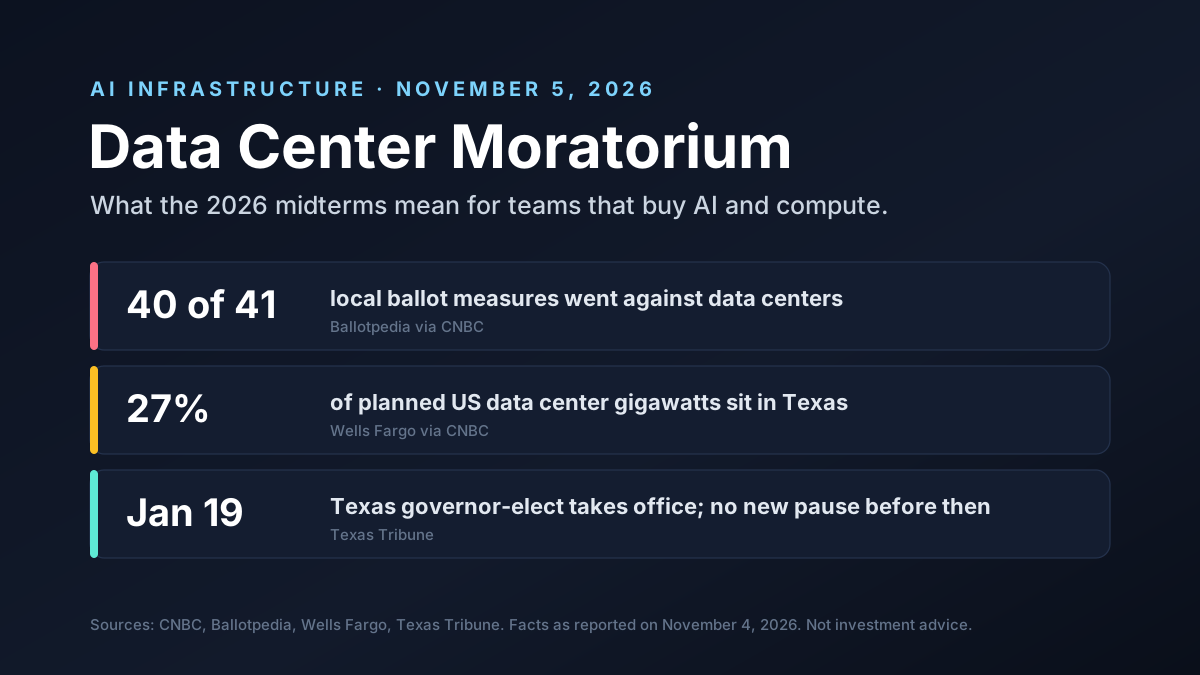
Data centers were on the ballot in the 2026 midterm elections, and they mostly lost. Texas elected a governor who promised a data center moratorium. Local voters sided against data centers in 40 of 41 measures, and the next day the stocks of the companies that build them fell hard.
For teams that buy AI, the vote matters more than the stock moves. Texas holds about a quarter of the planned US data center build. If that build slows, the AI compute your vendors promised for 2027 and beyond could arrive later or cost more.
This guide explains what voters decided, what a data center moratorium can and can't do, how the market read it and what to do about your own compute plans.
Disclosure and scope: Van Data Team builds data and AI systems for clients on several clouds and GPU providers. We drafted this article with help from Anthropic's Claude. We have no business ties to the companies named here, and we take no side in the election.
Facts come from official releases and from reports by CNBC, Reuters, the Texas Tribune, Yahoo Finance and others. Stock moves are as those outlets reported them on November 4. We label our own math. This isn't investment advice.
Key Takeaways
- The vote: 40 of 41 local measures went against data centers.
- Texas: Democrat Gina Hinojosa beat Governor Greg Abbott after promising a ban on all data center approvals, in the state that holds about 27% of the planned US data center build, according to Wells Fargo.
- Not yet in force: no new data center moratorium can start before she takes office on January 19. Abbott's own pause is already in place.
- The market split: data center builders fell as much as 24% on November 4, while Amazon and Microsoft rose about 6%.
- For AI buyers: the real risk is slower new supply from 2027 on, so check where your compute lives, ask about delivery dates and keep a second option ready.
Data Center Moratorium Vote at a Glance
| Item | What happened |
|---|---|
| Election day | November 3, 2026 |
| Local measures | 41 in 10 states, per Ballotpedia. Voters sided against data centers in 40. |
| Texas governor | Gina Hinojosa (D) beat Greg Abbott (R). She promised a moratorium on data center approvals. |
| Ohio | Amy Acton (D) won the governor's race and backs a "conditional moratorium." Ohio had 21 local measures. |
| Congress | Democrats won both the House and the Senate, per CNBC. |
| Texas share of the planned build | About 27% of planned US data center gigawatts (Wells Fargo) |
| When it could bite | Not before January 19, 2027, when the new governor takes office |
What Happened on November 3
Data centers became a real campaign issue this year. In a CNBC voter poll, 56% of voters called data centers a crucial or major factor in their decision. Candidates on the winning side in Texas, Ohio, Georgia and Wisconsin ran on pausing or tightening rules for them.
The biggest result came in Texas. Gina Hinojosa defeated Greg Abbott, who had sought a fourth term. She is the state's first Democratic governor since 1990, per Yahoo Finance.
Her pitch was blunt. "When I am governor I will issue a moratorium, a ban, on all data center approvals," she said in an October 22 video quoted by the Texas Tribune. She also wants to end data center tax breaks and make developers pay for power lines.
Ohio sent the same signal. Sherrod Brown won the Senate race after calling his rival "the face of data centers." Amy Acton won the governor's race backing a conditional moratorium, CNBC reported.
Voters Rejected Data Centers in 40 of 41 Local Measures
Local votes were even more one-sided. Ballotpedia counted 41 data center measures on local ballots in 10 states, CNBC reported, and voters sided against data centers in all but one of them.
Key details:
- Ohio had 21. That's over half.
- Other states that voted: California, Florida, Illinois, Kansas, Maine, New Jersey, Nevada and Wisconsin.
- Wells, Maine: more than 80% of voters backed a 180-day pause on data center building, per Route Fifty.
- The one exception: Harwood, North Dakota, where voters turned down extra review of industrial projects, data centers included.
Two caveats. Some votes were advisory and don't bind local officials. And trackers count in different ways: one cited by Yahoo Finance listed 28 measures. The trend is clear, but the exact count depends on who's counting.
Why Texas Matters Most
Texas is where the AI build is biggest. Here's how Wells Fargo splits the planned US build, per CNBC:
| State | Share of planned US data center gigawatts | Election signal |
|---|---|---|
| Texas | 27% | New governor promised a pause on approvals |
| Georgia | 7% | Pause-backing candidates won key races, per CNBC |
| Ohio | 5% | New governor backs a pause with conditions; 21 local measures |
| Pennsylvania | 5% | Not among the key races CNBC named |
Cheap land, fast permits and its own grid made Texas data centers the default choice. Abbott said in 2025 that he wanted Texas to be the "epicenter of AI development." Many of the largest AI campuses now in the works depend on Texas power.
That's why a Texas data center moratorium is a national story. A pause there could delay a large share of the new US AI build planned for the next few years. A pause in a small state wouldn't.
What Hinojosa's Data Center Moratorium Would Do
Her campaign called for an immediate, short-term data center moratorium on new approvals. It would last until lawmakers pass "real protections," in her words. It comes with a wider plan:
- Water: safeguards for local supplies.
- Power bills: developers, not households, would pay for new power lines.
- Tax breaks: she wants them gone and says Texas loses at least $1 billion a year to them.
- Grid reviews before big projects connect, plus more say for local towns.
Much is still unknown. She hasn't said how she would issue the pause, when it would start or whether it would reach projects that are already approved or under construction. That last question matters most for anyone who rents capacity in Texas.
Texas Already Has a Data Center Moratorium, of Sorts
Here's a detail many headlines skip. Texas has been pausing data centers since the summer, under Abbott.
On August 3, Abbott ordered a check of data centers waiting to join the state grid, which ERCOT runs, and paused those approvals until it's done. On September 21, he told the state's environment agency to "halt all permits sought by data centers" until that audit ends.
So a data center moratorium in Texas isn't new. The open questions are how long it lasts and how strict it gets. The audit was expected to run into December, per the Texas Tribune, and Hinojosa, who called Abbott's move an "election year pause," would keep a pause in place until new laws pass.
What Can a Governor Do Alone?
Abbott's orders show the split:
- A governor alone can steer state agencies. That's the fast path to a data center moratorium.
- Lawmakers are needed to end tax breaks, write water and power rules or decide who pays for power lines.
- The session opens on the second Tuesday in January of odd years, which is January 12, 2027.
The math in Austin is mixed. Democrats were on track to win the Texas House, per Yahoo Finance, while the state Senate looked set to stay Republican. Expect a fight over the details, and maybe court cases from developers.
How the Market Read the Data Center Moratorium Risk
AI data center stocks took the hit first. On November 4, shares of data center builders and gear makers fell as much as 24% while the S&P 500 rose about 2%, The Motley Fool reported. Modine, Sterling Infrastructure and Comfort Systems USA led the drop.
Data center firms and GPU clouds fell too. Here's what Reuters reported:
- Hut 8: down 23%
- Cipher Digital: down 21%
- IREN: down 11%
- Core Scientific: down 10%
- CoreWeave: down 9.5%
- Applied Digital: down 8.8%
- Amazon and Microsoft: up about 6% each
- Alphabet: up 4.6%
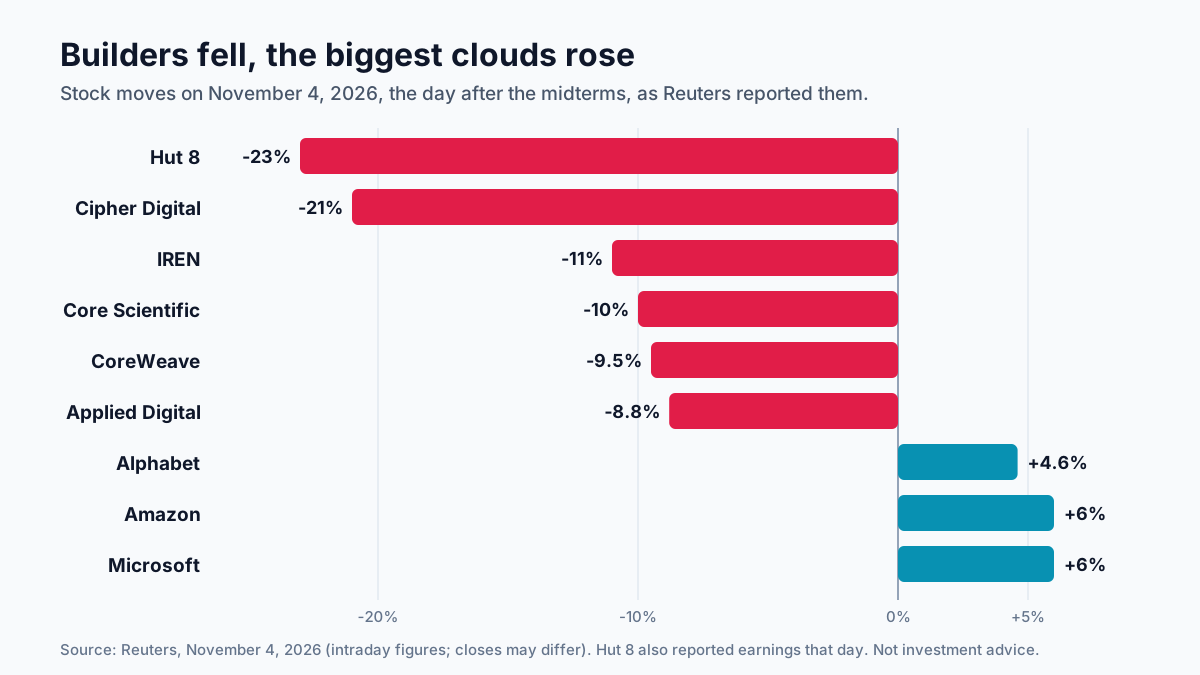
Not every drop was about the vote. Hut 8 reported its quarterly results that morning. Riot, which also reported, rose 9.6%, and many of these stocks had been sliding for weeks before the election, as we covered in AI bubble fears. Treat one day as a mood.
Why Did the Biggest Clouds Rise?
It looks odd. The firms spending the most on AI data centers gained on news that could slow that spending down. Analysts gave two reasons:
- What's built is worth more. "The hyperscalers already have data centers, so those assets are more valuable now," Art Hogan of B. Riley Wealth told Reuters.
- Rules help the big players. "Higher regulatory barriers entrench incumbents," Needham's Laura Martin wrote, per CNBC. Big clouds have the lawyers, power deals and built sites that new GPU clouds lack.
We saw the same split in September, covered in AI slowdown stocks: when the build looks set to slow, chips and builders fall while the big buyers rise.
Would a Data Center Moratorium Slow AI?
It depends on how wide and how long any data center moratorium is. The early numbers were small. In September, SemiAnalysis found that local pauses had held up only about 2.3 GW of US capacity, against 38 GW of new IT capacity due in 2027, per AI Weekly. In October, Goldman Sachs said the US growth outlook through 2027 "remains largely unchanged," per Reuters.
Both came before the vote. A statewide data center moratorium in Texas would be far bigger than the town-by-town pauses they measured, since so much of the planned build sits there.
Some expect cost more than delay. Jefferies analysts said tighter rules will raise build costs more than they shrink the pipeline, per Bloomberg as cited by Equibles. Each site gets pricier, but many still get built.
Builders also have ways around a data center moratorium:
- Move: shift new projects to states with fewer limits.
- Build their own power on site, a path Abbott's September order also tried to cover.
- Expand old sites that already have permits and grid hookups.
- Go to space, if you ask Elon Musk, who joked that "data centers in space" look "pretty appealing right now."
Our read: a data center moratorium would hit new sites planned for 2027 to 2029 hardest. Capacity running today keeps running. So the near-term effect on most AI buyers is small, and the medium-term risk is real.
What a Data Center Moratorium Means for AI Buyers
Most teams don't rent a data center. They buy AI through a cloud, a model API or a GPU provider. So the effect reaches you through your vendors.
Here's where it could show up:
- Delivery dates: new GPU capacity promised for 2027 could slip if it sits in a paused Texas or Ohio site.
- Prices: if new supply slows while demand keeps rising, GPU rental and model prices could stay high for longer. We covered the spending side in AI capex.
- Smaller providers: GPU clouds with one big site under construction carry more risk than giants with many regions. See our neocloud shakeout guide.
- Contracts: some providers may add delay clauses or raise prices to cover new fees.
Don't panic. The big clouds already run hundreds of sites, and most of today's AI traffic won't notice a pause. But if your plans depend on sites that aren't built yet, ask where it will come from and when.
Check Where Your Compute Lives
Start with a simple map. An hour of emails to your vendors usually fills it in.
| Question | Why it matters |
|---|---|
| Which regions run our main AI workloads? | It shows whether you lean on Texas or Ohio sites at all, which most teams have never checked. |
| Is any compute we were promised still being built? | Unbuilt sites carry the most risk. |
| Does our GPU provider have more than one site? | One site, one point of failure. |
| Could we move a workload to another region within a week if we had to? | A fast move keeps a delay from turning into an outage or a rushed, expensive rental. |
| Where do our model APIs run? | API providers rent from the same build. |
If most answers point to one state or one site, that's your exposure. Several regions and providers? You're in good shape.
Contract Terms to Ask For
Signing or renewing a compute deal? Ask for these:
- A firm delivery date, with credits if new GPUs arrive late.
- A named region, plus the right to move to another region at the same price if the first one is delayed.
- A price cap, or notice before any rise.
- An exit clause if the provider can't deliver what it sold you.
- Clear data rules, so a move between regions doesn't break your compliance.
They cost little to ask for. A provider that can't offer any of them is telling you something about its own risk.
Use Less Compute per Task
The cheapest hedge is to need less. Most AI workloads waste plenty.
Send simple steps to smaller models. Cache repeat work, and trim prompts and agent loops so each task burns fewer tokens, as our token efficiency guide shows.
Energy counts too. AI agents can use far more power per task than a plain chat, as we showed in our post on the hidden energy cost of AI agents. Every task you make leaner is capacity you won't have to hunt for later.
A Worked Example: One Team's Exposure
Take a hypothetical analytics company. It runs model inference on a big cloud and has signed with a GPU provider for training compute due in mid-2027. Those GPUs sit at a Texas site still being built, the kind of project a data center moratorium would hit first.
Say the company needs 64 GPUs from that deal. If the site slips six months, the team must rent elsewhere at short notice. If short-term rentals cost 30% more than the contract rate, that's a 30% higher bill for half a year (our math, on made-up numbers).
The fix costs little now:
- Ask the provider which site the GPUs come from.
- Add a credit to the contract if they show up late.
- Test one workload in a second region, so a switch is a known step and not a guess.
Three emails and one test today avoid a scramble next year.
What to Watch Next
| When | What to watch |
|---|---|
| December 2026 | ERCOT's audit of data centers waiting to connect, which Abbott's pause depends on |
| January 12, 2027 | The Texas Legislature's regular session opens |
| January 19, 2027 | Hinojosa takes office and could issue her pause |
| Early 2027 | Ohio's new governor sets out the details of a pause |
| Ongoing | Court challenges, project moves to other states and vendor price changes |
Also watch the details of any order. The key question is whether a data center moratorium covers only new approvals or also projects already approved. The first would slow the future. The second would hit capacity many buyers are counting on.
Data Center Moratorium: Our Take
The midterms made one thing plain: many voters don't want data centers next door. That view now has power in the state with the biggest AI build, and in dozens of towns.
Still, a data center moratorium in Texas isn't law yet, and Texas has had a pause of its own since the summer. The likely result is slower, costlier building rather than a full stop. Capacity running today stays up.
For AI buyers, that points to a calm plan. Know where your compute lives, get delivery dates in writing, keep a second option tested and use less compute per task. Teams that do this won't care much how the next policy fight ends.
How Van Data Team Helps
We help teams keep AI running when the supply side gets shaky:
- Compute maps that show where your AI work really runs.
- Backup regions and providers, so one paused site doesn't stall you. See our multi-cloud FinOps guide.
- Lower cost per task through model routing, caching and lean agents.
- Portable designs that let you switch fast, as in our model portability lesson.
Explore our cloud cost optimization and AI agent development services, or get in touch to review your compute exposure.
AI Model Brief
The AI models worth knowing, once a week
What shipped, how it scores on independent benchmarks, what it costs per million tokens and what was deprecated, from the data behind our AI model benchmarks.
We use your address only to send the brief. See our privacy policy.
See this week’s brief
Founder of Van Data Team. Builds Vanaxity, the AI agent system for SEO, GEO, and AEO, and leads data engineering delivery for B2B teams.
About the authorArticle FAQ
Questions readers usually ask next.
These short answers clarify the practical follow-up questions that often come after the main article.
Need a similar system?
If this article maps to a workflow your team already operates, the next step is usually a scoped review of the system, constraints, and rollout path.
Consultation
Scope your next AI workflow.
Share the system and blockers. We will map fit, gaps, and the next step.