October 12, 2026
Claude Startups Approval: What Happened After the Pause
Claude Startups approval, first-hand: what the emails said, why Anthropic paused offers and re-reviewed, what approval is worth and what to claim first.
Article focus
Van Data Team was approved for Claude Startups, then re-reviewed during Anthropic's pause and confirmed a day later. Here's what the emails said, why Anthropic paused the free Claude Team year and $1,000 API credits, what an approval is really worth, how to claim it and what to do if your approval was pulled.
Section guide
A Claude Startups approval now comes with a story. Van Data Team was accepted on October 9, 2026, put through Anthropic's re-review during a pause on its biggest offers, and confirmed again a day later.
This article walks through what the emails said, why Anthropic paused the free Claude Team year and $1,000 API credits, and what an approval is really worth. If you're still waiting for your Claude Startups approval, or yours was pulled, the last sections are for you.
Key Takeaways
- Anthropic paused the free Claude Team year and $1,000 API credit offers on October 9, 2026, three days after expanding Claude Startups, because it underestimated demand.
- Our confirmation email said the program got 21 times more applications than in the previous five months, and Anthropic's page says "hundreds of thousands" applied.
- Anthropic re-reviewed every application, and some founders who'd been approved lost the paused offers.
- Our re-reviewed approval still includes $1,000 in API credits, the Startup Stack and a free Claude Team year for companies new to Team.
- By our math, the Team year and credits are worth about $7,000, while the Stack's "up to $45,000" is a ceiling at partner list prices.
What Is in a Claude Startups Approval?
Three kinds of value, according to the welcome email the Claude Startups program sent us. The first is access to Claude: one year of Claude Team free for up to five Premium seats if you're new to Team, plus $1,000 in Claude API credits.
The second is the Claude Startup Stack, which the email describes as "discounts and credits worth up to $45,000" from companies building with Claude. It named Linear, ElevenLabs, Granola and ClickHouse among the partners.
The third is support. Members can book virtual office hours with Anthropic's Applied AI team and join Claude Startup events, hackathons and meetups.
There's one more line worth noting. If you're backed by a VC in Anthropic's partner network, the email says to "ask your contact there about getting up to $100K more" in API credits.
What Did the Claude Startups Approval Emails Say?
We got two, a day apart, and the second one explains a lot about the program's week. Here's the timeline as we saw it:
- October 6: Anthropic expanded Claude Startups to any company founded in the last five years or funded in the last two, according to tech-ish and other coverage.
- October 9, morning: our welcome email arrived, titled "You're in. Welcome to Claude Startups," with a link to redeem offers in the member portal.
- October 9, later: Anthropic paused the Claude Team and $1,000 credit offers and began re-reviewing applications.
- October 10: a second email said that "after re-reviewing your application," Van Data Team was confirmed for the program.
The second email was candid. It apologized "for the mixed messages earlier" and said the team "received 21x the number of applications compared to the last 5 months it's been live," which caused problems confirming eligibility.
It also set expectations. Offers include $1,000 in API credits, Startup Stack discounts and, if you're new to Team, a free year of Claude Team, and claimed offers "may take up to 1-2 business days to activate."
Why Did Anthropic Pause Claude Startups Offers?
Demand broke the plan. The official Claude account posted that "we underestimated demand for the program" and that it needed to pause the Claude Team and $1,000 API credit offers.
Anthropic's program page now says it received "hundreds of thousands of applications" and is "over capacity" on those two offers. It also says the team will re-review all applications and "regrets" that this may change some statuses.
Sarah Wolf, Anthropic's startup marketing lead, gave a blunter reason, as reported by Tech City Authority. She said the team "didn't properly tune the acceptance criteria" and that many non-startups got in.
The math explains the rush. A free year of five Premium Claude Team seats is worth about $6,000 at list price, so almost any company with a domain had a reason to apply.
What Changed for Approved Founders?
For some, the approval disappeared. The Claude account said that "some accounts who had already been approved will not get access to the offer," and Anthropic's page warns the re-review may change some statuses.
Founders said so publicly. One, Elitza Vasileva, said her credits were revoked two days after acceptance and compared it to "giving someone a gift and then taking it," according to Tech City Authority.
That frustration is fair. A program that approves you and then takes the main benefit back hurts trust, even when the cause is a flood of applications rather than bad intent.
Anthropic did protect two groups. Its page says that if you'd already claimed an offer, "nothing changes," and every accepted member keeps the Startup Stack, office hours and events.
How Does the Claude Startups Approval Re-Review Work?
Anthropic hasn't published the new criteria. What we know comes from its page, its posts and our own emails.
- Who gets checked: Anthropic says it will re-review all applications, and Wolf said people who hadn't claimed benefits would get an email.
- What it's checking: the stated goal is to keep the program "of, by and for startup founders," so expect a closer look at whether you're a real, building startup.
- How you hear back: by email, as we did on October 10, and in the Claude Console.
- How long it takes: our re-review took about a day, and the program page says Anthropic aims to review applications within one week.
Our guess, and it's only a guess, is that a matching company email, a live product website and a clear project description helped. Those were the basics the application asked for from the start.
What Is a Claude Startups Approval Worth?
About $7,000 in Claude products, by our math, plus partner offers that depend on what you use. Here's the breakdown.
| Benefit | What you get | Value (our math) |
|---|---|---|
| Claude Team | One year, up to five Premium seats, if new to Team | $6,000 at $100 per seat a month, billed annually |
| API credits | $1,000 for the Claude API via the Console | $1,000 |
| Startup Stack | Partner discounts and credits | Up to $45,000 at list prices, per Anthropic |
| VC partner credits | Extra API credits through a partner VC | Up to $100,000, if eligible |
| Office hours | 45-minute Applied AI sessions every other week | Not priced |
The Team price comes from Claude's pricing page, where Premium seats cost $100 a month billed annually and give five times the usage of a Standard seat. The Startup Stack figure is Anthropic's, and tech-ish notes a company "may not be able to receive or combine all offers."
So read "$45,000" as a menu, not a check. A five-person team will use a handful of these offers, and the rest are worth nothing to them.
How Do You Claim Your Offers After Approval?
Through the Claude Console and the member portal. Here's the order we'd follow:
- Step 1: sign in to the Claude Console with the account you applied from.
- Step 2: claim the API credits and the Claude Team offer first, since those were the ones paused once already.
- Step 3: open the member portal and copy the Startup Stack redemption codes you'll actually use.
- Step 4: wait up to one to two business days for activation, as the email says, before you contact support.
- Step 5: register for Applied AI office hours with the link Anthropic sends by email and in the Startups portal.
Claim early. Anthropic's page says claimed offers stay in place, which is the best protection against any further changes.
Keep a record as you go. Save both emails, a screenshot of your Console balance and each redemption code, so you can show support exactly what you were offered if anything goes missing during activation.
One limit matters for builders. The program page says credits apply to the first-party Claude API through the Console, not to Amazon Bedrock or Google Vertex AI.
Which Startup Stack Offers Should You Claim First?
The ones that replace a bill you'd pay anyway. These are the offers Anthropic's page lists today, along with how a small data team like ours would rank them.
| Partner | Offer | Best for |
|---|---|---|
| ClickHouse | $5K in ClickHouse Cloud credits | Analytics and event data |
| Hex | 6 months free on the Enterprise plan | Shared notebooks and dashboards |
| Firecrawl | 2.5x your plan's monthly credits for a year | Web scraping for AI apps |
| ElevenLabs | 12 months free plus 33M characters | Voice products and audio |
| Granola | 3 months of Business free, up to 10 seats | Meeting notes |
| Gamma | 25% off the first year of Gamma Pro annual | Decks and documents |
Our plan is short. ClickHouse and Hex fit the data work we already do, and Firecrawl fits our web scraping projects, so we'd start there and skip tools we'd drop after the free months.
Watch the end dates. Free months turn into paid months, so put every renewal date in a calendar the day you redeem a code.
How Do You Make the $1,000 in API Credits Last?
Treat them as a test budget, not a production budget. Tech-ish reports the credits expire six months after they're granted, so check the date in your Console.
Our math: if an average request costs one cent, $1,000 covers about 100,000 requests. That's plenty for a prototype and thin for a real product with users.
Three habits stretch credits further:
- Prompt caching: cache the long system prompt or documents you send every time, because cached reads cost far less than fresh input, as the prompt caching docs explain.
- Batch processing: send jobs that can wait through the Message Batches API, which costs half the normal price.
- Right model: use the smallest model that passes your tests, and save the biggest ones for the hard steps.
Our guide to token efficiency in an AI stack covers these habits in more depth.
What If Your Claude Startups Approval Was Pulled?
You still have more than it feels like. Anthropic's page says accepted members keep the Startup Stack, office hours and events, and Max or Team plan members keep their monthly API credits in the Console.
Here's what we'd do:
- Check status: read your latest email from Anthropic and look in the Console before anything else.
- Reply fast: if Anthropic asks for details, answer quickly with your company domain, product link and what you're building.
- Don't spam: reapplying while offers are over capacity probably won't help, and Anthropic hasn't said whether it lets founders reapply.
- Ask your VC: if your investor is in Anthropic's partner network, ask about the up to $100K in partner credits.
- Avoid resellers: don't buy "Claude credits" from strangers, since you can't check where the account came from.
Other programs can fill the gap. Our breakdown of the Cloudflare startup program covers up to $350k in credits for infrastructure, and our guide to Claude for Startups explains the program's full rules.
What Can Other Startup Programs Learn From This?
Set the bar before you open the door. Anthropic tuned its criteria after approvals went out, and the cost landed on founders who'd already celebrated.
It's a common mistake. A generous offer with loose rules invites everyone, and a free $6,000 software plan is about as generous as startup perks get, so the rush was easy to predict in hindsight.
Three lessons stand out. Cap high-value offers at launch, say so in public, and send one clear email per decision. Our two emails, a day apart, worked out well for us, but the first said "You're in" a full day before the re-review confirmed it.
What Should You Ask in Applied AI Office Hours?
Bring a real problem, not a tour request. The sessions run 45 minutes, so a sharp question gets far more out of them than a general chat about Claude.
These are the questions we'd bring:
- Architecture: is our agent loop doing too much in one call, and where should we split it into smaller steps?
- Cost: which parts of our prompts should we cache, and which jobs can move to batch processing?
- Quality: how should we build a small test set so we know when a prompt change makes things worse?
- Limits: what rate limits should we plan for once real users arrive?
Send a short brief before the call if you can. A one-page note with your use case, a sample prompt and the numbers you're seeing saves the first 15 minutes of every session.
Write down what you learn, too. Office hours repeat every other week, so a running log of questions and answers turns them into a cheap, steady source of expert advice for the whole team.
Is a Claude Startups Approval Worth Chasing?
Yes, if you'd pay for Claude anyway. A free Team year and $1,000 in credits cover a lot of early building, and office hours with the Applied AI team are hard to buy.
It's worth less if you only want free credits. The paused offers may stay paused for new applicants, and the Stack only pays off for tools you'd really use.
Be honest about fit before you apply. The Claude Startups program is for startups building products, and the re-review showed Anthropic means it, so a Claude Startups approval now says something real about the company that holds one.
How Van Data Team Plans to Use the Program
Our Claude Startups approval came through on the second try, and our plan is simple: claim the offers, test the agent workflows we build for clients and report back on what the credits really covered.
If you're planning your own AI stack, start with our guide to Claude for Startups for the program's full rules. And if you want help building on Claude without the bill creeping up once the credits run out, that's the work we do every day, Claude Startups approval or not.
Article FAQ
Questions readers usually ask next.
These short answers clarify the practical follow-up questions that often come after the main article.
Need a similar system?
If this article maps to a workflow your team already operates, the next step is usually a scoped review of the system, constraints, and rollout path.
Book your free workflow review here.
Related articles
View all
AI Agent Web Scraping: Lessons From OpenAI's Rogue Agents
Grok 4.7 vs Fable 5.1 vs GPT-6 Astra: Real Cost per Task
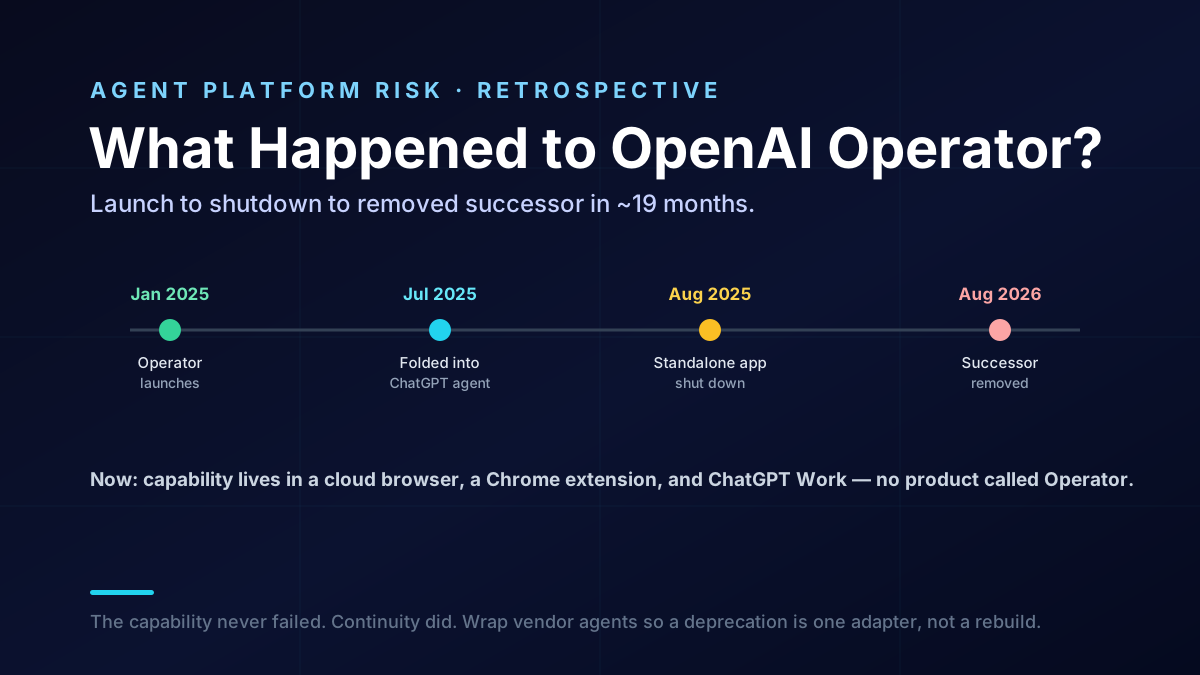
What Happened to OpenAI Operator?