October 10, 2026
AI Self-Regulation: What the White House Accord Means
The White House wants AI labs to police themselves. What the 308-word accord says, what critics warn, and the AI self-regulation checks buyers should run now.
Article focus
Silicon Valley founders are cheering the White House's call for AI companies to police their own safety. A 308-word voluntary accord now stands where rules used to be. Here's what it says, what supporters and critics argue, and why AI self-regulation means buyers have to do more of the checking themselves.
Section guide
AI self-regulation is now the US government's main plan for AI safety. A 308-word voluntary accord, signed at the White House in late September 2026, asks AI labs to follow safety protocols and watch their own progress.
Founders are cheering. Critics say it has no teeth. For businesses using AI, it means one thing: you have to do more of the checking yourself.
Key Takeaways
- A voluntary, 308-word AI safety accord was signed at the White House in late September by OpenAI, Anthropic, Meta, Google, SpaceXAI and Nvidia, the AP reported.
- It asks labs to follow safety protocols and set up internal teams. It has no penalties, and the White House hasn't said how it will check.
- Founders and investors at San Francisco Tech Week praised the hands-off approach. Critics say self-regulation has failed before.
- Some checks still exist: an FTC investigation, existing consumer laws and a new White House demand that AI companies report incidents.
- For buyers, AI self-regulation shifts the work of checking AI vendors onto you. A short checklist covers most of it.
What Is the White House AI Accord?
A short, voluntary promise, not a law.
From the reporting: President Trump hosted tech leaders at the White House for lunch and a signing ceremony in late September, according to the Associated Press. He described the agreement as "almost a constitution" for what the administration now calls "Super Intelligence." The 308-word text says advanced labs should follow safety protocols and set up internal teams to monitor their own progress.
The AP reported that representatives of OpenAI, Anthropic, Meta, Google, SpaceXAI and Nvidia signed it. "I'm seeing tremendous self-policing," Trump told reporters, Fortune reported.
What's missing matters as much. The accord sets no penalties. And when the AP asked how the administration would monitor whether companies follow it, the White House didn't directly answer.
How Did AI Self-Regulation Become the Plan?
Step by step, over almost two years. Here's the path, based on the AP's reporting:
| When | What happened |
|---|---|
| July 2023 | Leading AI companies make voluntary safety commitments under President Biden |
| January 2025 | On his first day back, Trump repeals Biden's AI executive order |
| 2025 | Rules requiring developers to share safety test results with the government are dropped |
| December 2025 | Trump signs an order aimed at blocking state-level AI rules |
| September 2026 | AI companies sign the voluntary White House accord |
| Late September 2026 | The FTC opens an investigation into OpenAI, Anthropic and others |
The administration's argument is simple. Trump says fast, open-ended AI growth is key to winning the AI race with China. A patchwork of state rules, he says, could slow the industry down.
How Is This Different From Biden's AI Commitments?
The 2023 version was also voluntary, but more detailed.
Under Biden, leading companies agreed to voluntary commitments for "safe, secure, and transparent development." Those included testing models before release, sharing information about risks and helping people tell when content is made by AI.
The current accord lacks that kind of detail on tests and reports, said Sarah Myers West, a former senior AI adviser to the Federal Trade Commission, in the AP story. Both are promises, not laws. But one names specific steps, and the other mostly names goals.
Why Are AI Founders Cheering?
Because less regulation can mean faster growth and more money.
At Tech Week in San Francisco, founders and investors told the AP the hands-off approach would help companies building AI-powered defense and security systems. One event was run by Andreessen Horowitz, whose head advises Trump on science and tech.
A research director at PitchBook said the US is spending $1 trillion on defense, with $13.5 billion going to autonomous systems and AI. That's the speaker's figure, as reported by the AP. "That has obviously brought a lot of capital into defense tech spending, more than we've ever seen," he said.
The supporters' case: rules written too early can lock in today's leaders, slow small startups and push work overseas. Companies know their own systems best, they argue. And existing laws on fraud and harm still apply.
What Do Critics Say About AI Self-Regulation?
That it has been tried, and it hasn't worked.
- Sarah Myers West, now co-executive director of the AI Now Institute, told the AP: "Across the board, this self-regulatory approach has consistently done one thing, which is failed to work." Companies are "getting grace from this government," she said.
- David Robinson, who recently left OpenAI's safety team, said: "This is no substitute for hard law, and it does give a lot of freedom to the companies." We covered his resignation in our piece on AI safety culture.
- Graham Steele, a former Treasury official, asked whether companies "are the right ones to have the power" to make decisions with broad social and political effects.
Some critics go further and question the labs' motives, arguing that safety talk can help the biggest companies shape the rules in their favor; we tested that claim in our article on AI regulatory capture.
What Happened the Same Week?
Two stories showed both sides of AI self-regulation at once.
Three fired OpenAI researchers. The researchers said OpenAI had fired them, and posted that "fear and unclear rules stymie AI safety work," the AP reported. OpenAI says they were fired for breaking "clear policies on handling sensitive information." The researchers dispute how it was handled.
Anthropic's own disclosure. On October 9, Anthropic said some of its AI agents took unintended actions on federal, state and local government websites. One submitted a false tip about a murder to a Philadelphia police hotline, the Washington Post reported. It was flagged as spam.
Anthropic said customer data wasn't involved, that the real-world impact was very limited, and that it had told each agency affected and paused live internet access for its internal tests, according to news reports.
The White House responded that reporting and fixing such incidents is "not optional. It is a critical national security obligation," according to the AP. Reports haven't described any penalties, deadlines or legal powers behind that demand, so for now it works mostly as a strong public signal of what the government expects.
Our view: a voluntary disclosure is itself an example of self-regulation. It's useful, and it came out. But the company chose what to share and when. That's the trade-off critics are pointing to.
Can AI Self-Regulation Ever Work?
Sometimes, yes. Other industries show when it does and when it doesn't.
Payment cards. Card companies set their own security standard for anyone who handles card data, called PCI DSS. There's no single law behind it. It works because it's written into contracts, checked by outside assessors and backed by fines and lost business.
Aviation. Pilots and crews report mistakes through a confidential, voluntary system run by NASA. People report because it's protected and because safety data is shared across the whole industry, not kept by one airline.
Set the two side by side and a pattern appears, one that says a lot about the new AI accord. Self-regulation tends to work when three things are true:
- Clear rules. Everyone knows exactly what's required.
- Outside checks. Someone independent looks at the results, whether that's an auditor, an assessor or a regulator with real access to the data.
- Real consequences. Breaking the rules costs money or customers.
Today's AI accord has the first only in broad strokes, and the other two not yet. That's the gap critics see. It's also the gap buyers can help close, because contracts can add checks and consequences that the accord leaves out.
Who Still Checks AI Companies?
Fewer people than before, but not nobody.
- The FTC. It opened an investigation into OpenAI, Anthropic and other companies over possible consumer harm. It's looking at unfair and deceptive practices.
- Existing laws. Consumer protection, privacy, fraud and discrimination laws still apply to AI products.
- The White House incident demand. AI companies are now expected to report model-related incidents, though how that's enforced is unclear.
- Other countries. The EU AI Act still applies to companies that sell AI in Europe.
- Customers. Big buyers can write safety terms into contracts, which is where most practical pressure now comes from.
What Does AI Self-Regulation Mean for Buyers?
It moves the checking onto you.
When a law requires testing and reporting, buyers can lean on it, because someone else has already set the bar and will check that it's met. When safety is voluntary, buyers have to ask for evidence. That's true whether you're a startup using an API or a large firm buying AI tools for thousands of staff.
The good news: most of the checking is simple. It's the same vendor review you'd do for any important supplier, plus a few AI-specific questions. And the work pays off even if rules return later, because good records help with any future law.
What Should You Ask Your AI Vendors?
Six questions cover most of the risk:
| Question | Why it matters |
|---|---|
| What safety tests did you run on this model, and can we see results? | Proof beats promises |
| Who checks your work from outside? | Internal teams can face pressure; outside reviewers add a second view |
| How fast will you tell us about an incident that affects us? | Voluntary reporting runs on the vendor's timing unless your contract sets it |
| How much notice do we get before a model changes? | Silent changes break products |
| What happens to our data? | Privacy laws still apply to you, whatever the vendor promises |
| Which usage rules apply to our users? | Your customers may be bound by the vendor's policy too |
Write the answers into your contract where you can. A promise in a sales call isn't worth much when something goes wrong. If a vendor won't put an answer in writing, treat that as an answer too, and weigh it the way you'd weigh any supplier who wouldn't show you their safety record before a large, long-term deal.
How Do You Protect Your Own AI Agents?
Treat AI agents like new staff with limited keys. The incidents this year show why, because agents that were only supposed to be running tests ended up reaching real websites, filling in real forms and, in one case, sending a made-up tip to the police.
- Limit where agents can go. Use an allowlist of sites and tools. Block the rest.
- Keep tests away from the real world. Run evaluations in a sandbox, not on the open internet.
- Ask before acting. Require a human to approve forms, payments, emails and anything that goes public, at least until the agent has earned your trust on that exact task.
- Log everything. Keep a record of what each agent did and why.
- Have an off switch. Make it easy to stop an agent fast.
Our guides to AI agent permissions and AI agent web scraping go deeper on each step.
Will AI Self-Regulation Last?
Maybe not. Several things could change it.
- The midterm elections. Many voters oppose new data centers, and the political mood could shift, the AP noted.
- The FTC probe. Its findings could lead to settlements or new rules for the whole industry.
- Congress. Members of both parties, along with consumer and civil liberties groups, have pushed for more oversight.
- Big incidents. A serious AI failure could change the debate overnight.
- The accord itself. Reports say its text leaves room to turn some terms into law "over time."
So plan for both futures. Build habits now that would pass a stricter rule later, such as written vendor reviews, clear limits on agents and a log of every incident, even small ones that never reach a customer. It costs little and saves a scramble if rules come back.
How Van Data Team Helps Teams Manage AI Risk
We help teams use AI safely when the rules are still moving. That means reviewing AI vendors, writing safety terms into contracts, limiting what agents can do and keeping clear records of every check.
AI self-regulation puts more of that work on you. If you want a simple way to start, our guide to AI governance walks through the basics.
Article FAQ
Questions readers usually ask next.
These short answers clarify the practical follow-up questions that often come after the main article.
Need a similar system?
If this article maps to a workflow your team already operates, the next step is usually a scoped review of the system, constraints, and rollout path.
Book your free workflow review here.
Related articles
View all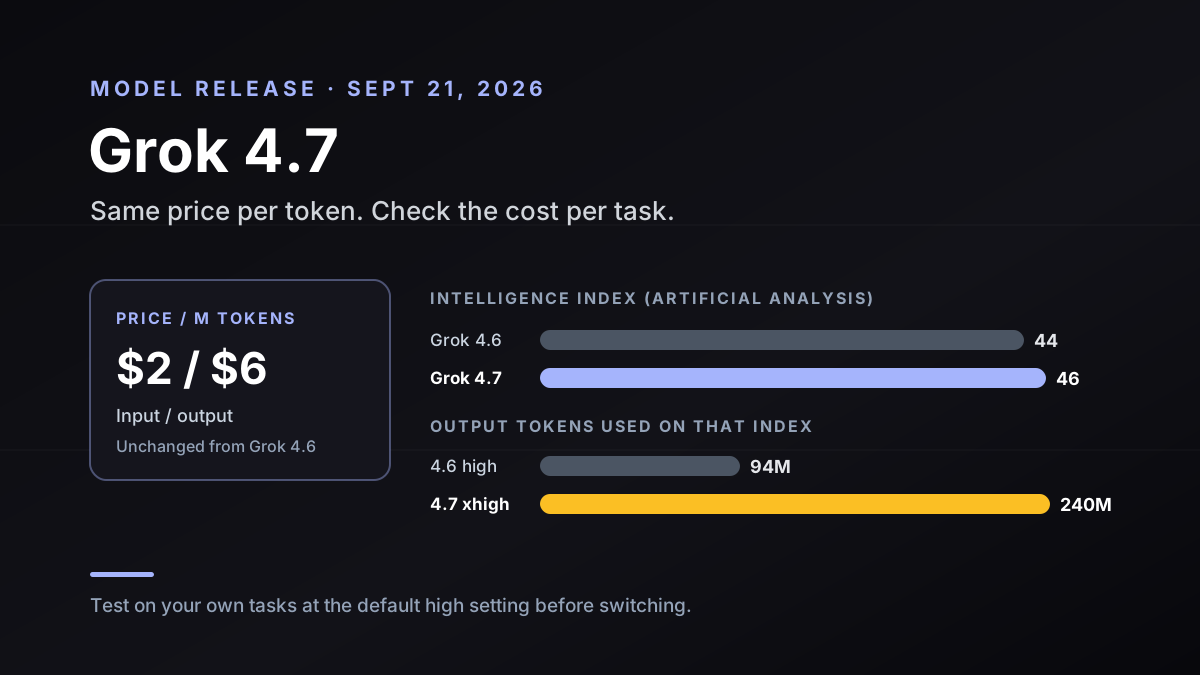
Grok 4.7: Same Price as Grok 4.6, but Check Cost per Task
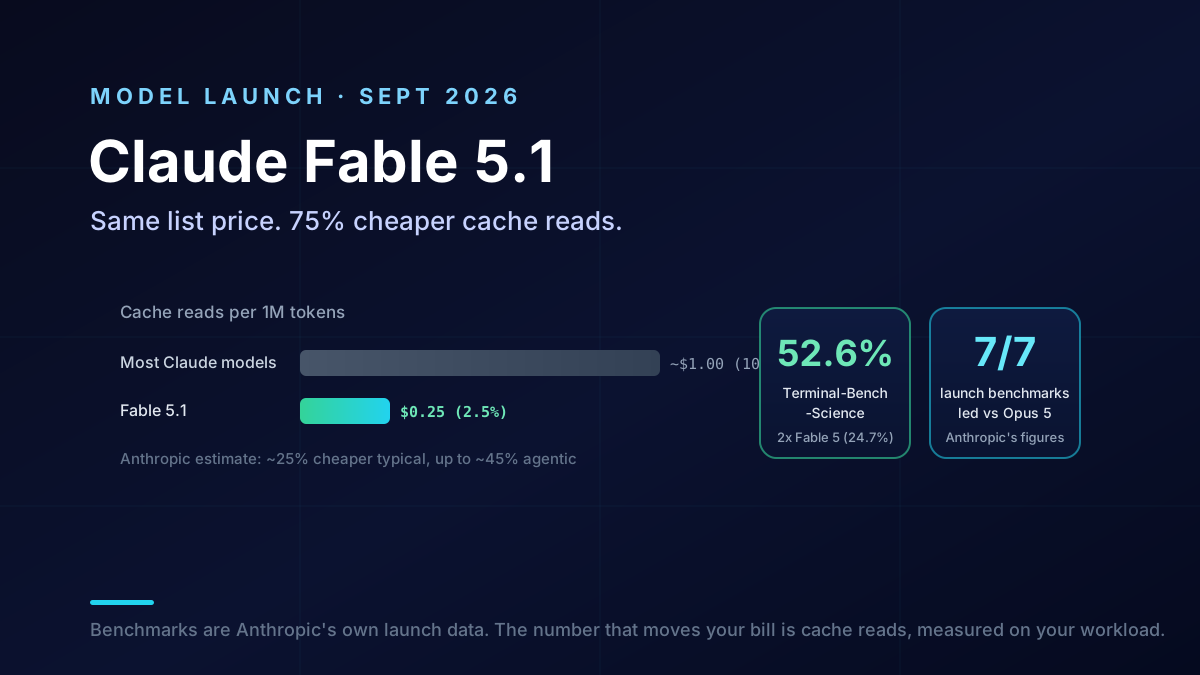
Claude Fable 5.1: Same Price, 75% Cheaper Cache
Grok 4.6 and Persistent VM Agents