Nvidia Megaspeed Probe: What Data Teams Should Check Now
Nvidia Megaspeed probe explained: the spy claims, the $2B GPU questions and Nvidia's denial, plus a checklist for data teams that rent GPU clouds abroad.
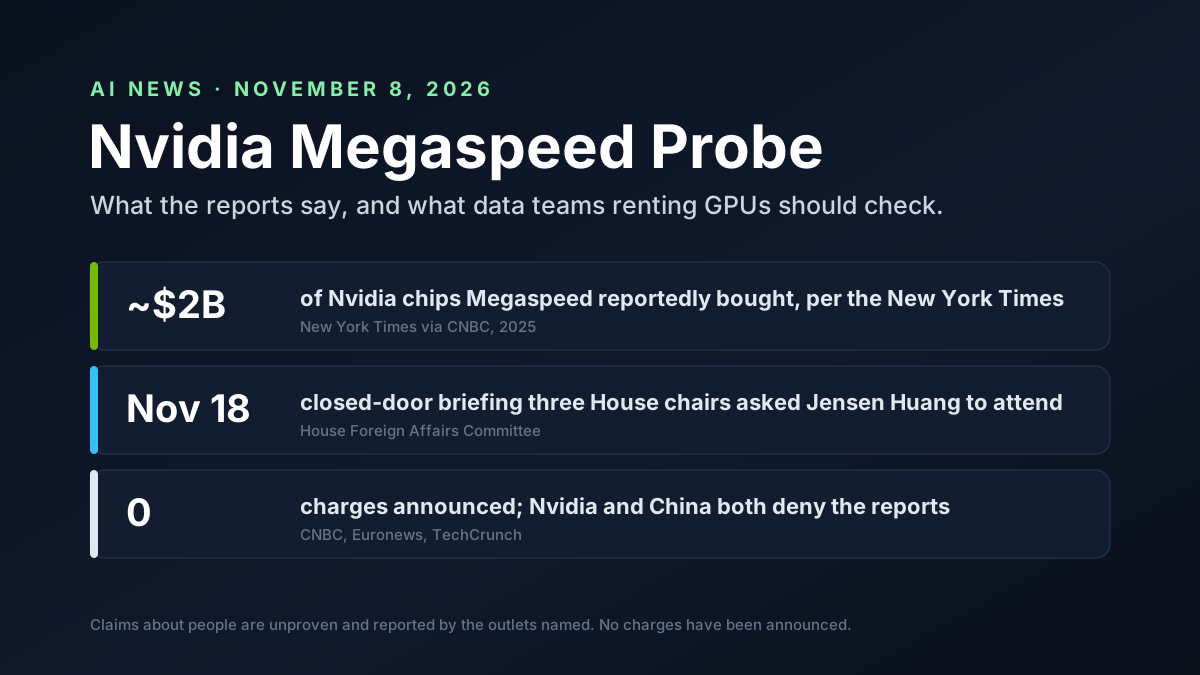
A US spy memo has put Nvidia's biggest customer in Southeast Asia, and its CEO, in the news. Reports say a Megaspeed executive was recruited by China's spy agency and grew close to Jensen Huang. Nvidia denies anything improper. China calls it a smear.
Most of it is a claim, not a finding. But it raises a question every data team renting GPUs should be able to answer: where do our GPUs actually run, and who owns them? This guide covers both.
Disclosure and scope: Van Data Team builds data and AI systems for clients. We have no business ties to Megaspeed. This is not legal or investment advice, and we drafted it with help from Anthropic's Claude before checking each claim against the sources linked below.
The claims about people are unproven. We quote them only as reported, name the outlet each time and include every denial we found. Our own math is labeled.
Key Takeaways
- The claim: US reports say a Megaspeed executive was recruited by China's Ministry of State Security and grew close to Nvidia CEO Jensen Huang.
- No charges: nobody has accused Huang of a crime. The memo isn't public.
- The denials: Nvidia says these were normal customer meetings, and China's foreign ministry calls the reports a baseless smear.
- The chips: Megaspeed reportedly bought nearly $2 billion of Nvidia chips. Singapore and the US have looked at it since 2025.
- Congress: three House chairs asked Huang to brief them behind closed doors on November 18, 2026.
- For data teams: this is a vendor risk story, so know where your rented GPUs sit, who owns them and how fast you could leave if you had to.
Nvidia Megaspeed Story at a Glance
| Item | What has been reported | Source |
|---|---|---|
| The company | Megaspeed, a cloud firm based in Singapore. It is a big Nvidia buyer. | CNBC, TechCrunch |
| The chips | Nearly $2 billion of top Nvidia chips, bought through a unit in Malaysia. | New York Times, via CNBC (2025) |
| The claim | A US memo says China's spy agency recruited a Megaspeed executive. | TechCrunch, citing media reports |
| The link to Nvidia | She reportedly grew close to CEO Jensen Huang. The FT says the memo describes a romance. | New York Times, Financial Times |
| Charges | None so far, for Huang or Nvidia. | All reports we read |
| Nvidia's answer | Normal customer meetings. No secrets shared. | Nvidia statement to CNBC |
| Congress | A closed-door briefing is requested for November 18, 2026. | House Foreign Affairs Committee |
What the Reports Say About Jensen Huang
The story came out in stages. On October 29, 2026, the New York Times said US officials believe a Megaspeed executive, Alice Huang, was passing data to Beijing while she grew close to Jensen Huang. She's a Chinese citizen. She's no relation to him.
Then came the memo. On November 6, the Times reported that a US memo says China's top spy agency, the Ministry of State Security, recruited her to watch Nvidia's CEO, TechCrunch wrote. The Financial Times added that the memo describes a romantic relationship.
Reports on the memo say her brief included pushing him to argue for looser US limits on chip sales to China. We haven't seen it. No outlet has published it.
What the Reports Do Not Say
Headlines run ahead of facts. The reports describe what US spy agencies believe, not a court finding.
- No outlet we read accuses Jensen Huang of a crime or of sharing secrets.
- No charges have been announced against him, Nvidia or Megaspeed staff.
- The memo isn't public, so nobody outside government can test its sources.
- The House letter calls the executive a "publicly reported" spy asset, which points to press reports, not a ruling.
Spy agencies target famous executives all the time, and being a target is not the same as doing anything wrong. That's the fair way to read this story until more facts come out.
The Nvidia Megaspeed Link: Who Is Megaspeed?
Megaspeed runs data centers and rents out computing power. It's based in Singapore. In October 2025, the New York Times reported that it split from a Chinese gaming firm in 2023. It said Megaspeed had bought nearly $2 billion of Nvidia's best chips through a unit in Malaysia.
The paper said the chips went into data centers in Malaysia and Indonesia. Those sites seemed to serve users in China over the internet, it said, citing officials and people who knew the matter.
CNBC reported at the time that Singapore police were looking into Megaspeed "for suspected breaches of our domestic laws." The Times said the US Commerce Department was checking whether it had dodged export controls.
Both firms pushed back:
- Megaspeed says it follows all laws, including US export rules.
- Nvidia said in 2025 it saw no sign its chips were diverted, calling Megaspeed "a small commercial cloud" that US rules allow.
How Nvidia and China Responded
Nvidia said no. "Our regional cloud customers receive ordinary business information, not sensitive NVIDIA trade secrets, and zero information relevant to national security," it told CNBC on November 5.
It added that meeting buyers is part of a CEO's job. Huang talks with thousands of them each year. A spokesperson told the Times his contacts with her were "not unusual," and that Nvidia doesn't share secret data with customers.
China pushed back the next day. On October 30, a foreign ministry spokesman, Guo Jiakun, called the first report baseless and a smear, Euronews reported.
Megaspeed didn't reply to CNBC.
What Does Congress Want From Jensen Huang?
Congress moved fast. On November 4, three Republican House chairs wrote to Huang. They are Brian Mast (foreign affairs), John Moolenaar (China) and Rick Crawford (intelligence).
Their letter asks him to brief them behind closed doors on November 18, 2026, about his contacts with her and how Nvidia guards against foreign spies. He has until November 11 to say yes or pick a new date.
The Senate joined in. Chris Coons, a Democrat, posted that "Congress will investigate and get answers," Axios reported. Both parties are now asking questions.
The timing is awkward. Nvidia posts its third-quarter results on November 17, as CNBC noted. That's one day before the briefing.
The Nvidia Megaspeed Timeline
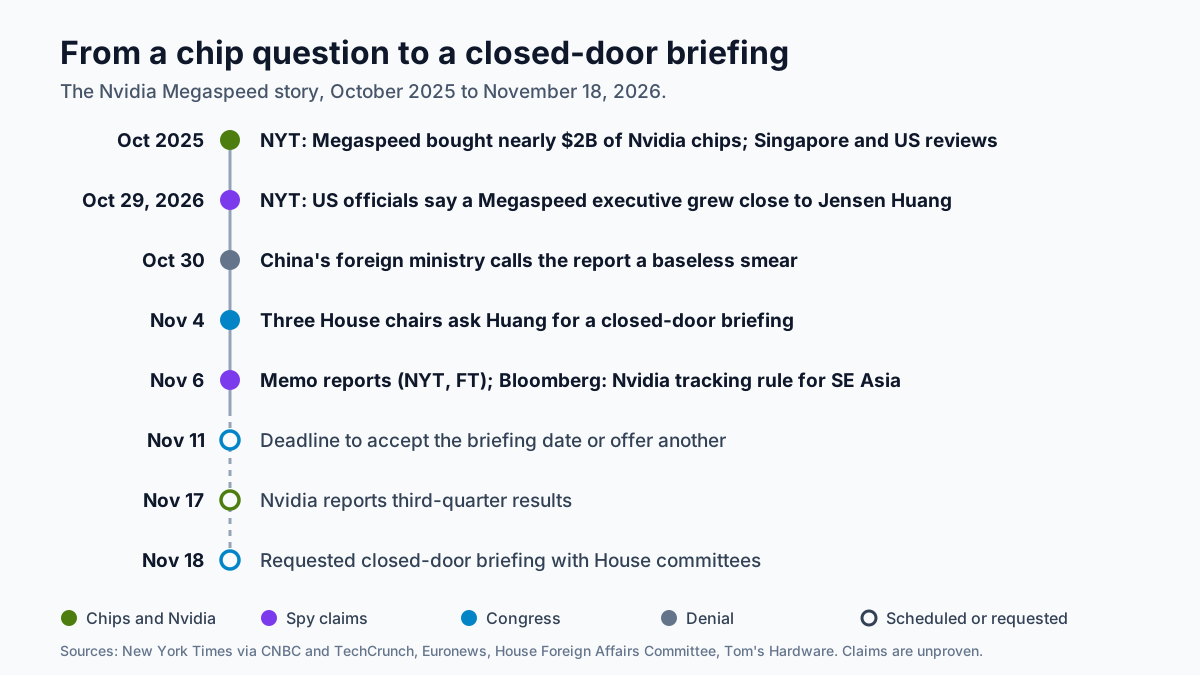
The chart puts the 2025 chip questions and the 2026 spy claims on one line. They're two stories. They meet at one company.
Why Is Remote GPU Access a Gray Area?
US export controls were built for boxes on ships. They stop Nvidia's top chips from going to China without a license, but they say much less about a firm in another country that owns the chips and rents their power to users in China over the internet.
That's the gap the 2025 reports pointed at. If GPUs sit in Malaysia and users in China log in from home, which rule applies? CNBC wrote that Chinese firms have used this "legal gray area" by renting computing power from data centers in Southeast Asia.
Governments are closing the gap in pieces:
- Malaysia said in July 2025 it would require permits to export or transfer US-made AI chips.
- Singapore charged three men in February 2025 with fraud tied to server shipments, in a case The Register linked to Nvidia GPUs bound for China.
- US lawmakers have proposed bills that would make chipmakers check where their chips end up.
None of this is settled law for cloud rental yet. Still, expect more checks on where chips sit and who uses them.
Nvidia's Fleet Intelligence Rule for Southeast Asia
Nvidia seems to be moving before the law does. Bloomberg reported on November 6, 2026 that it now asks clouds in Southeast Asia to join a tracking tool called Fleet Intelligence. Those that don't can't get Nvidia Cloud Partner status, Tom's Hardware wrote.
What is it? It's software that sends GPU data, like load and health, to Nvidia's cloud. Reports say it can also help confirm where a GPU physically sits, using signals like network delay.
Some details are still open, TechRepublic noted:
- Must current partners join, or only new ones?
- Does location data go to Nvidia or US officials by default?
- Will the rule spread beyond Southeast Asia?
That matters for buyers. A provider in the program can prove where its GPUs are, and one outside it may struggle to, which makes partner status more than a logo.
What the Nvidia Megaspeed Probe Means for Data Teams
Most data teams will never meet a chip smuggler. Many do rent GPUs from smaller clouds, though, because they're cheaper or easier to get. That's fair, but your jobs then depend on a vendor whose legal risk you may never see.
Here's what can go wrong when a GPU provider gets caught up in an export case:
- A sudden stop: police or customs seize servers, or the provider loses access to chips and support.
- Lost partner status: if Nvidia drops a provider, upgrades and help can dry up.
- Your data held: logs, images and datasets on seized hardware can sit in an evidence room for months.
- Questions for you: if the provider served banned users, officials may ask what you knew.
- Brand damage: your customers may not want their data in a place that's in the news for spying.
None of these is likely with a well-run provider. All of them are cheap to plan for.
Questions to Ask Your GPU Cloud Provider
Put these six questions in writing before you sign, or at your next renewal. A good provider answers in a day.
| Question | A good answer | A warning sign |
|---|---|---|
| Where are the GPUs, exactly? | A named data center and city, in writing | "Somewhere in the region" |
| Who owns the company? | Named owners and a clear group chart | Layers of shell firms you can't trace |
| Are you an Nvidia Cloud Partner? | Yes, and they can show it | Vague talk of "partners" |
| How do you screen customers? | ID checks and sanctions-list screening | No questions asked of you |
| Do you track hardware location? | Yes, through tools like Fleet Intelligence | No tracking, or no idea |
| What happens if a regulator steps in? | Notice, time to export data and refunds | No clause at all |
A GPU Cloud Due Diligence Checklist
Keep the answers with your vendor records. Review them yearly, and again whenever your provider shows up in the news.
- Put the data center address, city and country in the contract, not just a region name.
- Check the provider and its owners against the US Entity List and OFAC sanctions lists.
- Confirm Nvidia Cloud Partner status.
- Ask whether it tracks GPU location, for example with Fleet Intelligence, and who sees that data.
- Expect it to check your identity too.
- Add a clause on notice, data export and refunds if a regulator or Nvidia steps in.
- Keep a second provider warm, with a tested plan to move.
The last item matters most. A provider can pass every check and still get swept into someone else's case.
Keep Your Data Safe on Rented GPUs
Rented GPUs see your data in plain form while they work. So the provider's country and owners decide who could demand it. Encryption at rest helps. It doesn't cover data while a model trains on it.
A few habits cut the risk without slowing work:
- Send less: strip names, emails and IDs before training data leaves your own cloud.
- Keep the source at home: store raw data and model weights in your main cloud account, and copy only what a job needs.
- Wipe on exit: get proof that disks are wiped.
- Log access: record which jobs pulled which datasets, so you can answer questions later.
For health records, payments or other regulated data, rent GPUs in the data's home country.
A Worked Example: Pricing the Risk of a Cheap GPU Cloud
Here's a simple way to compare a cheap provider with a checked one. The numbers are our own illustration, not real quotes.
Say your team needs a GPU cluster for a year. Provider A costs $70,000 a month and can't answer half the questions above, while Provider B costs $100,000 a month and passes every check. You guess there's a 10% chance Provider A is forced to stop for two weeks this year, and a 1% chance for Provider B.
| Item | Provider A (cheaper) | Provider B (verified) |
|---|---|---|
| GPU price per month | $70,000 | $100,000 |
| Chance of a two-week forced stop in a year (our guess) | 10% | 1% |
| Cost of a two-week stop (team idle, missed launch) | $150,000 | $150,000 |
| Expected stop cost per year | $15,000 | $1,500 |
| GPU spend per year | $840,000 | $1,200,000 |
| Total expected cost per year | $855,000 | $1,201,500 |
On these numbers, Provider A still wins by about $346,500 a year. So the lesson isn't to avoid cheaper clouds. It's that risk has a price you should write down.
The math moves fast if a stop would block a launch, lose a key client or leave regulated data on a seized server. Say a two-week stop would cost you $3 million. Provider A's expected stop cost jumps to $300,000 a year, the gap shrinks to about $90,000 and the checked provider starts to look like cheap insurance.
What Not to Conclude From the Nvidia Megaspeed Reports
It's easy to read too much into a spy story. The facts so far don't support any of these:
- That Jensen Huang did something wrong: no one has charged or formally accused him.
- That every Southeast Asian cloud is risky: most are honest and well run.
- That Nvidia's chips are unsafe: the questions are about who buys and rents them, not the hardware.
- That export law changed today: Congress is asking questions. It hasn't passed new rules.
The fair takeaway is narrow. Know your GPU vendors as well as you know your bank.
What to Watch Next in the Nvidia Megaspeed Story
| Date | What to watch |
|---|---|
| November 11, 2026 | Does Huang accept the November 18 date, or offer a new one? |
| November 17, 2026 | Nvidia posts its third-quarter results. Listen for China and Southeast Asia. |
| November 18, 2026 | The closed-door briefing, if it goes ahead, and anything the three chairs say once it ends. |
| Coming weeks | Any Senate probe after Coons's pledge. |
| Ongoing | The Singapore and US reviews of Megaspeed. |
| Ongoing | Does Nvidia confirm the tracking rule, or widen it? |
Watch the briefing most. Public hearings or new chip-tracking bills afterward would land on every GPU cloud in the region.
Nvidia Megaspeed: Our Take
This story has two layers. The top one is about a famous CEO, a spy agency and a memo nobody outside government has seen. It may turn out to be serious, or it may fade. Either way it's about people, and we'd wait for facts before judging anyone.
The lower layer is about where GPUs go after they're sold. That one is real and growing, memo or no memo.
For data teams, the right move is boring. Know your GPU vendor. Write the risk down, keep your stack portable, and the next headline about a GPU cloud becomes something you read rather than something you scramble to fix.
How Van Data Team Helps
We help teams run AI and data work on systems they know and can move:
- Vendor and cost checks that weigh GPU prices against risk. See cloud cost optimization.
- Data pipelines that run the same on any cloud, built by our data pipeline development team so a move takes days, not months.
- AI agents and model serving you can move in a day. See AI agent development.
- Alerts and runbooks for the day a provider goes dark, from system operations.
For related reading, see our guides to China's AI export controls and NVIDIA Vera Rubin NVL72.
Renting GPUs abroad, or planning to? Get in touch and we'll help you check the vendor, price the risk and build a plan to move if you ever need to.
AI Model Brief
The AI models worth knowing, once a week
What shipped, how it scores on independent benchmarks, what it costs per million tokens and what was deprecated, from the data behind our AI model benchmarks.
We use your address only to send the brief. See our privacy policy.
See this week’s brief
Founder of Van Data Team. Builds Vanaxity, the AI agent system for SEO, GEO, and AEO, and leads data engineering delivery for B2B teams.
About the authorArticle FAQ
Questions readers usually ask next.
These short answers clarify the practical follow-up questions that often come after the main article.
Need a similar system?
If this article maps to a workflow your team already operates, the next step is usually a scoped review of the system, constraints, and rollout path.
Consultation
Scope your next AI workflow.
Share the system and blockers. We will map fit, gaps, and the next step.