LongCat-2.5 vs Claude Opus 5: Read the Benchmarks First
LongCat-2.5 claims to beat Claude Opus 5 on some agent tests for a fraction of the price. What Meituan's numbers show, where it trails and how to test it.
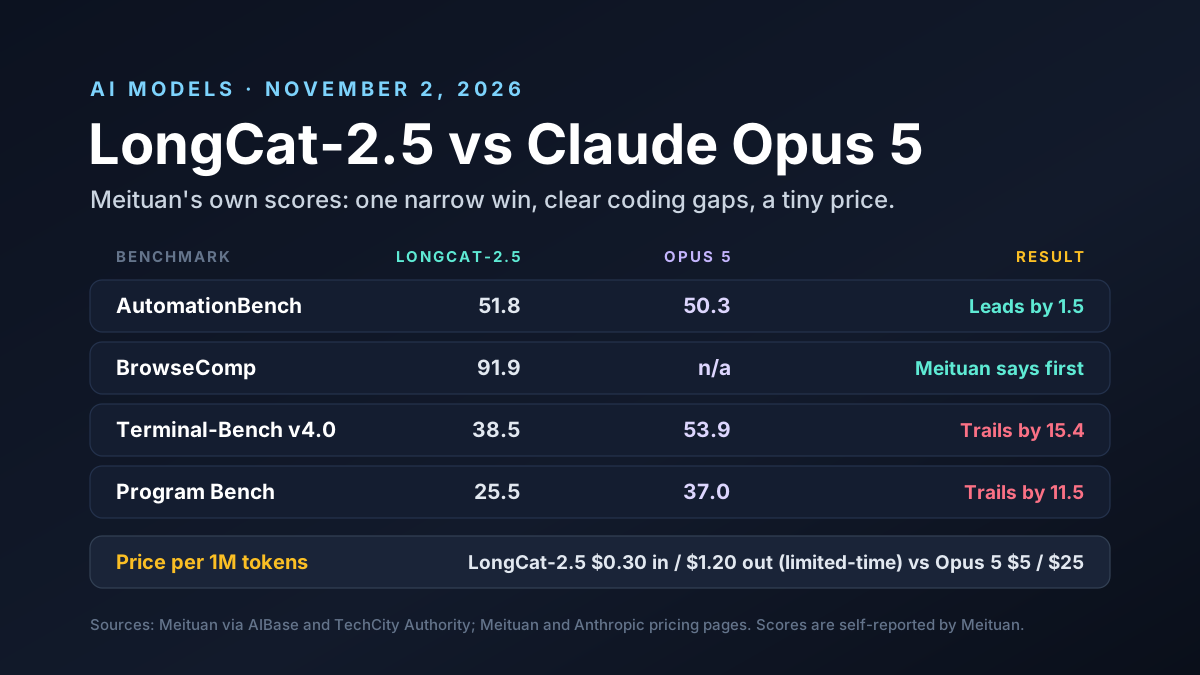
LongCat-2.5 is Meituan's new 1.6 trillion parameter model for long agent tasks, released on November 2, 2026. Meituan says it beats Claude Opus 5 on AutomationBench, 51.8 to 50.3, and ranks first on BrowseComp with 91.9.
But those scores are Meituan's own. It trails Opus 5 on several coding tests, and Opus 5 is no longer Anthropic's newest model. The bigger story is the price.
This guide reads Meituan's claims the way a buyer should. It covers what LongCat-2.5 is, where it leads, where it trails, what it costs per finished task and how to test it on your own work before you move anything.
Disclosure and scope: Van Data Team builds data and AI systems for clients. We use several model providers. Anthropic's Claude is one of them, and it helped us draft this article.
Anthropic makes the model LongCat-2.5 is measured against, so weigh our view with that in mind. We have no business ties to Meituan, and we haven't run LongCat-2.5 on client work yet.
Scores below are Meituan's own unless we say otherwise. Facts come from Meituan's API docs and from reports by AIBase, Startup Fortune, TechCity Authority and others. We label our own math.
Key Takeaways
- What it is: a natively multimodal agent model from Meituan, with 1.6 trillion total parameters and about 48 billion active per token.
- Claimed wins: 51.8 on AutomationBench against 50.3 for Claude Opus 5, and 91.9 on BrowseComp, which Meituan calls first place.
- Clear losses: it trails Opus 5 on Terminal-Bench v4.0 (38.5 vs 53.9) and Program Bench (25.5 vs 37.0), per Meituan's own table.
- Price: $0.30 per million input tokens and $1.20 per million output, as a limited-time rate. That's about 17 and 21 times cheaper than Opus 5 (our math).
- Access: API only. Weights are "coming soon," with no date.
- For buyers: test it on your own tasks, measure cost per finished task and check the data terms before you send anything sensitive.
What Is LongCat-2.5?
LongCat-2.5 is the newest large model from Meituan, the Chinese food delivery and local services group. Its LongCat team announced the model on November 2, 2026, and Meituan's API change log lists it the same day.
It's a mixture-of-experts model. Only part of the network works on each token. LongCat-2.5 has 1.6 trillion parameters in total, but only about 48 billion are active at a time, which makes it cheaper to run than its size suggests.
It's also natively multimodal. Images become tokens in the same system as text, instead of passing through a separate vision add-on. Meituan pitches it for visual coding, design work, 3D tasks and long agent jobs across terminals, browsers and spreadsheets.
The model builds on LongCat-2.0, a 1.6 trillion parameter coding model that Meituan open-sourced under the MIT license this summer. A LongCat-2.5-Preview reached the API on September 25 with image understanding. The November release is the full model, and this time it came with benchmark results.
LongCat-2.5 at a Glance
| Item | Detail |
|---|---|
| Maker | Meituan's LongCat team |
| Released | November 2, 2026 (a preview went live on September 25) |
| Size | 1.6 trillion total parameters, about 48 billion active per token |
| Context window | 1,048,576 tokens, per Meituan's API docs |
| Max output | 262,144 tokens, per Meituan's API docs |
| Inputs | Text and images in one token system |
| Access | Chat app and API; works with Claude Code, Codex and other agent tools |
| Weights | Not released; GitHub and Hugging Face are listed as coming soon |
| Price per million tokens | $0.30 input, $0.006 cached input, $1.20 output (limited-time) |
Some news reports put the output limit at 128,000 tokens. Meituan's parameter page says 262,144, so we use Meituan's figure.
Where LongCat-2.5 Beats Claude Opus 5
Meituan published results on nine benchmarks across coding, general agent work and visual tasks, according to AIBase. Two of them carry the headline claims:
- AutomationBench: 51.8. Meituan's table puts Claude Opus 5 at 50.3. AutomationBench tests whether an agent can finish real automation workflows in task setups that can be repeated.
- BrowseComp: 91.9. Meituan says this ranks first. BrowseComp tests how well an agent digs up hard-to-find facts on the web. The reports we read didn't list rival scores for it, so there's no way yet to tell how wide that first-place margin really is.
A 1.5-point lead is thin. On a 600-task test, it's about nine tasks (our math), the kind of gap that a new prompt, a retry rule or a longer time limit can erase on its own. So read it as a tie that Meituan chose to headline.
The bigger jumps are against Meituan's own older model. Startup Fortune reports that Terminal-Bench v2.1 rose from 70.8 to 88.4, and DeepSWE v1.1 rose from 9.7 to 64.6. Those numbers say more. They compare Meituan with itself, so at least the method is the same.
Meituan also lists 83.1 on MCP Atlas, 78.6 on Vision2Web and 55.4 on 3DCodeBench, where it claims a slight lead over rivals.
Where It Still Trails
Meituan's own table shows clear gaps. Here are the matchups with a named rival, as reported by TechCity Authority and AIBase:
| Benchmark | LongCat-2.5 | Rival in Meituan's table | Result |
|---|---|---|---|
| AutomationBench | 51.8 | Claude Opus 5: 50.3 | Leads by 1.5 |
| Terminal-Bench v4.0 | 38.5 | Claude Opus 5: 53.9; GPT-5.6-Sol: 37.3 | Trails Opus 5 by 15.4 |
| Program Bench | 25.5 | Claude Opus 5: 37.0 | Trails by 11.5 |
| DeepSWE v1.1 | 64.6 | GPT-5.6-Sol: 72.7 | Trails by 8.1 |
| BrowseComp | 91.9 | Not reported | Meituan says first |
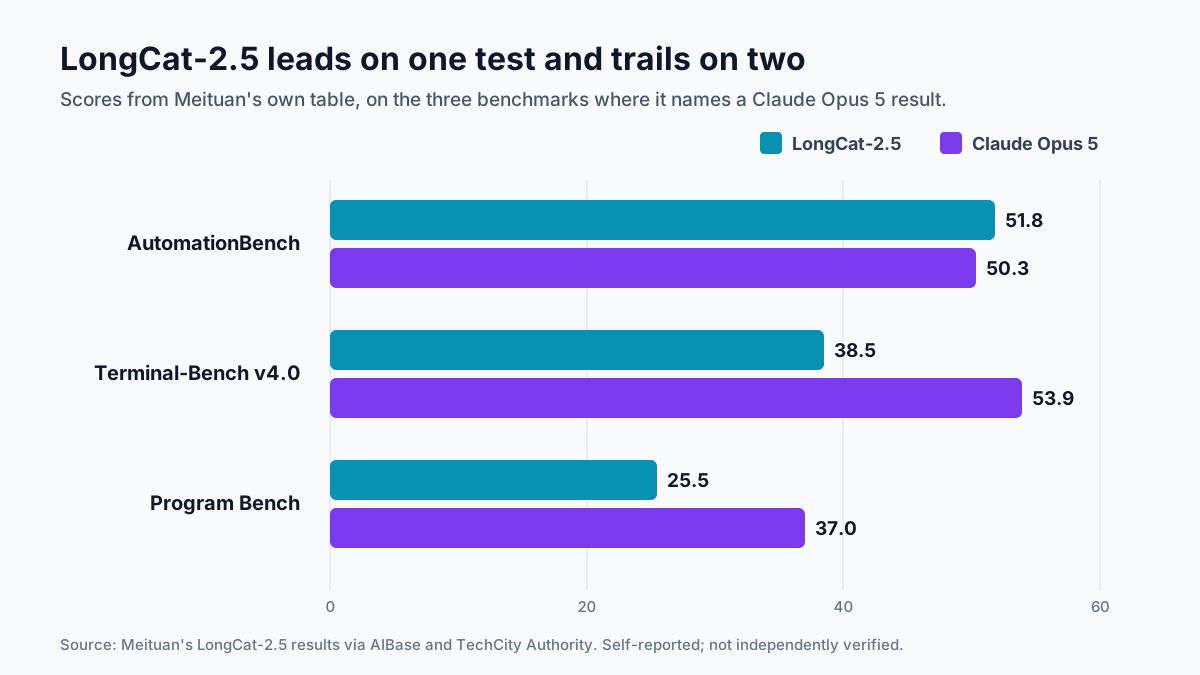
Meituan doesn't hide this. AIBase's report says LongCat-2.5 still lags top overseas models at code writing and terminal commands. Those are the jobs many teams buy a coding agent for.
So the fair summary is mixed. LongCat-2.5 looks strong at browsing and workflow automation. It looks weaker at long coding and terminal work, where Opus 5 keeps a clear lead.
Why Benchmark Numbers Don't Travel Between Tables
Here's a trap. BenchLM, an independent tracker, lists Claude Opus 5 at 26.0% on AutomationBench. Meituan's table lists Opus 5 at 50.3.
Same model, same test name, nearly double the score.
Why? The setup differs. BenchLM's figure comes from a 600-task public subset that Moonshot, the maker of Kimi, ran. Meituan hasn't said which split, tools or time limits it used, and each of those can swing a score by a wide margin.
The rule is simple. Compare models only inside one table that ran them all the same way. Never take LongCat's 51.8 from one source and set it next to an Opus number from another.
Then wait for outside tests. Our LongCat-2.5 benchmark page shows no independent score yet, because none existed when we last updated it.
Meituan's Claims vs What We Could Check
Here's how the launch claims hold up against Meituan's own docs and the reports we read:
| Claim | What we found |
|---|---|
| 1.6 trillion parameters, about 48 billion active | Reported the same way by AIBase, TechCity Authority and others |
| 1 million token context | Confirmed: 1,048,576 tokens in Meituan's API docs |
| 128,000-token max output | Meituan's docs say 262,144 |
| Beats Claude Opus 5 on AutomationBench | Meituan's own run; other tables score Opus 5 very differently |
| First on BrowseComp | Meituan's claim; no rival scores were published with it |
| Trained fully on Chinese chips | Meituan cites domestic accelerators but hasn't named them |
| Open weights | Not yet; listed as coming soon |
The Opus 5 Comparison Is One Generation Old
Claude Opus 5 came out on July 24, 2026. Anthropic then released Claude Opus 5.5 on September 22, at a lower $4 per million input tokens and $20 per million output. Meituan's comparison set, as reported, includes Opus 4.8 and Opus 5, but not Opus 5.5.
That's normal. Big models train for months, and rivals ship in the meantime. But it matters for buyers.
If you compare LongCat-2.5 with what you'd actually buy from Anthropic today, the bar is Opus 5.5. Meituan hasn't published that matchup, and no one else has run it yet.
LongCat-2.5 Pricing: The Real Headline
Here are list prices per million tokens, from Meituan's pricing page and Anthropic's published rates:
| Model | Input | Cached input | Output |
|---|---|---|---|
| LongCat-2.5 (limited-time rate) | $0.30 | $0.006 | $1.20 |
| Claude Opus 5.5 | $4.00 | $0.20 | $20.00 |
| Claude Opus 5 | $5.00 | $0.50 | $25.00 |
By our math, LongCat-2.5 input costs about one-seventeenth of Opus 5's price and one-thirteenth of Opus 5.5's. Output costs about one-twenty-first and one-seventeenth. Cached input shows the widest gap: $0.006 against $0.20, roughly 33 times cheaper than Opus 5.5. Our Claude Opus 5 vs LongCat-2.5 page keeps both sets of prices current.
There are two catches:
- The rate is temporary. Meituan labels it "limited-time" and gives no end date.
- It can change. The pricing page says prices are subject to change, and that the platform's own billing records take precedence.
So budget for a rise. Any plan built on $0.30 needs a line for what happens if the price doubles or triples, and our piece on the AI model price war explains why launch prices rarely last.
A Worked Example: Token Bill vs Task Bill
Say your team runs 1,000 coding-agent tasks a month. Each task reads 200,000 tokens, of which 150,000 are cached, and writes 8,000. Here's the token bill (our math, at list prices, with cache-write fees left out):
| Model | Uncached input | Cached input | Output | Monthly total |
|---|---|---|---|---|
| LongCat-2.5 | $15.00 | $0.90 | $9.60 | $25.50 |
| Claude Opus 5.5 | $200.00 | $30.00 | $160.00 | $390.00 |
| Claude Opus 5 | $250.00 | $75.00 | $200.00 | $525.00 |
LongCat-2.5 wins by about 15 times against Opus 5.5. But tokens aren't the whole bill.
Now add failures. Suppose, for illustration only, that LongCat-2.5 finishes 50% of your tasks and Opus 5.5 finishes 75%. Each failed task takes an engineer 15 minutes to fix, at $60 an hour. That's $15 per failure.
- LongCat-2.5: 500 failures at $15 is $7,500, plus $25.50 in tokens. Total: about $7,526.
- Opus 5.5: 250 failures at $15 is $3,750, plus $390 in tokens. Total: $4,140.
In this made-up case, the cheap model costs almost twice as much. Now flip it. LongCat-2.5 only needs to finish about 73% of tasks to break even here, and above that it wins easily.
That's why the number to track is cost per finished task, not cost per token.
Trained on Chinese Chips: What We Know
Meituan says it tuned long-context training and 4-bit inference for domestic Chinese AI chips. AI Weekly reports that no Nvidia hardware was used. Meituan hasn't named the chip family or the cluster size.
Its predecessor set the tone. When LongCat-2.0 launched, the South China Morning Post reported Chinese claims that it was the biggest AI model trained on local chips.
The serving work is concrete. Meituan says its W4A4 setup, which stores expert weights and activations in 4 bits, matched the full model on its tests. Against an 8-bit baseline, it reports:
- Prefill, the step where the model reads your whole prompt before it writes anything: 43.3% faster.
- Decoding: 42.77% faster.
- Time to first token: 15.91% shorter.
Why should a buyer care? Cheap chips and 4-bit serving help explain the low price. They also mean Meituan's supply doesn't hang on Nvidia export licenses, which matters if US chip rules tighten again.
Weights, Licenses and China's Export Draft
For now, LongCat-2.5 is API only. Meituan lists GitHub and Hugging Face releases as coming soon, with no date. LongCat-2.0's weights are on Hugging Face under the MIT license, but no one knows yet if 2.5 will get the same terms.
There's also a policy question. On October 16, China published draft export controls covering AI models that meet any of three tests:
- Size: at least 2 trillion parameters.
- Compute: at least 10^26 training FLOPs.
- Rank: a place in the global top 10.
At 1.6 trillion parameters, LongCat-2.5 sits under the size line. The other two tests could still apply, and Meituan hasn't said.
Reports on the draft say public open-source releases and API use fall outside the export rules. Comments close on November 15. Our guide to China's AI export controls covers the details.
If you plan to self-host, don't count on the weights until they ship.
Using LongCat-2.5 in Claude Code and Other Agents
Meituan built LongCat-2.5 to slot into agent tools people already use. Its change log says it works with Claude Code, Codex, Hermes and other agent harnesses. It offers an Anthropic-style endpoint, so tools built for Claude can point at it with a new base URL and model name.
Three setup details matter:
- Context limits in your tool. One developer found that Claude Code assumed a 200,000-token window for the unknown model and compacted early, until the limit was raised by hand. Check what your harness assumes.
- Fixed temperature. Meituan's docs say temperature is fixed at 1.0 with thinking on and 0.7 with it off. Other values get overridden, so you can't lower it to make runs more repeatable.
- Rate limits. Throttled calls return HTTP 429, and Meituan's quick start suggests retries with backoff. Build that in before you scale up.
Keep the switch in config, not in code. Then a bad week for one provider costs you a config change instead of a rewrite. Our model portability lesson explains why.
Is LongCat-2.5 Safe for Company Data?
That depends on your data and your rules, not on the model. Before you send anything sensitive, read the LongCat API platform's data terms and find out:
- Where requests are processed and stored.
- How long logs are kept, and who at the provider can see them.
- Whether your inputs can train future models, and how to opt out.
Then check your own side. Many firms have rules on sending customer or regulated data across borders, or to vendors that haven't passed a security review. Start with public code, synthetic data or internal docs that hold no customer details.
Benchmarks also say nothing about safety. Test how LongCat-2.5 handles prompt injection, risky shell commands and requests to leak secrets, as you would with any agent model. Our AI agent evaluation guide has a starting checklist.
How to Test LongCat-2.5 in a Week
A one-week trial beats a month of reading benchmark tables. Here's the plan we'd use:
- Pick 30 to 50 real tasks from your backlog, each with tests or a known good answer.
- Run them on LongCat-2.5 and your current model in the same harness, with the same tools and time limits.
- Score finished tasks only. A task counts if its tests pass or a reviewer accepts it.
- Log tokens and retries for every run, so you can work out cost per finished task.
- Time the human fixes on failures. That's often the biggest cost.
- Run safety probes, such as hidden instructions planted in files and web pages.
- Decide by job type. You might send browsing or spreadsheet work to LongCat-2.5 and keep hard coding on Claude.
Run each task at least twice. Temperature is fixed, so results will vary from run to run, and one lucky pass can fool you. Our Qwen vs DeepSeek vs Kimi bake-off includes a scorecard you can reuse.
Who Should Try It, and Who Should Wait
- Try it now: teams with high-volume, low-risk agent work such as web research, data entry, spreadsheet tasks or UI mockups, where the price gap is huge and mistakes are cheap to catch.
- Test, then decide: coding teams. Meituan's own table shows Opus 5 ahead on terminal and program tests, so measure on your own repo.
- Wait: teams that need self-hosting, strict data handling or a fixed price. Too much is still open.
What to Watch Next
- Independent scores from trackers such as Artificial Analysis and BenchLM, which will show whether Meituan's numbers hold up when someone else runs the tests.
- Open weights on Hugging Face, and the license that comes with them.
- The post-discount price.
- China's final export rules after the November 15 comment deadline.
- A head-to-head with Claude Opus 5.5, the model most Anthropic buyers would actually use today.
LongCat-2.5: Our Take
LongCat-2.5 is a serious model at a striking price. In a few months, Meituan went from a summer coding model to a multimodal agent model that it says matches Claude Opus 5 on some agent tests, built without Nvidia chips.
But "competes with Claude Opus 5" stretches the facts. It narrowly leads one automation test, tops one browsing test and trails clearly on coding and terminal work. All of that is on Meituan's own numbers, against a model Anthropic has already replaced.
So test it on your work. If it finishes enough of your tasks, the price makes it hard to ignore.
How Van Data Team Helps Teams Test New Models
We help teams try new models without betting the business on a launch chart:
- Model bake-offs on your real tasks, scored on finished work.
- Cost per task tracking across providers.
- Model routing, so each job goes to the cheapest model that does it well.
- Safety and data reviews before a new provider touches company data.
Explore our AI agent development services, check current scores on our AI model benchmarks page, or get in touch to plan a two-week model test.
AI Model Brief
The AI models worth knowing, once a week
What shipped, how it scores on independent benchmarks, what it costs per million tokens and what was deprecated, from the data behind our AI model benchmarks.
We use your address only to send the brief. See our privacy policy.
See this week’s brief
Founder of Van Data Team. Builds Vanaxity, the AI agent system for SEO, GEO, and AEO, and leads data engineering delivery for B2B teams.
About the authorAI model benchmarks
Models in this article
Current pricing, context window and independent scores for each model.
Side by side
Article FAQ
Questions readers usually ask next.
These short answers clarify the practical follow-up questions that often come after the main article.
Need a similar system?
If this article maps to a workflow your team already operates, the next step is usually a scoped review of the system, constraints, and rollout path.
Consultation
Scope your next AI workflow.
Share the system and blockers. We will map fit, gaps, and the next step.