June 20, 2026
Did the US government ban Claude Fable 5?
Claims that the US government banned Claude Fable 5 remain unverified; see what evidence is missing and how teams should harden AI workflows now.
Article focus
Why Did The US Government Ban Claude Fable 5? breaks down when source systems are scattered, reviews stay manual, handoffs are unclear, and risk is hard to prove.
Section guide
Why Did The US Government Ban Claude Fable 5? breaks down when source systems are scattered, reviews stay manual, handoffs are unclear, and risk is hard to prove. This guide is for operators who need a practical map, workflow, dashboard signal, review gate, and implementation plan. At Van Data Team, we start by tracing source systems, ownership, automation boundaries, and escalation paths before turning the review into production work.
Did the US government ban Claude Fable 5? The most careful answer is that, as of 2026-06-20, there is no credible public evidence that the US government banned or restricted Anthropic's Claude Fable 5 via an export-control directive in June 2026. Several secondary reports may describe such a restriction, but it is not confirmed by Anthropic's official newsroom or an official government source.
That distinction matters for founders, CTOs, data teams, and AI operators. If a model you depend on can disappear because of policy, safety, export-control, or provider decisions, the real buyer problem is not only "what happened?" It is "can our workflow keep running when a model changes overnight?"
At Van Data Team, we start by turning this kind of report into an operational map: affected workflows, source confidence, model dependencies, fallback routes, customer communication, monitoring, and review gates. For teams building production agents, that is the same discipline behind AI agent development: the model is one component, not the whole system.
This guide separates verified source signals from interpretation, then turns the issue into a practical framework for resilient AI workflows.
How Van Data Team Makes This Operational
At Van Data Team, we treat Why did the US government ban Claude Fable 5? as an operating workflow, not a theory section. We start by mapping the current handoff, source systems, decisions, review gates, dashboards, and recovery paths. The useful output is a scoped delivery plan: which signals to collect, which workflow gaps to close, which automation belongs behind a human review gate, and which dashboard or runbook lets the team act next.
Key Takeaways
- As of 2026-06-20, there is no credible public evidence that the US government banned or restricted Claude Fable 5 via an export-control directive in June 2026.
- The word "ban" is imprecise for operators; the actionable issue is model access risk, especially for foreign-national access, API availability, and provider dependency.
- Teams should not make public claims from secondary reports alone. They should classify evidence as primary, official company, reputable secondary, or unverified.
- Production AI systems need provider abstraction, model routing, eval portability, human review, cost controls, and access-error monitoring before a disruption happens.
- The right response is not panic migration. It is a scoped risk review that identifies which workflows break, what fallback is acceptable, and who approves the switch.
Why did the US government ban Claude Fable 5? The short answer from the evidence
There is no verified public evidence that the US government banned Claude Fable 5. Several secondary outlets may report that Anthropic received a US government export-control directive affecting Claude Fable 5 and Claude Mythos 5, but that claim should be treated as unverified unless it is backed by an official Anthropic source or an official government source.
That is the clearest public answer. The important caveat is that this does not mean every secondary article has its details right. It also does not mean teams should repeat agency names, legal theories, exact government reasoning, or enforcement mechanics unless those details appear in primary documents or official statements.
The safest way to frame the evidence is:
| Claim | Current evidence status | How to use it |
|---|---|---|
| Anthropic suspended access to Fable 5 and Mythos 5 | Not confirmed by a cited credible source here | Do not state as fact unless verified |
| Reports say the trigger was a US government export-control directive | Reported but unverified from the cited sources here | Attribute to reports and flag unverified |
| The underlying government document is publicly inspectable | Not established from the cited sources here | Do not imply it unless found |
| The exact technical risk is fully proven | Not established from the cited sources here | Present as reported concern, not fact |
| Every secondary article's timeline and explanation are correct | Not established | Treat as reporting, not proof |
This is how senior teams should read the story. A secondary report can describe what others claim happened and why they say it happened. It does not automatically validate every downstream claim that appears in the search results.
What Anthropic says happened
No cited official Anthropic source in this draft confirms that Anthropic received a US government export-control directive affecting Claude Fable 5 or Claude Mythos 5. If an official launch post for Claude Fable 5 and Claude Mythos 5 exists, teams should verify it directly rather than relying on secondary summaries.
Some reports describe a government concern involving a potential narrow jailbreak related to cybersecurity. Those reports should remain attributed to reporting unless Anthropic, a government source, or another credible source publicly confirms the details.
Operators should read that as an unresolved question involving capability, safety, access control, and government risk tolerance. It is not a simple product outage. It is also not a normal deprecation.
A normal outage asks: "When will the service recover?"
A model-access restriction asks harder questions:
- Which users, geographies, employee groups, or customer classes are affected?
- Are API calls failing, being routed, or being blocked by policy?
- Are cached outputs still usable under contract and compliance rules?
- Does the workflow require the specific model, or only a capability level?
- Who is allowed to approve a fallback model?
Teams should also monitor official infrastructure surfaces, such as Claude status, because a status page can be a stronger signal than an uncited summary when access actually changes.
Why "ban" is the wrong operating frame
Search intent uses the word "ban" because it is short and emotionally clear. Production teams need a more precise vocabulary.
There are several different events that can look the same to users:
| Event type | What users see | What operators should check |
|---|---|---|
| Provider outage | API errors, timeouts, degraded latency | Status page, retry behavior, incident updates |
| Product withdrawal | Model removed or deprecated | Changelog, migration path, contract terms |
| Policy restriction | Some requests or users blocked | Usage policy, regional policy, account notices |
| Export-control restriction | Access limited by user class, country, or legal status | Official legal source, provider statement, counsel review |
| Safety recall | Model disabled after risk assessment | System card, safety notice, provider explanation |
The mistake we see is treating all five as the same incident. That leads to bad decisions. A provider outage might call for retries and queueing. A policy restriction might call for routing and customer segmentation. An export-control issue might call for legal review before any workaround is considered.
The US Export Administration Regulations also explain why the words "foreign person," "release," and "deemed export" can matter in technology access. The eCFR text for 15 CFR Part 734 defines export concepts that include releasing technology or source code to a foreign person in the United States. That does not prove that any Claude Fable 5 directive exists, but it explains why access control can become more complex than blocking traffic by country.
How AI teams should respond before changing architecture
A SaaS team might see the headline on a Thursday night and immediately ask engineering to rip Fable 5 out of every agent. That is understandable. It is also usually the wrong first move.
Use a short source-verification workflow before making public claims or large architecture changes.
-
Check official provider sources Start with the provider newsroom, developer changelog, API docs, status page, and account notices. In this case, official Anthropic sources and status pages would be stronger sources than secondary summaries.
-
Look for public government records Search for a public directive, Federal Register notice, agency release, or legal filing. If you cannot find one, say so internally. Do not fill the gap with guesses.
-
Classify the event Label it as outage, suspension, policy restriction, export-control issue, safety action, or unknown. The label drives the response.
-
Map affected workflows List every production workflow that calls the model directly or indirectly. Include agents, batch jobs, dashboards, internal tools, and customer-facing features.
-
Assign confidence labels Use "confirmed by provider," "reported by media," "not yet verified," or "internal inference." This keeps leadership memos honest.
-
Freeze external claims until reviewed Do not tell customers that a government agency did a specific thing unless you can cite a credible source for the exact claim.
Here is a hypothetical example. Mina, the CTO of a B2B analytics startup, sees reports that a key model may be unavailable outside the United States. Her team has a launch scheduled for Monday. Instead of pausing the whole launch, she asks for a two-hour dependency review: which features call the model, which customers use those features, what fallback exists, and what public language is safe. The result is not a panic rewrite. It is a launch decision with known risk.
That is the discipline. Verify the source, then scope the blast radius.
If you want this translated into a working implementation plan, Van Data Team can run a model dependency review that returns a source signal map, workflow dependency matrix, fallback model table, monitoring gap list, and implementation scope. The output is designed for engineering, product, and leadership to read from the same page.
The implementation architecture for model-access risk
The following illustration summarizes model access risk architecture:
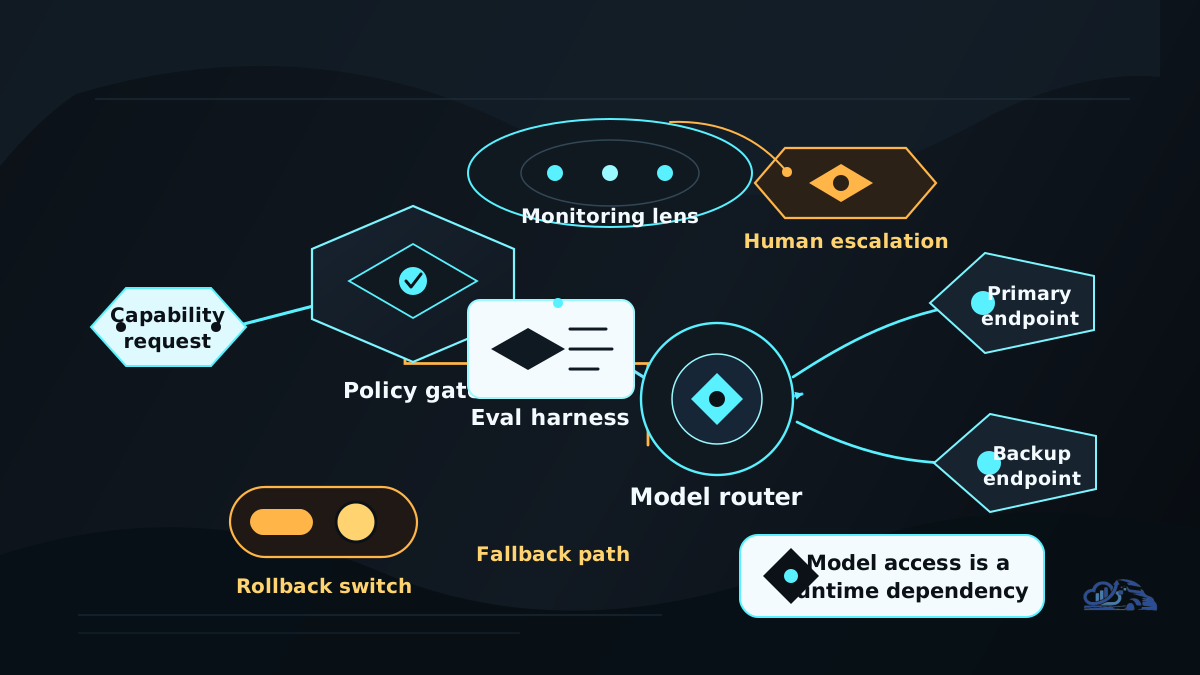
A resilient AI workflow treats model availability as a runtime dependency. It does not hard-code one model into every prompt path and hope contracts stay stable.
The architecture should have six parts.
1. Provider abstraction
The application should call an internal model interface, not a provider SDK directly from business logic. That interface defines request shape, allowed tools, timeout policy, cost tags, logging, and fallback behavior.
For example, an agent should ask for long_context_reasoning or code_review_high_confidence, not "always call Fable 5." The router can then choose the best available provider based on policy, quality, latency, and cost.
2. Task-based model routing
Different tasks need different fallback rules. A low-risk summary can tolerate a cheaper or slower model. A customer-facing action may need human review if the preferred model is unavailable.
Use a model routing table like this:
| Workflow | Primary capability | Acceptable fallback | Required review |
|---|---|---|---|
| Internal research brief | Long-context synthesis | Comparable long-context model | Sample review |
| Customer support draft | Policy-aware writing | Safer mid-tier model | Review before send |
| Code migration agent | Tool use and repository reasoning | Queue until approved fallback | Senior engineer approval |
| Executive KPI narrative | Structured analysis and concise writing | Prior stable model plus rules | Finance owner review |
This table is more useful than a generic "switch providers" plan. It ties the fallback to the business risk.
3. Evaluation portability
A fallback is not real until you have tested it. Keep a small evaluation harness for each critical workflow: representative prompts, expected outputs, refusal cases, policy checks, latency budget, and cost budget.
The goal is not to prove that every model is identical. The goal is to know where quality changes when the route changes.
This is where AI agents with human review become practical. Review should sit where fallback uncertainty is high or business impact is high, not after every step.
4. Monitoring and reporting
Model incidents need dashboards that show more than uptime. Track access errors, refusal spikes, fallback route usage, latency changes, token spend, human-review queue size, and quality-review failures.
For leadership, the dashboard should answer three questions:
- What broke?
- Which workflows are affected?
- What response is currently active?
That is a natural fit for agentic BI and reporting, where operational data is paired with narrative summaries and routed to the people who need to act.
5. Human escalation
Some workflows should stop when the preferred model is unavailable. Others should continue with review. A few can degrade automatically.
Document those decisions before the incident. During an access disruption, the worst time to debate risk tolerance is while customers are waiting.
6. Recovery and rollback
When the preferred model returns, do not blindly switch everything back. Run a short recovery check: provider status, output quality, policy behavior, cost, latency, and any new contract or compliance language.
A fallback system without recovery rules becomes a second source of drift.
A practical runbook for Claude Fable 5-style disruptions
Use this runbook when a frontier model becomes restricted, unavailable, or disputed.
| Step | Owner | Output |
|---|---|---|
| Verify source | Product or policy lead | Source list with confidence labels |
| Classify incident | Engineering lead | Outage, restriction, recall, policy change, or unknown |
| Map dependency | Platform or data lead | Affected workflow list |
| Choose response | Product, engineering, legal | Continue, degrade, queue, pause, or migrate |
| Activate fallback | Engineering | Model router change or feature flag update |
| Monitor drift | Data or QA lead | Quality, latency, cost, and error report |
| Communicate status | Leadership | Internal memo and approved customer language |
| Review after recovery | Engineering and product | Lessons, missing tests, and architecture changes |
For a team running AI agents, this should live beside the normal incident playbook. A model is not just a vendor. It is an operating dependency.
Our AI agent ops playbook goes deeper on the review, escalation, and observability patterns that make this kind of runbook usable in production.
Common mistakes to avoid
The first mistake is writing "the government banned it" without attribution. A precise article says that, as of 2026-06-20, no credible public evidence confirms that the US government banned or restricted Claude Fable 5 via an export-control directive. If you have not reviewed the underlying government document, do not pretend you have.
The second mistake is using secondary reports as if they were source documents. Secondary coverage can help you understand the narrative, but it should not be the foundation for customer messaging or architecture decisions.
The third mistake is treating unavailability as proof of legal restriction. APIs fail. Providers deprecate models. Accounts get flagged. Regions change. Product launches roll back. The response depends on the event type.
The fourth mistake is building single-provider agent workflows with no routing layer. This is fragile even when the provider is stable. It becomes dangerous when policy, safety, or regional access changes.
The fifth mistake is ignoring review burden. A fallback model may be cheaper and available, but if it doubles human review time, the real cost moved from tokens to operators.
Here is another hypothetical example. A revenue ops team has an AI workflow that drafts renewal-risk summaries before account reviews. The preferred model becomes unavailable. A weaker fallback can still summarize CRM notes, but it misses nuance in contract clauses. The right response is not to shut down the workflow. It is to route contract-heavy accounts to human review and let low-risk summaries continue.
That is a production answer. It protects the business without freezing the whole system.
Evaluation criteria for choosing the next move
When a model is restricted or unavailable, the decision is not "migrate or wait." There are several possible moves.
| Option | Best when | Limitation |
|---|---|---|
| Wait and queue jobs | The model is uniquely capable and work is not time-sensitive | Backlog can grow quickly |
| Route to fallback model | The task has tested alternatives | Quality may drift |
| Degrade feature | Users can accept reduced capability | Customer messaging must be clear |
| Add human review | Business impact is high | Review queue becomes the bottleneck |
| Re-architect workflow | Dependency is strategic and recurring | Takes longer than an incident fix |
| Pause feature | Legal or safety uncertainty is high | Product and customer impact is visible |
Evaluate each option against seven dimensions:
- Evidence confidence
- Customer impact
- Legal or compliance exposure
- Quality risk
- Cost and token budget
- Latency and availability
- Human review capacity
At Van Data Team, we usually start with the smallest reversible change that protects the workflow. That often means a feature flag, route change, queue, or review gate before a full migration.
For globally distributed teams, written artifacts matter here. A founder-led delivery model keeps the source review, architecture decision, and implementation scope in one loop instead of splitting them across policy, engineering, and vendor management.
Conclusion: verify the source, then harden the workflow
When someone asks "Why did the US government ban Claude Fable 5?", the best answer is not a sensational one-line claim. The best answer is source-grounded: as of 2026-06-20, there is no credible public evidence that the US government banned or restricted Anthropic's Claude Fable 5 via an export-control directive in June 2026.
The practical lesson is bigger than one model. Frontier AI access can change because of policy, safety, provider strategy, outages, or regulation. Teams that depend on these models need fallback architecture before the next incident.
Van Data Team can help scope that work into concrete outputs: a model dependency map, fallback matrix, eval checklist, monitoring dashboard gaps, human-review workflow, and implementation plan. To turn the risk review into an engineering scope, talk through your project with the same kind of operational detail you would expect in a production incident review.
Article FAQ
Questions readers usually ask next.
These short answers clarify the practical follow-up questions that often come after the main article.
Need a similar system?
If this article maps to a workflow your team already operates, the next step is usually a scoped review of the system, constraints, and rollout path.
Free resilience review
Stress-test Claude Fable 5 exposure
Turn the Claude Fable 5 ban claim into a dependency map, fallback plan, review gates, and concrete next steps for your agents.
- Source-confidence checklist for Claude Fable 5 ban claims
- Map of workflows, tools, and customers exposed to model or provider changes
- Fallback routing plan across approved models and degraded service modes
- Human review checkpoints for policy, safety, and customer-impact decisions
- 30-day implementation sequence for observability, alerts, and owner handoffs
Related articles
View all
Anthropic's AI Distillation Report: What It Alleges
AI Agent Runtime: Cloudflare Computer Combines Isolates and Containers
Anthropic Claude in Microsoft 365 GCC: Governance Guide