August 3, 2026
EU AI Act Compliance in Production: Auditable Pipelines
Build EU AI Act compliance into production with an auditable pipeline, Compliance as Code controls, explainability, human review, and a readiness runbook.
Article focus
EU AI Act compliance in production means turning governance controls into runtime evidence. For engineering, MLOps, and AI governance teams shipping high-risk or general-purpose AI, evidence that lives in slides is a risk when auditors ask for live proof.
Section guide
EU AI Act compliance in production means turning governance controls into runtime evidence. For engineering, MLOps, and AI governance teams shipping high-risk or general-purpose AI, evidence that lives in slides is a risk when auditors ask for live proof. This guide provides an auditable-pipeline design, a Compliance-as-Code checklist, and a readiness runbook for the current transparency phase and the high-risk phases that follow.
At Van Data Team, we start by mapping the decision, data, tools, handoffs, and accountable owner. Teams that need this operating layer can use our production AI agent workflows to connect data pipelines, review gates, and reporting to the actual decision path.
The governance inflection point is August 2, 2026, when transparency obligations chiefly apply. General-purpose AI model obligations have applied since August 2, 2025. High-risk obligations now follow later phases. This article provides engineering guidance, not legal advice. Confirm your classification, role, and duties with counsel.
Key Takeaways
- Transparency is the principal obligation milestone on August 2, 2026, not a universal high-risk enforcement date.
- GPAI provider obligations have applied since August 2, 2025.
- Standalone Annex III obligations move to December 2, 2027, while Annex I product obligations move to August 2, 2028.
- Compliance evidence should be generated continuously through logging, lineage, evaluations, access decisions, and human review.
- Penalties can reach EUR 35 million or 7% of global annual turnover, whichever is higher.
EU AI Act compliance timeline: what applies now
The August milestone makes transparency the immediate production obligation while high-risk duties land later under the amended schedule.
Reported fact: According to the Data Protection Report enforcement timeline, providers of systems that interact with people must make that interaction clear. Relevant providers must also support machine-readable identification of generated or manipulated content. Deployers have duties covering deepfakes, emotion recognition, and biometric categorization in applicable contexts.
The timeline should be presented as follows:
| AI category or milestone | Current status | Immediate engineering response |
|---|---|---|
| GPAI models | Provider obligations have applied since August 2, 2025. | Maintain model documentation, ownership records, evaluation evidence, and downstream information flows. |
| Transparency | These obligations chiefly apply from August 2, 2026. | Put disclosures and content-labeling checks in release and runtime paths. |
| Original high-risk milestone | August 2, 2026 was the pre-Omnibus schedule. | Remove the obsolete date from policies, tickets, dashboards, and executive reporting. |
| Standalone high-risk systems | Annex III obligations apply from December 2, 2027. | Build and test the evidence system before the application date. |
| High-risk AI in regulated products | Annex I obligations apply from August 2, 2028. | Align AI controls with the product's broader quality and conformity workflow. |
Provider and deployer responsibilities differ. A provider may own model design, documentation, logging capabilities, and release controls. A deployer may control inputs, operating procedures, monitoring, worker notices, and human oversight. One company can hold different roles across separate workflows.
Van Data Team analysis: The deferral creates implementation runway, not idle time. Audit trails need operational history. Reviewers need practice using stop and override controls. Monitoring rules need real incidents and false positives before teams can trust them.
The mistake we see is treating a later deadline as permission to defer instrumentation. Retrofitting lineage after a model, prompt, or dataset changes rarely reconstructs the original decision with enough confidence.
Auditable AI pipelines turn governance into live proof
An auditable AI pipeline links every governed decision to its data, system versions, policy checks, tool activity, and accountable human actions.
The technical anchor is the Article 12 record-keeping requirement. The duty belongs to the high-risk framework landing in later phases, but it establishes a clear design direction today. Retrospective documentation can't create runtime evidence that was never recorded.
The official AI Act text states:
"High-risk AI systems shall technically allow for the automatic recording of events (logs) over the lifetime of the system."
A production implementation should include these connected layers:
- Execution identity: Give every request, workflow, model call, tool call, approval, and output a correlated identifier.
- Version lineage: Record the deployed model, prompt, dataset, retrieval index, policy bundle, orchestration code, and tool contract.
- Data governance: Capture provenance, residency decisions, freshness checks, quality results, and least-privilege access outcomes.
- Human oversight: Store the reviewer, decision, reason, escalation state, and whether stop or override authority was used.
- Tamper evidence: Protect records through append-oriented storage, restricted mutation paths, integrity checks, and controlled retention.
- Evidence retrieval: Let an authorized reviewer query a decision and export its evidence bundle without rebuilding it from tickets.
Don't turn logging into uncontrolled data duplication. Store references or protected representations when full inputs contain sensitive data. The evidence schema should show what was used, where it came from, who accessed it, and which retention policy applies.
Retention isn't a universal engineering constant. The correct period depends on the system, organizational role, intended purpose, applicable law, and counsel-approved policy. The pipeline should enforce the approved retention class and record deletion or legal-hold events.
Google Cloud's regulated digital-health infrastructure guidance describes programmatic controls, automated audit trails, digital retention, and an evidence plane for regulated software. That is a useful cloud architecture position, not proof that a workload complies. Its architecture guidance should also be read against the amended high-risk timeline.
Audit-event delivery may use streaming for rapid detection or batch processing for less urgent evidence workloads. The choice should follow freshness, volume, recovery, and audit-query needs. The same operating logic used for choosing an audit-event ingestion pattern applies here.
Reference design for clinical decision support
The following illustration summarizes one decision, complete evidence:
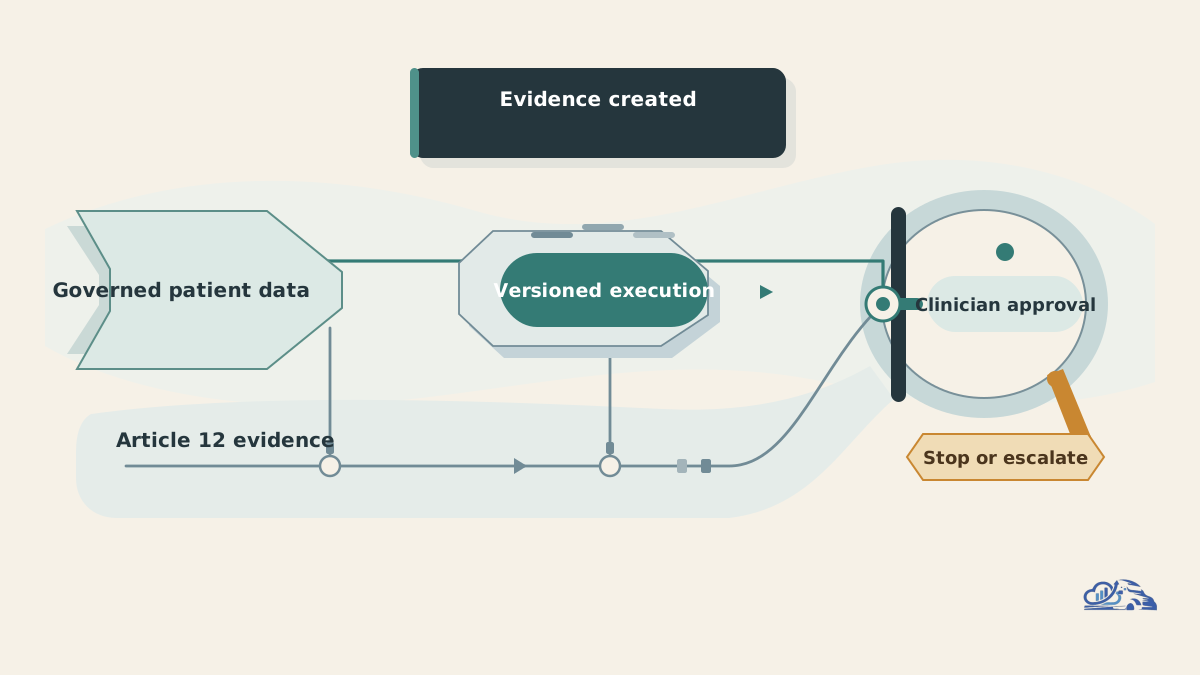
This illustrative healthcare workflow shows how evidence can follow a governed decision. It is Van Data Team analysis, not a customer case or a claim that the system is legally classified.
| Pipeline stage | Recommended control | Evidence produced |
|---|---|---|
| Intake and classification | Record intended purpose, system owner, approved use, role, and risk decision. | Versioned system record and approval reference |
| Governed data access | Enforce least privilege, provenance, residency, lineage, quality, and freshness policies. | Access decision, dataset version, lineage pointer, and quality result |
| Pre-release evaluation | Run approved quality, robustness, safety, and workflow tests. | Signed evaluation result and failed-control details |
| Model or agent runtime | Record model, prompt, policy, workflow, retrieval, and tool versions. | Correlated trace and version manifest |
| Human oversight | Route defined decisions to an authorized clinical reviewer with stop and override powers. | Reviewer identity, decision, reason, and escalation state |
| Output and disclosure | Apply the required disclosure and release policy before delivery. | Output reference, disclosure result, and delivery status |
| Retention and retrieval | Write records to a tamper-evident store under an approved retention class. | Queryable evidence bundle and retention metadata |
| Monitoring and response | Detect missing events, policy drift, failed evaluations, and unauthorized activity. | Alert, incident link, rollback action, and remediation owner |
The design doesn't make the model the final clinical authority. It makes the system's boundaries inspectable. An auditor can determine which data and software shaped an output, whether a review occurred, and what happened after a control failed.
Compliance as Code makes controls executable
Compliance as Code is an engineering pattern that expresses governance requirements as testable policy, deployment gates, runtime rules, and evidence schemas.
It is not a single vendor product. It also isn't a substitute for legal interpretation. Counsel and accountable governance owners define the obligation; engineering turns the approved control into repeatable system behavior.
The operating loop is:
policy definition -> deployment test -> runtime enforcement -> evidence generation -> human review -> audit retrieval -> control improvement
A compact policy contract might look like this:
control_id: governed_ai_execution
applies_when: regulated_decision_or_governed_data
requires:
 - correlated_trace
 - approved_versions
 - access_decision
 - evaluation_result
 - human_review_state
on_missing_evidence:
 action: block_or_escalate
 owner: ai_governance
In CI/CD, the policy can block an unapproved model, prompt, dataset, tool, or control change. At runtime, the same policy can reject unauthorized access, require a disclosure, or route a decision to review. Monitoring then detects missing records, policy drift, evaluation failures, and unhandled escalation.
Explainable AI should use the same evidence path. The record should identify the decision basis, relevant inputs, retrieved sources, system version, control results, uncertainty, and reviewer rationale. It shouldn't depend on exposing or retaining private model chain-of-thought.
Human oversight also needs operational authority. A reviewer who can only acknowledge a result isn't an effective control. Define who can approve, reject, stop, override, escalate, and trigger rollback. Our guide to AI agents with human review shows how to place those decisions inside the workflow.
Agent frameworks need controls at every boundary
LangGraph, LangChain, CrewAI, native function calling, MCP, and Plan-and-Execute can orchestrate complex work, but none provides compliance by default.
The framework is only one layer. A governed agent crosses model, state, tool, data, policy, and human boundaries. Each boundary needs a traceable identity, permission decision, result, and accountable recovery path.
| Orchestration pattern | Main governance pressure | Evidence boundary |
|---|---|---|
| LangGraph or LangChain workflows | State can branch, retry, pause, and resume. | Record node transitions, state versions, retries, checkpoints, and review events. |
| CrewAI or other multi-agent flows | Responsibility can become unclear across agents. | Record agent identity, delegation, shared context, tool authority, and final ownership. |
| Native function calling with MCP | Tools can read governed data or change external systems. | Record tool schema, server identity, arguments, authorization, result, and side effect. |
| Plan-and-Execute | The plan can change after intermediate results. | Preserve plan versions, execution decisions, stop conditions, and replanning reasons. |
Production monitoring must cover cost, latency, token budget, observability, and evaluation together. A workflow can pass a quality test while exceeding its operating budget. It can also stay fast while silently losing tool-call records or using stale data.
Track prompt and model versions, tool permissions, retries, fallback paths, and escalation outcomes. Connect those traces to data lineage, freshness, and SLA state. Evaluation should cover the intended use, robustness, disclosure behavior, access policy, tool misuse, and reviewer routing.
Consider a hypothetical recruitment agent built with native function calling and an MCP server. It retrieves candidate records, scores job criteria, and sends a recommendation for review. Logging only the final recommendation leaves major gaps. The evidence needs the governed data version, retrieval result, scoring policy, tool authorization, model version, review decision, and any override.
Run a readiness playbook before an audit request
A readiness exercise should prove that the organization can trace, explain, stop, and export evidence for a real production execution.
Use this runbook:
- [ ] Inventory AI systems, GPAI models, agents, tools, datasets, intended uses, owners, and deployment regions.
- [ ] Establish category, provider or deployer role, and applicable obligations with counsel.
- [ ] Define an evidence contract for every workflow that can affect a governed outcome.
- [ ] Instrument data lineage, disclosures, evaluations, tool calls, access decisions, and human actions.
- [ ] Express release and runtime controls as versioned policy.
- [ ] Test rejected access, missing logs, failed evaluations, overrides, escalation, fallback, and rollback.
- [ ] Run a mock audit using production evidence rather than prepared screenshots.
- [ ] Assign remediation owners and repeat after material model, data, policy, or workflow changes.
Common failure modes include using the original high-risk date as the current deadline, presenting GPAI duties as new, and assuming generic cloud logs establish compliance. Other gaps include losing prompt lineage, omitting agent tool actions, or creating review queues without stop authority.
A mock audit passes when reviewers can trace a sampled decision end to end. They should be able to reproduce the version manifest, verify access and disclosures, find human interventions, and inspect control failures. The team should also demonstrate evidence-integrity alerts, rollback behavior, and an export that doesn't require manual reconstruction.
For agent systems, include cost, latency, token use, data freshness, policy results, and evaluation outcomes in the audit view. These aren't all standalone legal requirements. They are operating signals that help explain system behavior, identify drift, and show whether controls still work under production pressure.
Van Data Team can scope this into a workflow inventory, evidence-contract map, control-gap dashboard, human-review design, mock-audit report, and delivery plan. Teams building stop and recovery paths can also use our production agent operations and human escalation playbook.
Conclusion: make evidence a runtime output
The durable response to the phased rollout is to make compliance evidence a normal output of every governed execution.
Transparency applies from August 2, 2026. GPAI provider duties have applied since August 2, 2025. High-risk obligations now arrive through the later Annex III and Annex I phases. That schedule gives teams time to build stronger controls, but only if implementation starts before evidence is urgently needed.
EU AI Act compliance becomes operational when a team can trace a decision, explain the approved basis, verify data and system versions, show human authority, and prove what happened after failure.
Van Data Team can turn that target into an implementation scope covering the evidence contract, pipeline instrumentation, policy gates, review workflow, audit dashboard, and recovery runbook. Start with the workflow that carries the highest consequence, then make its evidence live, queryable, and owned.
Article FAQ
Questions readers usually ask next.
These short answers clarify the practical follow-up questions that often come after the main article.
Need a similar system?
If this article maps to a workflow your team already operates, the next step is usually a scoped review of the system, constraints, and rollout path.
Book your free workflow review here.
Related articles
View all
China AI Slowdown: Why Beijing and Trump Both Said No
OpenAI's Jalapeño Chip: First Inference Benchmarks
Inside A2A's Multi-Cloud FinOps Data Pipeline on AWS