Google Gemini Spark: The always-on agent runtime
Google Gemini Spark is an always-on agent runtime for persistent, multi-step work. See the architecture, controls, and readiness checks production teams need.
Google Gemini Spark is Google's 24/7 always-on personal AI agent: a persistent assistant that can keep multi-step work running after the user leaves the session. The July 29, 2026 Australia announcement expands regional access; it is not a new global debut. Google first unveiled Spark at Google I/O 2026 in May 2026.
For builders, the hard question is not how to prompt it. It is how to trust a runtime with continuing access to inboxes, browsers, tools, APIs, and operational data. At Van Data Team, we start by mapping task intake, decisions, permissions, failure modes, and review gates before selecting the orchestration layer. That is how our production AI agent workflow design turns autonomy into an operating model rather than a demo.
This guide separates Google's reported facts from Van Data Team's analysis. It gives engineering leaders an implementation architecture, permission model, AgentOps stop-condition artifact, framework decision guide, and readiness gate for a controlled pilot.
Key Takeaways
Gemini Spark matters because it moves AI work from a bounded conversation into a persistent, tool-using runtime.
- The Australia announcement is a regional expansion after Spark's earlier I/O unveiling, not its first launch.
- Spark continues work on managed cloud infrastructure without requiring the user's device to remain open.
- Gmail, Chrome, and MCP make tools part of the execution path and the security boundary.
- Production trust requires traces, token and cost telemetry, data provenance, stop conditions, and human escalation.
The Australia rollout extends an earlier launch
Google's Australia announcement extends Gemini Spark beyond its initial US release; it does not introduce a separate Australia-specific product.
Reported fact. The confirmed product picture is compact:
| Confirmed element | Reported detail |
|---|---|
| Timeline | Spark debuted at Google I/O 2026 in May 2026, followed by the Australia rollout on July 29, 2026. |
| Runtime | Spark runs as a persistent runtime on dedicated Google Cloud virtual machines, so work can continue without an open user device. |
| Foundation | The agent is built on Gemini 3.5 Flash and Google Antigravity 2.0 and supports the Model Context Protocol (MCP). |
| Task interfaces | Spark can receive work through a dedicated Gmail address, browse with Chrome, and execute multi-step plans. |
| Integrations and access | Canva, OpenTable, and Instacart are initial integrations; MCP expansion includes GitHub, Notion, Slack, and other services exposing MCP servers. Access began with Google AI Ultra subscribers in the US before regional expansion, including Australia. |
Van Data Team analysis. That short description changes the production question. A chatbot can fail inside a response. A persistent agent can carry a weak assumption into later steps, call another tool, and create a side effect after the user has stopped watching.
What Google Gemini Spark changes about the unit of work
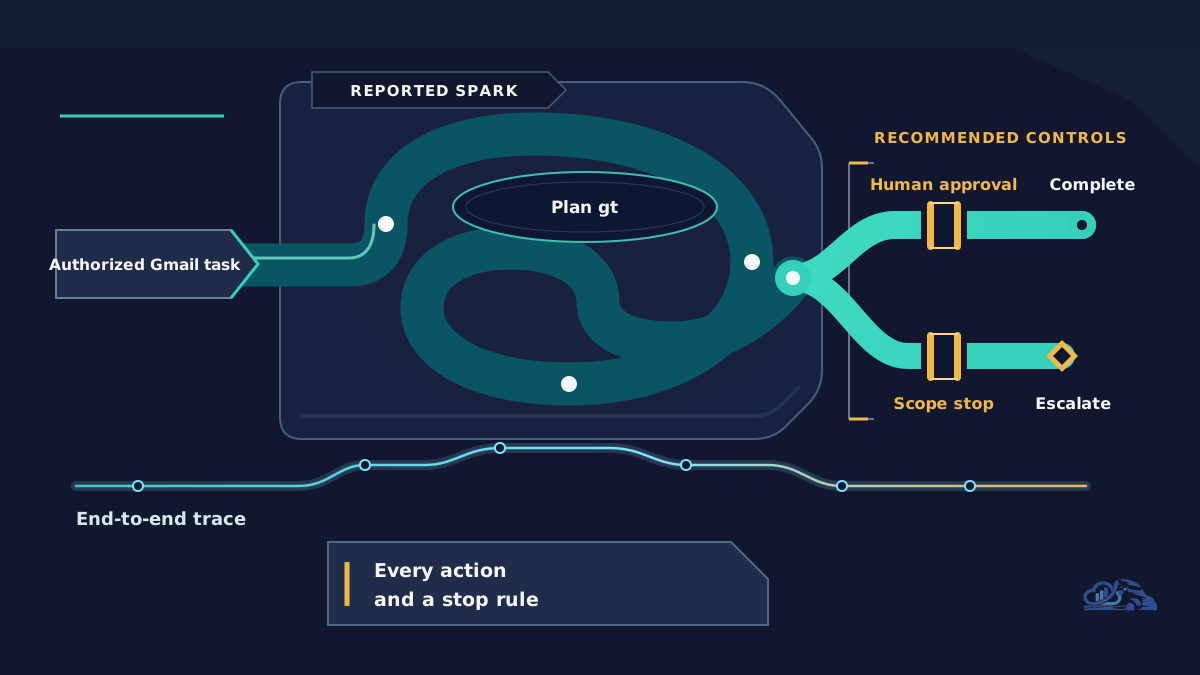
Google Gemini Spark changes the unit engineers must supervise from an answer to an execution path.
Reported fact. Spark accepts tasks, reasons over context, creates multi-step plans, and interacts with Gmail, Chrome, and connected tools while its runtime remains active.
Van Data Team analysis. The table below is our conceptual comparison, not an official Google specification.
| Conversational chatbot | Always-on agent runtime |
|---|---|
| Waits for the next prompt | Continues an assigned workflow |
| Returns a response | Executes and revises a multi-step plan |
| Centers state on a session | Centers state on a persistent task |
| Exposes tools during an interaction | Holds permissioned tool access across execution |
| Reviews the final answer | Reviews the plan, tool calls, side effects, and outcome |
A useful explanatory sequence starts with authorized task intake. The agent gathers context, proposes a plan, calls an allowed tool, evaluates the observation, selects the next action, and then completes or escalates. This is an operating model based on the reported capabilities, not a claim about Google's undisclosed internals.
Hypothetical bounded workflow. Maya, an operations lead, emails an authorized research request to Spark's dedicated address. Spark uses Chrome to gather public context and prepares a memo, but its policy blocks publishing or external messages. The trace records the request, sources, plan revisions, browser actions, and result. A reviewer checks provenance and scope before accepting the output, following the same risk-based logic used in AI agents with human review.
MCP makes integration easier, not automatically safer
MCP gives an always-on agent a common tool interface, but every connected capability still needs a narrow contract and an explicit approval boundary.
Reported fact. Spark includes full MCP support. Google's stated integration path starts with Canva, OpenTable, and Instacart, then expands through MCP to GitHub, Notion, Slack, and any service that exposes a compatible server.
Van Data Team analysis. Treat an MCP server as a permissioned production API, not as a box to tick. Define typed inputs, validate outputs, log connector calls, separate read scopes from write scopes, and reject requests outside the workflow's resource set.
| Surface | Recommended default | Approval or stop boundary |
|---|---|---|
| Gmail intake | Dedicated channel with authorized-sender checks | Escalate ambiguous, spoofed, or out-of-scope requests |
| Chrome | Read-oriented browsing on controlled destinations | Gate submissions, purchases, account changes, and external communications |
| MCP connectors and APIs | Connector-specific identities with narrow actions and resources | Review every new write scope or connected service |
| Warehouses and retrieval indexes | Governed views with source and freshness metadata | Stop when provenance or required freshness is unknown |
| Secrets | Managed storage with independent rotation and revocation | Never expose credentials in prompts, traces, or outputs |
Consequential writes should require human approval until the team has validated a policy for that action class. This is Van Data Team guidance, not a claim that these controls are built into Spark.
Production trust comes from traces and stop conditions
An always-on agent is production-ready only when operators can reconstruct its execution and stop it before uncertainty becomes a side effect.
Van Data Team analysis. A final answer is not enough for debugging. Capture the evidence needed to explain why the runtime chose a tool, what data it read, where it retried, how much it consumed, and whether the outcome passed acceptance rules.
| Control area | Telemetry to capture | Recommended stop or approval rule |
|---|---|---|
| Task intake | Sender, channel, requested outcome, authorization context | Reject unknown or ambiguous origins |
| Planning | Goal, proposed steps, tool choice, plan revisions | Pause when the plan leaves the approved task boundary |
| Tool use | Connector, operation, inputs, outputs, side-effect class | Require approval before unvalidated external writes |
| Data provenance | Source, lineage, retrieval time, freshness status | Stop when required provenance or freshness cannot be established |
| Model and runtime | Prompt and response tokens, model calls, attributed cost, elapsed time, retries, repeated steps | Stop at the team's task budget, timeout, retry, or no-progress policy |
| Outcome and recovery | Intended result, validation status, reviewer, rollback or compensating action | Do not complete without acceptance; escalate when recovery is unsafe |
Pricing, latency, token consumption, task success, and escalation rates need measurement from authorized product telemetry. Public sources do not establish those values, so they belong in an evaluation plan rather than a product claim.
The mistake we see is treating stop conditions as error handling added after launch. They are part of the runtime contract. Van Data Team's production AI AgentOps playbook goes deeper on tracing, escalation, and review placement.
Reliable agent decisions start with reliable data
Persistent reasoning does not repair stale, incomplete, or poorly governed data; it can amplify those defects across later actions.
Van Data Team analysis. Airflow, dbt, Kafka, warehouses, and retrieval indexes are adjacent data-engineering foundations, not confirmed Spark internals. Airflow can schedule and recover pipelines, dbt can model and test governed datasets, Kafka can deliver event-driven inputs, and warehouses can expose controlled views. Retrieval indexes should behave like agent-facing data products with provenance and freshness attached.
Hypothetical freshness failure. A procurement workflow reads an inventory mart whose upstream load has stalled. The agent's reasoning may be internally coherent while the recommendation is operationally wrong. The fix is an upstream freshness contract and a runtime stop condition, not a longer prompt.
Teams evaluating autonomy should pair resilient data pipeline engineering with staged modernization for AI readiness. A useful readiness review should produce a workflow map, source and lineage map, freshness and quality contract, permission matrix, evaluation set, and controlled delivery plan.
Choose managed or custom orchestration by ownership
Spark and custom agent frameworks solve different ownership problems, so the right choice depends on control, integration fit, and the operations burden the team can carry.
Van Data Team analysis. No comparative benchmark has been published, so there is no evidence-backed performance winner.
| Option | Strong fit | Team ownership and caution |
|---|---|---|
| Gemini Spark | Persistent personal workflows across Google's environment and connected tools | Google manages the runtime; the adopting team still owns task policy, data access, review, and incident handling |
| LangGraph or LangChain | Custom graphs, state, retrieval, and tool routing | The team owns deployment, tracing, recovery, and framework upgrades |
| CrewAI | Role-based agent collaboration where handoffs add real value | Validate delegation, shared state, and failure propagation between agents |
| Native function calling | Bounded tool use inside an existing application | Persistence, retries, and recovery need a surrounding workflow layer |
| Plan-and-Execute or a custom state machine | Explicit stages, deterministic gates, and domain-specific control | The team owns the planner, executor, state store, rollback, and evaluation harness |
Use a managed runtime when its ecosystem, access model, and supervision surface fit the workflow. Choose custom orchestration when data residency, connector behavior, evaluation, or recovery needs deeper control. Prefer deterministic automation when the task is predictable and does not benefit from contextual planning.
Production readiness gate
A controlled pilot should pass every applicable gate before the agent receives broader permissions.
- [ ] The workflow has a named owner and a bounded outcome.
- [ ] Approved tools, data sources, and side effects are documented.
- [ ] Task senders are authenticated, and connector scopes follow least privilege.
- [ ] Data quality, lineage, freshness, and pipeline service expectations are explicit.
- [ ] The full execution path is traceable without leaking secrets.
- [ ] Token, cost, latency, retry, and no-progress budgets have stop rules.
- [ ] Consequential external actions have human approval gates.
- [ ] Evals cover normal, ambiguous, stale-data, tool-failure, and adversarial cases.
- [ ] Outcome acceptance, incident ownership, rollback, and compensating actions are defined.
Operational Budget
Reported fact. Google describes Google Gemini Spark as a persistent, always-on agent running on dedicated Google Cloud VMs. That architecture keeps workflows active without an open user device, but the announcement alone does not establish the operating cost of a production workload.
Van Data Team analysis. Compare Spark and any alternative runtime using approved outcomes, not vendor token rates. For each representative workflow, record:
- end-to-end latency and tokens consumed;
- retries, tool-call failures, and recovery work;
- reviewer minutes required for approval;
- evaluation results for correctness, policy compliance, and task completion;
- total runtime, model, tool, data, and human-review cost.
Calculate accepted-output cost by dividing total workflow expenditure (including failed runs and recovery) by the number of results that pass the approval gate. A cheaper model can become the more expensive system if it needs repeated calls, creates long execution paths, or shifts verification to engineers.
Set token, retry, elapsed-time, and tool-call budgets before the pilot. Stop or escalate when a limit is reached, an evaluation fails, or recovery would repeat the same action. Production approval should require stable evaluation performance and a failure path that preserves state, records side effects, and supports safe human resumption.
The takeaway: persistence raises the operating standard
Google Gemini Spark makes the shift from session-based chat to persistent execution concrete. The Australia rollout broadens access to a runtime built for ongoing tasks, cloud execution, contextual planning, and connected tools. Those capabilities increase usefulness, but they also widen the security, data, and operations boundary.
Start with a bounded workflow that benefits from planning and tool use. Instrument the full path, narrow every permission, attach provenance and freshness to context, and stop before uncertainty reaches a consequential action.
If you want to test Google Gemini Spark or a custom runtime against a real workflow, scope a controlled agent pilot. The output should include the task boundary, signal and data map, permission matrix, observability and stop-condition specification, evaluation plan, and implementation scope.

Founder of Van Data Team. Builds Vanaxity, the AI agent system for SEO, GEO, and AEO, and leads data engineering delivery for B2B teams.
About the authorArticle FAQ
Questions readers usually ask next.
These short answers clarify the practical follow-up questions that often come after the main article.
Need a similar system?
If this article maps to a workflow your team already operates, the next step is usually a scoped review of the system, constraints, and rollout path.
Free agent review
De-Risk Your Gemini Spark Pilot
Review your Google Gemini Spark use case and leave with a practical pilot architecture, control model, and concrete implementation priorities.
- A persistent-runtime architecture covering task intake, planning, tools, state, and human checkpoints
- An AgentOps telemetry and stop-condition checklist for traces, token costs, retries, limits, and escalation
- A least-privilege access design for Gmail, browsers, MCP servers, APIs, and operational data
- A readiness assessment for data quality, lineage, freshness, pipeline SLAs, and retrieval indexes
- A phased pilot plan with orchestration options, success criteria, owners, and next steps
Consultation
Scope your next AI workflow.
Share the system and blockers. We will map fit, gaps, and the next step.