MLOps on AWS: Systems That Outlast Leadership Changes
Build durable MLOps on AWS with reproducible pipelines, controlled model serving, observability, cost ownership, tested rollback, and practical portability.
MLOps on AWS should keep every production model reproducible, promotable, observable, cost-accountable, and recoverable even when vendor leadership changes. If a personnel announcement makes your team wonder whether training, serving, or rollback still works, the real gap is not the org chart. It is undocumented dependency and ownership.
For platform engineers, ML engineers, and architects, the practical output is a dependency map, a promotion path, a serving decision, and a recovery plan. At Van Data Team, we start by tracing the workflow, artifacts, compute surfaces, review gates, signals, and owners already shaping production. Teams that need that review made operational can use our workload-driven cloud cost optimization approach to scope a dependency register, signal map, and prioritized delivery plan.
Amazon's official announcement says Dave Treadwell will move to AWS effective August 1, 2026, while Dave Brown leaves after nearly 19 years, transitions through the end of July, and takes a role outside Amazon. Brown's note frames the event as continuity rather than turmoil:
"I know you'll continue to accomplish incredible things together."
This is an orderly personnel change, not a product roadmap. Treat it as a prompt to inspect your controls, not as a reason to re-architect on speculation.
Key Takeaways
Durable AWS ML operations depend on evidence, ownership, and recovery controls that remain useful under any leadership team.
- The Brown-to-Treadwell handover signals continuity; it does not announce changes to EC2, containers, SageMaker, Bedrock, pricing, or ML strategy.
- Reproducibility requires one traceable contract across code, data, features, runtime, configuration, evaluation, artifact, and deployment.
- A model registry creates control only when approval, compatibility, deployment history, and rollback eligibility affect promotion.
- Model serving boundaries should follow scaling, permissions, release cadence, and failure isolation rather than platform fashion.
- Portability is most valuable where a dependency is critical, hard to reverse, weakly observable, or expensive to reconstruct.
The AWS handover is a prompt, not a product roadmap
The AWS handover establishes who will lead AWS Compute and ML Services, but it does not establish a new technical direction.
Treadwell is currently Senior Vice President of eCommerce Foundation. According to GeekWire's background report, he joined Amazon in 2016 after 27 years at Microsoft, where his work included Windows, Xbox, and the. NET framework. He later led Amazon's technology platform.
CNBC reports that Brown was one of AWS's earliest EC2 engineers and that AWS recorded 28% first-quarter revenue growth on strong AI demand. Brown rose to lead compute, AI, and machine-learning services. AWS CEO Matt Garman announced the transition in a staff note.
Those facts explain why the announcement matters. They do not tell practitioners what will happen to service features, pricing, accelerator families, container orchestration, or MLOps tooling.
| The news tells you | The news does not tell you |
|---|---|
| Treadwell assumes the AWS Compute and ML Services role | What EC2, EKS, SageMaker, or Bedrock will ship next |
| Brown is leaving for an external role after a planned handover | That Brown was fired, demoted, or pushed out |
| AWS has assigned an experienced Amazon platform leader | That customers should migrate, consolidate, or re-platform |
| Leadership continuity is the stated near-term signal | Future pricing, product priorities, or architecture guidance |
Map the compute and ML path before changing services
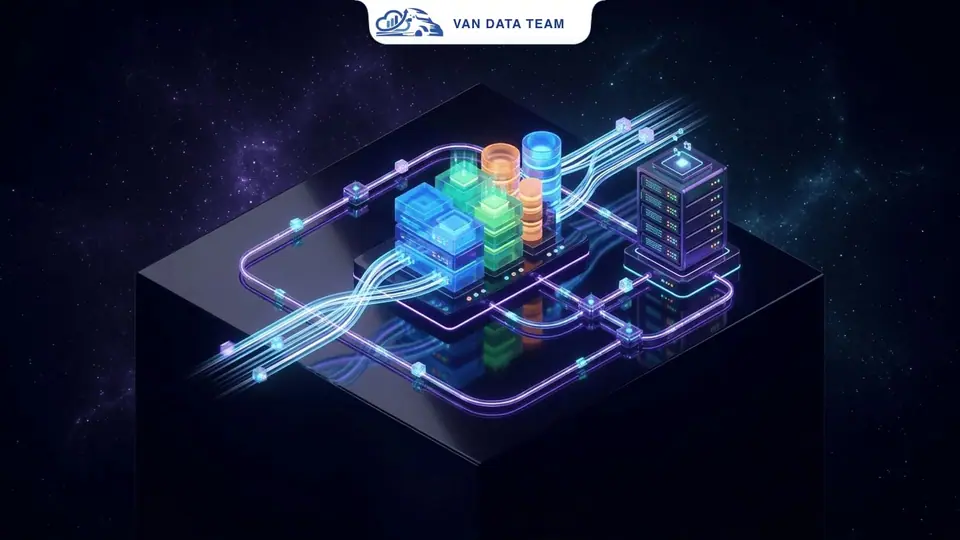
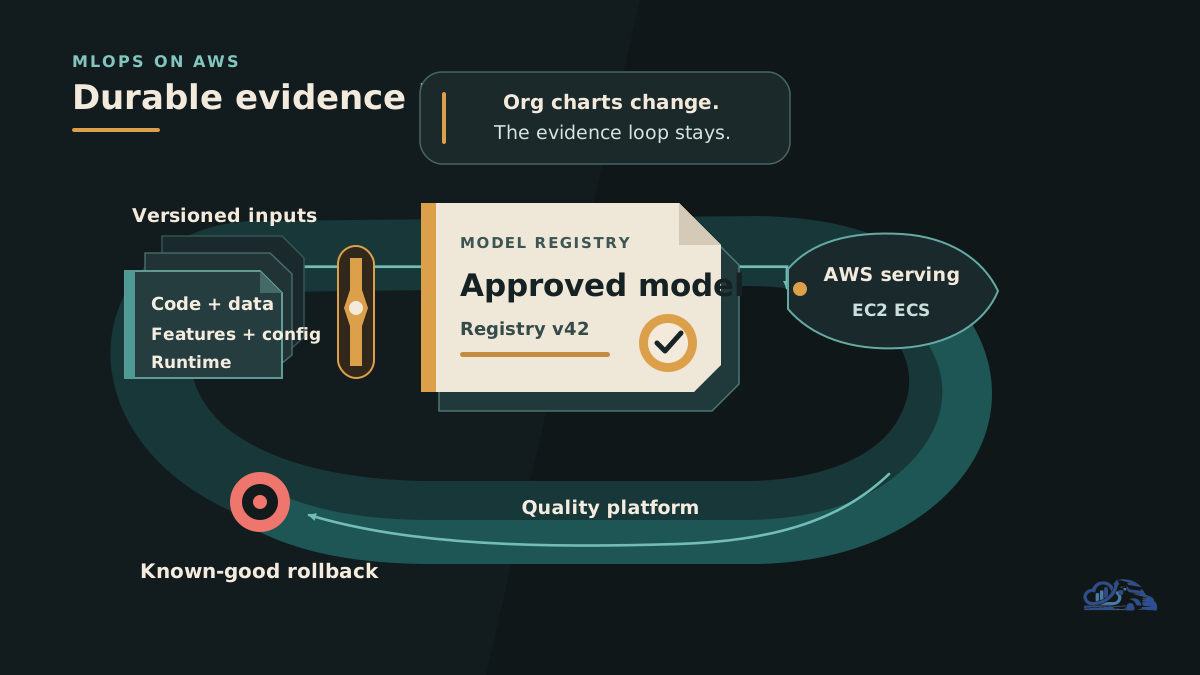
The following illustration summarizes the durable model evidence loop:
A resilient AWS ML platform ties every production model to a compute surface, immutable artifacts, an accountable owner, live signals, and a tested recovery action.
The official AWS Compute reference organizes the core surface around instances, containers, and serverless computing. For ML teams, the working inventory also includes accelerator-backed EC2, ECS, EKS, Fargate, Lambda, SageMaker, Bedrock, Inferentia, Trainium, and the training or inference workflows built on them.
Do not stop at service names. For each workload, record:
- The business workflow, technical owner, and on-call owner
- Whether the workload trains, evaluates, batches inference, or serves online
- The source, data reference, feature logic, configuration, model artifact, and container image
- The deployment controller, scaling signal, network boundary, identity policy, and secrets path
- The model version carried into logs, traces, quality checks, and cost allocation
- The failure boundary, previous approved artifact, rollback action, and escalation path
- The export, substitute, or rebuild path for each material managed-service dependency
The implementation path should be readable as one control loop: versioned code, data, features, configuration, and runtime produce an evaluated artifact; the registry records its evidence; promotion deploys an approved version; telemetry and cost signals identify that version; recovery restores a known-good state.
In an illustrative batch workflow, a training job completes successfully but its feature contract no longer matches the evaluation input. The pipeline should fail before registration. "The job ran" is not approval evidence, and a model that cannot pass the complete contract should never become deployable.
Make the registry and delivery pipeline enforce reproducibility
A model becomes production-ready only when the team can rebuild it, explain why it was approved, deploy it predictably, and restore the previous known-good version.
The training contract should connect source revision, data snapshot or immutable reference, transformation logic, runtime image, dependencies, hyperparameters, configuration, model artifact, evaluation evidence, registry state, and deployment target. If any link lives only in a notebook, ticket comment, or engineer's memory, reproduction is conditional.
Use the model registry as a control point, not an artifact cupboard. A useful registry communicates provenance, intended use, approval status, compatibility, deployment history, active environments, known limitations, and rollback eligibility. The deployment system must consume those fields; otherwise the metadata is documentation without enforcement.
A practical CI/CD path checks code and configuration, validates data and feature contracts, runs evaluation, builds and registers the artifact, reviews permissions and supply-chain evidence, requires promotion approval where risk warrants it, stages the release, verifies production signals, and triggers rollback on a failed gate.
The mistake we see is treating model promotion as ordinary application deployment with a larger binary. Model behavior depends on data and evaluation evidence, so delivery controls must validate both the software package and the model contract.
A useful recovery test is blunt: can an operator rebuild and redeploy an approved model from recorded inputs without undocumented manual work? If not, the pipeline is not yet reproducible.
Choose model serving by ownership and failure boundary
The right AWS serving surface is the one whose control, scaling model, isolation, and operating burden match the workload; no service is universally best.
| Serving surface | Good fit when | Main tradeoff to accept |
|---|---|---|
| EC2 | The team needs direct host, accelerator, network, or runtime control | The team owns more provisioning, patching, scaling, and recovery work |
| ECS with Fargate or EC2 capacity | Containerized serving needs AWS-native scheduling without Kubernetes as an operating requirement | Portability and low-level control depend on the selected launch and integration model |
| EKS | Kubernetes APIs, custom controllers, accelerator scheduling, or shared platform conventions are material requirements | Cluster lifecycle, policy, upgrades, and observability remain platform responsibilities |
| Lambda | Event-driven inference work fits the service execution model and does not require a persistent serving process | Runtime, packaging, state, and accelerator constraints narrow the workload fit |
| SageMaker managed serving | The team values managed ML deployment and model-lifecycle integration over infrastructure control | Service-specific deployment contracts and operating conventions increase dependency on SageMaker |
Treat an endpoint as a versioned service contract. Define request and response schemas, timeout and retry behavior, idempotency where relevant, failure semantics, and the model version returned in telemetry. Decouple callers with queues or events when synchronous inference is not required. Do not let an inference failure silently become an accepted business result.
Separate models when they need independent scaling, permissions, rollback, release cadence, or incident response. Sharing a cluster can be efficient; sharing a deployment boundary is safe only when the workloads have compatible failure and ownership profiles. A failed model release should be containable without rolling back unrelated services.
Consider an illustrative online service where a new artifact passes pre-production evaluation but produces elevated timeouts after deployment. Version-aware telemetry identifies the release, traffic returns to the previous approved artifact, and the incident stays inside that service boundary. Without version labels and rollback automation, the same event becomes a cross-team investigation.
Bedrock changes the managed dependency, not the need for control. Agent or application workflows still need explicit permissions, review gates, traceable prompts and configurations, fallback behavior, and human escalation. Van Data Team applies those controls when building production AI workflows with review gates. Our cloud-native orchestration case study also demonstrates the value of separating workflow contracts from infrastructure choices, although it is a cross-cloud example rather than AWS-specific proof.
Observe model quality, platform health, and cost together
Production observability is useful only when an operator can move from a signal to the affected workload, model version, owner, and recovery action.
Join model signals with platform signals. The operating view should connect input and feature drift, output distributions, evaluation evidence, request or job latency, errors, retries, timeouts, queue pressure, compute and accelerator utilization, deployed version, environment, and allocated cost. A drift dashboard without the serving version cannot explain a change. A cost dashboard without the workload owner cannot drive an action.
GPU cost governance should follow the workload rather than the account total. Allocate accelerator-backed resources to the training job, endpoint, model, environment, team, and purpose they support. Then investigate idle or orphaned capacity, failed jobs, repeated runs, oversized serving allocations, and capacity commitments against observed demand and recovery requirements.
Do not import a generic utilization target or savings promise. Set thresholds from service objectives, workload behavior, financial constraints, and acceptable queue or latency pressure. Useful evaluation measures include cost per successful approved training run, cost per completed batch, and serving cost per accepted business outcome. Each team must compute those values from its own spend and outcome data.
In an illustrative cost review, an accelerator-spend anomaly points to repeated failed training runs. The operator follows the allocation labels to a model, environment, pipeline stage, and owner, then fixes the failing gate before tuning instance choice. That sequence prevents right-sizing work from hiding a workflow defect.
For a deeper operating approach, see Van Data Team's guide to AWS cost optimization for data stacks. The same principle applies here: map spend to ingestion, training, serving, experimentation, and recovery work before deciding what to change.
Reduce vendor-continuity risk where it matters
Vendor-continuity risk falls when critical contracts, evidence, and recovery paths remain understandable outside a single managed-service workflow.
Preserve portable source, configuration, container images, model artifacts where formats permit, API and event schemas, infrastructure-as-code definitions, registry metadata, telemetry, audit records, and data export procedures. Portability does not require every workload to run on every cloud. It requires a credible answer to how a material dependency would be recovered, replaced, or rebuilt.
Managed AWS services can reduce platform burden while increasing service-specific dependencies. That is often a sound trade. Make it explicit by documenting the dependency's operational benefit, accountable owner, export path, recovery evidence, and substitute or reconstruction plan.
Prioritize portability when a dependency is business-critical, difficult to reverse, poorly observable, or expensive to reconstruct. A thin internal contract around model metadata, serving schemas, and telemetry often preserves useful options without rebuilding the managed service.
Turn the review into an operating workflow:
- Map compute, data, registry, deployment, identity, network, and observability dependencies
- Trace training, evaluation, registration, approval, serving, rollback, and retraining
- Identify manual and automated gates, then assign evidence and owners
- Connect drift, latency, failure, utilization, and cost signals to response actions
- Record intentional lock-in decisions and test the highest-impact recovery paths
- Prioritize gaps that combine business impact with weak visibility or unclear ownership
A scoped Van Data Team review should return a compute and ML dependency register, training and inference pipeline map, promotion and rollback matrix, observability ownership map, cost-allocation model, vendor-continuity risk register, and prioritized remediation backlog. That is a concrete implementation scope, not a recommendation to change services because an executive changed roles.
Operational Budget
Before production, run every candidate against the same representative workload, approval rubric, and failure scenarios. Vendor token pricing is only an input. A nominally cheaper model or serving path can cost more when it consumes a larger token budget, responds slowly, retries often, or shifts work to reviewers.
For MLOps on AWS, keep one scorecard per model and deployment configuration: evaluation results and final approval rate; end-to-end and tail latency; input and output tokens; instance or accelerator time; retry rate; reviewer minutes; and failure-recovery behavior, including how much of the workflow must be replayed. Capture rejected runs and partial failures, not just successful requests.
Use a unit that reflects the business outcome:
Cost per approved workflow result = total model, compute, storage, transfer, retry, review, and recovery cost ÷ approved results.
Pair this accepted-output cost with evaluation results so low spend cannot disguise weak quality or safety. Set token and latency budgets before rollout, define which failures can resume from checkpoints, and require the same evidence at every promotion gate. Van Data Team helps teams turn this scorecard into an operating review tied to workload owners, AWS cost signals, approval evidence, and tested recovery paths.
Tooling And Landscape Fit
The leadership handover does not change how teams should choose their control plane. SageMaker Pipelines fits teams seeking a managed, model-centered path across training, evaluation, registry, and deployment. Step Functions fits cross-service workflows involving jobs, approvals, retries, and AWS service integrations. Managed Airflow suits established DAG-based data platforms, while Kubeflow Pipelines or Argo Workflows on EKS suit Kubernetes-native teams willing to own more platform complexity for greater control and portability.
Serving choices should follow runtime needs:
- SageMaker endpoints fit managed online inference and integrated model lifecycle controls.
- ECS fits containerized services when Kubernetes APIs and controllers add little value.
- EKS fits platforms needing custom scheduling, service meshes, policy controls, or Kubernetes-native serving frameworks such as KServe.
- Lambda fits lightweight, event-driven inference within its runtime and packaging constraints.
- Batch processing fits asynchronous scoring where queueing is acceptable.
The runtime controls matter more than the platform label: pin model and image versions, set resource limits, enforce health checks and timeouts, cap concurrency, isolate autoscaling signals, stage rollouts, test rollback, and propagate model versions into telemetry and cost allocation. Durable MLOps on AWS uses managed abstractions where they reduce operational burden while retaining portable artifacts and interfaces where reversibility matters.
Conclusion
The AWS leadership handover is a continuity event, not an architecture directive. Durable MLOps on AWS still comes down to reproducible training, enforced registry and promotion controls, isolated serving boundaries, joined model and platform telemetry, accountable compute spend, and tested recovery.
Start with the system you have. Map every production model to its artifacts, compute surface, owner, signals, and rollback path. Then test whether an approved model can be rebuilt, promoted, observed, and restored without hidden manual steps.
If that review exposes unclear ownership or untested recovery, Van Data Team can turn it into a dependency register, control matrix, dashboard gap review, continuity risk register, and delivery backlog. Cloud leadership will change again. Your production discipline should remain legible and recoverable when it does.

Founder, Van Data Team - builds Vanaxity, the AI agent system for SEO, GEO, and AEO, and leads data engineering delivery for B2B teams.
About the authorArticle FAQ
Questions readers usually ask next.
These short answers clarify the practical follow-up questions that often come after the main article.
Need a similar system?
If this article maps to a workflow your team already operates, the next step is usually a scoped review of the system, constraints, and rollout path.
Free AWS architecture review
Pressure-Test Your MLOps on AWS
In a no-obligation MLOps on AWS review, map dependencies, promotion gates, observability, cost controls, and recovery gaps into a prioritized resilience plan.
- AWS compute and ML dependency map
- Model promotion and rollback gate checklist
- Observability signal and ownership matrix
- GPU and inference cost-governance priorities
- Prioritized portability and resilience action plan
Consultation
Scope your next AI workflow.
Share the system and blockers. We will map fit, gaps, and the next step.