August 8, 2026
BigQuery Data Transfer Service: Zero-Code, Agent-Callable Ingestion
Learn how BigQuery Data Transfer Service helps teams plan workflows, validate search intent, add review checkpoints, and deliver safer automation outcomes.
Article focus
Data engineering, platform, and architecture teams must decide whether brittle hand-built ETL glue for transactional databases and SaaS sources is worth its operating cost and security burden now that BigQuery Data Transfer Service supports managed connectors and agent-triggered.
Section guide
Data engineering, platform, and architecture teams must decide whether brittle hand-built ETL glue for transactional databases and SaaS sources is worth its operating cost and security burden now that BigQuery Data Transfer Service supports managed connectors and agent-triggered ingestion. This article provides a decision framework and checklist for choosing managed DTS over custom ETL and governing agent-driven transfers, using the same vendor-neutral data-governance discipline Van Data Team applies to its own pipelines.
BigQuery Data Transfer Service needs a practical end-to-end process because search content is only useful when the research, validation, review, improvement, and reporting stages are connected. This guide explains how teams can plan that pipeline, keep human review in the loop, and deliver a report that is detailed enough for SEO, content, and operations stakeholders.
Key Takeaways
- Start with search intent before drafting or optimizing.
- Validate metadata, headings, depth, links, and keyword usage before delivery.
- Use review findings to improve the draft instead of treating review as a final checkbox.
- Keep human approval in place for claims, recommendations, and publishing decisions.
- Deliver a report that lists artifacts, findings, and next actions.
- Prefer managed DTS when a supported connector can load into BigQuery with limited transformation.
- Treat the remote MCP Server as a governed control surface, not blanket permission for an agent to create, change, backfill, or delete transfers.
- Compare DTS and custom ETL with the same workload, acceptance rules, latency measurements, and total-cost model.
For related implementation context, see reduce AWS costs without slowing delivery.
Why BigQuery Data Transfer Service Needs a Full Pipeline
BigQuery Data Transfer Service works best when research, validation, review, and delivery are connected. A team should define the job, collect examples, identify risk, and measure each decision before expanding automation.
The BigQuery Data Transfer Service MCP reference documents the managed endpoint and available transfer tools. A practical agentic setup should cover the following layers:
| Setup layer | DTS configuration | Agentic control and evidence |
|---|---|---|
| Workload scope | Name the source, destination dataset, tables, freshness requirement, backfill policy, and required transformations | Confirm that the connector is supported and that DTS can handle the ingestion logic without unsupported transformations |
| Service endpoint | Enable the BigQuery Data Transfer API and connect over HTTP to https://bigquerydatatransfer.googleapis.com/mcp | Allowlist the managed endpoint and record the calling application and agent identity |
| IAM | Grant roles/mcp.toolUser for MCP calls, then only the underlying BigQuery transfer and dataset permissions required by the approved tools | Separate discovery permissions such as bigquery.transfers.get from consequential permissions such as bigquery.transfers.update |
| Source discovery | Use list_data_sources and get_data_source to inspect source support, required parameters, schedules, and authorization type | Do not let an agent infer connector support from a prompt or stale catalog |
| Credentials | Run check_valid_creds; use the required OAuth flow or an approved service account where the source supports it | Keep the MCP caller identity separate from the identity DTS uses to access the source |
| Destination | Set projectId, location, and destinationDatasetId; ensure the transfer and dataset locations match | Restrict projects, regions, datasets, and table patterns with allowlists |
| Transfer configuration | Provide dataSource, displayName, source-specific params, schedule options, notifications, and the transfer identity | Require a structured preview showing every field before approving creation or modification |
| Scheduling | Start with a manual schedule, then approve time-based or event-driven execution only when supported and observed | Put manual runs and backfills behind a separate approval gate |
| Observability | Capture transfer configuration, run state, logs, Pub/Sub notifications, freshness, retry behavior, and cost | Correlate every tool call with the resulting transfer configuration and run ID |
| Recovery | Define duplicate prevention, retry limits, backfill scope, failure routing, and rollback steps | Test permission failures, partial results, source outages, and destructive requests before increasing autonomy |
Research the Search Intent Behind BigQuery Data Transfer Service
The research stage for BigQuery Data Transfer Service should separate informational, commercial, and implementation intent. That prevents a technical guide from drifting into generic definitions when readers need operating models, examples, and rollout criteria.
| Search intent | Reader question | Evidence the article should provide |
|---|---|---|
| Informational | What does BigQuery Data Transfer Service manage? | Source discovery, connector fit, scheduling, credential handling, retries, backfills, and destination behavior |
| Commercial | Is managed DTS preferable to custom ETL? | Operating burden, security ownership, transformation needs, portability, recovery effort, and measurable total cost |
| Implementation | How can an agent interact with DTS safely? | MCP endpoint, IAM boundaries, tool names, configuration fields, approval rules, observability, and recovery examples |
| Decision support | What should this team choose? | A clear workload definition, business goal, reader profile, decision matrix, pilot evidence, and unresolved risks |
For every claim, document the source, expected reader, business goal, and decision the page should support. Check that each section answers the query, supports conversion goals, and avoids unsupported claims. Use external references such as OpenAI documentation and Google Search Central when planning technical and SEO checks.
Validate the Content Structure
Validation checks whether BigQuery Data Transfer Service appears naturally in the introduction, headings, metadata, and body copy. It also checks that the content has enough depth, internal links, external references, and practical examples.
Technical validation should confirm:
- The configured MCP endpoint is
https://bigquerydatatransfer.googleapis.com/mcp. - The selected source is returned by
list_data_sources, and its parameters are inspected withget_data_source. - The destination dataset and transfer configuration use the same location.
- Required source parameters, authorization, and credentials are present.
- The transfer uses an approved manual, time-based, or event-driven schedule.
- The calling agent and transfer runtime identity both have least-privilege access.
- Pub/Sub notifications, run logs, failure routes, and recovery ownership are defined.
- Consequential tools are excluded from the default agent toolset unless an approval gate is active.
- Metadata, headings, links, examples, and keyword usage support the reader’s actual decision.
- Exact claims remain on hold until their evidence is attached.
Connect validation to internal resources like AI agent development, data pipeline engineering, and autonomous research agent case study.
Add Review Gates Before Automation
The following illustration summarizes two lanes for agent-driven ingestion:
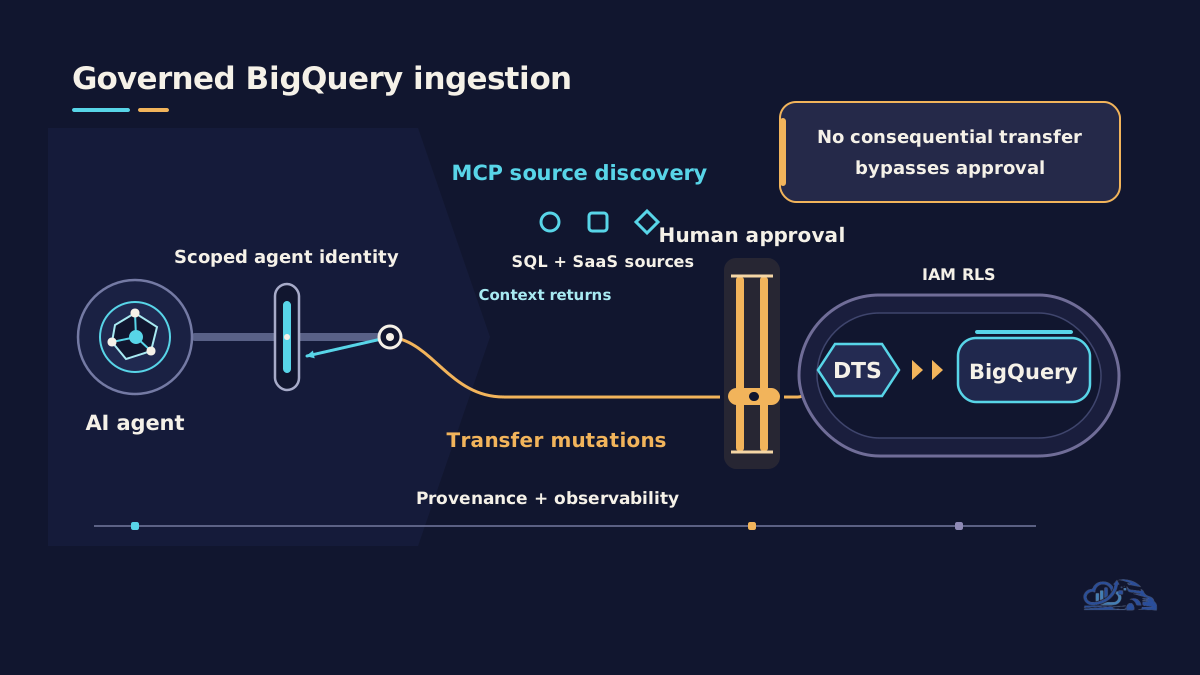
A review gate makes BigQuery Data Transfer Service safer because every recommendation can be checked against the source material. Reviewers should approve, reject, edit, and label decisions so future improvements have evidence instead of opinions.
| MCP action | Operational risk | Recommended default gate | Evidence required |
|---|---|---|---|
list_data_sources, get_data_source, list_transfer_configs, list_transfer_runs, list_transfer_logs | Read-only discovery may expose metadata | Permit only through a scoped read identity | Caller identity, project, location, tool input, and returned resource IDs |
create_transfer_config | Creates a new ingestion path and credential relationship | Human approval until the connector and destination are validated | Full configuration preview, source authorization, dataset location, schedule, cost owner, and recovery plan |
update_transfer_config | Can change destination, parameters, schedule, or runtime identity | Human approval with a field-level diff | Before-and-after configuration, reason, approver, and rollback value |
start_manual_transfer_runs | Can initiate a transfer or historical backfill | Separate approval for each run or approved date range | Transfer ID, requested scope, duplicate check, estimated operational impact, and recovery owner |
delete_transfer_config, delete_transfer_run | Removes configuration or run records | Deny by default; use an explicit break-glass process | Named owner, impact review, retained evidence, and recovery procedure |
Read-only source discovery can therefore precede mutation access. Creating, updating, backfilling, or deleting should remain behind review until observability and held-out evaluations demonstrate reliable behavior.
Improve the Draft With Deterministic Checks
Automated improvement for BigQuery Data Transfer Service should start with deterministic checks such as duplicate phrasing, weak metadata, missing links, thin sections, and keyword stuffing risk. These checks keep the pipeline consistent across topics.
Apply deterministic controls to both the article and the agent workflow:
- Reject duplicate or near-duplicate paragraphs.
- Flag metadata, headings, internal links, external evidence, or practical examples that are missing.
- Validate every MCP request against the published JSON schema.
- Allow only discovered
dataSourcevalues and approved projects, locations, datasets, buckets, and table patterns. - Reject a transfer configuration when its location differs from the destination dataset.
- Require
check_valid_credsor an approved service-account path before configuration creation. - Require a manual schedule during the pilot unless another schedule type has been explicitly approved.
- Block future-dated backfills, unbounded date ranges, unexpected write dispositions, and duplicate transfer requests.
- Keep deletion tools outside the routine agent toolset.
- Verify that every response is logged with the agent identity, tool name, input, output, transfer ID, approval state, and recovery route.
Measure the Pipeline Like a Product
Teams should measure BigQuery Data Transfer Service with accuracy, cycle time, review effort, escalation rate, and publishing readiness. The best metrics show whether the workflow is safer, faster, and more useful after every pass.
Benchmark DTS and custom ETL with identical source data, destinations, failure cases, and acceptance rules. Do not publish a performance percentage unless the cited material or a controlled pilot supports it.
| Performance metric | Calculation | Decision use |
|---|---|---|
| Source-to-usable latency | destination queryable time − source ready time | Compare median and tail freshness for DTS and custom ETL |
| Transfer execution latency | transfer end time − transfer start time | Separate connector execution time from upstream source delay |
| Latency reduction vs. custom ETL | ((custom ETL p95 latency − DTS p95 latency) / custom ETL p95 latency) × 100 | Report the measured percentage; a positive result means DTS was faster for the tested workload |
| Accepted-output cost | (connector + compute + model + storage + network + retry + review + recovery cost) / accepted outputs | Prevent a low direct connector fee from hiding review or recovery work |
| Cost savings vs. custom ETL | ((custom ETL total cost − DTS total cost) / custom ETL total cost) × 100 | Quantify savings only after applying the same acceptance rules |
| Maintenance reduction | ((custom ETL maintenance hours − DTS maintenance hours) / custom ETL maintenance hours) × 100 | Measure whether managed ingestion actually reduces operational labor |
| Retry rate | retried runs / total runs | Identify unstable sources, credentials, schedules, or schemas |
| Escalation rate | human-escalated actions / total agent actions | Calibrate approval policies and agent autonomy |
| Mean recovery time | total time to restore accepted output / incidents | Compare failure recovery, not only successful runs |
| Reviewer effort | reviewer minutes / accepted workflow result | Include human oversight in the operating budget |
| Policy compliance | approved actions with complete policy evidence / approved actions | Verify identity, approval, lineage, and recovery coverage |
| Review question | Evidence to collect | Delivery rule |
|---|---|---|
| Does BigQuery Data Transfer Service answer the search intent? | SERP notes, reader task, and draft outline | Revise before export when intent is unclear |
| Are claims safe to publish? | Source links, reviewer notes, and unsupported-claim checks | Hold exact claims until evidence is attached |
| Is the article ready for handoff? | SEO, AEO, GEO, visual, schema, and internal-link audit results | Deliver only when blocking gates pass |
Deliver the Report With Evidence
The final report for BigQuery Data Transfer Service should show what was researched, what was validated, what review issues remain, and which artifacts are ready for handoff. A clear report helps stakeholders trust the result without rereading every intermediate file.
For related implementation context, see batch vs streaming.
| Delivery artifact | Evidence included |
|---|---|
| Decision record | Source system, expected reader, business goal, supported decision, and managed-versus-custom recommendation |
| Transfer manifest | Project, location, data source, destination, parameters, schedule, notifications, and runtime identity |
| Access map | Agent identity, transfer identity, IAM permissions, source authorization, and dataset controls |
| Review log | Proposed action, approval decision, reviewer, timestamp, edits, and unresolved findings |
| Run evidence | Transfer configuration ID, run IDs, state, freshness, retries, errors, and recovery actions |
| Benchmark scorecard | DTS and custom ETL latency, accepted-output cost, reviewer effort, recovery time, and policy compliance |
| Handoff runbook | Owner, next action, approval rule, failure route, rollback step, and escalation contact |
| Content report | SEO, AEO, GEO, visual, schema, internal-link, source, and unsupported-claim checks |
Common Mistakes to Avoid
The most common mistake with BigQuery Data Transfer Service is skipping validation because the draft sounds fluent. A second mistake is optimizing only for keyword placement while ignoring user intent, proof, examples, and conversion goals.
Other avoidable mistakes include:
- Assuming every managed connector is available through every MCP tool without runtime discovery.
- Giving the agent mutation and deletion permissions when it only needs source and run discovery.
- Using a human’s broad credentials instead of a dedicated agent identity and scoped transfer identity.
- Creating a transfer before checking source credentials, required parameters, and destination location.
- Enabling automatic scheduling before a manual pilot has proved duplicate prevention and recovery.
- Allowing an agent to start an unreviewed backfill.
- Monitoring only successful completion while ignoring freshness, schema drift, retries, partial writes, cost, and SLA performance.
- Claiming latency reduction or cost savings without an identical-workload benchmark.
- Treating a fluent model response as evidence that the underlying transfer succeeded.
How Van Data Team Makes This Operational
At Van Data Team, we turn BigQuery Data Transfer Service decisions into an operating workflow. We first map every handoff: source systems, owners, transfer triggers, destination tables, approval points, dashboards, failure routes, and recovery steps. This exposes where custom ETL provides necessary logic and where it’s only brittle glue.
The result is a scoped delivery plan, not a platform recommendation in disguise. It defines signals for freshness, lineage, schema drift, retry, backfill, cost, and SLA. It also identifies monitoring and ownership gaps, then assigns each transfer path to managed DTS, custom ETL, or a hybrid design. We set least-privilege IAM boundaries and decide which MCP-initiated actions require human approval.
Agent-callable ingestion is introduced in stages. Read-only source discovery can come first. Creating, changing, or backfilling transfers stays behind a review gate until observability and held-out evaluations show reliable behavior. Every agent action needs an attributable identity, logged inputs, recorded outcomes, and a recovery path. The team leaves with a dashboard showing what needs attention and a runbook naming the next action, owner, approval rule, and rollback step.
Operational Budget
Before production rollout, compare managed BigQuery Data Transfer Service, custom ETL, and any MCP-driven agent path with the same workload. Include routine loads, schema drift, backfill, permission failures, partial writes, and source outages. Vendor token pricing is only the starting point. The useful metric is cost per approved workflow result: total connector, compute, model, storage, network, retry, review, and recovery costs divided by accepted outputs.
Score each candidate on:
- Accepted-output cost, including failed and rejected runs.
- End-to-end latency and token budget where models participate.
- Retry rate, reviewer minutes, and the time and cost required for safe failure recovery.
- Held-out evaluation results for correctness, completeness, freshness, policy compliance, and duplicate prevention.
Use identical acceptance rules for every option. A cheap agent call becomes expensive when it retries, creates cleanup work, or consumes reviewer time. A managed connector may justify a higher direct fee if it reduces operational labor and improves recovery.
Van Data Team recommends funding a limited pilot across several complete transfer cycles. Set production gates for quality, security, recovery, and budget. Approve rollout only when a candidate clears every gate together.
Tooling And Landscape Fit
BigQuery Data Transfer Service fits best when a supported connector can move data into BigQuery with limited transformation. It replaces connector maintenance, retry code, credential handling, and scheduling. Custom ETL or ELT remains stronger for unsupported sources, complex transformations, strict portability, unusual backfills, or specialized freshness and cost requirements.
DTS also complements orchestration tools. Airflow or Dagster can coordinate wider workflows while DTS handles ingestion. The Model Context Protocol (MCP) is an interoperability layer, not an agent framework. Native function calling suits narrow, controlled actions. LangGraph adds stateful workflows and approval gates. LangChain or CrewAI can coordinate multiple tools or agents, but their extra abstraction needs a clear purpose.
Google reports that its remote MCP Server lets agents discover sources and execute transfers. Van Data Team recommends treating that capability as a governed control surface, especially while its DTS support remains in Preview. Use scoped IAM identities, Row-Level Security, Column-Level Security, and customer-managed encryption keys. Require human approval for consequential transfers. Record every agent action and preserve lineage. Monitor freshness, schema drift, retry behavior, backfill scope, cost, and SLA performance. Run held-out evaluations against permission errors and destructive requests before granting greater autonomy.
Enable the service and establish Application Default Credentials:
gcloud services enable bigquerydatatransfer.googleapis.com \
  --project=PROJECT_ID

gcloud auth application-default login
For a Gemini CLI-style HTTP client, adapt the following configuration using the Google Cloud MCP client guidance:
{
  "name": "bigquery-dts",
  "version": "1.0.0",
  "mcpServers": {
    "bigquery-dts": {
      "httpUrl": "https://bigquerydatatransfer.googleapis.com/mcp",
      "authProviderType": "google_credentials",
      "oauth": {
        "scopes": [
          "https://www.googleapis.com/auth/cloud-platform"
        ]
      },
      "timeout": 30000,
      "headers": {
        "x-goog-user-project": "PROJECT_ID"
      }
    }
  }
}
Grant the agent roles/mcp.toolUser and only the underlying permissions required for its approved toolset. A discovery-only agent can use bigquery.transfers.get; creating, updating, deleting, or manually starting transfers requires consequential permissions such as bigquery.transfers.update and should remain gated.
Use a read-only discovery call before constructing any transfer:
ACCESS_TOKEN="$(gcloud auth application-default print-access-token)"

curl --location "https://bigquerydatatransfer.googleapis.com/mcp" \
  --header "Authorization: Bearer ${ACCESS_TOKEN}" \
  --header "x-goog-user-project: PROJECT_ID" \
  --header "content-type: application/json" \
  --header "accept: application/json, text/event-stream" \
  --data '{
    "jsonrpc": "2.0",
    "id": 1,
    "method": "tools/call",
    "params": {
      "name": "list_data_sources",
      "arguments": {
        "projectId": "PROJECT_ID"
      }
    }
  }'
After discovery, credential validation, and human approval, an agent can prepare a manual Cloud Storage transfer configuration. This example uses the published create_transfer_config tool schema and deliberately prevents automatic execution:
curl --location "https://bigquerydatatransfer.googleapis.com/mcp" \
  --header "Authorization: Bearer ${ACCESS_TOKEN}" \
  --header "x-goog-user-project: PROJECT_ID" \
  --header "content-type: application/json" \
  --header "accept: application/json, text/event-stream" \
  --data '{
    "jsonrpc": "2.0",
    "id": 1,
    "method": "tools/call",
    "params": {
      "name": "create_transfer_config",
      "arguments": {
        "dataSource": "GOOGLE_CLOUD_STORAGE",
        "projectId": "PROJECT_ID",
        "location": "LOCATION",
        "displayName": "Approved Cloud Storage ingestion",
        "destinationDatasetId": "DESTINATION_DATASET_ID",
        "params": {
          "data_path_template": "gs://BUCKET/PREFIX/*.csv",
          "destination_table_name_template": "DESTINATION_TABLE",
          "file_format": "CSV",
          "write_disposition": "APPEND"
        },
        "scheduleOptions": {
          "manualSchedule": {}
        },
        "notificationPubsubTopic": "projects/PROJECT_ID/topics/DTS_RUNS",
        "emailPreferences": {
          "enableFailureEmail": true
        },
        "serviceAccountName": "DTS_SERVICE_ACCOUNT"
      }
    }
  }'
Review the returned transfer configuration ID, source path, destination, runtime identity, write disposition, and notification route before permitting a separate start_manual_transfer_runs call.
Decision Matrix: BigQuery Data Transfer Service vs. Custom ETL
| Decision factor | BigQuery Data Transfer Service | Custom ETL or ELT | Selection rule |
|---|---|---|---|
| Source support | Strong when a managed connector supports the source | Can integrate unsupported or proprietary sources | Choose DTS only after runtime source discovery confirms support |
| Transformation complexity | Best for limited transformation during ingestion | Stronger for complex business logic, enrichment, and multi-stage transformation | Keep complex logic in custom processing or use a hybrid design |
| Infrastructure ownership | Google manages the transfer service and connector infrastructure | The team builds and operates compute, dependencies, deployment, and scaling | Prefer DTS when custom infrastructure adds no differentiated value |
| Connector maintenance | Managed connector behavior reduces custom API and retry code | The team owns API changes, pagination, rate limits, and connector fixes | Use custom ETL when control outweighs maintenance burden |
| Scheduling and retries | Managed scheduling, transfer runs, backfills, logs, and notifications | Scheduling, retries, idempotency, and recovery must be implemented or assembled | Prefer DTS for standard repeatable loads |
| Credentials | Supports managed authorization patterns and approved service accounts where available | The team designs credential storage, rotation, impersonation, and source access | Compare the complete credential lifecycle |
| Agent interaction | Managed remote MCP endpoint with defined discovery and transfer tools | Requires a custom API, function tool, or MCP server | Prefer DTS when the managed tool surface covers the required action |
| Approval controls | MCP tools can be divided into discovery, mutation, backfill, and deletion gates | Custom workflows can implement any approval model but must maintain it | Use least privilege and human approval in either design |
| Governance | Integrates with IAM, Row-Level Security, Column-Level Security, customer-managed encryption keys, and BigQuery controls | Equivalent controls must be designed across every custom component | Select the option with demonstrable policy coverage |
| Observability | Transfer configurations, run state, logs, notifications, freshness, retries, and cost can be monitored | The team defines and maintains logs, metrics, lineage, dashboards, and alerts | Compare evidence completeness, not dashboard appearance |
| Portability | Optimized for ingestion into BigQuery | Greater freedom to target multiple warehouses or clouds | Prefer custom ETL when strict portability is a requirement |
| Freshness and unusual backfills | Suitable when connector schedules and backfill behavior meet the workload | Can be optimized for specialized freshness or historical loading | Benchmark the exact source and recovery case |
| Performance | Source- and workload-dependent; measure source-to-usable and execution latency | Can be tuned for specialized paths but adds engineering ownership | Compare p50 and p95 latency with identical workloads |
| Total cost | Includes connector, BigQuery, model, retry, review, and recovery costs | Includes engineering, infrastructure, orchestration, maintenance, model, retry, review, and recovery costs | Calculate accepted-output cost and measured cost savings |
| Wider orchestration | Airflow or Dagster can coordinate workflows while DTS handles ingestion | Custom ETL can run directly inside the orchestrator | Use a hybrid design when ingestion is standard but downstream logic is complex |
| Best fit | Supported connector, limited transformation, governed BigQuery destination | Unsupported source, complex logic, strict portability, or specialized performance requirements | Approve the option that clears quality, security, recovery, and budget gates together |
Conclusion
BigQuery Data Transfer Service is most effective when it is managed as a complete pipeline instead of a loose set of prompts. Research clarifies intent, validation finds measurable gaps, review protects quality, improvement fixes repeatable issues, and the final report gives the team a clear delivery record.
For related implementation context, see AI agent ops playbook.
For agentic ingestion, that discipline means discovering source support, constraining MCP tools, requiring approval for consequential actions, preserving observability and lineage, and comparing measured latency and accepted-output cost against custom ETL before production rollout.
Article FAQ
Questions readers usually ask next.
These short answers clarify the practical follow-up questions that often come after the main article.
Need a similar system?
If this article maps to a workflow your team already operates, the next step is usually a scoped review of the system, constraints, and rollout path.
Book your free workflow review here.
Related articles
View all
The iPhone Duo: Apple's First Foldable iPhone
OpenAI's Navier-Stokes AI Agent Swarm: What It Shows
Serverless Voice Agents on AWS: A Production Guide