May 27, 2026
Customer onboarding journey for B2B SaaS Framework
Learn how to evaluate Customer Onboarding Journey For B2B SaaS with practical examples, evidence checks, cost controls, review gates, and rollout criteria.
Article focus
Customer onboarding journey for B2B SaaS examples Customer onboarding journey for B2B SaaS framework Customer onboarding journey for B2B SaaS workflow Customer onboarding journey for B2B SaaS best practices how to use Customer onboarding journey for B2B SaaS what is Customer...
Section guide
- Customer onboarding journey for B2B SaaS examples
- Customer onboarding journey for B2B SaaS framework
- Customer onboarding journey for B2B SaaS workflow
- Customer onboarding journey for B2B SaaS best practices
- how to use Customer onboarding journey for B2B SaaS
- what is Customer onboarding journey for B2B SaaS
- Customer onboarding journey for B2B SaaS implementation
The Customer onboarding journey for B2B SaaS is the operating path a new business account follows from handoff through setup, activation, adoption, retention, and expansion. It should define customer goals, owners, touchpoints, data signals, review checkpoints, and recovery paths so teams can move accounts to measurable value.
Many SaaS teams still treat onboarding as a welcome email, checklist, or product tour. That is too narrow for B2B. A buyer, admin, implementation lead, and end users may all need different steps before the account sees value.
A practical Customer onboarding journey for B2B SaaS connects process design with product analytics, customer success workflows, and reporting. Resources such as Journey Engine's B2B SaaS onboarding guide emphasize the link between onboarding, time-to-value, and long-term retention. This guide turns that idea into a workflow your team can operate, measure, and improve.
If your onboarding data is scattered across CRM notes, spreadsheets, product events, and support tickets, Van Data Team's data platform modernization work - and the broader playbook on data platform modernization for AI readiness - is a useful next step for making the journey visible.
Key Takeaways
- A strong Customer onboarding journey for B2B SaaS separates account onboarding from individual user onboarding, then connects both to the same success criteria.
- The core stages are handoff or signup, kickoff, setup, activation, adoption, retention, and expansion.
- Every stage needs an owner, customer action, internal action, data signal, risk trigger, and next step.
- Numeric onboarding benchmarks should come from your own CRM, product analytics, support, billing, and renewal data, not generic assumptions.
- Automation helps with reminders and visibility, but high-risk accounts still need human review and clear escalation paths.
What Is a Customer onboarding journey for B2B SaaS?
Definition: A Customer onboarding journey for B2B SaaS is the path a new business account and its users follow from first handoff through setup, activation, adoption, and retention. It maps the touchpoints, owners, data signals, and review checkpoints that help customers reach value.
The important word is "journey." A checklist can tell an implementation manager what to do. A product tour can show a user where to click. A journey shows how the whole account moves from purchase or signup to a business outcome.
This is why account onboarding and user onboarding should not be collapsed into one task. WorkOS explains the distinction between onboarding organizations and onboarding users in real-world B2B SaaS. The organization may need security setup, permissions, data import, stakeholder alignment, and reporting. Individual users may need training, contextual prompts, saved workflows, and help content.
| Concept | What it covers | Common owner | Main risk |
|---|---|---|---|
| Customer journey | Full account path from handoff to renewal | Customer success leadership | No shared view of value |
| Onboarding process | Steps used to implement and activate the account | CS, implementation, operations | Checklist completion without adoption |
| User onboarding | How individuals learn and use the product | Product, growth, education | Product activity with weak account value |
A Customer onboarding journey for B2B SaaS guide should therefore answer two questions at once: what must the account accomplish, and what must each user role do to support that outcome?
Why the Journey Matters Beyond Setup
A Customer onboarding journey for B2B SaaS matters because B2B buying and usage are rarely owned by one person. A buyer may approve the contract, an admin may configure the account, a technical lead may connect systems, and frontline users may decide whether the product becomes part of daily work.
When teams only track setup, they can miss the point. An account can complete configuration and still fail to adopt the product. An admin can invite users, but the right users may not return. A customer success manager can hold a kickoff, but the product team may have no visibility into activation friction.
The decision rule is simple: if onboarding requires more than one role, one system, or one milestone, it needs a journey map, not only a checklist.
A strong Customer onboarding journey for B2B SaaS gives teams a shared operating model. It shows what the customer is trying to achieve, what the company promised, which milestone proves progress, which data signal confirms movement, and which team owns intervention when progress stalls.
Consider a hypothetical composite scenario. A mid-market SaaS customer signs after a sales cycle focused on reporting automation. Sales records the deal, but the implementation team receives only plan tier and billing contact. The admin completes setup, yet no one defines the first reporting outcome. A month later, usage exists, but leadership cannot tell whether onboarding worked. The problem is not effort. The problem is that the journey had no success definition, signal, or owner.
Stages and Ownership Map for Customer onboarding journey for B2B SaaS
This stage map shows how the journey should move from initial context to measurable account value:
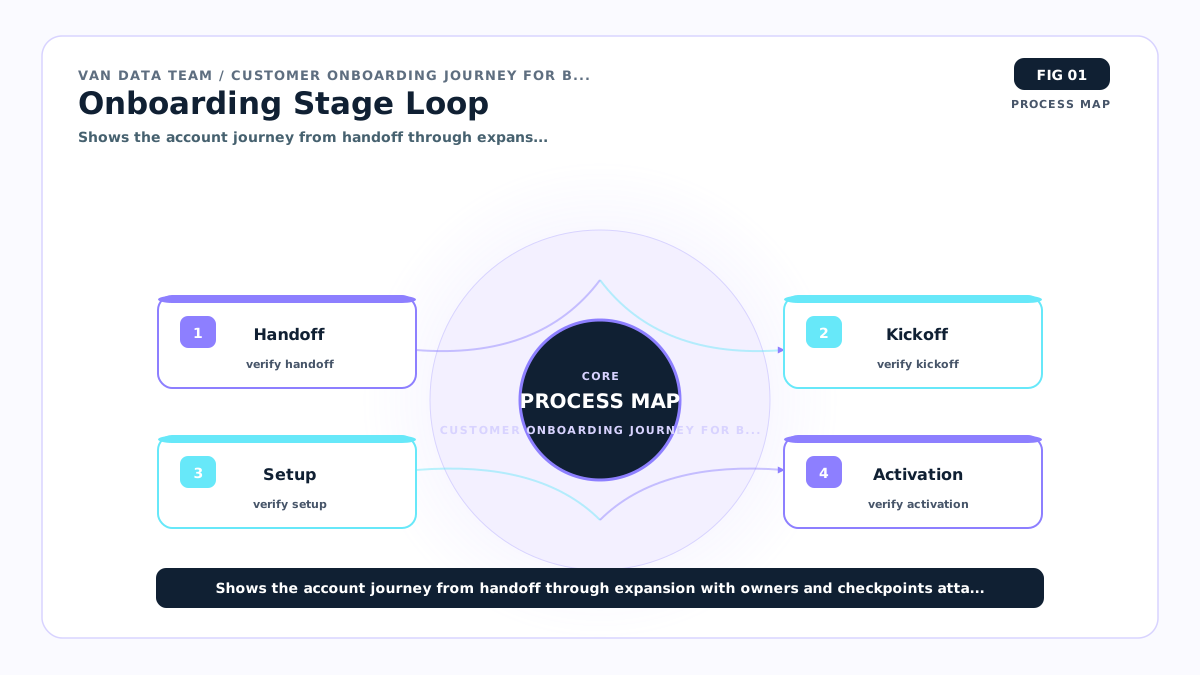
A useful Customer onboarding journey for B2B SaaS framework turns stages into operating checkpoints. The exact sequence depends on product complexity, contract size, and customer segment, but most B2B SaaS teams need the following stages.
| Stage | Customer goal | Internal owner | Key touchpoint | Data signal | Risk |
|---|---|---|---|---|---|
| Handoff or signup | Start with clear context | Sales, growth, or CS | CRM handoff, signup event, welcome email | Customer goals, stakeholders, use case, plan | Missing context |
| Kickoff and success definition | Agree on the outcome | CSM or implementation lead | Kickoff call, shared plan | Success criteria, first milestone, owner list | Vague value target |
| Setup and configuration | Prepare the environment | Implementation, support, product ops | Admin setup, integration, import, permissions | Required setup completion | Technical delay |
| Activation | Reach first meaningful value | CS and product | Guided workflow, training, in-product prompt | First value event | Activity without value |
| Adoption | Build repeated use | CS, product, education | Usage review, enablement, support | Role-based usage, repeat workflows | Wrong users engaged |
| Retention and expansion | Confirm value and find growth paths | CS leadership, account team | Business review, health review | Renewal signals, stakeholder engagement | Late risk detection |
A stage map should be practical enough to use in weekly review. If a stage has no owner, it will be forgotten. If it has no data signal, it will be debated. If it has no escalation path, stalled accounts will wait for the next meeting.
This is also where UXPressia's SaaS customer journey discussion is useful context: the journey should cover more than onboarding touchpoints. It should show the broader path from early experience to retention.
How to Build a Customer onboarding journey for B2B SaaS Workflow
The workflow becomes measurable when source systems feed a shared onboarding signal layer:
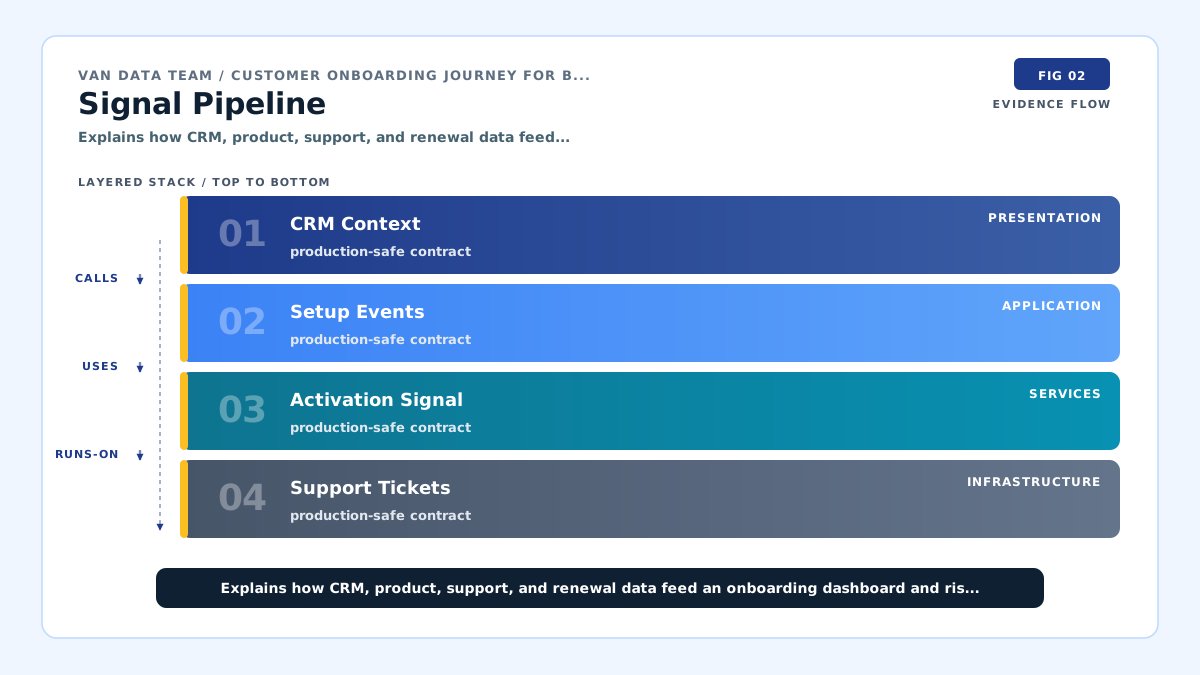
Customer onboarding journey for B2B SaaS implementation starts with the current reality, not the ideal process. Map what actually happens today: sales promises, signup events, kickoff calls, setup tasks, support tickets, training sessions, product usage, health reviews, and renewal conversations.
Then segment carefully. Enterprise, mid-market, and self-serve accounts may need different levels of human support, but do not invent segment rules without data. Start with a small number of journey paths and refine them as patterns become visible.
Use this workflow as a practical artifact:
flowchart LR
A[Handoff or signup] --> B[Kickoff and success definition]
B --> C[Setup and configuration]
C --> D[Activation milestone]
D --> E[Adoption review]
E --> F[Retention and expansion review]

A --> G[(CRM and signup data)]
C --> H[(Product and integration events)]
D --> I[(Activation signal)]
E --> J[(Usage and support signals)]
F --> K[(Health and renewal reporting)]

G --> L[Onboarding dashboard]
H --> L
I --> L
J --> L
K --> L

L --> M{Risk detected?}
M -->|Yes| N[Owner review and recovery action]
M -->|No| O[Continue planned journey]
N --> E
A Customer onboarding journey for B2B SaaS workflow should include six steps:
- Map every touchpoint from first handoff to fully adopted.
- Define success criteria by customer segment and use case.
- Assign owners for each stage, not only each task.
- Instrument setup, activation, adoption, support, and retention events.
- Create review checkpoints for stalled accounts and missing data.
- Use the findings to improve emails, product guidance, help content, and CS playbooks.
Data availability determines what can be automated. If setup completion is not tracked, reminders will be weak. If activation events are unclear, dashboards will create false confidence. For workflow automation across many data sources, see Van Data Team's cloud-native orchestration case study.
Best Practices That Make Onboarding Measurable
Customer onboarding journey for B2B SaaS best practices are less about adding more steps and more about making each step observable, owned, and recoverable.
| Best practice | Why it matters | Implementation note | Review checkpoint |
|---|---|---|---|
| Start with the customer's target outcome | Product setup is not the same as business value | Capture the first measurable outcome during handoff or kickoff | Can the team explain the customer's first value milestone? |
| Separate account and user onboarding | B2B customers have multiple roles and responsibilities | Map buyer, admin, technical lead, and end-user needs | Are the right roles active at the right stage? |
| Define one primary activation milestone | Too many milestones dilute focus | Choose the event that best represents first meaningful value | Did activation happen or only setup? |
| Connect templates to owners | Templates without ownership become documentation | Assign a team and escalation path to each stage | Who acts when the task is late? |
| Keep human review for high-risk accounts | Automation cannot resolve unclear goals or stakeholder conflict alone | Use alerts to focus human attention | Which stalled accounts need review this week? |
| Treat failures as process signals | Blaming the customer hides fixable system issues | Review incomplete handoffs, missing events, and repeated tickets | What changed in the process after the failure? |
A Customer onboarding journey for B2B SaaS framework should also include cost and complexity controls. Track only the signals your team will use. Extra events, dashboards, and reminders create review burden if no one acts on them.
For teams that need one source of truth, Van Data Team's enterprise data warehouse and analytics platform work shows how KPI automation and reporting reliability can support operational decision-making.
Examples and Patterns You Can Adapt
These Customer onboarding journey for B2B SaaS examples are role-based patterns, not universal templates.
Admin-led onboarding works when a customer admin can configure the account, invite users, assign permissions, and coordinate the first team workflow. The risk is that the admin completes setup while end users never build habits.
Implementation-led onboarding fits products that need integrations, data imports, workflow design, or custom reporting. The internal implementation lead owns readiness, but CS should still own success criteria and adoption follow-up.
Product-led onboarding uses in-product guidance, checklists, lifecycle emails, and timely prompts to help users reach value. Arrows' onboarding 101 guide is a useful reference for teams thinking about structured customer-facing onboarding plans. The risk is assuming product activity equals account success.
Hybrid onboarding is often best for complex B2B SaaS. Automation handles repeatable steps, while a human owner reviews high-risk accounts, unclear requirements, or low adoption signals.
Here is another hypothetical composite. A customer signs up for a workflow tool. The admin finishes configuration quickly, but frontline users ignore the product because their daily process still lives in spreadsheets. A hybrid journey catches this by tracking both admin setup and role-based adoption. CS runs a focused enablement session, product adjusts in-app guidance, and the account finally reaches the first repeated workflow.
Failure Modes, Metrics, and Production Operating Criteria
Use this matrix to separate healthy progress from missing data, unclear value, or unowned follow-up:
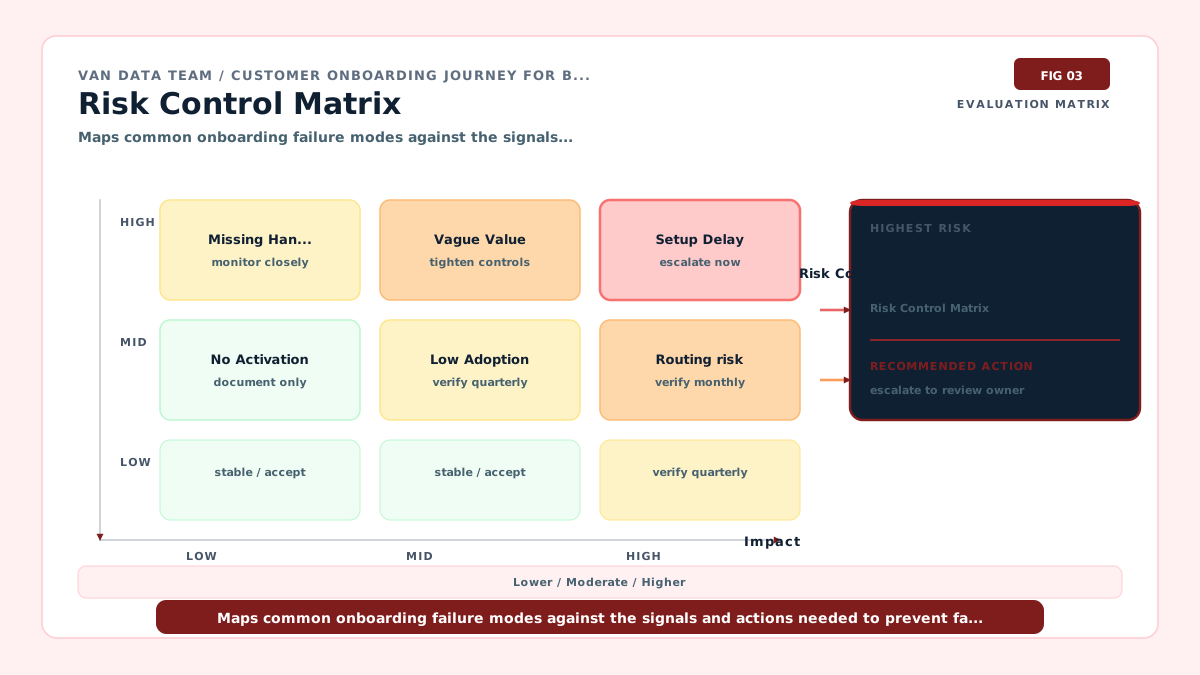
Common B2B SaaS onboarding mistakes include treating onboarding as a one-time setup event, designing only for individual users, relying on product tours without success criteria, failing to define activation, leaving journey events uninstrumented, creating checklists with no owner, reporting activity without adoption context, and automating outreach before the journey is understood.
Use this review checklist when a Customer onboarding journey for B2B SaaS is underperforming:
- Is the handoff complete enough for CS or implementation to act?
- Does every account have a defined first value milestone?
- Are setup, activation, and adoption measured separately?
- Can the team see blockers from support tickets or implementation notes?
- Is there an owner for stalled accounts?
- Are reports connected to retention and renewal conversations?
Metrics should be categories first, numbers second. Do not borrow benchmarks unless they come from a credible source that matches your product and customer segment.
| Metric category | Example signal | System needed | Numeric status |
|---|---|---|---|
| Setup metrics | Required configuration, integration, import, admin task completion | Product analytics, implementation tracker | Unknown. Requires internal onboarding data. |
| Activation metrics | First meaningful action or first value event | Product events, CS notes | Unknown. Requires defined activation event. |
| Adoption metrics | Repeated usage by the right roles | Product analytics by account and user role | Unknown. Requires usage events and role mapping. |
| Support signals | Onboarding tickets, unresolved blockers, repeated confusion | Support platform, ticket taxonomy | Unknown. Requires support data. |
| Retention signals | Health, renewal risk, stakeholder engagement, value confirmation | CRM, billing, CS platform | Unknown. Requires retention data linked to cohorts. |
| Operational signals | Handoff completeness, cycle time, escalation rate, review effort | CRM, workflow system, warehouse | Unknown. Requires process instrumentation. |
Production decisions also need operational criteria. Cost matters because onboarding dashboards and automations can sprawl across tools. Latency matters because a stalled account may need review before the next weekly meeting. Observability matters because every automated reminder should be traceable to an event, source system, and account state.
If AI agents summarize calls, support tickets, or implementation notes, add token budget and review rules. Set token usage as a measurement criterion, log source documents, and require human approval for renewal risk, escalation, or customer-facing claims. Evaluation should check whether summaries match source records and whether recommendations led to useful actions.
Failure recovery is part of the workflow. When data is missing, fall back to human review. When a product event fails, flag the account as measurement incomplete instead of healthy. When automation sends the wrong message, pause that journey branch and inspect the trigger logic.
For analytics transformation and metric definitions, Van Data Team's dbt reporting acceleration work is relevant even outside finance because onboarding teams face the same problem: inconsistent definitions create inconsistent decisions. If infrastructure cost is becoming part of the issue, review ways to cloud cost optimization guardrails for data platforms.
Conclusion: Make Onboarding a Measurable Operating System
A Customer onboarding journey for B2B SaaS is more than a setup plan. It is the operating system that connects customer goals, internal ownership, product behavior, support signals, and renewal readiness.
Start by mapping the real journey. Define the first value milestone. Separate account onboarding from user onboarding. Assign owners, instrument the key events, and create review checkpoints for stalled accounts. Then improve the journey with evidence instead of opinions.
The best Customer onboarding journey for B2B SaaS implementation is practical, measurable, and recoverable. It does not need every possible metric on day one. It needs enough visibility for the team to know where customers are, what value they are trying to reach, and who acts when progress breaks down.
If your team is ready to turn onboarding from scattered activity into a measurable workflow, Van Data Team can help build the data and orchestration layer behind it.
Article FAQ
Questions readers usually ask next.
These short answers clarify the practical follow-up questions that often come after the main article.
Need a similar system?
If this article maps to a workflow your team already operates, the next step is usually a scoped review of the system, constraints, and rollout path.
Book your free workflow review here.
Related articles
View all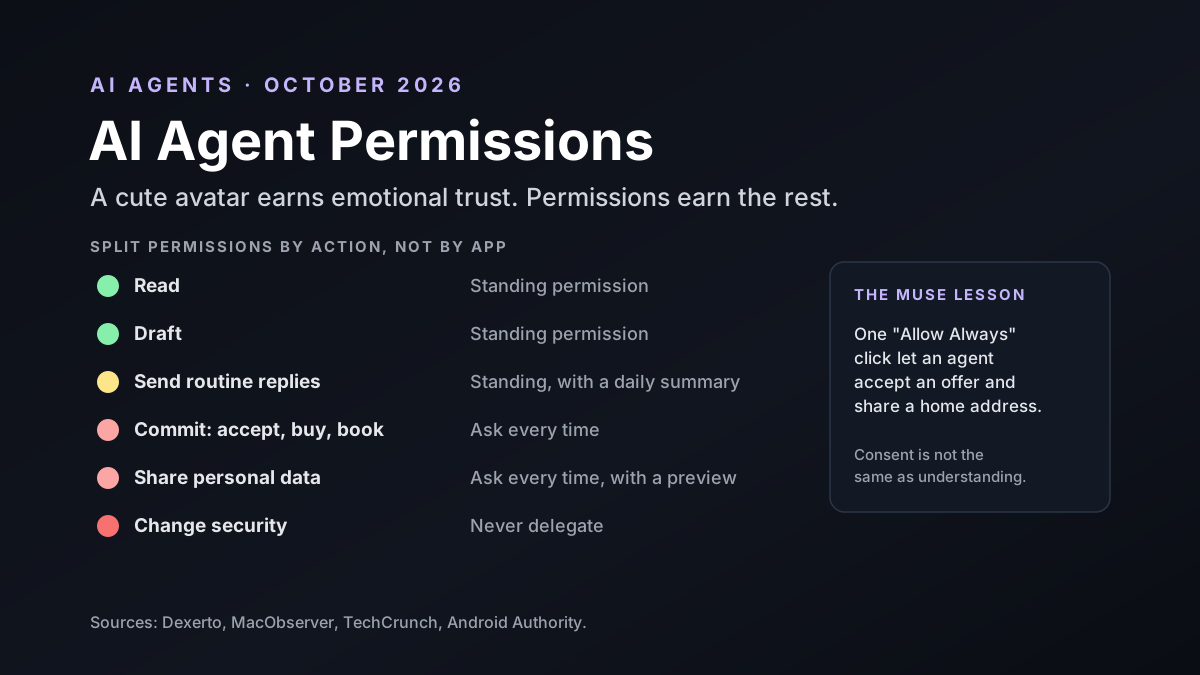
AI Agent Permissions: Lessons From Meta Muse and OpenAI Dots
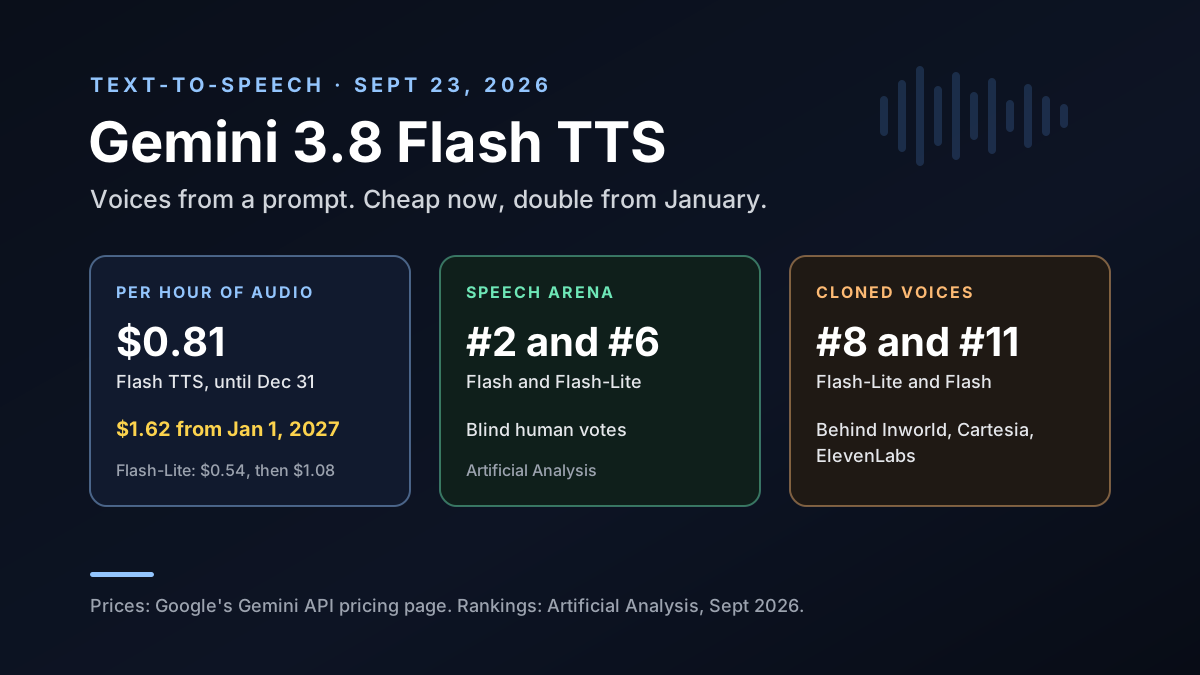
Gemini 3.8 Flash TTS: Price, Rankings and the Fine Print
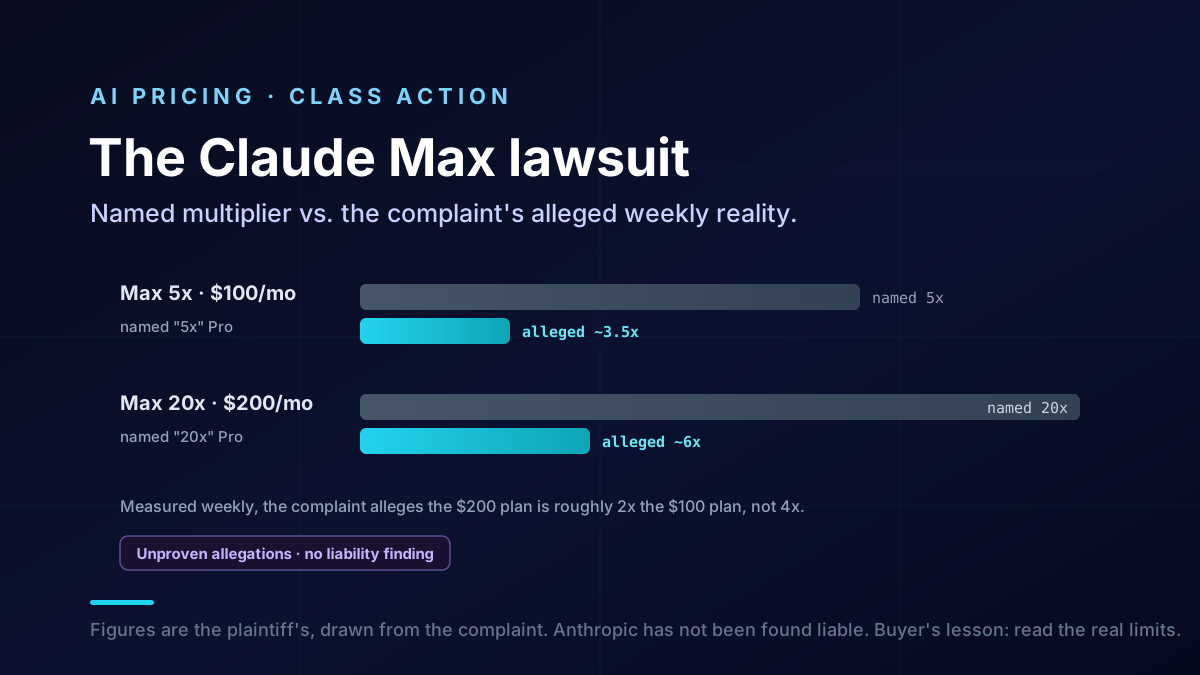
Claude Max Lawsuit: The 5x and 20x Usage Claims