AlphaGenome 2: What Cell-Type DNA Models Mean for Data Teams
AlphaGenome 2 predicts how DNA variants act in single cell types and nearly doubles causal variant recall. What's new, its limits and how data teams test it.
Most genetic variants linked to disease don't change a protein. They sit in the regions that control when and where genes switch on. And they often matter in just one kind of cell.
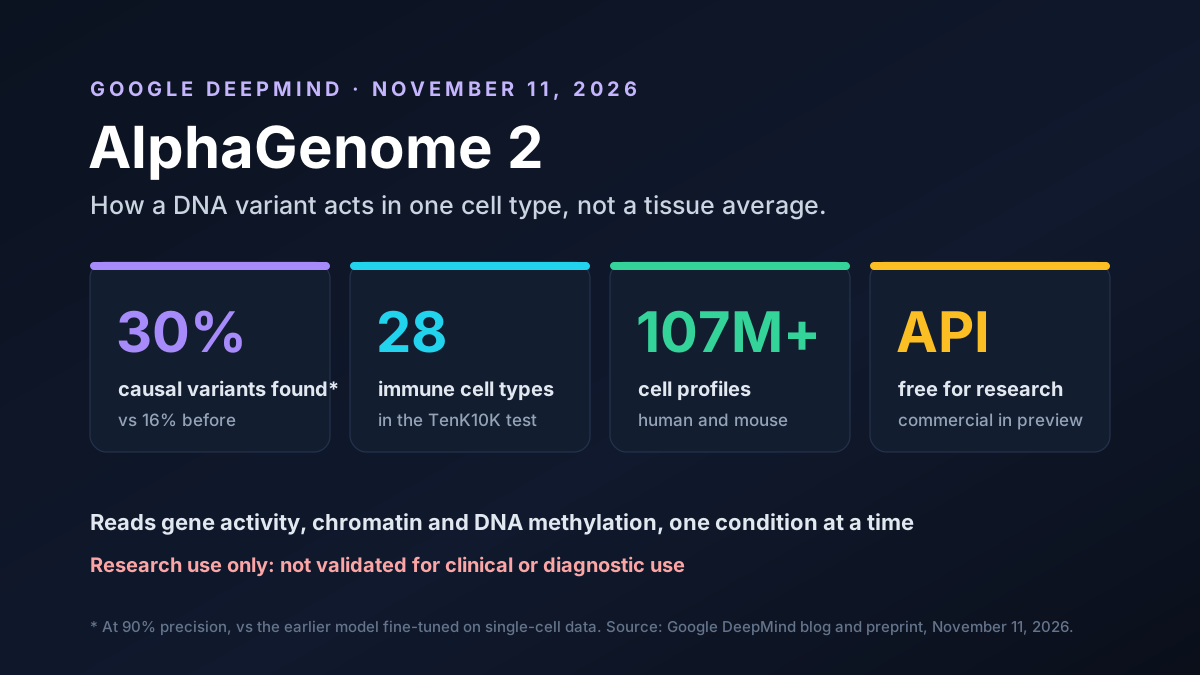
That's the gap AlphaGenome 2 tries to close. Google DeepMind released it on November 11, 2026. It predicts how a DNA variant changes gene activity in a specific cell type or cell state, not across a whole tissue.
DeepMind says it nearly doubles the number of likely causal variants it can find, compared with the earlier model. Here's what's new, how to read the numbers and what biotech data teams should do with it.
Key Takeaways
- It's cell-type specific. AlphaGenome 2 predicts variant effects in one tissue, cell type or state at a time.
- The headline gain is big. On 28 immune cell types, it found 30% of likely causal variants, against 16% for the earlier model.
- It learned from a lot of cells: more than 107 million cell profiles from human and mouse data.
- It's research only. Non-commercial access is through an API, commercial use is in private preview, and it isn't cleared for clinical use.
- It's not a lab replacement. It still finds only a minority of causal variants, so treat it as a way to rank what to test first.
Why Cell Types Matter in Genetics
Your body has hundreds of cell types. They all carry the same DNA, but each one reads it in its own way. A liver cell turns on liver genes. An immune cell turns on immune genes.
So a small change in DNA can matter a lot in one cell and not at all in another. If you only look at a whole tissue, that effect gets lost in the average. It's like listening for one voice in a crowd.
That's why cell-type detail is such a big deal. It tells you not just which variant matters, but where. And "where" is often the clue that points a research team toward a drug target, a cell to study or a test worth running first.
Key Terms in Plain Words
A few terms come up a lot in this story. Here's what they mean:
- Variant: a spot where one person's DNA differs from another's.
- Cell type: a kind of cell.
- Cell state: what a cell is doing now, such as resting or fighting an infection.
- Gene expression: how strongly a gene is switched on.
- Recall at 90% precision: of all the true hits, the share a tool finds while staying right nine times out of ten.
With those in mind, the numbers below are much easier to read.
AlphaGenome 2 at a Glance
Here are the core facts, as of November 13, 2026:
| Item | What's public |
|---|---|
| Released | November 11, 2026, by Google DeepMind |
| What it predicts | How DNA variants change gene activity in one tissue, cell type or state |
| Readouts | Gene expression, chromatin, histone marks and DNA methylation |
| Training data | More than 107 million cell profiles, human and mouse |
| Headline result | 30% vs 16% causal variant recall on 28 immune cell types |
| Access | API for non-commercial research; commercial in private preview |
| Clinical use | Not validated or approved |
What DeepMind Released on November 11
The announcement, from Adam Gayoso, Natasha Latysheva, Pushmeet Kohli and Žiga Avsec, describes AlphaGenome 2 as a conditional model. You give it about a million letters of DNA and name a condition. It predicts what happens in that condition.
The outputs cover the main layers of gene control:
- Gene expression, or how much a gene is switched on.
- Chromatin access, or how open a DNA region is.
- Histone marks that tag active or silent regions.
- DNA methylation, a readout DeepMind says users often asked for.
One feature stands out for data teams. Given one kind of measurement, such as single-cell gene activity, AlphaGenome 2 can predict the ones you didn't measure, such as chromatin access. That can stretch a limited budget for lab assays.
How AlphaGenome 2 Differs From the First AlphaGenome
The original AlphaGenome launched in June 2025, and its paper appeared in Nature in January 2026. Roughly 3,000 scientists in 160 countries had tried it by then, Singularity Hub reported.
Here's how the two compare:
| Feature | AlphaGenome | AlphaGenome 2 |
|---|---|---|
| Launched | June 2025; Nature paper January 2026 | November 11, 2026 |
| How it predicts | Many tissues in parallel | One chosen condition at a time |
| Level of detail | Close to tissue averages | Tissue, cell type or cell state |
| DNA methylation | No | Yes |
| New single-cell data | Needs fine-tuning | Adapts without retraining |
The key shift is the conditioning. The first model predicted a fixed set of tissues in parallel. For a variant that only matters in, say, one kind of immune cell, that signal could be diluted.
AlphaGenome 2 asks a sharper question. What does this variant do in this cell, in this state? That's closer to how biologists think about disease.
AlphaGenome 2 Benchmarks: The Numbers
DeepMind's main test uses TenK10K, a dataset that links genetic variants to gene activity across 28 primary immune cell types. Here are the reported results, from the technical paper:
| Benchmark | AlphaGenome 2 | Earlier best |
|---|---|---|
| Causal variant recall, TenK10K | 30% | 16% |
| Effect direction recall, TenK10K | 43% | 23% |
| Cell-type expression variance explained | 34% | 23% |
| Tissue expression change, GTEx (median r) | 0.71 | 0.61 |
| Enhancer to gene links, ENCODE (AUPRC) | 0.78 | 0.73 |
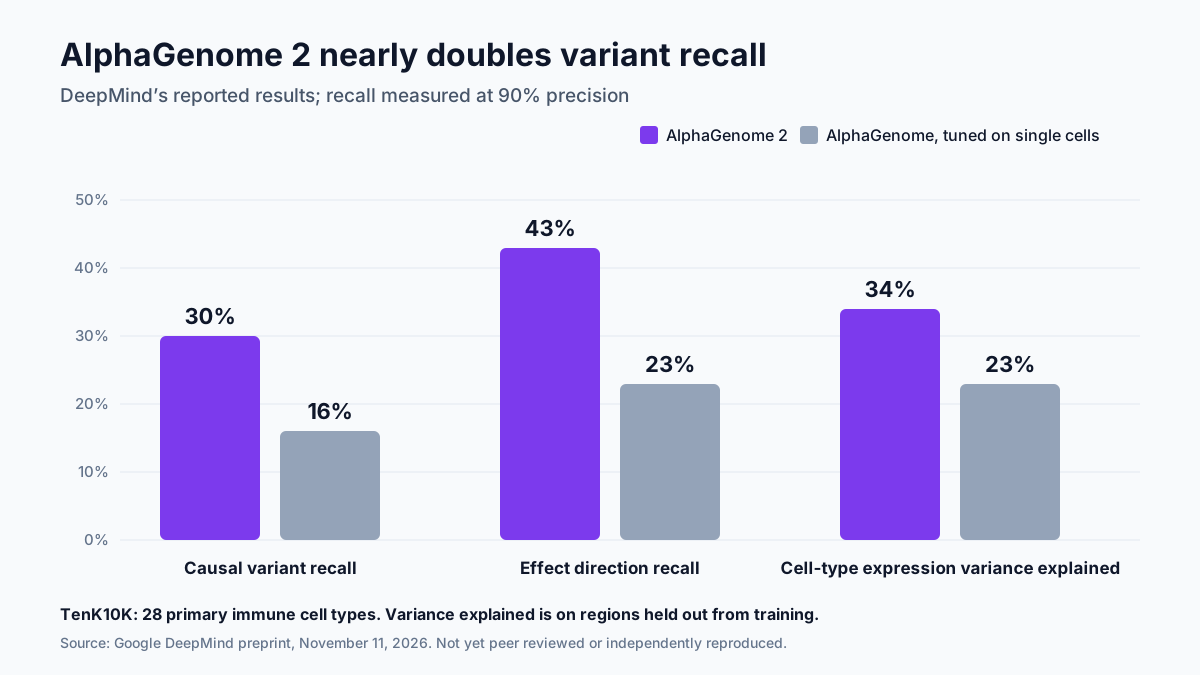
So at 90% precision, AlphaGenome 2 recovered 30% of the causal variants that change gene expression, against 16% for the earlier model fine-tuned on single-cell data. It also got the direction of the effect right for 43%, against 23%. On regions it hadn't seen in training, it explained 34% of cell-type expression variance, against 23%.
Two cautions apply. First, these are DeepMind's own numbers from a preprint, not yet peer reviewed. Second, 30% recall means it still misses most causal variants. The gain is real, but the ceiling is far away.
The IBD Example: A Lab Finding, Reproduced on a Computer
The most striking demo involves inflammatory bowel disease. In 2024, a study in Nature traced one IBD risk signal to a distant DNA switch that turns up a gene called ETS2 in gut immune cells. Proving that took careful lab work.
AlphaGenome 2 reached the same answer without new experiments. From a set of seven candidate variants, it flagged one, rs2836882. It linked it to ETS2 about 290,000 letters away, and placed the effect in gut monocytes and macrophages, per Unite.AI's summary of the paper.
It's a reproduction of known biology, not a new discovery. Still, it shows how the model could save months by pointing a lab at the right variant and the right cell type first.
DeepMind also showed a COVID-19 case. Given new single-cell data from a vaccine study, the model told apart activated and resting T cells. It predicted a stronger effect for a severe-COVID variant in the activated state.
What AlphaGenome 2 Still Gets Wrong
The paper is candid about limits. These matter if you plan to use the model in real work:
- Low recall: it recovers only a minority of likely causal variants.
- Distant effects: it can miss variants far from genes or in closed DNA.
- Thin data for some states: short-lived and disease states are rare in the training data.
- Fine cell types: similar neurons blur.
- Correlation, not cause: its view of each condition comes from observed data.
It also costs more to run per question. Because it predicts one condition at a time, scoring many cell types means many calls.
Who Can Use AlphaGenome 2
Access depends on who you are, per DeepMind and the AlphaGenome docs:
| Who | Access | Notes |
|---|---|---|
| Non-commercial researchers | AlphaGenome API and Colab tutorials | Free per the docs; rates vary with demand |
| Commercial research teams | Private preview | Contact DeepMind |
| Google Antigravity users | AlphaGenome 2 Skills | Coming soon |
| Community projects | Extra quota and credits | Submissions due November 30 |
| Clinics and diagnostics | Not allowed | Not validated for clinical use |
Prices and quota figures for commercial access haven't been published. DeepMind also offers precomputed data: enhancer to gene links across 640 reference conditions, and variant scores for more than 6.8 million variants across 510 conditions, per Data Studios.
AlphaGenome 2 for Data Teams
For a biotech or pharma data team, AlphaGenome 2 is less a product than a new pipeline stage. It sits between genetic studies and lab work.
A typical flow starts with inputs:
- Candidates: variants from a genetic study, grouped in small sets
- Conditions: the cell types and states that matter for your disease
Then the model does its part, and your team takes over:
- Score in batches: each variant in each condition, through the API
- Store and join: keep results next to your own gene and lab data
- Rank and review: send the top picks to biologists for testing
Steps 3 and 4 are where data work piles up. Fast. A few thousand variants across a few dozen cell types becomes tens of thousands of API calls. You need retries, rate limits, caching and a clear record of which model version produced which score.
That last point matters most. If you can't trace a ranking back to a model version and input, you can't defend a lab decision built on it.
What to Prepare Before You Call the API
A little prep saves a lot of rework. Before your first batch, line up these basics:
- Clean variant IDs in one format, with the genome build noted.
- A list of conditions written the way the API expects them.
- A storage plan for scores, inputs and model versions.
- A budget for calls, since each variant and cell pair is one request.
- A privacy check on any data tied to real patients.
None of this is hard. But teams that skip it often end up with scores they can't trace or compare later.
How to Test AlphaGenome 2 on Your Own Data
Don't trust a benchmark you didn't run. Here's a simple way to check whether AlphaGenome 2 helps. First, set up a fair test:
- Build a truth set: variants with known effects from your past lab work
- Score them blind: run AlphaGenome 2 and your current tools on the same set
Then compare the results:
- Count hits: see how many true variants each tool finds at 90% precision
- Check cell types: see if the top cell type matches what the lab found
- Track cost: note API calls, wait times and staff hours
If AlphaGenome 2 ranks your known hits higher, it can cut the number of variants you send to the lab. If it doesn't, you've learned that cheaply.
Worked Example: Fewer Experiments, Same Hits
Here's our own math with made-up numbers, to show what better recall can mean.
Say a team has 2,000 candidate variants and expects about 100 to be truly causal. At 90% precision, a model with 16% recall finds about 16 of them among roughly 18 flagged variants. A model with 30% recall finds about 30 among roughly 33 flagged.
Now say each lab test costs $5,000. Testing the 33 top picks costs about $165,000 and should confirm around 30 hits. Finding 30 hits with the older model's list would mean digging much deeper into weaker candidates, at a far lower hit rate.
The benchmark numbers won't match your data exactly, because every program has its own diseases, cell types and mix of strong and weak candidates. But this is the shape of the gain: a shorter, better list for the lab.
AlphaGenome 2 vs AlphaFold
People often mix up DeepMind's biology models, so here's a quick guide. AlphaFold predicts the 3D shape of proteins. It helps with the parts of DNA that code for proteins.
AlphaGenome works on the rest. It reads the control regions that decide when, where and how much a gene is used. That's where most disease-linked variants sit.
The two answer different questions. AlphaFold tells you what a protein looks like. AlphaGenome 2 is built for variant effect prediction: what a DNA change does to gene activity, and in which cells. A drug program may need both.
What It Means for Drug Discovery Data
Partners are already lining up. Peter Donnelly, CEO of Genomics Limited, said the firm plans to bring AlphaGenome 2 into its Mystra platform, which links genetic studies to drug programs.
For drug discovery teams, the value is in target picking. A variant that acts in one cell type points to that cell type as the place to intervene. Getting that wrong early can waste years.
It also raises the bar for data infrastructure. Single-cell data, variant scores and lab results need to live in one place, with clean IDs and versions. Teams that already work this way will get value fastest.
Risks and Open Questions
There's still a lot to learn before anyone builds a program on AlphaGenome 2:
- No peer review yet: the main numbers come from DeepMind's preprint.
- No public weights for AlphaGenome 2 so far, so you can't run it in-house.
- Unknown commercial terms: prices, quotas and data terms for companies aren't public.
- Dependence on one vendor: your pipeline would rely on an external API.
- Clinical limits: it isn't approved for diagnosis, and shouldn't be used that way.
Data privacy is the other question. If you send sequences tied to patients, check what the API keeps and where, and talk to your legal and ethics teams first.
What to Watch Next
A few things will show how far this goes:
- Peer review of the AlphaGenome 2 paper.
- Independent tests on new datasets, especially non-immune cells.
- Commercial terms once the private preview opens up.
- AlphaGenome 2 Skills in Google Antigravity, which could let coding agents call the model directly inside research workflows.
- Community projects selected after the November 30 deadline.
For more on DeepMind's recent work, see our post on DeepMind's RSA-1024 findings.
AlphaGenome 2: Our Take
AlphaGenome 2 is a real step toward reading the part of the genome where most disease risk hides. Moving from tissue averages to single cell types is the right direction, and doubling recall on a hard benchmark is meaningful.
But it's a ranking tool, not an answer machine. For most teams, the smart move is a small, honest test on known variants, with clean data plumbing around it. If it shortens your lab list, scale it. If not, you've lost little.
How Van Data Team Helps
We help life science and data teams put models like this to work safely:
- Batch scoring pipelines with retries, caching and version tracking, via data pipeline development.
- Research agents that rank variants and draft lab shortlists for review, through AI agent development.
- Benchmark dashboards that compare models on your own truth sets, through agentic BI reporting.
- Compute and API cost reviews for large scoring jobs, through our cloud cost optimization service.
This article is based on DeepMind's announcement, its preprint and public reporting as of November 13, 2026. It isn't medical advice. Planning a variant scoring pipeline? Get in touch and we'll help you design a first test.
AI Model Brief
The AI models worth knowing, once a week
What shipped, how it scores on independent benchmarks, what it costs per million tokens and what was deprecated, from the data behind our AI model benchmarks.
We use your address only to send the brief. See our privacy policy.
See this week’s brief
Founder of Van Data Team. Builds Vanaxity, the AI agent system for SEO, GEO, and AEO, and leads data engineering delivery for B2B teams.
About the authorArticle FAQ
Questions readers usually ask next.
These short answers clarify the practical follow-up questions that often come after the main article.
Need a similar system?
If this article maps to a workflow your team already operates, the next step is usually a scoped review of the system, constraints, and rollout path.
Consultation
Scope your next AI workflow.
Share the system and blockers. We will map fit, gaps, and the next step.