Gemini 4 Neon vs Gemini 4 Carbon vs Gemini 4 Hydrogen
Gemini 4 Neon vs Gemini 4 Carbon and Hydrogen: prices before and after Carbon doubles on December 1, scores, output limits and which Gemini 4 model to use.
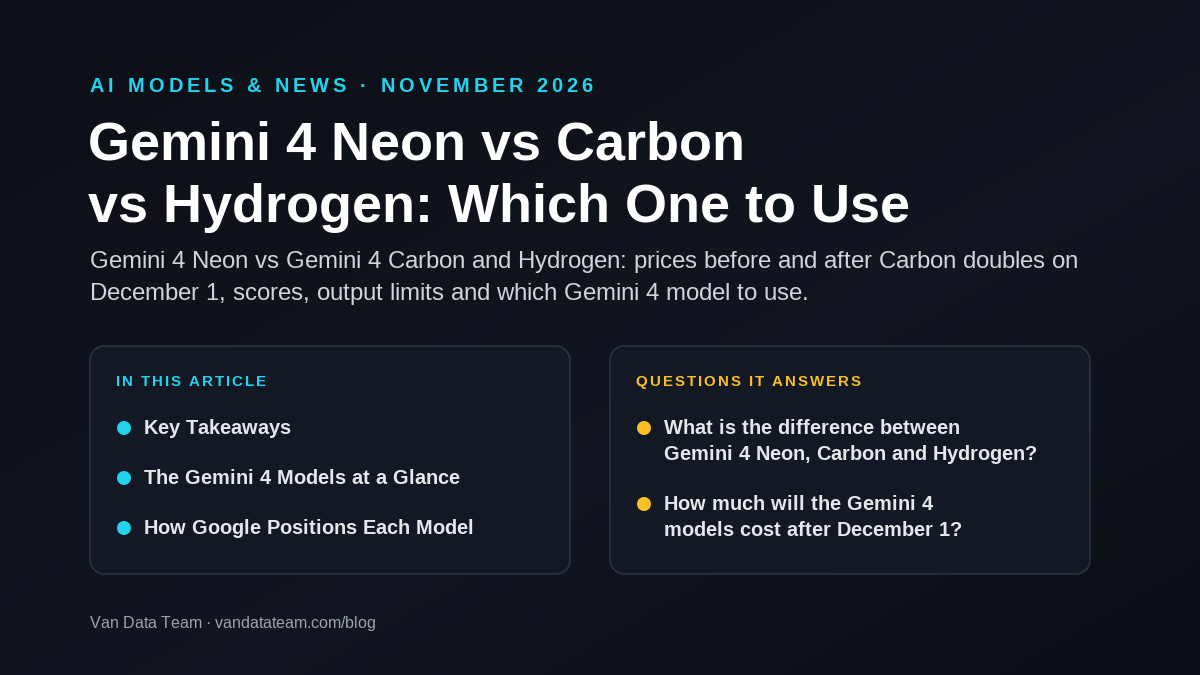
Google now sells three new Gemini 4 models at three price points. Gemini 4 Carbon, its strongest, went on general sale on November 10, 2026. Gemini 4 Hydrogen, the fast one, followed on November 12, and Gemini 4 Neon, in between, on November 18. On December 1, Carbon's introductory price ends and its rates double.
That date changes the math. Until November 30, Carbon costs less per token than Neon; from December 1 it costs a third more. This guide compares the three on Google's own tables, on independent tests and on what a typical task costs, so you can decide which to use where. Each pair links to a full side-by-side page in our AI model comparison tool.
Disclosure and scope: Van Data Team builds AI systems for clients on models from Google, OpenAI and Anthropic, and we have no paid ties to any of them. We drafted this with help from Anthropic's Claude. Lab scores come from Google's Gemini 4 Carbon launch table and the Neon and Hydrogen model cards; independent scores come from Arena (boards of November 22, 2026) and Epoch AI (data of November 23, 2026), as recorded in our catalog.
Key Takeaways
- Three tiers: Carbon for the hardest work, Neon in the middle, Hydrogen for fast everyday steps.
- December 1 reprices Carbon: from $2 and $10 to $4 and $20 per million tokens; Neon stays at $3 and $15, Hydrogen at $1.50 and $7.50.
- Neon matches Carbon on Arena: the two are level on both Arena Text and Arena WebDev.
- Hydrogen is a step down, not a cliff: about 20 points lower on Arena Text and 65 on WebDev, at half Neon's price.
- Only Hydrogen has a free tier.
- Argon is the long-answer model: up to 1 million output tokens, at Carbon's prices.
The Gemini 4 Models at a Glance
| Model | In the API | Price to Nov 30 (in / out) | Price from Dec 1 | Cached input | Max output | Free tier |
|---|---|---|---|---|---|---|
| Gemini 4 Carbon | Nov 10, 2026 | $2 / $10 | $4 / $20 | $0.10, then $0.20 | 65K default, 1M with long decode | No |
| Gemini 4 Neon | Nov 18, 2026 | $3 / $15 | $3 / $15 | $0.15 | 65K default, 1M with long decode | No |
| Gemini 4 Hydrogen | Nov 12, 2026 | $1.50 / $7.50 | $1.50 / $7.50 | $0.075 | 65K default, 1M with long decode | Yes |
| Gemini 4 Argon | Sep 30, 2026 | $2 / $10 | $4 / $20 | $0.10, then $0.20 | 1M (background past 64K) | No |
All four read text, images, video, audio and PDFs in a context of about 1 million tokens, and all four bill at one rate across that context. Batch work on Carbon, Neon and Hydrogen costs half the standard rate. Neon, Hydrogen and Argon support only implicit caching, where Google caches repeated input for you.
How Google Positions Each Model
Google's Neon model card sums up the family in one line: Carbon tackles the hardest, long-horizon projects, Hydrogen handles fast everyday execution, and Neon balances depth and efficiency. Neon and Hydrogen are both adapted from Carbon.
In practice:
- Carbon leads Google's cybersecurity results and long-horizon engineering; it was open first to cyber defenders in Google's Fairwind Program
- Neon targets complex coding, analysis and enterprise workflows at a lower cost per task; Google says it costs 32% less per task than Carbon at its default setting
- Hydrogen is Google's recommended upgrade from Gemini 3.8 Flash, built for quick steps and parallel sub-agents, and it's the one on the free tier
Google even suggests mixing them: in its Antigravity agent, Neon can act as an orchestrator directing parallel Hydrogen sub-agents. See the Gemini 4 Neon model page, the Carbon page and the Hydrogen page.
Independent Scores Side by Side
Here is what Arena and Epoch AI report for the four Gemini 4 models, as recorded in our catalog:
| Test | Carbon | Neon | Hydrogen | Argon |
|---|---|---|---|---|
| Arena Text | 1539 | 1523 | 1502 | 1528 |
| Arena WebDev | 1769 | 1766 | 1701 | 1681 |
| GPQA Diamond (Epoch AI) | 96.5% | 96.3% | 96.8% | 96.4% |
| FrontierMath Tiers 1-3 (Epoch AI) | 90.5% | 91.2% | 88.1% | 86.0% |
| SimpleQA Verified (Epoch AI) | 77.7% | 75.2% | 70.9% | 76.0% |
| Epoch Capabilities Index | 169.7 | Not yet | 166.8 | 166.5 |
Arena and the Capabilities Index publish a range around each score, and we only call a model ahead when the ranges don't overlap. On that rule:
- Arena Text: Carbon, Neon and Argon are level; Hydrogen is below all three
- Arena WebDev: Carbon and Neon are level and ahead of Hydrogen and Argon, which are level with each other
- Capabilities Index: Carbon, Hydrogen and Argon are level; Epoch AI hasn't scored Neon yet
- Science and math: all four sit within about a point on GPQA Diamond, while FrontierMath spreads them from 86.0% to 91.2%
Carbon's Arena Text rating, 1539, is the highest in our catalog. Neon's ratings rest on 5,611 Text and 2,310 WebDev votes, so they can still move.
What Google's Own Tables Show
Google published a table with each launch. They are separate runs, but they share a few tests. Claude Opus 5.5 appears in both the Carbon and Neon tables and scores the same in each on Agents' Last Exam, AutomationBench, Chartography and GraphWalks, which suggests Google ran those the same way. On RiemannBench it doesn't (69.6% in the Carbon table, 80% in Neon's), so treat that row as rough.
| Benchmark | Carbon | Neon | Hydrogen | Argon |
|---|---|---|---|---|
| Agents' Last Exam v1.1 | 77.4% | 75.8% | 71.6% | 69.0% |
| AutomationBench | 53.9% | 56.3% | Not listed | 51.3% |
| Chartography | 72.5% | 73.5% | 66.6% | 71.6% |
| GraphWalks, 256K to 1M tokens | 96.2% | 95.2% | Not listed | 84.2% |
| RiemannBench | 80% | 84% | Not listed | 76% |
Neon and Carbon trade places across these rows, while Hydrogen trails both where Google lists it. Google also ran Neon and Hydrogen on Terminal-Bench 4.1, where Neon scores 65.2% against Hydrogen's 57.0%, and on Terminal-Bench-Science 0.1, 70.5% against 51.4%. Those are the clearest signs of what the extra cost of Neon buys over Hydrogen: longer, harder agent work.
Gemini 4 Neon vs Gemini 4 Carbon
Until November 30, Carbon is the better deal: it costs less per token than Neon and scores at least as well. From December 1, Carbon costs $4 and $20 against Neon's $3 and $15, and the two are level on both Arena boards and close on Epoch AI's tests.
Reasons to keep Carbon after December 1:
- Hard, long-horizon tasks, where Google's own table puts it ahead on Agents' Last Exam
- Security work, where Carbon leads Google's cybersecurity table
- Fact recall, where it leads Neon on SimpleQA Verified, 77.7% against 75.2%
For most other work, test Neon: if it passes your tasks, it costs a quarter less per token. See the Gemini 4 Carbon vs Gemini 4 Neon page and our Carbon and Argon pricing guide.
Gemini 4 Neon vs Gemini 4 Hydrogen
Hydrogen costs half as much as Neon, $1.50 and $7.50 per million tokens, and it's on the free tier. It scores lower on both Arena boards and on Google's agent tests, but matches Neon on GPQA Diamond.
Use Hydrogen for high-volume steps: classifying, extracting, summarizing, routine tool calls and the many sub-agents of a larger job. Use Neon when a step needs longer reasoning or a harder coding or terminal task, where Google's tables show the widest gaps. See the Gemini 4 Hydrogen vs Gemini 4 Neon page.
Worked Example: What a Task Costs
Here's a simple cost model, using our own math and list prices. Take an agent step that reads 100,000 tokens and writes 10,000:
- Gemini 4 Hydrogen: $0.15 for input plus $0.075 for output, or $0.225
- Gemini 4 Neon: $0.30 plus $0.15, or $0.45
- Gemini 4 Carbon: $0.30 through November 30, then $0.40 plus $0.20, or $0.60
- Gemini 4 Argon: the same as Carbon, $0.30, then $0.60
Run that step 10,000 times and the gap becomes real: about $2,250 on Hydrogen, $4,500 on Neon and $6,000 on Carbon from December 1. These figures assume the same token counts on every model. In practice, a stronger model may finish in fewer steps, and thinking tokens count as output, so measure cost per finished task on your own work.
Which Gemini 4 Model Should You Use?
| If you need | Start with | Why |
|---|---|---|
| High-volume, routine steps | Gemini 4 Hydrogen | Half Neon's price, and on the free tier for testing |
| Complex coding and analysis after December 1 | Gemini 4 Neon | Level with Carbon on Arena at a quarter less per token |
| The hardest long-horizon or security tasks | Gemini 4 Carbon | Leads Google's agent and cybersecurity results |
| Very long answers, such as full rewrites | Gemini 4 Argon | Up to 1 million output tokens per response |
| An orchestrator with many sub-agents | Neon leading Hydrogen | The pairing Google itself suggests in Antigravity |
The cheapest setup is usually a mix: Hydrogen for most steps, and Neon or Carbon only where Hydrogen's answers fall short. Log which model handled each step, so you can see where the money goes.
What the Benchmarks Don't Tell You
- Lab tables: every row in Google's tables is Google's own run, on tests Google chose
- Separate runs: the Carbon, Neon and Hydrogen tables came out on different days and don't all cover the same tests
- Settings: results and costs change with the thinking level each model uses
- New ratings: Neon and Hydrogen's Arena ratings rest on a few thousand votes each
Use these numbers to narrow the list, then run two models on your own tasks and compare success rate, cost and time per finished task.
The Gemini 4 Lineup: Our Take
Gemini 4 Neon is the model most teams on Carbon should test before December 1. It matches Carbon on both Arena boards and comes close on Epoch AI's tests, and from December 1 it costs a quarter less. Carbon remains the pick for the hardest agent and security work, and Hydrogen is the sensible default for high-volume steps, at half Neon's price.
For how Neon compares with OpenAI's and Anthropic's models at similar prices, see our Gemini 4 Neon vs GPT-6.2 Sol vs Claude Opus 5.5 comparison.
Van Data Team in practice
Which Gemini 4 model should run our agents: Neon, Carbon or Hydrogen?
Usually more than one. Most agent systems send routine steps to a fast, cheap model and only the hard ones to a stronger model, so the bill follows the work. We test the candidates on your own tasks, set routing rules by task type and difficulty, and keep the model choice in configuration so a price change means editing a setting. We have built routing across Claude, OpenAI and Gemini models for a client platform.
AI Agents
Zeno Fitness and Habit PlatformMulti-provider routing across Claude 3 Haiku, OpenAI, and Gemini
AI Model Brief
The AI models worth knowing, once a week
What shipped, how it scores on independent benchmarks, what it costs per million tokens and what was deprecated, from the data behind our AI model benchmarks.
We use your address only to send the brief. See our privacy policy.
See this week’s brief
Founder of Van Data Team. Builds Vanaxity, the AI agent system for SEO, GEO, and AEO, and leads data engineering delivery for B2B teams.
About the authorAI model benchmarks
Models in this article
Current pricing, context window and independent scores for each model.
Article FAQ
Questions readers usually ask next.
These short answers clarify the practical follow-up questions that often come after the main article.
Need a similar system?
If this article maps to a workflow your team already operates, the next step is usually a scoped review of the system, constraints, and rollout path.
Consultation
Scope your next AI workflow.
Share the system and blockers. We will map fit, gaps, and the next step.