Gemini 4 Neon vs GPT-6.2 Sol vs Claude Opus 5.5
Gemini 4 Neon vs GPT-6.2 Sol and Claude Opus 5.5: Google's new $3 model against OpenAI's $2 and Anthropic's $4 options on scores, limits and task costs.
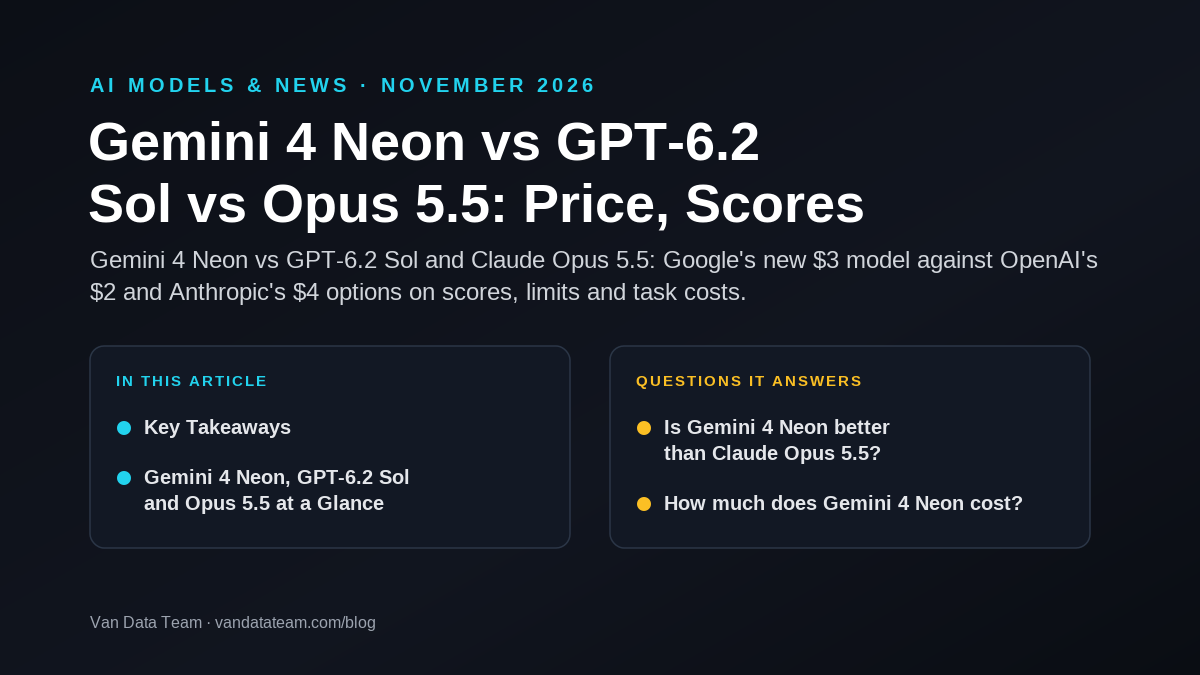
Google released Gemini 4 Neon on November 18, 2026, and priced it between two models many teams already run. At $3 per million input tokens and $15 per million output tokens, it costs a quarter less than Anthropic's Claude Opus 5.5 ($4 and $20) and half again as much as OpenAI's GPT-6.2 Sol ($2 and $10), which came out the day before.
Google's own model card compares Neon with exactly these two. This guide sets that table beside independent results from Arena and Epoch AI, then looks at what each model charges for long prompts, caching and long answers. Each pair links to a full side-by-side page in our AI model comparison tool.
Disclosure and scope: Van Data Team builds AI systems for clients on models from Google, OpenAI and Anthropic, and we have no paid ties to any of them. We drafted this with help from Anthropic's Claude, and Anthropic makes one of the models compared here. Lab scores come from Google's Gemini 4 Neon model card; independent scores come from Arena (boards of November 22, 2026) and Epoch AI (data of November 23, 2026), as recorded in our catalog.
Key Takeaways
- Price in the middle: Neon costs $3 and $15 per million tokens, against $2 and $10 for GPT-6.2 Sol and $4 and $20 for Opus 5.5.
- Google's table favors Neon: it leads Opus 5.5 on 11 of 13 shared benchmarks and GPT-6.2 Sol on 11 of 12.
- Independent tests are closer: Neon and Opus 5.5 are level on Arena Text, and Opus 5.5 leads Arena WebDev.
- GPT-6.2 Sol trails on Arena Text, at 1414 against Neon's 1523 and Opus 5.5's 1514.
- Long prompts flip the bill: past 272,000 input tokens, GPT-6.2 Sol costs more per request than Neon.
- Output limits differ: Neon writes 65,536 tokens by default, the other two up to 128,000.
Gemini 4 Neon, GPT-6.2 Sol and Opus 5.5 at a Glance
| Model | Released | Price per 1M tokens (in / out) | Cached input | Context | Max output |
|---|---|---|---|---|---|
| Gemini 4 Neon | Nov 18, 2026 | $3 / $15 | $0.15 (implicit only) | 1.05M | 65K default, 1M with long decode |
| GPT-6.2 Sol | Nov 17, 2026 | $2 / $10 | $0.10 | 1.05M | 128K |
| Claude Opus 5.5 | Sep 22, 2026 | $4 / $20 | $0.20 | 1M | 128K |
All prices are list prices per million tokens. Google bills Neon at one rate across its whole context, Anthropic does the same for Opus 5.5, and OpenAI bills a GPT-6.2 Sol request with more than 272,000 input tokens at $4 and $15 for the whole request. All three halve their rates for batch work.
What's New in Gemini 4 Neon
Neon sits between Google's two other new Gemini 4 models. Google says Carbon "tackles your hardest, long-horizon projects", Hydrogen handles fast everyday work, and Neon balances depth and efficiency. Its model card says it is adapted from Gemini 4 Carbon, with knowledge up to March 2026.
The practical details, from Google's model page and pricing page:
- Input: text, images, video, audio and PDF, in a 1,048,576-token context
- Output: text only, 65,536 tokens per request by default and up to 1,048,576 with long decode
- Thinking: four levels, low, medium, high (the default) and xhigh
- Caching: implicit only, at $0.15 per million cached tokens; you can't create a cache yourself
- Where: the Gemini API on the paid tier, Gemini for business, Google Antigravity and the Gemini app for Pro and Ultra subscribers
Google's launch post says Neon at its default high setting costs 32% less per task than Gemini 4 Carbon. A separate Neon for cyber variant goes only to vetted defenders in Google's Fairwind Program. See the Gemini 4 Neon model page for every recorded score and price.
Google's Own Table
Google's model card scores Neon, Claude Opus 5.5 and GPT-6.2 Sol on the same tests. These are Google's runs, on benchmarks Google chose:
| Benchmark | Gemini 4 Neon | Claude Opus 5.5 | GPT-6.2 Sol |
|---|---|---|---|
| CursorBench 4.1 | 65.4% | 58.1% | Not run |
| Terminal-Bench 4.1 | 65.2% | 65.8% | 61.5% |
| FrontierCode 2.0 | 46.2% | 47.3% | 43.8% |
| AutomationBench | 56.3% | 42.5% | 41.3% |
| Agents' Last Exam v1.1 | 75.8% | 71.6% | 73.0% |
| Terminal-Bench-Science 0.1 | 70.5% | 63.3% | 68.0% |
| Chartography | 73.5% | 66.3% | 75.1% |
| GraphWalks, 256K to 1M tokens | 95.2% | 66.8% | 80.1% |
| SEC-bench Pro | 90.5% | Not run | 88.3% |
| WebExploitBench v1.2 | 51.3% | 37.1% | Not run |
The table shows 10 of the card's rows; the comparison pages carry all 14 we record. Across those 14, Neon scores highest on 11. Opus 5.5 wins Terminal-Bench 4.1 and FrontierCode 2.0, both coding tests, by about a point each, and GPT-6.2 Sol wins Chartography, which tests reading dense charts.
Two cautions. Google picked the tests, and the biggest gaps sit on agent and long-context tasks, where how a lab runs the test matters a lot. We leave out the Artificial Analysis and Vals indexes Google also lists, as we do for every lab table.
Independent Scores Side by Side
Arena ranks models by votes from people comparing answers, and Epoch AI runs fixed tests itself. Here is what our catalog records:
| Test | Gemini 4 Neon | Claude Opus 5.5 | GPT-6.2 Sol |
|---|---|---|---|
| Arena Text | 1523 | 1514 | 1414 |
| Arena WebDev | 1766 | 1820 | 1755 |
| GPQA Diamond (Epoch AI) | 96.3% | 90.6% | Not yet |
| FrontierMath Tiers 1-3 (Epoch AI) | 91.2% | 91.2% | Not yet |
| SimpleQA Verified (Epoch AI) | 75.2% | 72.2% | Not yet |
Arena publishes a range around each rating, and we only call one model ahead when the ranges don't overlap. On that rule:
- Arena Text: Neon and Opus 5.5 are level; both are well ahead of GPT-6.2 Sol, which also sits below its predecessor GPT-6.1 Sol (1446)
- Arena WebDev: Opus 5.5 leads both; Neon and GPT-6.2 Sol are level
- Epoch AI: Neon leads Opus 5.5 on GPQA Diamond, a graduate-level science test, and they tie on FrontierMath; Epoch hasn't run GPT-6.2 Sol yet
Neon's Arena ratings rest on 5,611 Text votes and 2,310 WebDev votes so far, so they can still move.
Gemini 4 Neon vs Claude Opus 5.5
This is the closest pair. Neon is cheaper per token, $3 and $15 against $4 and $20, and Google's table puts it ahead on most rows. Independent tests narrow that gap: the two are level on Arena Text and FrontierMath, and Opus 5.5 is clearly ahead on Arena WebDev, 1820 against 1766.
The other differences:
- Answer length: Opus 5.5 writes up to 128,000 tokens per request; Neon stops at 65,536 unless you use long decode
- Caching: Opus 5.5 lets you write a cache yourself ($5 per million for 5 minutes, $8 for an hour) and read it at $0.20; Neon caches repeated input automatically at $0.15 and offers no manual cache
- Long context: Google's GraphWalks test, which checks reasoning over 256,000 to 1 million tokens, has Neon at 95.2% against 66.8%
Our read: for web front ends and coding agents where Opus 5.5 already works, the switch is not obvious. For long-document analysis, research and agent work across many tools, Neon is worth a test at a lower price. Compare them on the Opus 5.5 vs Gemini 4 Neon page.
Gemini 4 Neon vs GPT-6.2 Sol
GPT-6.2 Sol is a third cheaper per token, and on Arena WebDev the two are level. Neon leads GPT-6.2 Sol on 11 of the 12 rows they share in Google's table and by a wide margin on Arena Text.
Where Sol has the edge:
- Price for ordinary prompts: $2 and $10 per million, against $3 and $15
- Answer length: 128,000 output tokens by default
- Chartography: 75.1% against 73.5% in Google's own table
Where Neon has it:
- Long prompts: past 272,000 input tokens, Sol bills the whole request at $4 and $15, while Neon keeps $3 and $15
- Arena Text: 1523 against 1414
- Long-context reasoning: 95.2% against 80.1% on GraphWalks in Google's table
Our read: for high-volume steps with short prompts, GPT-6.2 Sol is cheaper. For very long inputs, Neon can cost less per request. See the Gemini 4 Neon vs GPT-6.2 Sol page and our earlier GPT-6.2 Sol comparison.
Worked Example: What a Task Costs
Here's a simple cost model, using our own math and list prices. Take an agent step that reads 100,000 tokens and writes 10,000:
- GPT-6.2 Sol: $0.20 for input plus $0.10 for output, or $0.30
- Gemini 4 Neon: $0.30 plus $0.15, or $0.45
- Claude Opus 5.5: $0.40 plus $0.20, or $0.60
Now a long prompt of 300,000 tokens with the same 10,000-token answer:
- Gemini 4 Neon: $0.90 plus $0.15, or $1.05
- GPT-6.2 Sol: past 272,000 tokens the whole request moves to $4 and $15, so $1.20 plus $0.15, or $1.35
- Claude Opus 5.5: $1.20 plus $0.20, or $1.40
So Sol is cheapest for short steps and Neon for long ones. These figures assume the same token counts on every model. In practice the models think and write different amounts for the same task, which changes the bill, so measure cost per finished task on your own work.
Which Model Should You Use?
| If you need | Start with | Why |
|---|---|---|
| Long documents and research over huge inputs | Gemini 4 Neon | One rate across 1M tokens and the best long-context score in Google's table |
| Web front ends and app UI | Claude Opus 5.5 | Leads Arena WebDev among these three |
| The lowest cost on short, frequent steps | GPT-6.2 Sol | $2 and $10 per million tokens |
| Long answers without special modes | GPT-6.2 Sol or Opus 5.5 | 128K output tokens per request |
| Agents that call many tools | Gemini 4 Neon | Leads AutomationBench and Agents' Last Exam in Google's table |
Many teams end up with two models: a cheap default for routine steps and a stronger one for the hard cases. Keep the model name in your logs and a small test set ready, so a new release or a price change is a quick check, not a project.
What the Benchmarks Don't Tell You
- Vendor tables: Neon's lab scores come from Google, which chose the tests and ran the other models too
- Settings: each model's score and cost change with its thinking or effort level
- Fresh ratings: Neon's Arena ratings are a few days old and rest on a few thousand votes
- Missing data: Epoch AI hasn't run GPT-6.2 Sol, so the science and math rows compare only two models
Use these numbers to narrow the list, then run two or three models on your own tasks and compare success rate, cost and time per finished task.
Gemini 4 Neon: Our Take
Gemini 4 Neon is a strong new option at a middle price. On Google's own tests it beats Claude Opus 5.5 and GPT-6.2 Sol on most rows, and on independent tests it matches Opus 5.5 on Arena Text while costing a quarter less. Opus 5.5 keeps a clear lead on web development, and GPT-6.2 Sol stays the cheapest per token for short prompts.
Our advice: if you run Opus 5.5 for analysis or long-document work, test Neon on the same tasks. If you run GPT-6.2 Sol with very long prompts, check what those requests cost after the 272,000-token mark. For how Neon fits with Google's other Gemini 4 models, see our Gemini 4 Neon vs Carbon vs Hydrogen guide.
Van Data Team in practice
Should our agents move to Gemini 4 Neon, or stay on GPT-6.2 Sol or Claude Opus 5.5?
Test before you move. The three bill differently for long prompts, caching and output, so the cheapest per token is not always the cheapest per finished task. We run your own agent tasks on each model, compare success rate, tokens and time per task, and keep the model behind a routing layer so a switch is a setting, not a rewrite. We have built routing across Claude, OpenAI and Gemini models for a client platform.
AI Agents
Zeno Fitness and Habit PlatformMulti-provider routing across Claude 3 Haiku, OpenAI, and Gemini
AI Model Brief
The AI models worth knowing, once a week
What shipped, how it scores on independent benchmarks, what it costs per million tokens and what was deprecated, from the data behind our AI model benchmarks.
We use your address only to send the brief. See our privacy policy.
See this week’s brief
Founder of Van Data Team. Builds Vanaxity, the AI agent system for SEO, GEO, and AEO, and leads data engineering delivery for B2B teams.
About the authorAI model benchmarks
Models in this article
Current pricing, context window and independent scores for each model.
Article FAQ
Questions readers usually ask next.
These short answers clarify the practical follow-up questions that often come after the main article.
Need a similar system?
If this article maps to a workflow your team already operates, the next step is usually a scoped review of the system, constraints, and rollout path.
Consultation
Scope your next AI workflow.
Share the system and blockers. We will map fit, gaps, and the next step.