GPT-6.2 Sol vs Claude Sonnet 5.5 vs Gemini 4 Argon
GPT-6.2 Sol vs Claude Sonnet 5.5 and Gemini 4 Argon at the same $2 and $10, plus the upgrade from GPT-6.1 Sol: scores, limits and costs after December 1.
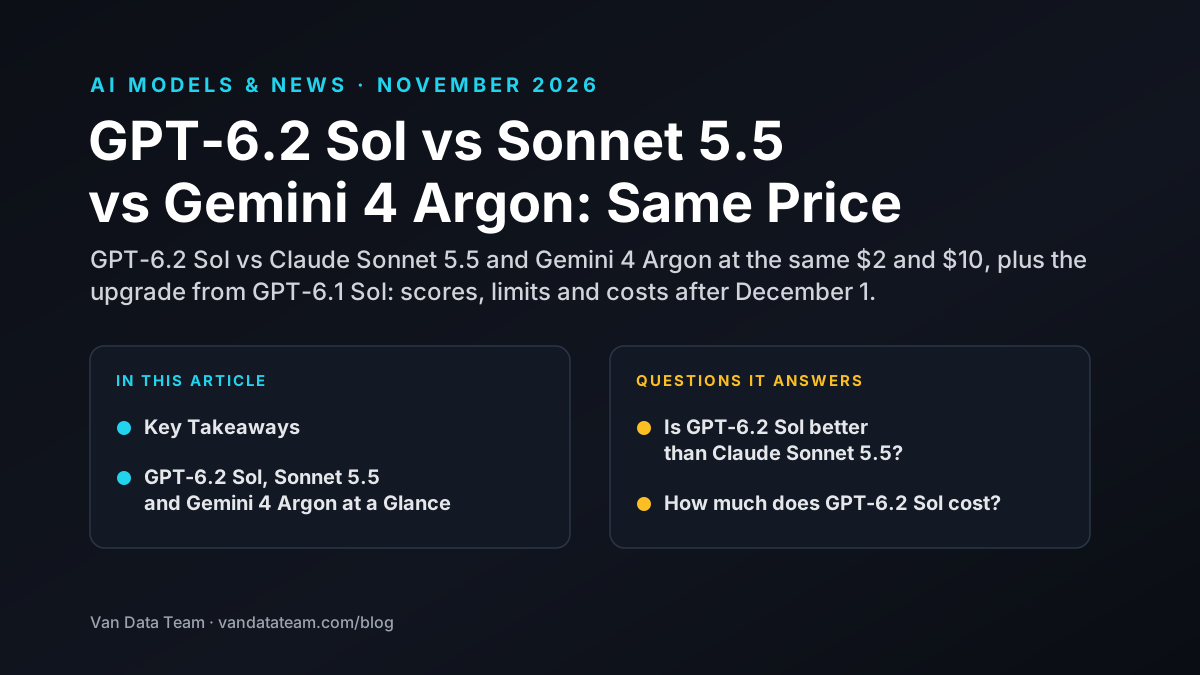
Three of the most used mid-priced AI models now cost exactly the same: $2 per million input tokens and $10 per million output tokens. OpenAI's GPT-6.2 Sol joined Anthropic's Claude Sonnet 5.5 and Google's Gemini 4 Argon at that price on November 17, 2026, as the successor to GPT-6.1 Sol. The match won't last long: Argon's price doubles to $4 and $20 on December 1.
With the rate card out of the way, the choice comes down to scores, limits and how each model bills long prompts and caching. This guide covers all three, plus the question GPT-6.1 Sol users have: is the new Sol worth switching to? Each pair links to a full side-by-side page in our AI model comparison tool.
Disclosure and scope: Van Data Team builds AI systems for clients on models from OpenAI, Anthropic and Google, and we have no paid ties to any of them. We drafted this with help from Anthropic's Claude, and Anthropic makes one of the models compared here. Scores for GPT-6.2 Sol come from OpenAI's launch post; scores for the other models come from independent testers, Arena and Epoch AI, unless we say otherwise.
Key Takeaways
- Same price today: $2 and $10 per million tokens for all three, and $0.10 per million for cached input.
- Argon doubles on December 1, to $4 and $20, so GPT-6.2 Sol and Sonnet 5.5 will cost half as much per token.
- GPT-6.2 Sol beats GPT-6.1 Sol on all five public benchmarks in OpenAI's charts, at the same price.
- No shared scores yet: OpenAI's charts leave out Sonnet 5.5 and Argon, and independent testers hadn't rated GPT-6.2 Sol when we wrote this.
- Each leads somewhere: on independent tests, Sonnet 5.5 leads Arena WebDev, Argon leads Arena Text and GPT-6.1 Sol leads Epoch AI's FrontierMath.
- Limits differ: Argon writes up to 1M tokens in one answer, and GPT-6.2 Sol charges more for prompts past 272,000 tokens.
GPT-6.2 Sol, Sonnet 5.5 and Gemini 4 Argon at a Glance
| Model | Released | Price per 1M tokens (in / out) | Cached input | Context | Max output |
|---|---|---|---|---|---|
| GPT-6.2 Sol | Nov 17, 2026 | $2 / $10 | $0.10 | 1.05M | 128K |
| Claude Sonnet 5.5 | Sep 28, 2026 | $2 / $10 | $0.10 | 1M | 128K |
| Gemini 4 Argon | Sep 30, 2026 | $2 / $10 to Nov 30, then $4 / $20 | $0.10, then $0.20 | 1.05M | 1M (background past 64K) |
| GPT-6.1 Sol | Sep 29, 2026 | $2 / $10 | $0.10 | 1.05M | 128K |
All prices are list prices per million tokens. OpenAI bills a GPT-6.2 Sol request with more than 272,000 input tokens at $4 and $15 for the whole request, the same rule as GPT-6.1 Sol, while Anthropic bills Sonnet 5.5 at one rate across its 1M window. Argon isn't on the Gemini API's free tier.
What's New in GPT-6.2 Sol
OpenAI calls GPT-6.2 Sol its go-to model for everyday work, and says many of its own staff use it as their default. It keeps GPT-6.1 Sol's prices and limits: a 1,050,000-token context with up to 922,000 input tokens, 128,000 output tokens, and text and image input (model page). Its knowledge runs to June 1, 2026.
The gains are in the scores. Here is GPT-6.2 Sol against GPT-6.1 Sol in OpenAI's launch charts, both at max effort, with OpenAI's cost per task:
| Benchmark | GPT-6.2 Sol | GPT-6.1 Sol |
|---|---|---|
| Agents' Last Exam v1.1 | 73.0% ($1.32 per task) | 72.5% ($2.02 per task) |
| Terminal-Bench-Science 0.1 | 68.0% ($2.21) | 57.0% ($5.47) |
| FrontierCode 2.0 | 43.8% ($1.29) | 39.0% ($1.03) |
| BenchCAD 2.1 Core | 73.1% ($1.60) | 52.6% ($1.61) |
| AutomationBench 1.0.6 | 41.1% ($0.27) | 36.1% ($0.30) |
The new Sol scores higher on every row and costs less per task on four of the five; FrontierCode is the exception. OpenAI adds two more claims: on FrontierCode 2.0 it comes within half a point of GPT-6.2 Astra at about a fifth of the cost, and on LifeVal, OpenAI's own test of everyday tasks, it outscores GPT-6 Astra at about a seventh of the cost.
It's in the API, in ChatGPT Work and Codex for Plus, Pro, Enterprise and Edu users, and in GitHub Copilot on the Pro+, Max, Business and Enterprise plans. OpenAI's system card rates it Critical for cybersecurity and High for biological and chemical capabilities, and below the High threshold for AI self-improvement that GPT-6.2 Astra reaches.
If you run GPT-6.1 Sol today, this is the easiest upgrade on the list: same price, same limits, better scores on OpenAI's tests. Rerun your own test set first, then switch. See the GPT-6.1 Sol vs GPT-6.2 Sol page and the GPT-6.2 Sol model page.
GPT-6.2 Sol vs Claude Sonnet 5.5
There's no shared benchmark yet: OpenAI's charts don't include Sonnet 5.5, and Arena and Epoch AI hadn't rated GPT-6.2 Sol when we wrote this. Until they do, the closest guide is GPT-6.1 Sol, which OpenAI's charts put below the new model. Against Sonnet 5.5 on independent tests, GPT-6.1 Sol:
- Ties on Epoch AI's Capabilities Index, 168.5 against 166.6, inside each other's published ranges
- Ties on Arena Text, 1481 against 1473, also inside the ranges
- Trails on Arena WebDev, 1742 against 1772, so Sonnet 5.5 is the stronger web app builder there
- Leads on Epoch AI's FrontierMath, 93.7% against 88.8%, and on SimpleQA Verified, a fact recall test, 73.9% against 46.5%
The billing details differ more than the scores:
- Long prompts: past 272,000 input tokens, GPT-6.2 Sol bills the whole request at $4 and $15; Sonnet 5.5 keeps $2 and $10 up to its 1M limit
- Caching: both charge $0.10 per million for cache reads, and $2.50 per million to write a cache, but OpenAI's write keeps for 30 minutes and Anthropic's basic one for 5 (a 1-hour write costs $4)
- Batch: both halve their rates, to $1 and $5
Our read: for web front ends and very long prompts, start with Sonnet 5.5. For math-heavy reasoning and fact recall, the Sol line has the better record. Compare them on the Sonnet 5.5 vs GPT-6.2 Sol page.
GPT-6.2 Sol vs Gemini 4 Argon
The main difference here is time. Argon matches Sol's price only until November 30. From December 1, Google charges $4 and $20 per million tokens and $0.20 for cached input, twice Sol's rates. Our Gemini 4 Carbon and Argon pricing guide shows what that does to a monthly bill.
Argon has two real strengths:
- Huge outputs: up to 1 million tokens in one answer, against Sol's 128,000, though answers past 64,000 tokens need background execution
- Arena Text: 1522, above GPT-6.1 Sol's 1481 and Sonnet 5.5's 1473, with Epoch AI's GPQA Diamond at 96.4%
GPT-6.1 Sol leads Argon on Arena WebDev, 1742 against 1679, and on FrontierMath, 93.7% against 86.0%. Argon also has no explicit context caching: Google caches repeated input automatically instead.
Each lab also reports its own numbers, but on separate runs. Google's Gemini 4 Carbon launch table puts Argon at 69.0% on Agents' Last Exam and 51.3% on AutomationBench; OpenAI's charts put GPT-6.2 Sol at 73.0% and 41.1%. Different labs run the same test with different settings, so treat those gaps as hints, not a ranking. See the Gemini 4 Argon vs GPT-6.2 Sol page and our Gemini 4 Argon review.
Sonnet 5.5 vs Argon
The two older models have independent scores on the same tests. Argon leads on Arena Text (1522 against 1473) and on Epoch AI's GPQA Diamond and SimpleQA Verified, while Sonnet 5.5 leads on Arena WebDev (1772 against 1679) and FrontierMath (88.8% against 86.0%). They tie on Epoch AI's Capabilities Index. From December 1, Sonnet 5.5 costs half as much per token. See the Sonnet 5.5 vs Gemini 4 Argon page.
Independent Scores Side by Side
These come from Arena (Text on November 11, WebDev on November 15, 2026) and Epoch AI (November 16, 2026), as recorded in our catalog. GPT-6.2 Sol had no independent rating yet, so its predecessor stands in.
| Test | GPT-6.1 Sol | Claude Sonnet 5.5 | Gemini 4 Argon |
|---|---|---|---|
| Arena Text | 1481 | 1473 | 1522 |
| Arena WebDev | 1742 | 1772 | 1679 |
| Epoch Capabilities Index | 168.5 | 166.6 | 166.5 |
| GPQA Diamond (Epoch AI) | 95.4% | 95.6% | 96.4% |
| FrontierMath Tiers 1-3 (Epoch AI) | 93.7% | 88.8% | 86.0% |
| SimpleQA Verified (Epoch AI) | 73.9% | 46.5% | 76.0% |
Arena and the Capabilities Index publish a range around each score; where two ranges overlap, as on the Capabilities Index here, we call it a tie. OpenAI's own system card reports 96.0% on GPQA Diamond for GPT-6.2 Sol, but that's OpenAI's run, not Epoch AI's, so it isn't in the table.
Worked Example: What a Task Costs
Here's a simple cost model, using our own math and list prices. Take an agent step that reads 100,000 tokens and writes 10,000:
- GPT-6.2 Sol: $0.20 for input plus $0.10 for output, or $0.30
- Claude Sonnet 5.5: the same $0.30
- Gemini 4 Argon: $0.30 through November 30, then $0.60
Now take a long prompt of 300,000 tokens with the same 10,000-token answer:
- GPT-6.2 Sol: past 272,000 tokens the whole request moves to $4 and $15, so $1.20 plus $0.15, or $1.35
- Claude Sonnet 5.5: $0.60 plus $0.10, or $0.70
So for routine steps the three cost the same until December 1, and for very long prompts Sonnet 5.5 costs about half as much as Sol. These figures assume equal token counts; in practice the models write different amounts for the same task, so measure on your own work.
Which Model Should You Use?
| If you need | Start with | Why |
|---|---|---|
| An upgrade for GPT-6.1 Sol workloads | GPT-6.2 Sol | Same price, higher scores on all five public benchmarks OpenAI shows |
| Web front ends and app UI | Claude Sonnet 5.5 | Leads Arena WebDev among these models |
| Prompts over 272,000 tokens | Claude Sonnet 5.5 | One rate across its 1M window |
| Very long answers, such as large rewrites | Gemini 4 Argon | Up to 1M output tokens in one response |
| Math-heavy reasoning | GPT-6.2 Sol | Its predecessor leads FrontierMath, and OpenAI's charts put it higher |
| The lowest bill after December 1 | GPT-6.2 Sol or Sonnet 5.5 | Half Argon's new rate per token |
Many teams will use two of these, with one as the default and another for the jobs it handles better. Keep the model name in your logs and a small test set ready, so the next release or price change is a quick check.
What the Benchmarks Don't Tell You
- No head-to-head yet: no single test has scored GPT-6.2 Sol, Sonnet 5.5 and Argon together
- Vendor charts: GPT-6.2 Sol's scores come from OpenAI, which picked the tests
- Predecessor as proxy: GPT-6.1 Sol's independent scores are a guide to the new model, not a measurement of it
- Effort settings: results and costs change with the effort level each model runs at
Use these numbers to narrow the list, then test two or three models on your own tasks and compare success rate, cost and time per finished task.
GPT-6.2 Sol: Our Take
GPT-6.2 Sol is a free upgrade for GPT-6.1 Sol users: same price, same limits, better scores on every public test OpenAI shows. Against Sonnet 5.5 and Argon, the picture is less clear until independent tests arrive. Sonnet 5.5 has the edge for web work and long prompts, Argon for very long outputs and Arena Text, and the Sol line for math.
Our advice: switch GPT-6.1 Sol workloads after a short test, and if Argon is your default, run Sol and Sonnet 5.5 on the same tasks before December 1, when Argon's price doubles. For the top-tier models, see our GPT-6.2 Astra vs Claude Fable 5.2 vs Gemini 4 Carbon comparison.
Van Data Team in practice
Which mid-priced model should run our agents: GPT-6.2 Sol, Claude Sonnet 5.5 or Gemini 4 Argon?
Run all three on a sample of your own agent tasks before you commit, because they cost the same per token but not per finished task. We measure success rate, tokens used and time per task for each model, check how each handles your longest prompts and outputs, and set up routing so that a price change, like Argon's on December 1, means changing a setting rather than rewriting code. We have built routing across Claude, OpenAI and Gemini models for a client platform.
AI Agents
Zeno Fitness and Habit PlatformMulti-provider routing across Claude 3 Haiku, OpenAI, and Gemini
AI Model Brief
The AI models worth knowing, once a week
What shipped, how it scores on independent benchmarks, what it costs per million tokens and what was deprecated, from the data behind our AI model benchmarks.
We use your address only to send the brief. See our privacy policy.
See this week’s brief
Founder of Van Data Team. Builds Vanaxity, the AI agent system for SEO, GEO, and AEO, and leads data engineering delivery for B2B teams.
About the authorAI model benchmarks
Models in this article
Current pricing, context window and independent scores for each model.
Article FAQ
Questions readers usually ask next.
These short answers clarify the practical follow-up questions that often come after the main article.
Need a similar system?
If this article maps to a workflow your team already operates, the next step is usually a scoped review of the system, constraints, and rollout path.
Consultation
Scope your next AI workflow.
Share the system and blockers. We will map fit, gaps, and the next step.