Gemini 4 Carbon and Argon Pricing: What Changes on December 1
Gemini 4 Carbon and Argon cost $2 and $10 per million tokens through November 30, then $4 and $20. What changes on December 1 and how to cut the bill.
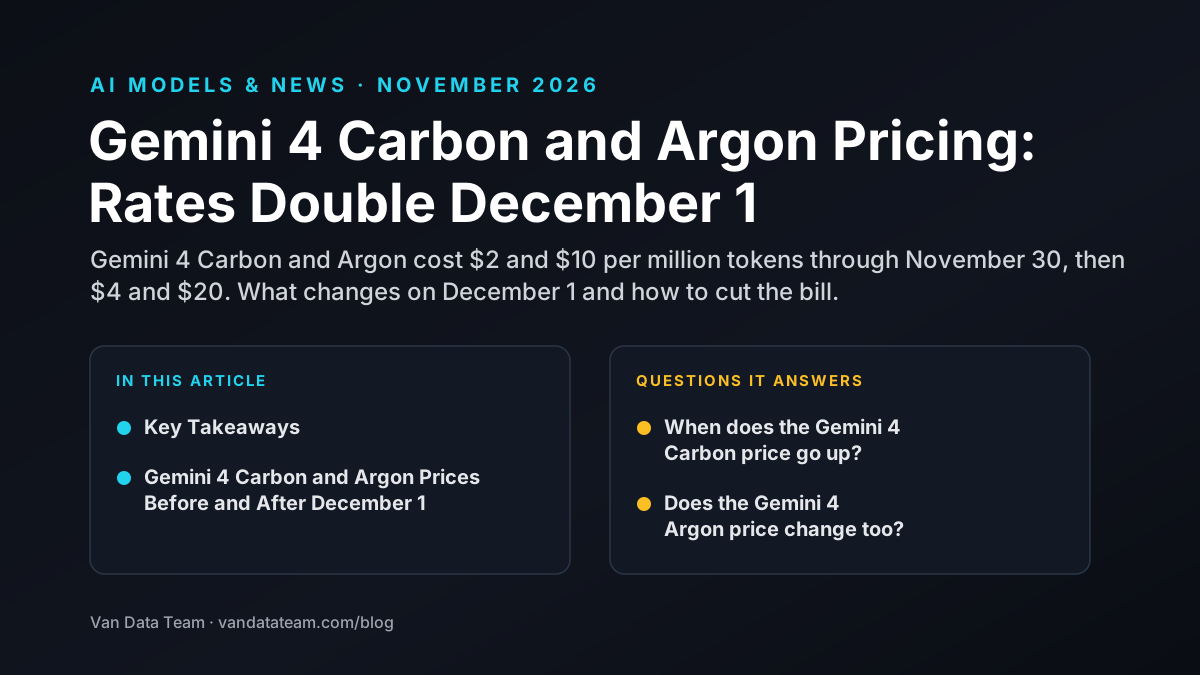
Google's launch prices for its two newest Gemini models end on November 30, 2026. From December 1, Gemini 4 Carbon and Gemini 4 Argon cost twice as much per token on the paid Gemini API: $4 per million input tokens and $20 per million output tokens, up from $2 and $10. Google's pricing page lists both rates with their dates, and its November 10 release notes for Carbon give the same end date.
If either model runs in production, the same work will cost twice as much unless you change something. Here are the old and new rates, what the change does to a monthly bill, how the two compare with Claude and GPT models at the new price and what you can do before December 1.
Disclosure: Van Data Team builds AI systems with models from several providers, including Google, Anthropic and OpenAI, and sells a fixed-price AI Model Cost Audit. We drafted this with help from Anthropic's Claude, then checked every price against Google's pricing page and our benchmark data. All prices are list prices in US dollars, before any discount or commitment.
Key Takeaways
- Gemini 4 Carbon and Gemini 4 Argon cost $2 and $10 per million input and output tokens through November 30, 2026.
- From December 1, both cost $4 and $20. Cached input doubles too, from $0.10 to $0.20.
- Carbon's batch rates double as well: $1 and $5 now, $2 and $10 from December 1.
- Neither model has a free tier on the Gemini API, and thinking tokens are billed as output.
- At the new price, both match Claude Opus 5.5's list price of $4 and $20.
- Caching, batch requests, shorter answers and routing easy calls to a cheaper model can take much of the sting out of the increase.
Gemini 4 Carbon and Argon Prices Before and After December 1
These are Google's rates per million tokens on the paid tier of the Gemini Developer API.
| Rate per million tokens | Through November 30, 2026 | From December 1, 2026 |
|---|---|---|
| Gemini 4 Carbon input | $2.00 | $4.00 |
| Gemini 4 Carbon output, including thinking tokens | $10.00 | $20.00 |
| Gemini 4 Carbon cached input | $0.10 | $0.20 |
| Gemini 4 Carbon batch input | $1.00 | $2.00 |
| Gemini 4 Carbon batch output | $5.00 | $10.00 |
| Gemini 4 Carbon batch cached input | $0.05 | $0.10 |
| Gemini 4 Argon input | $2.00 | $4.00 |
| Gemini 4 Argon output, including thinking tokens | $10.00 | $20.00 |
| Gemini 4 Argon cached input | $0.10 | $0.20 |
Source: Gemini Developer API pricing, read on November 14, 2026. Both models cache repeated input implicitly; Google doesn't support explicit caching for either. Grounding with Google Search is billed separately.
Carbon has been generally available in the Gemini API since November 10, 2026, after two weeks open only to cyber defenders and trusted partners. Our Gemini 4 Carbon analysis covers its benchmarks, and our Gemini 4 Argon analysis covers Argon's.
What the Change Does to a Monthly Bill
Here's a worked example. It's our own math on the rates above, not a quote from Google.
Say your app sends 50 million input tokens and gets back 10 million output tokens a month on Gemini 4 Carbon. Many apps resend the same long system prompt or documents, so the second and third rows assume 80% of the input is served from the cache.
| Scenario | Through November 30 | From December 1 |
|---|---|---|
| Standard requests, no caching | $200 | $400 |
| Standard requests, 80% of input cached | $124 | $248 |
| Batch requests, 80% of input cached | $62 | $124 |
Two things stand out. First, output drives the bill. Without caching, output is half the cost; with caching, it's about 80%. Thinking tokens count as output, so a model that thinks longer costs more for the same answer.
Second, the cheapest setup after December 1 costs the same as the cached setup today. Moving work that can wait to batch, with caching on, keeps this example at $124 a month.
Argon's standard and cached rates are the same as Carbon's, so its first two rows would match.
How Gemini 4 Carbon and Argon Compare After December 1
Here's the new Gemini 4 price next to other models in our AI model benchmarks. The last column prices a fixed workload of 10 million input and 2 million output tokens, the same one our comparison pages use.
| Model | Input per 1M tokens | Output per 1M tokens | 10M input + 2M output |
|---|---|---|---|
| Gemini 4 Carbon, from December 1 | $4.00 | $20.00 | $80 |
| Gemini 4 Argon, from December 1 | $4.00 | $20.00 | $80 |
| Claude Opus 5.5 | $4.00 | $20.00 | $80 |
| Claude Fable 5.2 | $8.00 | $40.00 | $160 |
| GPT-6 Astra | $10.00 | $50.00 | $200 |
| GPT-6.1 Sol | $2.00 | $10.00 | $40 |
| Claude Sonnet 5.5 | $2.00 | $10.00 | $40 |
| Gemini 3.8 Flash | $0.75 | $3.75 | $15 |
List prices from our benchmark data, each checked on its provider's pricing page between October 11 and November 11, 2026.
From December 1, Carbon and Argon cost the same per token as Claude Opus 5.5, half as much as Claude Fable 5.2 and well under half of GPT-6 Astra. GPT-6.1 Sol and Claude Sonnet 5.5 keep the $2 and $10 that Carbon and Argon charge today.
Price per token isn't price per task, though. A model that writes longer answers or thinks longer can cost more for the same job. Our guide to token efficiency explains why. For scores and prices side by side, see Claude Opus 5.5 vs Gemini 4 Carbon, Claude Sonnet 5.5 vs Gemini 4 Carbon and Gemini 4 Argon vs GPT-6.1 Sol.
Five Ways to Keep the Bill Down
- Let caching work for you. Carbon and Argon cache repeated input automatically, and from December 1 cached input costs $0.20 per million tokens against $4 for regular input. Put the parts that never change, such as system instructions and reference documents, at the start of the prompt so they can be reused.
- Move work that can wait to batch. Carbon's batch rates are half its standard ones. Overnight document runs, backfills and evaluation sets rarely need an answer in seconds.
- Cap the output. Output costs five times as much as input on both models, and thinking tokens count as output. Ask for shorter answers and set a maximum output length for each call.
- Route easy calls to a cheaper model. Classification, extraction and short summaries often run well on a cheaper model such as Gemini 3.8 Flash. Test it on your own tasks before you switch.
- Re-run your budget before December 1. As a first estimate, double what you spend on Carbon or Argon today, set a budget alert in Google Cloud and check whether the new number changes which model you'd pick.
Should You Switch Before December 1?
Not on price alone. Here's a quick guide:
| Your situation | What to do |
|---|---|
| You use Carbon for cyber defense or very long inputs | Stay, and cache and batch what you can |
| You use Argon for general tasks | Test GPT-6.1 Sol and Claude Sonnet 5.5, which keep the $2 and $10 price |
| Most of your calls are short and simple | Test a cheaper model such as Gemini 3.8 Flash for those calls |
| You compare against Claude Opus 5.5 | Compare on quality and tokens per task; the list price is now the same |
Whatever you choose, keep the model a setting rather than code, so the next price change is a config edit.
Gemini 4 Pricing: Our Take
A doubling sounds dramatic, but it takes Carbon and Argon to the list price of Claude Opus 5.5, which is where many teams already budget for a frontier model. The teams that will feel it most built on the launch price without caching or batch.
You have until November 30 at the old rate. Use it to measure your real cost per task, turn on what saves money and decide which calls need a frontier model at all.
Related reading: Gemini 4 Carbon: Benchmarks, Price and Who Gets It First, Gemini 4 Argon and our look at the AI model price war.
AI Model Brief
The AI models worth knowing, once a week
What shipped, how it scores on independent benchmarks, what it costs per million tokens and what was deprecated, from the data behind our AI model benchmarks.
We use your address only to send the brief. See our privacy policy.
See this week’s brief
Founder of Van Data Team. Builds Vanaxity, the AI agent system for SEO, GEO, and AEO, and leads data engineering delivery for B2B teams.
About the authorAI model benchmarks
Models in this article
Current pricing, context window and independent scores for each model.
Side by side
Article FAQ
Questions readers usually ask next.
These short answers clarify the practical follow-up questions that often come after the main article.
Need a similar system?
If this article maps to a workflow your team already operates, the next step is usually a scoped review of the system, constraints, and rollout path.
Consultation
Scope your next AI workflow.
Share the system and blockers. We will map fit, gaps, and the next step.