Gemini 4 Carbon: Benchmarks, Price and Who Gets It First
Gemini 4 Carbon tops the Artificial Analysis index by one point and leads on cyber tests. Where it trails, what it costs and what to do before you can use it.
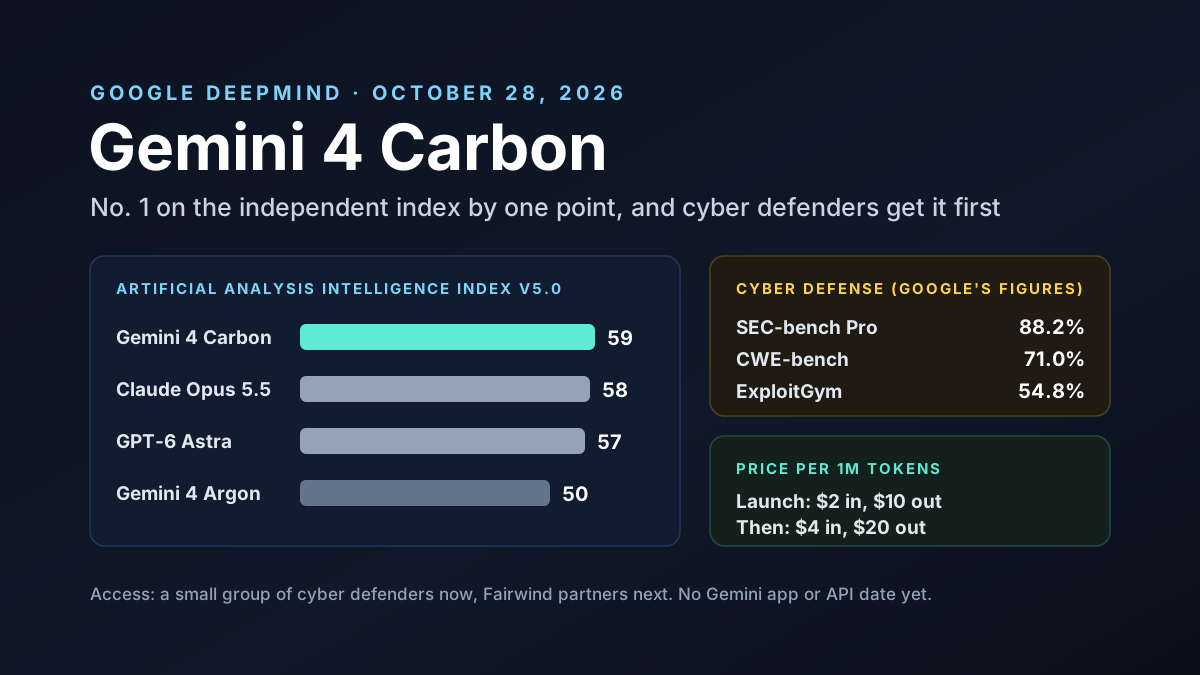
Gemini 4 Carbon is Google's newest frontier model, and it now sits at the top of the main independent leaderboard. Google announced it on October 28, 2026. Carbon scores 59 on the Artificial Analysis Intelligence Index v5.0, one point ahead of Claude Opus 5.5.
The twist was who got it first. Google gave it to cyber defenders before anyone else, because its biggest gains are in finding and fixing software flaws. That's unusual. Here's where Carbon leads, where it trails, what it costs and how your team can get ready to test it.
Disclosure: Van Data Team builds AI systems with models from several providers, including Google, Anthropic and OpenAI. This article was researched with Claude, and Anthropic's Claude Opus 5.5 is one of the models compared here. Benchmark scores are reported as Google's or Artificial Analysis's. We haven't tested Carbon ourselves yet.
Key Takeaways
- Google announced Gemini 4 Carbon on October 28, 2026, two weeks after Gemini 4 Argon became widely available.
- It ranks first on the Artificial Analysis Intelligence Index v5.0 with 59 points. Claude Opus 5.5 has 58, GPT-6 Astra 57 and Argon 50.
- Its headline strength is cyber defense: 88.2% on SEC-bench Pro, 54.8% on ExploitGym and 71.0% on CWE-bench, all by Google's count.
- It trails Opus 5.5 on OSWorld-2.1 and GPT-6 Astra on FrontierSWE 2. Opus 5.5 also leads the Artificial Analysis Coding Agent Index.
- Cyber defenders got access first. Since November 10, 2026, Carbon has been generally available in the paid Gemini API.
- Pricing is $2 and $10 per million input and output tokens through November 30, 2026, then doubles to $4 and $20 on December 1.
What Is Gemini 4 Carbon?
Gemini 4 Carbon is a large language model from Google DeepMind. It's the second model in the Gemini 4 family, after Gemini 4 Argon. Google calls it its next frontier model, which means its most capable one.
Carbon is built on Argon, not trained as a separate line. Think upgrade, not reboot.
Google aimed it at three things: long, hard tasks, coding and cyber defense. It says Carbon can stay on one task for hours. The Decoder notes that its ExploitGym score came from runs of up to ten hours. Big claims.
Google also says Carbon is safer in day-to-day use. In Google's own tests, it makes about half as many unsupported claims as Argon. It also cut successful prompt injection attacks on the Gray Swan benchmark from 0.7% to zero.
Gemini 4 Carbon at a Glance
| Item | Detail |
|---|---|
| Announced | October 28, 2026 |
| Maker | Google DeepMind |
| Built on | Gemini 4 Argon |
| Independent rank | First on the Artificial Analysis Intelligence Index v5.0, with 59 points |
| Main strength | Cyber defense: finding, testing and patching software flaws |
| First access | A small group of cyber defenders, then trusted partners through the Fairwind Program |
| Gemini API | Generally available since November 10, 2026, on the paid tier only |
| Price per million tokens | $2 input and $10 output through November 30, 2026, then $4 and $20; cached input 95% off |
How Big Is the Lead on the Index?
It's real, but it's small. Carbon has 59 points on the Artificial Analysis Intelligence Index v5.0. Claude Opus 5.5 has 58, GPT-6 Astra has 57 and Argon has 50.
| Model | AA Intelligence Index v5.0 | AA Coding Agent Index |
|---|---|---|
| Gemini 4 Carbon | 59 | 59 |
| Claude Opus 5.5 | 58 | 62 |
| GPT-6 Astra | 57 | Not reported in launch coverage |
| Gemini 4 Argon | 50 | 50 |
One point is a thin margin. A new release from any rival could flip the order in a week, and labs now ship new models every few weeks, so a one-point lead may not last long. What stands out more is the jump from Argon: nine points in about a month is a big gain for one model family.
Keep one detail in mind. Artificial Analysis changes its index from time to time, and the scores only compare within one version. On the older v4 index, Argon scored 53, not 50. So don't compare Carbon's 59 with numbers from earlier articles.
Artificial Analysis also tracks individual tests. By Trending Topics' count, Carbon has the top score on four of the index's nine, including AA-Omniscience and Terminal-Bench-Science. It doesn't win everywhere, and that matters for picking a model.
Where Gemini 4 Carbon Leads
Google's launch table compares Carbon with Argon, Claude Opus 5.5 and GPT-6 Astra across a long list of tests. Carbon has the top score on all but two of them. Google ran the cyber tests "without guardrails," so they show the raw model, not the safety-filtered product.
Here are the rows with the clearest gaps. These are Google's figures, as transcribed from its launch chart by CellCog, so treat them as vendor results until others repeat them.
| Benchmark (what it tests) | Gemini 4 Carbon | Best rival | Gap (our math) |
|---|---|---|---|
| SEC-bench Pro (finding flaws) | 88.2% | GPT-6 Astra, 85.4% | +2.8 points |
| ExploitGym (testing whether a flaw is real) | 54.8% | GPT-6 Astra, 42.4% | +12.4 points |
| CWE-bench (patching flaws) | 71.0% | Argon and Astra, 68.0% | +3.0 points |
| Terminal-Bench 4.0 (command-line tasks) | 65.2% | Claude Opus 5.5, 59.6% | +5.6 points |
| GraphWalks, 256k to 1M tokens (long context) | 96.2% | Argon, 84.2% | +12.0 points |
The long-context result is worth a closer look. GraphWalks asks a model to follow links across a huge document. A 96.2% score from 256,000 to one million tokens means Carbon keeps track of details across very long inputs, like a full codebase or a year of tickets.
Google also reports that Carbon climbed 89 points to fourth place on WebDev Arena, where people vote on which model built the better web page. Fourth place is good, but it isn't first.
Where Gemini 4 Carbon Falls Short
Carbon has clear weak spots, and they're in areas many teams care about.
- Using a computer. On OSWorld-2.1, which tests an AI working a desktop like a person, Claude Opus 5.5 scores 87.2% and Carbon 81.5%.
- Large software tasks. On FrontierSWE 2, GPT-6 Astra scores 65.5% and Carbon 61.2%.
- Coding agents. On the Artificial Analysis Coding Agent Index, Opus 5.5 running in Claude Code scores 62. Carbon, running in Google's Antigravity CLI, scores 59.
- Hallucinations. On AA-Omniscience, Carbon makes up answers more often than Argon: 11% against 4%.
- Speed and tokens. The Decoder reports that Carbon uses 2.3 times Argon's reasoning tokens, and some agent tasks take more than twice as long.
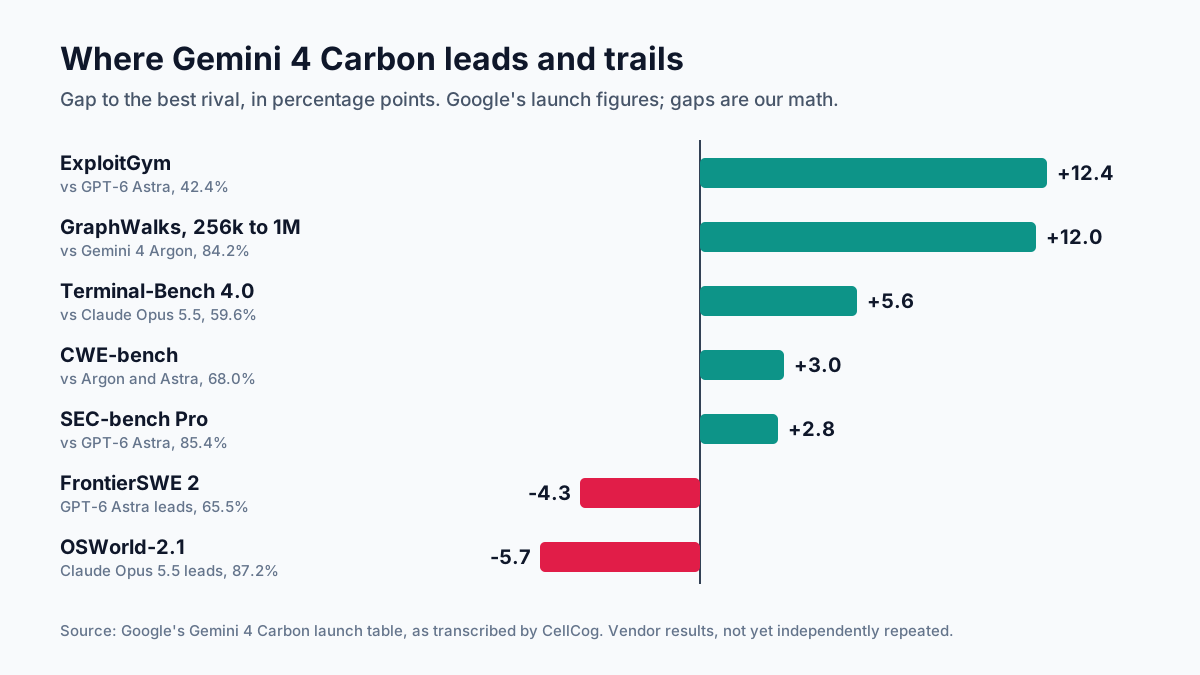
So if your main job is an agent that clicks through apps, or a coding agent working inside a large repo, Carbon isn't the clear pick. Opus 5.5 or Astra may still be better there. You'd need to test on your own tasks to know.
Why Cyber Defense Is the Headline
Google built its launch around security, and the numbers show why. Carbon covers the three main steps of a defender's job:
- Finding flaws: 88.2% on SEC-bench Pro, which tests whether a model can find real flaws in software.
- Confirming them: 54.8% on ExploitGym, which checks whether a found flaw can actually be triggered.
- Fixing them: 71.0% on CWE-bench, which tests patches.
The ExploitGym gap is the largest. Carbon beats the next model by more than 12 points. For defenders, that step matters: confirming that a flaw is real is what turns a long list of warnings into a short list of urgent fixes.
Google also quotes its own Chrome team. It says Carbon "performed more than 10X better" than another lab's large frontier model at writing high-quality patches. Google doesn't name the other model or share the test, so treat this as a claim, not a result.
For security teams, the practical promise is simple. A model that finds flaws, checks them and drafts patches could help small teams keep up with a growing backlog. But every patch still needs a human review before it ships, because a fix that looks right can break other code or hide the flaw instead of removing it.
Who Can Use Gemini 4 Carbon Now?
Anyone with a paid Gemini API account, since November 10, 2026. Google rolled it out in stages, starting with the people best placed to use its cyber skills for defense:
- From October 28: a small group of cyber defenders.
- Next: more trusted partners through Google DeepMind's Fairwind Program.
- November 10: general availability in the Gemini API, on the paid tier only.
There's no free tier for Carbon. Google's pricing page also links it to Google AI Studio for testing. The gap from launch to the API was about two weeks, the same as for Argon.
Why Labs Ship to Defenders First
This isn't new for Google. It released Gemini 4 Argon to cyber defenders first too, on September 30. Argon reached the paid API and Gemini app about two weeks later, on October 13.
The logic is simple. A model that's good at finding flaws helps both sides. Giving defenders a head start lets them find and fix problems before attackers get the same tool.
Other labs now do the same with their strongest models. We looked at the incidents behind that caution in our piece on AI agent incidents at the UN Security Council. If your team builds agents that touch code or systems, our guide to agentic AI security covers the basic controls.
The Hallucination Trade-Off
Here's the detail most launch posts skip. Carbon knows more than Argon, but it also guesses more.
On AA-Omniscience, a knowledge test from Artificial Analysis, Carbon answered 58% of questions correctly. Argon answered 48%. But Carbon's hallucination rate is 11%, against 4% for Argon. That rate counts how often a model gives a wrong answer when it could have said it didn't know.
| AA-Omniscience | Gemini 4 Carbon | Gemini 4 Argon |
|---|---|---|
| Correct answers (higher is better) | 58% | 48% |
| Hallucination rate (lower is better) | 11% | 4% |
Both numbers are good next to most rivals. Carbon's rate is still the second-lowest of all models tested, behind only Argon. But for some jobs, the gap matters a lot. Context decides.
Think about where a wrong answer costs more than no answer:
- Favor Argon's caution for legal research, medical notes, financial reports and compliance checks, where "I don't know" beats a confident mistake.
- Favor Carbon's knowledge for coding and research help, where a person checks the output anyway.
- Test both when you aren't sure, using questions where you already know the right answer.
What Will Gemini 4 Carbon Cost?
Carbon's prices match Argon's, and so does the date its introductory rates end: November 30, 2026.
| Price per million tokens | Introductory | Regular |
|---|---|---|
| Input | $2.00 | $4.00 |
| Output | $10.00 | $20.00 |
| Cached input (95% off) | $0.10 | $0.20 |
The introductory price ends on November 30, 2026. From December 1, Google charges the regular rates in the right-hand column (Google's pricing page). Batch requests cost half the standard rates: $1 and $5 per million input and output tokens now, $2 and $10 from December 1. Plan your budget on the regular price. We work through the change on a typical bill in Gemini 4 Carbon and Argon pricing.
Artificial Analysis also measures what it costs to run its whole index at regular prices. Carbon costs $7.76 per task, against $10.04 for Claude Opus 5.5 and $6.25 for GPT-6 Astra. By our math, that makes Carbon about 23% cheaper than Opus 5.5 per task and about 24% more expensive than Astra, which puts it in the middle of the three on cost.
Price per token is only half the story. Carbon thinks longer than Argon, so it uses more tokens on the same job. Our guide to token efficiency explains why tokens per task drive the bill more than the price list does.
A Worked Cost Example
Here's a rough monthly estimate. It's our own math, based on the prices above, not a quote from Google.
Say your app sends 50 million input tokens and gets back 10 million output tokens each month. Many apps reuse the same long system prompt or documents, so assume 80% of the input can be cached.
| Scenario | Input cost | Output cost | Monthly total |
|---|---|---|---|
| Introductory price, no caching | $100 | $100 | $200 |
| Regular price, no caching | $200 | $200 | $400 |
| Regular price, 80% of input cached | $48 | $200 | $248 |
Two lessons stand out. First, the end of the launch price doubles the bill if nothing else changes. Second, output tokens drive most of the cost once you cache your input. Since Carbon writes more and thinks longer than Argon, watch output volume closely in any pilot.
Two Weeks After Argon: Google's Fast Pace
Google shipped Carbon just two weeks after Argon became widely available, and four weeks after Argon's first announcement. That's a very short gap between two top models from one lab.
| Date (2026) | Step |
|---|---|
| September 30 | Gemini 4 Argon announced, first for cyber defenders |
| October 13 | Argon reaches the paid Gemini API and the Gemini app |
| October 28 | Gemini 4 Carbon announced, first for cyber defenders |
| Not announced | Carbon in the Gemini API and the Gemini app |
The fast pace is good news for buyers, since prices hold while scores climb. There's a catch. But it also creates work. Every new model means new tests, new prompts and new cost checks.
The lesson for builders is to avoid hard-wiring one model into your product:
- Keep the model name in config, so a switch is a one-line change.
- Keep a test set you can rerun in an hour, so you can compare any new release against your current model on exactly the same tasks, with the same scoring, before you change anything in production.
- Track cost per task for every model you try.
Then a new release becomes a quick check you can finish in an afternoon, not a rebuild that ties up your whole team for weeks.
What Benchmarks Don't Tell You
Launch tables are useful, but they have limits. Keep these in mind when you read Carbon's.
- Most numbers come from Google. Only the Artificial Analysis scores are independent so far, and even its own page for Carbon wasn't fully live when the first news reports went out.
- Many leads are small. Several rows in Google's table differ by less than one point, which is within the range where a small change in test setup can change the winner.
- The cyber scores have no safety filters. Google tested the raw model. The product you get may refuse some of the same tasks.
- Your tasks aren't in the table. A model that wins on public tests can still lose on your documents, your code and your users' questions.
None of this makes Carbon weak. It means the table is a starting point, not a buying decision.
A Simple Example: Choosing a Model for a Code Review Agent
Here's a made-up example to show how to use these numbers. It isn't a real case.
A software company runs an agent that reviews every pull request for security problems. Today it uses Claude Opus 5.5. The team wants to know whether it should switch to Carbon, and what that switch would really cost in time and money.
The benchmarks point both ways. Carbon's cyber scores suggest it may spot more flaws. But Opus 5.5 leads the coding agent index, and Carbon's higher hallucination rate could mean more false alarms.
So the team builds a test set first. It collects 200 old pull requests where the real flaws are known, runs both models on the same set and counts three things: flaws found, false alarms and cost per review, at the December 1 price. The answer comes from that test, not from a launch chart.
Should You Switch to Gemini 4 Carbon?
Not before you test it. Carbon is in the paid Gemini API now, but its lead is small and its price doubles on December 1. Switch when your own results say so.
Here's a simple way to decide:
| Your situation | What to do now |
|---|---|
| You run a security team | Test Carbon first; it's built for your work |
| You already use Gemini 4 Argon | Run a quick switch test; the two cost the same per token |
| You build computer-use agents | Stay with the current leader on OSWorld; recheck when new results land |
| Wrong answers are costly in your app | Compare hallucination rates on your own data before any switch |
| You're starting a new project | Keep the model swappable, and budget at the December 1 price |
How to Get Ready to Test Gemini 4 Carbon
Do this before you run the first test:
- Build your own test set. Collect 50 to 200 real tasks from your own work, each with a known good answer, so you can score any model the same way every time. Our guide to AI agent evaluation shows how.
- Track cost per task, not price per token. Log the tokens in and out for each job on your current model, so you know your real cost per task before any new model arrives.
- Make the model swappable. Put the model name and settings in config, not in code.
- Set a hallucination budget. Decide how many wrong answers per hundred your app can live with, and which kinds of wrong answers must never reach a customer at all.
- Plan for caching. Find the long, repeated parts of your prompts, like system rules and reference documents, so you can cache them from day one and cut input costs by up to 95%.
With these in place, you can test Carbon in a day instead of a month.
What to Watch Next
- Where else Carbon shows up, such as the Gemini app, now that the API is open.
- December 1, when the launch price ends and the cost per token doubles.
- Full independent results from Artificial Analysis, LMArena and other testers, especially on coding agents and computer use, where Carbon trails its two closest rivals today.
- Carbon's safety report, including how the guarded product scores on cyber tests.
- Rival replies from Anthropic and OpenAI, who now trail by one and two points on the index.
Gemini 4 Carbon: Our Take
Gemini 4 Carbon is a strong release. It takes first place on the main independent index, makes a big jump over Argon and posts standout cyber defense scores. Its long-context results look especially useful for teams working with huge codebases and document sets.
But its lead is one point, most of its numbers come from Google and its price doubles on December 1. It also trails rivals on computer use and coding agents, and it guesses more often than Argon. For most teams, the right move is to prepare a test set, run Carbon against what you use today and switch only when your own results say so.
Related reading: Claude Opus 5.5 Benchmarks: What the Chart Shows and Hides and GPT-6 Astra: OpenAI's New Frontier Model.
Van Data Team in practice
How should we test Gemini 4 Carbon against Claude Opus 5.5 before switching our AI agent?
Test Gemini 4 Carbon on your own tasks, not on leaderboard scores, and keep your agent ready to swap models. We build a test set from real cases such as code reviews or vulnerability triage, score Carbon against Claude Opus 5.5 and GPT-6 Astra on accuracy, unsupported claims and cost per task, and design the agent so the model is a configuration choice. We have run production agents that route across Claude, OpenAI and Gemini.
AI Agents
Zeno Fitness and Habit PlatformMulti-provider routing across Claude 3 Haiku, OpenAI, and Gemini
AI Model Brief
The AI models worth knowing, once a week
What shipped, how it scores on independent benchmarks, what it costs per million tokens and what was deprecated, from the data behind our AI model benchmarks.
We use your address only to send the brief. See our privacy policy.
See this week’s brief
Founder of Van Data Team. Builds Vanaxity, the AI agent system for SEO, GEO, and AEO, and leads data engineering delivery for B2B teams.
About the authorAI model benchmarks
Models in this article
Current pricing, context window and independent scores for each model.
Article FAQ
Questions readers usually ask next.
These short answers clarify the practical follow-up questions that often come after the main article.
Need a similar system?
If this article maps to a workflow your team already operates, the next step is usually a scoped review of the system, constraints, and rollout path.
Consultation
Scope your next AI workflow.
Share the system and blockers. We will map fit, gaps, and the next step.