ChatGPT Wallet: What AI Agent Payments Mean for Merchants
ChatGPT Wallet lets OpenAI's dots agents pay with card tokens and Face ID checks. What launched, how it works and what merchants and data teams should fix.
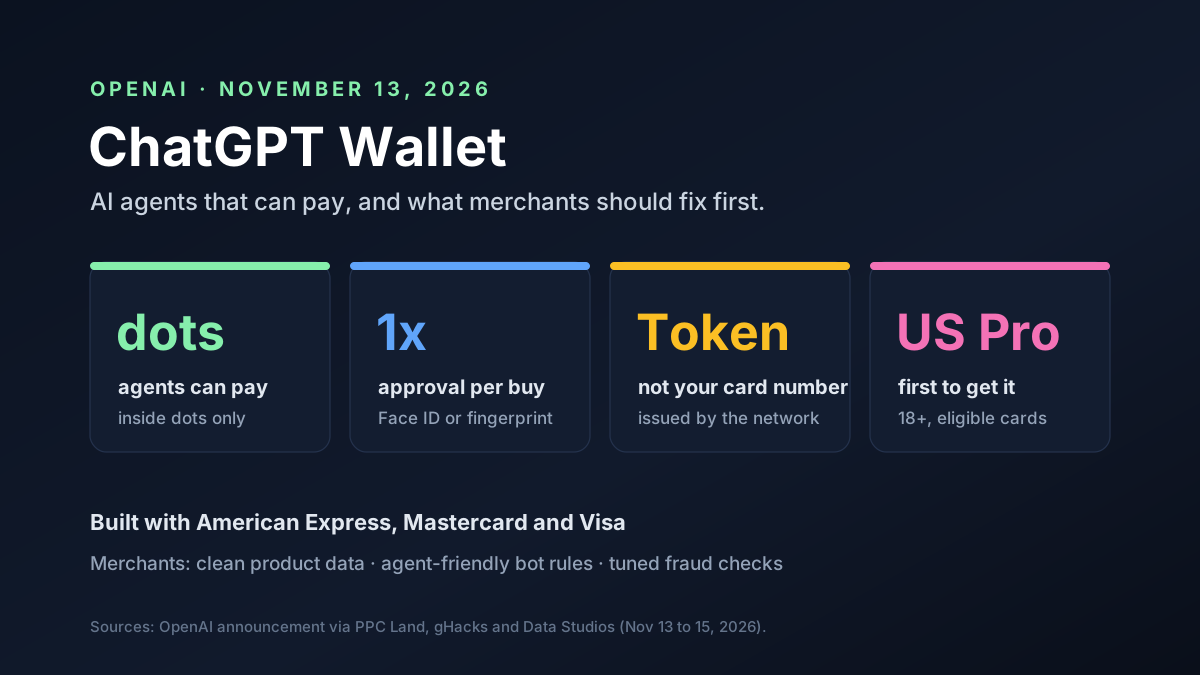
OpenAI wants its agents to finish the job, not just find the product. On November 13, 2026, it launched ChatGPT Wallet, built with American Express, Mastercard and Visa, so its dots agents can pay for things on a user's behalf.
The design is careful. Every purchase needs a Face ID or fingerprint check, and the agent never sees the real card number. But the bigger story is what it asks of merchants. If agents start buying, your product data, bot rules and fraud checks decide whether you get the sale.
This guide covers what launched, how it works, why OpenAI's first try at in-chat buying stalled, and what merchants and data teams should fix first.
Key Takeaways
- Agents can now pay. ChatGPT Wallet lets OpenAI's dots agents complete purchases for US Pro users.
- Cards stay hidden. A network token stands in for the real card, so neither the agent nor the merchant sees it.
- People still approve. Every purchase needs a biometric check, and the spending limits that would let agents buy on their own are planned but not yet live.
- It's a second try. OpenAI's Instant Checkout launched in 2025 and shut down in March 2026.
- Merchants have work to do. Clean product data, agent-friendly bot rules and fraud tuning now affect sales.
ChatGPT Wallet at a Glance
Here's what's public, as of November 15, 2026:
| Item | What's public |
|---|---|
| Launched | November 13, 2026 |
| Partners | American Express, Mastercard and Visa |
| Where it works | Inside OpenAI's dots agents only |
| Who gets it first | US ChatGPT Pro subscribers, 18 and older |
| Approval | A security check, such as Face ID or a fingerprint, on every purchase |
| Card data | Replaced by a network payment token |
| Coming later | Spending limits and pre-approved categories, no date yet |
OpenAI says ChatGPT has 1.2 billion weekly users, PPC Land reported. Many already use it to research products. The wallet is OpenAI's bet that some of that research can turn into purchases without leaving the chat.
How ChatGPT Wallet Works
The flow has five steps. A user asks a dots agent to buy something. The agent finds the item and builds the order.
Then the user approves it with a security check, such as Face ID or a fingerprint scan. After that, the card network issues a payment token: a stand-in card number with its own security code and expiry date. The merchant charges the token.
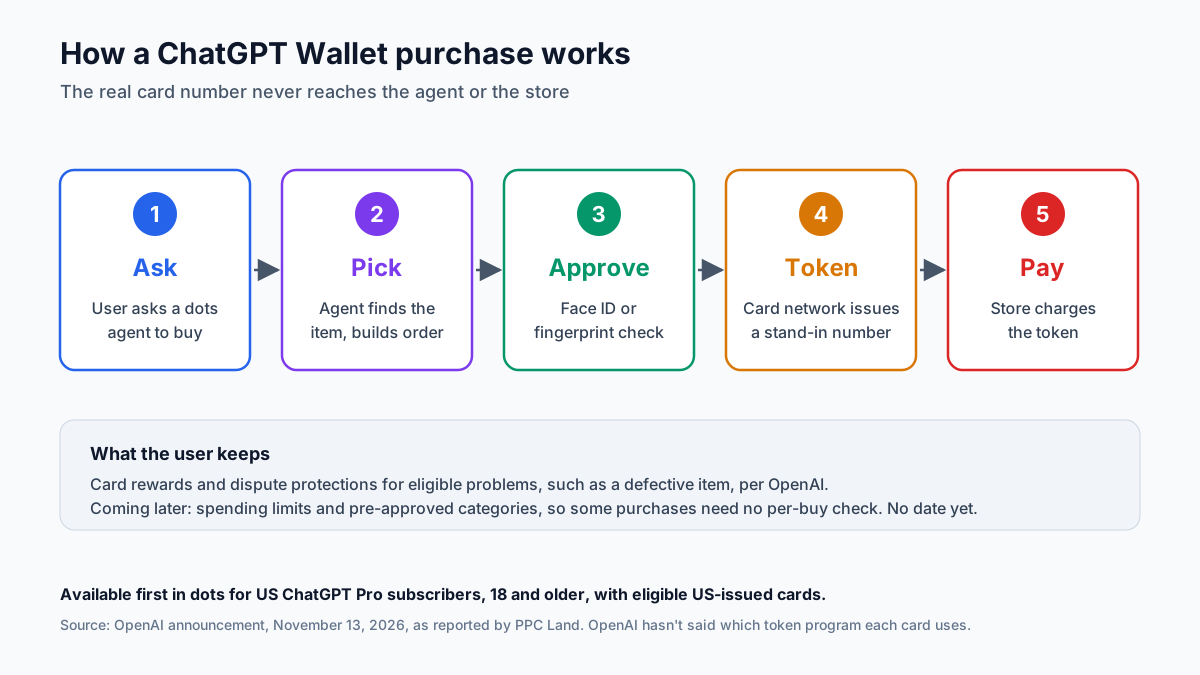
That token is the key safety feature. If an agent or a merchant site is compromised, the real card number isn't there to steal. OpenAI also says users keep their card rewards and their dispute rights for problems like a defective item.
A few limits apply at launch, per gHacks and Data Studios:
- It works only inside dots, not in regular ChatGPT chats.
- Only eligible US-issued cards can be added.
- Each purchase is approved one at a time.
Why Payment Tokens Matter
Tokens aren't new. Phone wallets have used them for years. When you tap a phone to pay, the store gets a token, not your card number.
ChatGPT Wallet uses the same idea for agents. That's smart for two reasons. First, a stolen token is far less useful than a stolen card. Second, the store's checkout already knows how to handle tokens, so it doesn't need a new system.
The open question is scope. OpenAI hasn't said if each token works once or many times. A one-time token would be safest. Expect more detail as the rollout grows.
What ChatGPT Wallet Is, and What It Isn't
There's some confusion about the name, so here's a quick guide:
| ChatGPT Wallet is | ChatGPT Wallet isn't |
|---|---|
| A way for dots agents to pay for you | A new credit card |
| Built on card network payment tokens | A place to store money |
| Approved by you on every purchase | Available in regular ChatGPT chats |
| Live for US Pro users first | A crypto or stablecoin wallet |
The last row matters for anyone who saw "wallet" and thought of crypto. Coverage is consistent that this runs on normal card networks and tokens, with no stablecoins involved, per Benzinga and others.
What Are OpenAI's dots Agents?
dots are OpenAI's agents that can take actions, such as browsing, comparing and checking out, rather than just answering questions. We looked at how dots handles approvals in our post on AI agent permissions, alongside Meta's Muse.
The wallet fills a gap. Before it, an agent could fill a cart but needed the user to step in at payment. Now the agent can finish, with the user's biometric check as the final gate.
That makes the approval step the most important design choice in the product. It's also the part OpenAI plans to loosen. It says it will later let users pre-approve purchases within spending limits, categories or time periods, but it hasn't said when.
ChatGPT Wallet vs Instant Checkout: Why the First Try Stalled
This isn't OpenAI's first move into buying. Instant Checkout launched on September 29, 2025, with Stripe and Etsy sellers, built on its Agentic Commerce Protocol. It shut down in March 2026.
| Item | Instant Checkout (2025) | ChatGPT Wallet (2026) |
|---|---|---|
| Launched | September 29, 2025 | November 13, 2026 |
| Built with | Stripe and Etsy sellers | American Express, Mastercard and Visa |
| Where | Regular ChatGPT chats | Inside dots agents |
| Who buys | The user, in the chat | The agent, after the user approves |
| Status | Shut down in March 2026 | Rolling out to US Pro users |
The numbers explain why. Walmart said in-chat conversion was three times lower than when ChatGPT sent shoppers to its own website, per PPC Land. People liked researching in ChatGPT. Many still wanted to buy on the store's site.
The wallet changes the model. Instead of asking the shopper to check out inside a chat, it lets an agent do the checkout on the merchant's own site, with a token. That keeps the merchant's site and systems at the center, which may suit retailers better.
What ChatGPT Wallet Means for Merchants
OpenAI published a Commerce Partner Playbook alongside the launch. It groups merchant work into four areas:
| Area | What OpenAI asks merchants to do | Who usually owns it |
|---|---|---|
| Product information | Keep product feeds and listing claims accurate | Ecommerce and data teams |
| Agent access | Let verified agents through bot protection and CDN rules | Web and security teams |
| Payments and risk | Work with payment and fraud partners on agent purchases | Payments and fraud teams |
| Deeper integration | Add plugins and WebMCP tools for agents | Engineering |
OpenAI also named its partners. Adyen, Checkout.com and Stripe are working on payments, and Forter, Riskified, Sardine and Signifyd on fraud and risk.
The honest part is the warning. OpenAI concedes that legitimate agent purchases may still be flagged as fraud and declined or canceled. That's the real risk for merchants: a good order from a real customer, lost because a risk model saw an unfamiliar pattern.
Security Questions Shoppers Should Ask
The design protects card numbers well. But an agent that can buy things still raises fair questions. Before turning it on, it's worth asking:
- What exactly will I approve, and does the approval screen show the final total?
- What if it picks wrong?
- How do I see a history of what the agent bought and why?
- How do I remove a card, or turn the wallet off?
- Who do I contact first if something goes wrong: OpenAI, the store or my card issuer?
OpenAI's answers on some of these will come with time. For now, the per-purchase biometric check is the main safety net, which is a good reason to read each approval screen rather than tap through it.
What Card Networks Gain
American Express, Mastercard and Visa aren't just partners here. They have a lot riding on agent payments going well.
If agents shop with cards, the networks keep their place in the checkout. If agents moved to other rails, they could lose it. So it makes sense that all three joined the launch.
For merchants, this is good news. It means agent payments will likely run through the same card systems, fraud tools and dispute rules they use today. That's far easier than learning a new payment method.
The Bot Blocking Problem
Many stores block automated traffic, and for good reason. Bots scrape prices, hoard stock and test stolen cards. But a shopping agent looks a lot like a bot.
This is already visible. Amazon blocked Meta's Muse agent from buying on Amazon.com in September 2026. An audit by Blend found that bot protection refused its AI shopping agent at 29 of 200 UK and US retailers, PPC Land reported.
OpenAI's answer is Web Bot Auth, a way for agents to prove who they are, plus guidance on CDN and firewall settings. For merchants, the choice is now a business one. Blocking all agents keeps out bad bots but may also turn away paying customers.
What ChatGPT Wallet Means for Data Teams
Here's the part most coverage skips. Agents don't browse like people. They read structured data, compare fields and follow policies to the letter. Your data quality becomes your sales pitch.
| Data area | Why it matters for agent shoppers | First fix |
|---|---|---|
| Product attributes | Agents compare specs, not photos | Fill sizes, materials and compatibility fields |
| Price and stock | A wrong price or stock flag kills the sale | Sync feeds at least hourly |
| Policies | Agents read returns and shipping terms | Publish them as plain, structured text |
| Agent traffic | You can't improve what you can't see | Tag and report agent sessions separately |
| Declines | False fraud flags lose real sales | Track decline rates for agent orders |
Three changes matter most:
- Treat the product feed as a storefront, since missing sizes or vague specs push an agent toward a rival
- Separate agent traffic in analytics, because mixing it with human sessions hides both trends
- Watch decline and cancel rates for agent orders on their own dashboard
None of these needs a big project. Most are clean-up work on data teams already own.
An Agent-Ready Product Data Checklist
If you only do one thing, make your catalog easy for a machine to read. Here's a short checklist:
- Every product has a clear title.
- Key specs, such as size, material, weight and compatibility, sit in their own fields.
- Prices, sale prices and stock levels match the live site.
- Shipping times and costs are stated per product or region.
- Return and warranty terms are written in plain, structured text that a machine can read without guessing what a phrase like "easy returns" really means.
- Images have useful alt text, since agents may read it.
A store that passes this list is ready for agents, and it'll likely rank better in AI search too. The same clean data feeds Google Shopping, marketplaces and your own site search.
How to Prepare Your Store in 30 Days
Here's a simple plan for a mid-size online store. Weeks one and two:
- Audit your product feed for missing attributes, stale prices and stock errors
- Review bot rules with your CDN or security vendor, and ask about Web Bot Auth support
Weeks three and four:
- Talk to your payment and fraud partners about how they'll recognize agent orders
- Set up reporting for agent sessions, conversions and declines
At the end, you'll know how agent-ready your store is. You'll also have the data to decide how far to go next, such as whether to add WebMCP tools or a deeper integration with OpenAI's partners.
Metrics to Track for Agent Commerce
Once agent orders start, you need a way to see them. Here are the measures that matter most:
| Metric | What it tells you |
|---|---|
| Agent sessions | How often agents visit your store |
| Agent conversion rate | How many agent visits end in an order |
| Decline rate | How often good agent orders get blocked |
| Cancel and return rate | Whether agents pick the right items |
| Average order value | Whether agent orders differ from human ones |
Start simple. Even a weekly report with these five numbers will tell you more than most stores know about agent shoppers today.
Worked Example: The Cost of False Declines
Here's our own math with made-up numbers, to show why fraud tuning matters.
Say a store gets 1,000 agent orders a month at an average of $80. That's $80,000 in potential sales. If its risk system wrongly declines 8% of them because the pattern looks unusual, it loses $6,400 a month.
Now say tuning brings false declines down to 2%. The loss drops to $1,600, saving about $4,800 a month, or nearly $58,000 a year. The point isn't the exact figure. It's that agent orders need their own fraud review, not the rules built for bots.
Risks and Open Questions
There's still a lot OpenAI hasn't said:
- Fees: no word yet on costs for users or merchants
- Liability: who pays if an agent buys the wrong item
- Token details: whether tokens are single-use, and which network programs apply
- Wider rollout: no date for Plus, free users or other countries
- Delegation: spending limits are planned, but auto-buying raises new risks
The liability question matters most. An approved purchase that turns out wrong sits in a gray zone between user error, agent error and merchant error.
What to Watch Next
A few signals will show whether agent payments take off:
- Rollout beyond Pro and beyond the US
- Spending limits and pre-approved categories going live
- Merchant reactions, especially from large retailers that block agents today
- Card network programs for agent payments and how widely they're adopted
- Conversion data, if OpenAI or retailers share it
ChatGPT Wallet: Our Take
ChatGPT Wallet is a smarter design than OpenAI's first shopping push. It keeps purchases on the merchant's site, hides card data behind tokens and puts a biometric check on every buy.
For merchants and data teams, the lesson is that agent commerce runs on data and trust signals. Stores with clean feeds, sensible bot rules and tuned fraud checks will win these orders. Stores without them may never know what they lost.
The timing also helps. The rollout is small, so merchants have a few months to prepare before agent orders reach real volume. Use that window to fix the feed, review bot rules and set up reporting, while the stakes are still low and the lessons are cheap.
How Van Data Team Helps
We help retailers get ready for agent shoppers:
- Product feed pipelines that keep attributes, prices and stock accurate, via data pipeline development.
- Agent traffic and decline dashboards, through agentic BI reporting.
- Shopping and support agents built on your own catalog, with clear limits on what they can say and do, via AI agent development.
- Feed and infrastructure cost reviews, through our cloud cost optimization service.
This article is based on OpenAI's announcement and press coverage as of November 15, 2026. Want to know how agent-ready your store is? Get in touch and we'll help you run a first audit.
AI Model Brief
The AI models worth knowing, once a week
What shipped, how it scores on independent benchmarks, what it costs per million tokens and what was deprecated, from the data behind our AI model benchmarks.
We use your address only to send the brief. See our privacy policy.
See this week’s brief
Founder of Van Data Team. Builds Vanaxity, the AI agent system for SEO, GEO, and AEO, and leads data engineering delivery for B2B teams.
About the authorArticle FAQ
Questions readers usually ask next.
These short answers clarify the practical follow-up questions that often come after the main article.
Need a similar system?
If this article maps to a workflow your team already operates, the next step is usually a scoped review of the system, constraints, and rollout path.
Consultation
Scope your next AI workflow.
Share the system and blockers. We will map fit, gaps, and the next step.