Vulcan Rocket Failure: What It Means for Amazon Leo
A Vulcan rocket failure on November 15, 2026 destroyed 40 Amazon Leo satellites. What went wrong, what it means for Amazon's Starlink rival and team lessons.
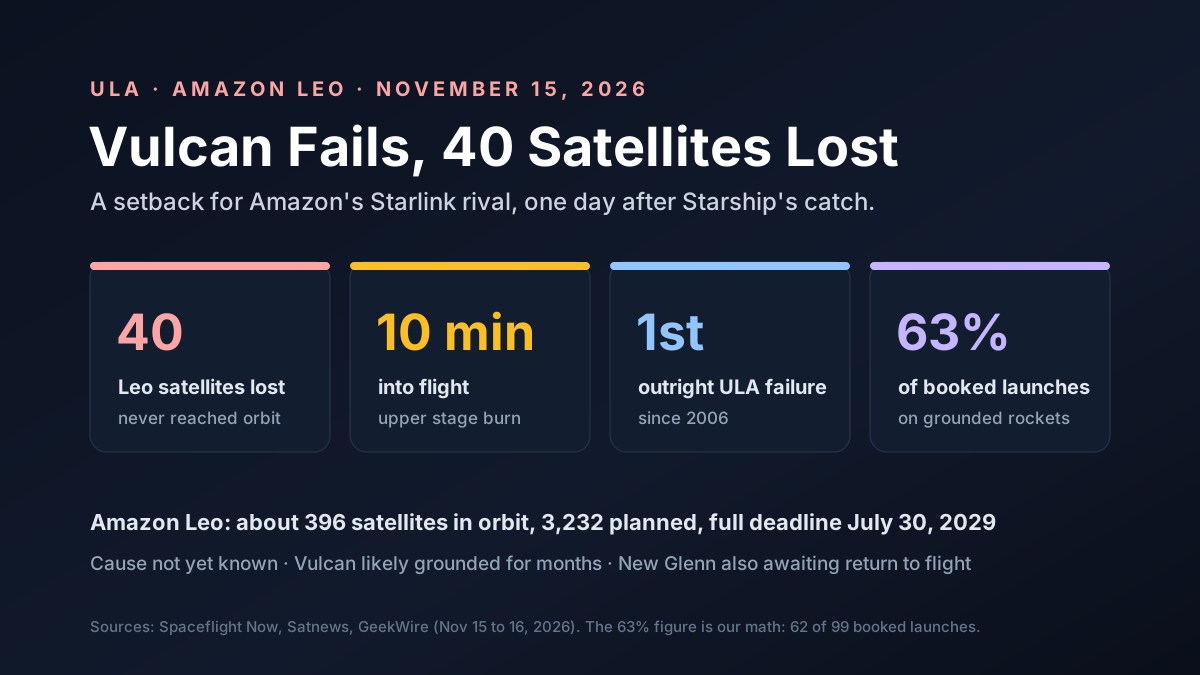
Amazon's satellite internet plans took a hard hit this weekend. On November 15, 2026, a United Launch Alliance (ULA) Vulcan Centaur rocket failed about 10 minutes after liftoff, and all 40 Amazon Leo satellites on board were lost.
It happened at 12:40 p.m. EST, which was 12:40 a.m. on November 16 in Vietnam. According to Spaceflight Now, it was ULA's first outright mission failure since the company was formed in 2006.
The timing made it worse. Just one day earlier, SpaceX caught a Starship upper stage after orbit. The contrast between Starlink's best day and its main rival's worst day was hard to miss.
This guide covers what happened, what it means for Amazon Leo and what tech and data teams can learn from a launch failure like this.
Key Takeaways
- 40 satellites lost. The Vulcan failed about 10 minutes into flight and never reached orbit.
- A rare failure. It's ULA's first total mission loss in about 20 years of flying, which is a rare record for any launch company in the business.
- Cause unknown. ULA said it didn't yet have data on what went wrong, and engineers will now spend weeks going through the flight data to find out.
- A big delay for Amazon. Vulcan carried 38 of Amazon's 99 booked Leo launches, and it's likely grounded for months.
- Two rockets down. Blue Origin's New Glenn, Amazon's other big launcher, is also waiting to fly again.
Vulcan Rocket Failure at a Glance
Here's what's been reported, as of November 16, 2026:
| Item | What's reported |
|---|---|
| Mission | Vulcan Leo 1 (LV-01), Vulcan's fifth flight |
| Liftoff | November 15, 2026, 12:40 p.m. EST, Cape Canaveral |
| Failure | Anomaly about 10 minutes into flight |
| Payload lost | 40 Amazon Leo satellites |
| Cause | Not yet known |
| Milestone | ULA's first outright failure since 2006 |
| Next | Investigation and a likely grounding |
ULA said the rocket "suffered an anomaly 10 minutes into the flight and failed to deliver the Amazon mission to orbit." It added that it had no specific data yet on what happened.
What Happened in the Vulcan Rocket Failure
The launch didn't come easily. It slipped twice before liftoff, then held at 20 seconds before launch for a technical issue. Here's the timeline, based on Spaceflight Now and Satnews:
| When (EST) | What happened |
|---|---|
| Friday, Nov 13 | Attempt scrubbed after a nitrogen plant outage at the Cape |
| Saturday, Nov 14 | Delayed by network problems between the rocket and ground systems |
| Sunday, T-20 seconds | Hold for a technical issue, then cleared |
| 12:40 p.m. | Liftoff at the end of the launch window |
| About 1:40 after liftoff | Solid boosters separate, appearing normal |
| About 10 minutes | Anomaly during the upper stage burn |
| About 50 minutes | ULA confirms the mission failed |
The six solid rocket boosters appeared to work normally. That matters, because boosters caused both of Vulcan's earlier problems, so ULA's fixes seem to have done their job and the trouble came later in the flight.
Spaceflight Now noted two odd signs from the webcast. The first stage burned longer than planned. Then the Centaur upper stage, which burns hydrogen and was meant to fire for about 12 minutes to reach orbit, made odd turns early in that burn.
The webcast ended without confirming the upper stage finished its burn. About 50 minutes after liftoff, ULA confirmed the failure.
It's not yet known whether the hold at T-20 seconds played any role. Treat any cause you see online as a guess until ULA publishes findings.
ULA's First Outright Failure Since 2006
ULA has a long record of reliable launches with its Atlas and Delta rockets. That's why this failure stands out.
Vulcan itself has had a rougher start. It's a new rocket, and this was only its fifth flight:
| Date | Vulcan event |
|---|---|
| January 2024 | First flight, a success |
| October 2024 | A solid booster nozzle fell off, payload still delivered |
| February 2026 | A similar booster problem on the USSF-87 mission |
| February to November 2026 | Nine-month stand-down for fixes |
| November 15, 2026 | Return to flight fails, 40 satellites lost |
Before this flight, ULA made two sets of fixes:
- Boosters: CEO Mark Peller said ULA found three likely causes of the nozzle problem and fixed all of them.
- Engines: Blue Origin improved a valve in the BE-4 engines on Vulcan's first stage, after a New Glenn rocket blew up on the pad in May.
Those fixes may have worked. The boosters looked normal. But a different problem still ended the mission. That's a hard lesson for any complex system.
What the Vulcan Rocket Failure Means for Amazon Leo
Amazon Leo, once called Project Kuiper, is Amazon's plan to take on Starlink. It needs thousands of satellites in low orbit to work at full scale.
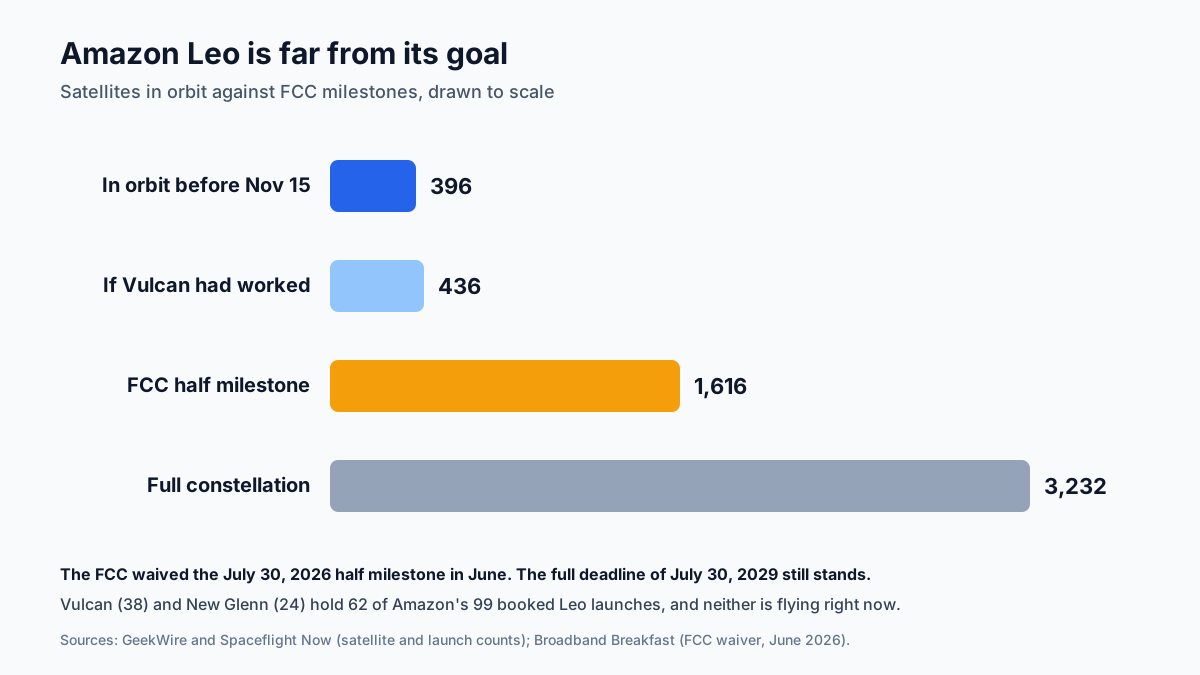
Before Sunday, Amazon had about 396 satellites in orbit, launched on 14 missions since April 2025, according to GeekWire. This flight would have brought the total to 436. The full plan calls for 3,232.
The bigger problem is launch capacity. Here's how Amazon's booked launches stack up, per Spaceflight Now:
| Rocket | Leo launches booked | Status as of November 16 |
|---|---|---|
| ULA Vulcan | 38 | Grounded pending investigation |
| Blue Origin New Glenn | 24 | Awaiting return to flight after a May pad explosion |
| Arianespace Ariane 6 | 24 | Flying |
| SpaceX Falcon 9 | 13 | Flying |
ULA has also flown eight older Atlas V rockets for Leo. But Atlas V is being retired, so Vulcan was meant to carry much of the load from here.
Amazon Leo's statement was calm. It said there's risk with any launch, "especially true for inaugural missions like LV-01," and called ULA a trusted partner.
The FCC Deadline Problem
Amazon's license from the FCC, the US telecom regulator, came with deadlines. It was meant to have half its network, 1,616 satellites, in orbit by July 30, 2026.
It didn't make it. In June 2026, the FCC granted a limited waiver instead of the two-year extension Amazon had asked for, as Broadband Breakfast reported. The key terms:
- The interim deadline was waived, but satellites launched after it can lose spectrum priority for a time.
- The final deadline stays. Amazon must have the full network up by July 30, 2029.
- Missing it has a cost. The license would shrink to the number of satellites actually working on that date, which could leave Amazon with far fewer than it planned.
So every lost launch matters. Forty satellites isn't a huge share of 3,232. But months of grounding could cost far more than this one flight.
The Vulcan Rocket Failure in Numbers
Here's our own math. These are estimates, not Amazon's numbers:
- Progress: 396 of 3,232 satellites is about 12% of the full network.
- Milestone gap: about 1,220 more satellites to reach 1,616.
- Launches needed: at 40 satellites per Vulcan-sized launch, that gap is roughly 31 launches.
- Grounded share: Vulcan and New Glenn together hold 62 of 99 booked launches, about 63%.
That last figure is the real risk. Nearly two thirds of Amazon's booked launches sit on rockets that aren't flying right now. For now, Amazon's active options are Ariane 6 and Falcon 9, which belongs to its main rival, SpaceX.
What It Means for Starlink and the Satellite Internet Race
Starlink already has a huge lead, with thousands of satellites in orbit and millions of customers. A one-day gap between SpaceX's first Starship catch and Vulcan's failure made that lead look even wider.
SpaceX flies its own rockets, so it controls its own schedule, while Amazon needs other companies' rockets and has to wait whenever one of them fails. Money can't fix that.
Still, one failure doesn't decide the race. Amazon has deep pockets, a working satellite design and launches booked on four rockets. It says initial service is still planned before the end of 2026 in the US, the UK and a few other countries. The question is how fast it can scale after that.
Lessons From the Vulcan Rocket Failure
You don't need to build rockets to learn from this. The same patterns show up in software, data and AI systems:
| What happened at ULA | The tech team version |
|---|---|
| The known booster problem was fixed, then a new one appeared | Fixing one bug doesn't make the whole system safe |
| Engineers depend on telemetry to find the cause | Keep detailed logs before you need them |
| Two of four launch providers are down at once | Don't put most of your plan on one or two vendors |
| ULA posted an update within about 50 minutes | Tell customers early, even with few answers |
The vendor point hits close to home for many teams. If most of your stack runs on one cloud or one AI provider, an outage there stops your work. We covered that risk in our post on Claude and Microsoft outages.
The "fixed one bug" point is just as common. Teams fix the problem that caused the last incident, add a test so that exact problem can't happen again, close the ticket and then relax. But the next failure often comes from somewhere new. Broad testing, not just a regression test for the last bug, is what catches it.
And flight data matters most after something breaks. ULA's engineers will rebuild the flight second by second from the data the rocket sent down. Your team can only do that if you logged enough before the incident, in enough detail, and kept those logs long enough to look back.
What It Means for Businesses Planning Satellite Internet
Some companies are planning around Amazon Leo for remote sites, ships, farms or backup links. If that's you, this failure is a reason to plan carefully, not to panic:
- Don't bet on a date. Treat Leo service dates as targets until coverage is live where you need it.
- Keep a backup link. Pair satellite internet with cellular, fiber or a second satellite provider.
- Buffer data locally. Make sure remote sites can store data and send it later if the link drops.
- Read the service terms. Check uptime promises and what happens if coverage slips.
Local buffering is the one data teams often miss. A pipeline that assumes a constant connection will lose data the first time a link goes down, and nobody may notice until a report comes up short weeks later. A store-and-forward pipeline won't.
How a Launch Failure Review Works
ULA will now lead a review with Amazon. Because this was a commercial launch, the FAA, the US air safety regulator, usually oversees it too. These reviews tend to follow the same steps:
- Collect the data. Gather every bit of data the rocket sent down, plus video and ground records.
- Build the timeline. Line up what each part of the rocket did, second by second.
- List the possible causes. Engineers build a fault tree, a map of everything that could explain what they saw.
- Rule causes in or out. Each branch is tested with data, ground tests or analysis.
- Fix and verify. The fix is tested on the ground, and often reviewed by the customer and regulators, before the rocket is cleared to fly again.
This can take weeks or months. Vulcan's last stand-down, for the booster problem, lasted nine months.
Sound familiar? It's a root cause analysis, and it only works if the data was captured in the first place.
Risks and Open Questions
There's still a lot we don't know:
- The cause: what failed during the upper stage burn, and whether it's linked to the hold at T-20 seconds
- The grounding: how long Vulcan stays down, which could be months
- National security launches: the Space Force has put its Vulcan missions on hold pending analysis
- New Glenn: when Blue Origin's rocket flies again for Amazon
- Insurance: whether the satellites were insured, which hasn't been disclosed
What to Watch Next
A few signals will show how deep the damage goes:
- ULA's first findings on what went wrong
- Vulcan's return-to-flight date, and whether Amazon flies on it next
- New Glenn's return to flight
- Amazon's next Leo launches on Ariane 6 and Falcon 9
- Leo service launch in the US and UK, promised before the end of 2026
Vulcan Rocket Failure: Our Take
This is a serious setback, but not a fatal one. Amazon lost 40 satellites. Worse, it lost months of launch time on its biggest rocket deal, and that delay will ripple through every plan that depended on those flights.
The deeper lesson is about dependence. Amazon spread its launches across four rockets. That was smart.
But two of them are grounded at once. That kind of risk is easy to miss on a spreadsheet, where each deal looks safe on its own and nobody asks what happens if two fail together.
For tech and data teams, the takeaways are familiar:
- Fix the last bug, but test widely.
- Log everything.
- Spread your risk across vendors.
- Tell people what you know early, even when you don't know much.
How Van Data Team Helps
We help teams build systems that keep working when a supplier or link fails:
- Data pipelines that buffer, retry and recover from outages, via data pipeline development.
- AI agents with fallbacks across model providers, through AI agent development.
- Monitoring dashboards for vendor health and data quality, through agentic BI reporting.
- Cloud cost and resilience reviews, through our cloud cost optimization service.
This article is based on ULA's statements and coverage by Spaceflight Now, Satnews, GeekWire and Broadband Breakfast as of November 16, 2026. Worried about vendor risk in your stack? Get in touch and we'll help you review it.
AI Model Brief
The AI models worth knowing, once a week
What shipped, how it scores on independent benchmarks, what it costs per million tokens and what was deprecated, from the data behind our AI model benchmarks.
We use your address only to send the brief. See our privacy policy.
See this week’s brief
Founder of Van Data Team. Builds Vanaxity, the AI agent system for SEO, GEO, and AEO, and leads data engineering delivery for B2B teams.
About the authorArticle FAQ
Questions readers usually ask next.
These short answers clarify the practical follow-up questions that often come after the main article.
Need a similar system?
If this article maps to a workflow your team already operates, the next step is usually a scoped review of the system, constraints, and rollout path.
Consultation
Scope your next AI workflow.
Share the system and blockers. We will map fit, gaps, and the next step.