SpaceX Starship Catch: What Ship 42 Means for Full Reuse
SpaceX caught Ship 42 with its tower arms after 14 orbits, the first Starship catch from orbit. What happened, why the booster was lost and what comes next.
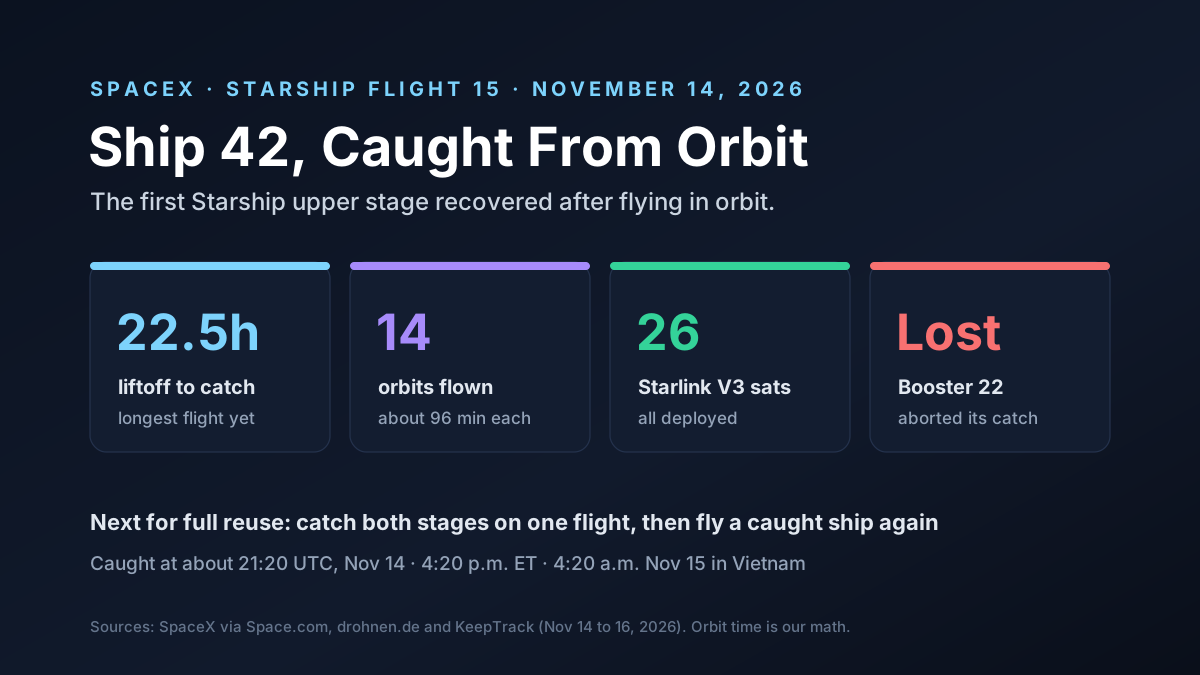
SpaceX just did something no one had done before. On November 14, 2026, it caught a Starship upper stage with the arms of its launch tower, after the ship had spent almost a day in orbit.
The Starship catch came at about 21:20 UTC, which was 4:20 a.m. on November 15 in Vietnam. Ship 42 had flown 14 orbits, released 26 Starlink V3 satellites and come home to Starbase in Texas.
SpaceX's Dan Huot summed it up on the webcast: "We caught a Starship. And now everything changes."
It wasn't a perfect day. The Super Heavy booster was lost offshore. But the ship catch is the piece SpaceX has been missing for years, and it matters well beyond rockets.
This guide covers what happened, why it matters, what went wrong and what teams that run complex systems can learn from it.
Key Takeaways
- A world first. Ship 42 is the first Starship upper stage caught after flying in orbit.
- A long flight. It flew for about 22.5 hours and circled the Earth roughly 14 times before heading home to the tower in Texas.
- A full payload. All 26 Starlink V3 satellites were deployed, and three of them took photos of the ship's heat shield for engineers.
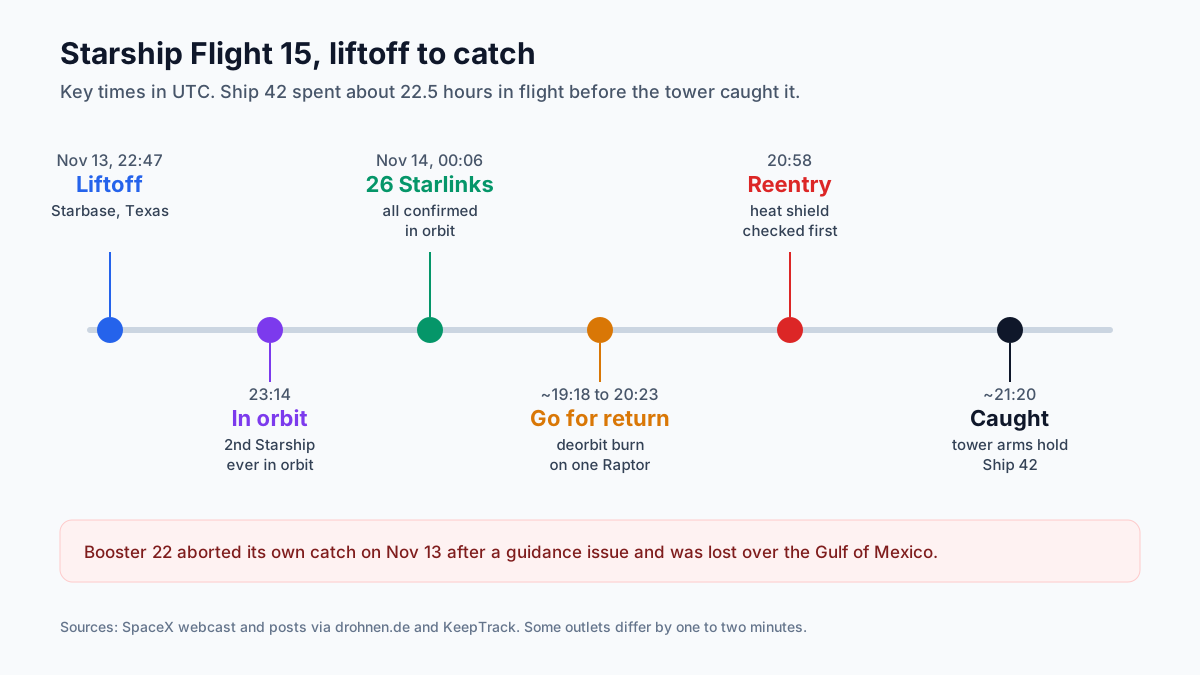
- A lost booster. Booster 22 aborted its own catch and was lost over the Gulf of Mexico.
- The big goal is closer. Full reuse of both stages now looks possible, but it hasn't been done yet.
SpaceX Starship Catch at a Glance
Here's what's been reported, as of November 16, 2026:
| Item | What's reported |
|---|---|
| Mission | Starship Flight 15 |
| Vehicles | Ship 42 and Super Heavy Booster 22, both Version 3 |
| Liftoff | November 13, 2026, 22:47 UTC, Starbase, Texas |
| Ship catch | November 14, about 21:20 UTC (4:20 p.m. ET) |
| Time in flight | About 22.5 hours, roughly 14 orbits |
| Payload | 26 Starlink V3 satellites, all deployed |
| Booster | Lost offshore after an automatic abort |
| First? | First Starship upper stage caught after orbit |
These details come from SpaceX's webcast and posts, as reported by drohnen.de, KeepTrack and Space.com. Times differ by a minute or two between outlets.
What Happened on Starship Flight 15
Flight 15 lifted off on the evening of November 13 local time. About 27 minutes later, Ship 42 reached orbit. That's only the second time a Starship has done so.
Then came the payload. The ship released 26 Starlink V3 satellites, and SpaceX confirmed all of them in orbit within about 40 minutes. Three of those satellites carried cameras. They turned around and photographed the ship's heat shield, so engineers could check it before reentry.
SpaceX said the images showed the heat shield was "healthy." So it skipped its backup plan of a splashdown in the ocean and went for the catch.
Here's the full timeline:
| Time (UTC) | Event |
|---|---|
| Nov 13, 22:47 | Liftoff from Pad 2 at Starbase |
| Nov 13, 23:14 | Ship 42 enters orbit, the second Starship to do so |
| Nov 13, 23:27 | Starlink V3 deployment begins |
| Nov 14, 00:06 | SpaceX confirms all 26 satellites in orbit |
| Nov 14, 20:23 | Deorbit burn on one Raptor engine |
| Nov 14, 20:58 | Reentry begins on the way back to Texas |
| Nov 14, 21:20 | Tower arms catch Ship 42 |
How the Starship Catch Worked
The return took several careful steps, each one a chance for something to go wrong:
| Step | What Ship 42 did |
|---|---|
| 1. Deorbit burn | Fired one Raptor engine to slow down and drop out of orbit |
| 2. Reentry | Fell back belly-first, with the heat shield taking the heat |
| 3. Flip | Swung from a belly-down glide to upright near the tower |
| 4. Landing burn | Lit three Raptor engines and slowed to a hover |
| 5. Catch | The tower arms closed and held it |
The tower's two arms, nicknamed "chopsticks," then closed around the ship. They didn't grab the body. They caught two small pins on either side, each sticking out only about a foot, per Ars Technica's account cited by KeepTrack.
That's a tiny target for a vehicle about 50 meters tall. The catch came less than a minute after the ship broke through the clouds.
What Happened to Booster 22
The plan was a double catch: booster and ship on the same flight. That part didn't work.
Booster 22 aborted its own catch late in its return. Here's the sequence SpaceX described:
- It detected a guidance, navigation and control problem.
- It canceled the tower catch on its own.
- It diverted to an offshore landing zone over the Gulf of Mexico.
- It hovered, shut down its engines and was destroyed by its flight termination system just before hitting the water.
Elon Musk gave a simpler reason on X. He said the engines slightly underperformed and the booster was low on fuel. Teslarati reports that Musk promised engine and software changes.
Still, the system worked. When something looked wrong, the booster chose a safe place to come down instead of risking the tower. That's a design choice worth copying, and we'll come back to it.
Why the Starship Catch Matters for Full Reuse
Rockets are expensive because most of them get thrown away. SpaceX changed that with Falcon 9, which lands and reuses its first stage. But Falcon 9's upper stage still burns up or stays in orbit after each flight, so every single mission needs a brand new upper stage built from scratch.
Starship is meant to fix that too. Both stages are designed to come back and fly again, like an airplane. Here's where that effort stands:
| Part | Before Flight 15 | After Flight 15 |
|---|---|---|
| Super Heavy booster | Caught several times since 2024 | Lost this time, catch still proven |
| Starship upper stage | Always expended | Caught intact after orbit |
| Both on one flight | Not done | Still not done |
| Ship flown again | Not done | Now possible in principle |
Catching the booster was hard. Catching the ship is harder, for three reasons:
- Speed: it comes back from orbit, far faster than a booster returning from a short climb.
- Heat: reentry heat can reach well over a thousand degrees, so the heat shield must hold up.
- Precision: after all that, it must slow down and hover precisely enough to land on two pins.
Now that it has worked once, the next steps are clear. Catch both stages on the same flight. Then inspect a caught ship, refuel it and fly it again. If SpaceX can do that often, and turn a ship around in days rather than months, the cost of reaching orbit could drop sharply for everyone who launches satellites.
The Starship Catch in Numbers
Here are the key numbers from Flight 15:
| Figure | What it is |
|---|---|
| 22.5 hours | Liftoff to catch, the longest Starship flight so far |
| 14 | Orbits completed by Ship 42 |
| 26 | Starlink V3 satellites deployed |
| 3 | Satellites with cameras to inspect the heat shield |
| About 1 foot | Size of each of the two pins the tower arms caught |
| 2nd | Time a Starship has reached orbit |
One more figure stands out. SpaceX says each Starlink V3 satellite adds about 1 terabit per second of capacity. It also says the 26 satellites on this flight equal about ten Falcon 9 launches of its older V2 Mini satellites.
Starship's Road to This Moment
This catch didn't come out of nowhere. It builds on more than two years of tests, with failures along the way:
| Flight | Date | What it proved |
|---|---|---|
| Flight 5 | October 2024 | First Super Heavy booster caught by the tower |
| Flight 14 | September 28, 2026 | First Starship in orbit, cut short by an engine failure |
| Flight 15 | November 13 to 14, 2026 | First ship caught after orbit, booster lost |
| Next | Not yet announced | Both stages caught on one flight, then a ship reflight |
Flight 14 is a useful contrast. It reached orbit in September 2026, but one ship engine failed during the climb. SpaceX cut the mission from about ten hours to about three and brought the ship down on one engine.
Less than two months later, Flight 15 flew almost a full day and came home in one piece. That's fast. It shows how quickly SpaceX turns each failure into a fix.
What It Means for Starlink and Satellite Internet
Starship's main day job, for now, is launching Starlink. The V3 satellites are much larger than earlier models and need Starship's size to get to orbit.
More capacity per launch means more internet bandwidth in orbit, sooner, and for customers that could mean better speeds and wider coverage over the next year or two. SpaceX said the new satellites could start serving customers within a few weeks.
It also widens the gap. Amazon's Leo network, Starlink's main competitor, had a very different weekend. One day after the catch, a ULA Vulcan rocket failed and lost 40 Amazon Leo satellites. We cover that in a separate post.
Worked Example: Reading the Flight Numbers
Here's our own math, to show what the reported numbers imply.
- Orbit time: 22.5 hours divided by 14 orbits is about 96 minutes per orbit.
- Altitude check: a 96-minute orbit fits a low orbit a few hundred kilometers up, and reports put the target at about 275 km.
- Capacity: if each V3 satellite adds about 1 terabit per second, as SpaceX says, 26 satellites add roughly 26 terabits per second.
- Caveat: that last figure is SpaceX's claim multiplied out, not a measured number.
The lesson is to check that numbers agree with each other. When orbit count, flight time and altitude line up, you can trust the report a bit more.
What Data and AI Teams Can Learn From Flight 15
You don't need a rocket to take lessons from this flight. Many of the same ideas apply to data pipelines and AI systems:
| What SpaceX did | The data team version |
|---|---|
| Booster aborted itself when something looked wrong | Pipelines that stop and fail safe on bad data |
| Satellites photographed the heat shield | Independent checks, not just self-reported health |
| Practice descents into the ocean first | Rehearse in staging before production |
| Backup splashdown plan kept ready | A tested rollback path for every release |
The booster abort is the clearest example. It did three things right:
- It noticed a problem on its own.
- It decided a catch wasn't safe.
- It moved somewhere it could fail without hurting anything else.
It lost the booster but protected the tower, which is far harder and slower to replace, and which SpaceX needs for every launch and catch that comes next.
Good data systems work the same way. When a pipeline sees bad data, it should stop and alert someone, not push the bad data into reports. Losing one run is cheap. Corrupting a dashboard that people trust is not.
The heat shield cameras are a second lesson. SpaceX didn't just trust the ship's own sensors. It used a separate view to check the most important part before the riskiest step.
For an AI agent, the same idea means checking its work with a separate test or reviewer before it takes an action you can't undo. We wrote about that in our guide to AI agent permissions.
Risks and Open Questions
There's still a lot we don't know:
- Ship condition: how much work Ship 42 needs before it could fly again
- Booster fix: whether engine and software changes solve the fuel problem
- Double catch: when SpaceX will catch both stages on one flight
- Reflight: when a caught ship will actually fly a second time
- Cadence: how fast SpaceX can launch, inspect and relaunch
Musk has said he expects weekly Starship flights at some point in the first half of 2027. Treat that as a goal. SpaceX's past timelines have often slipped.
What the Starship Catch Doesn't Prove Yet
It's easy to read too much into one good flight. Here's what Flight 15 didn't show:
- That a caught ship can fly again. Reuse means flying the same ship twice, after inspection and refueling, on a schedule measured in days or weeks, and that hasn't happened yet.
- That catches are reliable. One success is a start.
- That both stages can come back on one flight. The booster was lost this time.
- That costs have fallen. Cheaper launches depend on fast, low-cost turnaround, which is still unproven.
None of this takes away from the achievement. It just keeps it in proportion.
What to Watch Next
A few milestones will show whether full reuse is real. Here's our short list, in rough order:
- Flight 16, and whether it tries the double catch again
- A ship reflight, using a caught ship rather than a new one
- Propellant transfer in orbit, which NASA needs for Moon landings
- Starlink V3 service, and how much it lifts speeds for customers
- Rival progress, including Amazon Leo's next launches
We've also covered how space and AI are starting to overlap, in our posts on NASA and IBM's lunar foundation model and SpaceX's moves in AI.
SpaceX Starship Catch: Our Take
The Starship catch is a real milestone. A fully reusable rocket has been a dream for decades, and catching an upper stage after orbit is one of the hardest steps in that dream.
But it's one step, not the finish line. The booster was lost. No caught ship has flown again yet. The next few flights will show whether this becomes routine or stays a one-off.
For teams outside the space industry, the lesson is in how SpaceX got here:
- It tested often and failed in public.
- It kept safe fallbacks ready.
- It checked its own work with independent views.
Those habits work for data and AI systems too.
How Van Data Team Helps
We help teams build systems that fail safely and show what's going on:
- Data pipelines that stop on bad data and alert the right people, via data pipeline development.
- AI agents with checks, approvals and safe fallbacks, through AI agent development.
- Monitoring dashboards for system health and data quality, through agentic BI reporting.
- Cloud cost reviews for compute-heavy work, through our cloud cost optimization service.
This article is based on SpaceX's statements and coverage by Space.com, drohnen.de, KeepTrack and EarthSky as of November 16, 2026. Want help building systems with safe fallbacks? Get in touch and we'll help you plan it.
AI Model Brief
The AI models worth knowing, once a week
What shipped, how it scores on independent benchmarks, what it costs per million tokens and what was deprecated, from the data behind our AI model benchmarks.
We use your address only to send the brief. See our privacy policy.
See this week’s brief
Founder of Van Data Team. Builds Vanaxity, the AI agent system for SEO, GEO, and AEO, and leads data engineering delivery for B2B teams.
About the authorArticle FAQ
Questions readers usually ask next.
These short answers clarify the practical follow-up questions that often come after the main article.
Need a similar system?
If this article maps to a workflow your team already operates, the next step is usually a scoped review of the system, constraints, and rollout path.
Consultation
Scope your next AI workflow.
Share the system and blockers. We will map fit, gaps, and the next step.