OpenAI Robotics Team Disbanded: What It Means for Robot AI
The OpenAI robotics team is gone, folded into core research and Applied on a bet that GPT-6 Astra can run robots. What changed and what it means for your team.
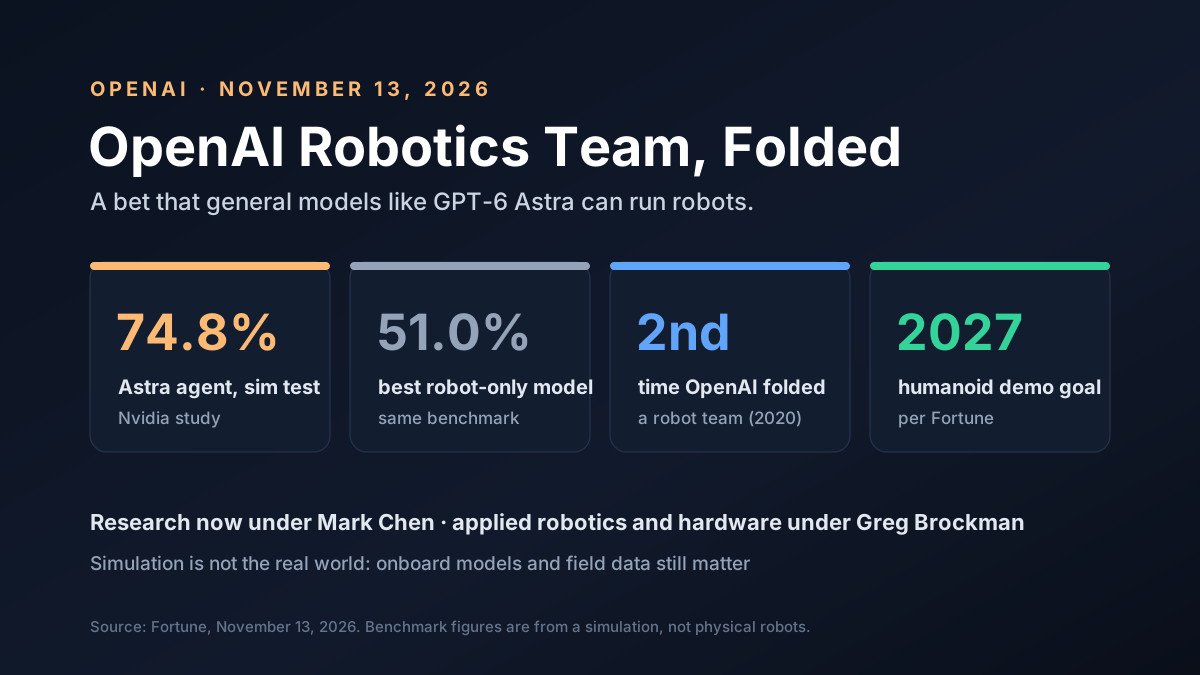
OpenAI just made a big bet about robots, and it did it by shrinking an org chart. On November 13, 2026, Fortune reported that OpenAI had dissolved its stand-alone robotics team and spread the staff across its core research and product groups.
The reason is the interesting part. OpenAI believes its general-purpose models, such as GPT-6 Astra, can now run robots without a separate robotics stack. If that's right, it changes how robot AI gets built, and who builds it.
This guide covers what changed, the data behind the bet, what experts think and what it means for robotics and data teams.
Key Takeaways
- The team is gone, the work isn't. Researchers moved under Mark Chen, and hardware staff under Greg Brockman.
- General models are the bet. OpenAI thinks models like GPT-6 Astra can handle robot tasks directly.
- The key number is from a simulation: 74.8% for an Astra-powered agent against 51.0% for specialized models, in an Nvidia study.
- It's the second time. OpenAI also wound down a robotics team in 2020.
- Hardware continues. A humanoid demo is reportedly targeted for 2027.
OpenAI Robotics Team Changes at a Glance
Here's what's been reported, as of November 15, 2026:
| Item | What's reported |
|---|---|
| News | OpenAI dissolved its stand-alone robotics team |
| Reported by | Fortune, November 13, 2026 |
| Researchers moved to | Main research, under Chief Research Officer Mark Chen |
| Applied and hardware staff moved to | Applied, under President Greg Brockman |
| Layoffs | None reported |
| Stated reason | General models such as GPT-6 Astra now handle robot tasks |
| Hardware plan | A humanoid demo targeted for 2027 |
An OpenAI spokesperson told Fortune that robotics "remains a core part of OpenAI's long-term vision." The company framed the change as a way to speed up robotics work, not drop it.
What Changed for the OpenAI Robotics Team
The move split one team into two homes. The research side joined OpenAI's main research group, under Chief Research Officer Mark Chen. The applied robotics and hardware side joined the Applied organization, under President Greg Brockman.
That split says a lot. Research now sits next to the people building the frontier models, and hardware sits next to the people who turn models into products.
In other words, robotics is no longer a side project with its own stack. It's one more thing the main models should do.
No layoffs were reported. Fortune described the change as reassignments, and Startup Fortune and AI Weekly carried the same account.
Why the OpenAI Robotics Team Was Folded Into the Main Models
The core claim is simple. Frontier models have become good enough at reasoning, vision and planning that they can control a robot directly, at least for many tasks.
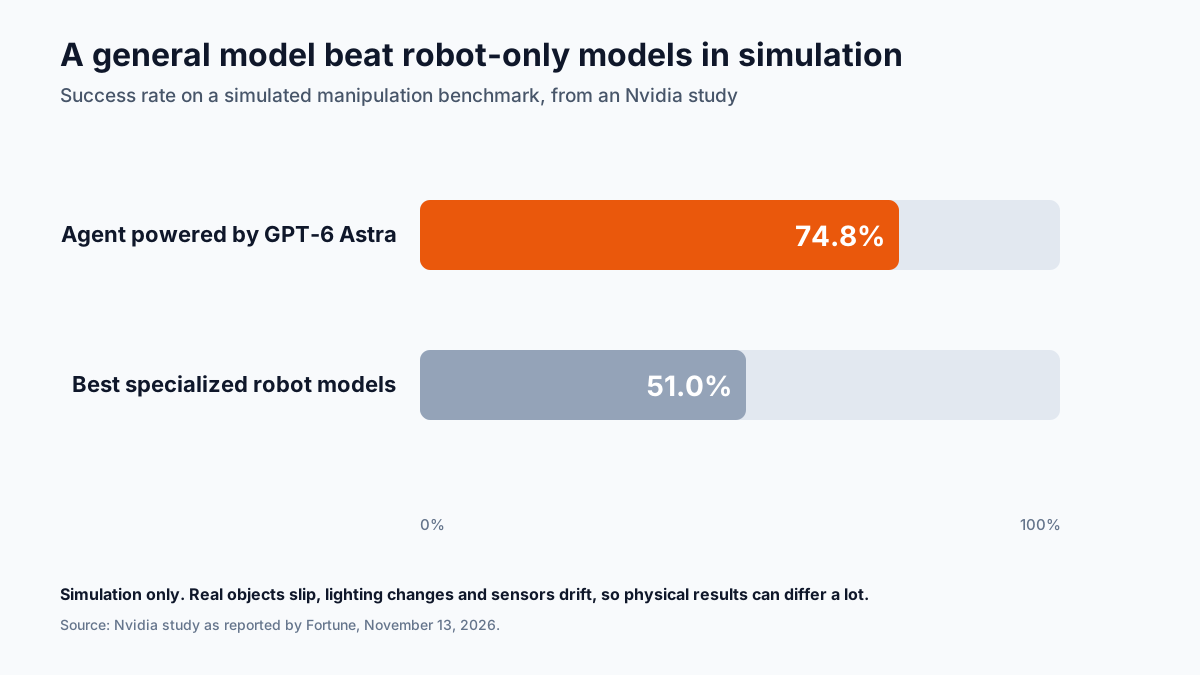
The number behind it comes from an Nvidia study cited by Fortune. On a simulated manipulation benchmark, an agent powered by GPT-6 Astra reached a 74.8% success rate. The best specialized robotic models on the same leaderboard reached 51.0%.
That's a big gap. It suggests a model trained mostly on text, images and code can beat models built only for robots, at least in simulation. If it holds up in the real world, it means robot makers could rent their brains instead of building them.
What Is GPT-6 Astra?
GPT-6 Astra is OpenAI's top model. It can read text, look at images and write code. It's the same kind of model people use for chat and coding, not a robot model.
That's what makes the news stand out. A model built for words and pictures is now doing robot work well enough that OpenAI dropped its special robot team. We compared Astra with other top models in our post on Claude Fable 5.2 and its rivals.
For robots, Astra's job is mostly planning. It looks at a scene, decides what to do and breaks the task into steps.
The OpenAI Robotics Team Story in Numbers
Here are the figures that matter in this story, all from Fortune's report:
| Figure | What it is |
|---|---|
| 74.8% | Astra-powered agent success on a simulated manipulation test |
| 51.0% | Best specialized robot models on the same test |
| 2020 | Year OpenAI wound down its first robotics team |
| February 2025 | When the Figure partnership ended |
| 2027 | Target for a first public humanoid demo |
Only one of these is a performance number, and it's from a simulation. The rest are dates and plans. That's worth keeping in mind before reading too much into the move.
The OpenAI Robotics Team's Second Ending
This isn't OpenAI's first exit from a dedicated robotics team. Here's the history, per Fortune:
| When | What happened |
|---|---|
| 2020 | OpenAI winds down its first robotics team, later blamed on limited robot data |
| 2024 | OpenAI rebuilds a robotics team and partners with Figure |
| February 2025 | Figure ends the partnership to build its own robot AI |
| November 13, 2026 | Fortune reports the stand-alone team is dissolved |
| 2027 | Target for a first public humanoid demo, per Fortune |
The 2020 reason is worth noting. Cofounder Wojciech Zaremba later said the team lacked enough robot data. That was the core problem with robot AI for years: you can't scrape the internet for robot movements the way you can for text.
The 2026 reason is the opposite. OpenAI now thinks general models carry enough knowledge about the world that robot-specific data matters less. That's a big shift in six years.
What Experts Say About the OpenAI Robotics Team Move
Not everyone is convinced the general model will win. Here's how three experts read it, per Fortune:
| Expert | Affiliation | View, per Fortune |
|---|---|---|
| Guanya Shi | Carnegie Mellon | Robotics is no longer a special problem, but small onboard models still matter |
| Russ Tedrake | MIT and Walden Robotics | Robots in real workplaces gain experience that helps them adapt |
| Pete Florence | Generalist | It's unclear any existing model will dominate robotics |
Shi's point about onboard models is important, because a robot working near people can't always wait for a cloud model on the other side of the internet to send back an answer.
It may need to react in milliseconds. Or keep working offline. That's a job for a smaller model running on the robot itself.
Tedrake's point is about data. Robots already working in real places collect experience that labs can't easily copy. That data is hard to fake. Companies with robots in the field may keep an edge, even if general models get better.
OpenAI's Humanoid Robot Plans
The team change doesn't mean OpenAI is out of hardware. Fortune reports that OpenAI is building its own humanoid robot, and that Sam Altman is aiming for a first public demo of it in 2027, roughly a year from now.
That fits the new setup in two ways:
- The hardware team now sits in Applied, close to the people who ship products.
- The robot's brain would come from the same general models OpenAI already sells to developers.
We don't know much more. OpenAI hasn't shared specs, a price or a launch date for a humanoid robot product, and it hasn't said which tasks the first version is meant to do or who it's for. Treat the 2027 date as a goal, not a promise.
Simulation Isn't the Real World
The 74.8% figure deserves care. It comes from a simulated benchmark, not from robots working in homes or factories.
Simulations miss a lot of what makes real work hard:
- Real objects slip, bend and break.
- Lighting changes through the day.
- Floors aren't flat, and people walk past.
- Sensors drift.
A model that aces a simulated pick-and-place task can still fumble a real cup. Reality is messier. Some coverage also reports far weaker results on physical hardware, though those figures aren't confirmed by Fortune.
So read the benchmark as a strong signal, not a proof. The real test is whether general models can do useful, repeatable work outside the lab.
General Models vs Onboard Models
The likely answer isn't one or the other. It's a split, with each kind of model doing the job it's good at:
| Job | General model in the cloud | Small model on the robot |
|---|---|---|
| Planning a task | Strong fit | Limited |
| Reacting in milliseconds | Weak, network delay | Strong fit |
| Working offline | Not possible | Possible |
| Learning new tasks | Strong fit | Needs retraining |
| Cost per action | Higher | Lower once deployed |
In this setup, a general model plans what to do, and a small model on the robot handles the fast, physical parts. Many robotics teams already work this way. OpenAI's move suggests the planning half is getting much stronger.
A Simple Robot AI Stack
It helps to see where each piece fits. Most robot systems have layers like these:
| Layer | What it does | Who usually builds it |
|---|---|---|
| Task planning | Decides what to do next | Now often a general model |
| Perception | Sees objects and people | General or vision models |
| Motion control | Moves arms and wheels safely | Robot maker |
| Safety stop | Halts when something goes wrong | Robot maker, on the robot |
OpenAI's bet is about the top two layers. The lower layers still need fast, local software. That's where most robotics firms spend their effort today, because a robot that plans well but moves badly is still a robot you can't put next to a person.
What It Means for Robotics Startups
For startups, this cuts both ways. Here's the upside:
- No need to build a giant planning model from scratch.
- More focus on hardware, safety and real-world deployment.
- Faster setup for new tasks.
And the downside:
- A home-grown robot model now has to beat a frontier model that improves every few months.
- Relying on a rented model adds cost and a supplier you don't control.
Pete Florence's caution applies here: it's not clear any one model will dominate.
We covered how investors are treating the space in our post on physical AI funding. OpenAI's move may push more money toward hardware and deployment, and less toward stand-alone robot models.
What It Means for Companies Buying Robots
If you buy or lease robots for a warehouse, a store or a plant, this news is mostly good. Smarter planning models could make robots easier to set up for new tasks.
But don't change plans on one headline. Ask your vendor three things:
- Which model plans the robot's tasks, and where does it run?
- What happens if the network goes down mid-task?
- How is each new task tested before it runs near people, and who signs off on it at your site?
Good answers will be specific. Vague answers are a sign the system isn't ready for your floor.
What It Means for Data Teams
Robots run on data, and that doesn't change. What changes is which data matters most.
If general models handle planning, the valuable data shifts to the real world:
- Field logs from robots doing real work, with failures labeled
- Task success data measured the same way across sites
- Safety events, such as near misses, recorded and reviewed
- Simulation runs linked to real outcomes, to see where sims mislead
Teams that can collect, clean and compare this data will be able to judge any model, general or specialized, on their own tasks. That's more useful than trusting a leaderboard.
Start small. Pick one task. Log every attempt with the same fields and review failures each week. A few hundred clean, labeled attempts will tell you more about a model than any press release or leaderboard, because they come from your own robots doing your own work.
Worked Example: Why Benchmark Size Matters
Here's our own math, to show why one benchmark number needs context.
Say a benchmark runs 100 trials, and a model succeeds on 75. The true success rate could easily be anywhere from about 66% to 83%, using a standard 95% confidence range. With 1,000 trials, the range narrows to roughly 72% to 78%.
That's why trial counts matter. A gap like 74.8% against 51.0% is large enough to matter even with modest samples. But small gaps between models on small tests often mean very little.
When you evaluate robot AI for your own work, run enough trials to trust the result, and run them on your own tasks.
Lessons From the OpenAI Robotics Team Move
Even if you never touch a robot, there's a broader lesson. A simple one. General models keep taking over jobs that used to need special models.
It happened with translation, then with code, and now it may be happening with robot planning. Each time, teams that built narrow tools had to ask whether a general model could do the job better or cheaper.
So check your own stack:
- List the special models you run for single tasks.
- Test a general model on the same task every few months.
- Compare accuracy, speed and cost side by side.
The answer may change faster than you expect.
Risks and Open Questions
There's a lot we still don't know:
- Real-world results: how general models perform on physical robots at scale
- Latency and cost: whether cloud models can be fast and cheap enough per action
- Safety: how a general model is tested before it moves heavy objects near people
- The humanoid: what OpenAI's robot will do, and when it ships
- Talent: whether robotics experts stay once their team is folded into larger groups
The talent question matters. Folding a team can speed things up, but it can also scatter the people who know robots best.
What to Watch Next
A few signals will show whether the bet pays off:
- Real-world demos of GPT-6 Astra or later models running robots
- OpenAI's humanoid, with a public demo targeted for 2027
- Partnerships with robot makers that want to license OpenAI's models
- Independent benchmarks on physical hardware, not just simulation
- Moves by rivals, such as Google DeepMind, that run their own robotics programs
OpenAI Robotics Team: Our Take
OpenAI's move is a confident bet that robot intelligence is becoming a special case of general intelligence. The simulation results support it, and the org change makes it official.
But robots live in the real world, and that's where the hard problems are. For most teams, the practical lesson is to keep options open: use general models where they plan well, keep fast models on the robot, and build the data to judge both on your own tasks.
And watch 2027. If OpenAI shows a humanoid doing useful work with a general model at its core, the debate will shift quickly. If it doesn't, specialized robot AI will have more time to prove itself.
How Van Data Team Helps
We help teams build the data side of robotics and physical AI:
- Data pipelines for robot logs, sensor data and simulation runs, via data pipeline development.
- Evaluation agents that test models on your own tasks and track results, through AI agent development.
- Dashboards for task success, safety events and model comparisons, through agentic BI reporting.
- Compute cost reviews for training and simulation, through our cloud cost optimization service.
This article is based on Fortune's November 13, 2026 report and related coverage as of November 15, 2026. Planning a robotics data stack? Get in touch and we'll help you scope it.
AI Model Brief
The AI models worth knowing, once a week
What shipped, how it scores on independent benchmarks, what it costs per million tokens and what was deprecated, from the data behind our AI model benchmarks.
We use your address only to send the brief. See our privacy policy.
See this week’s brief
Founder of Van Data Team. Builds Vanaxity, the AI agent system for SEO, GEO, and AEO, and leads data engineering delivery for B2B teams.
About the authorAI model benchmarks
Models in this article
Current pricing, context window and independent scores for each model.
Article FAQ
Questions readers usually ask next.
These short answers clarify the practical follow-up questions that often come after the main article.
Need a similar system?
If this article maps to a workflow your team already operates, the next step is usually a scoped review of the system, constraints, and rollout path.
Consultation
Scope your next AI workflow.
Share the system and blockers. We will map fit, gaps, and the next step.