Why AI Stocks Fell on Record Results: 5 Lessons for Buyers
AI stocks fell on November 2 despite record results at Anthropic, Apple and Palantir. What the numbers showed, why investors sold and what it means for buyers.
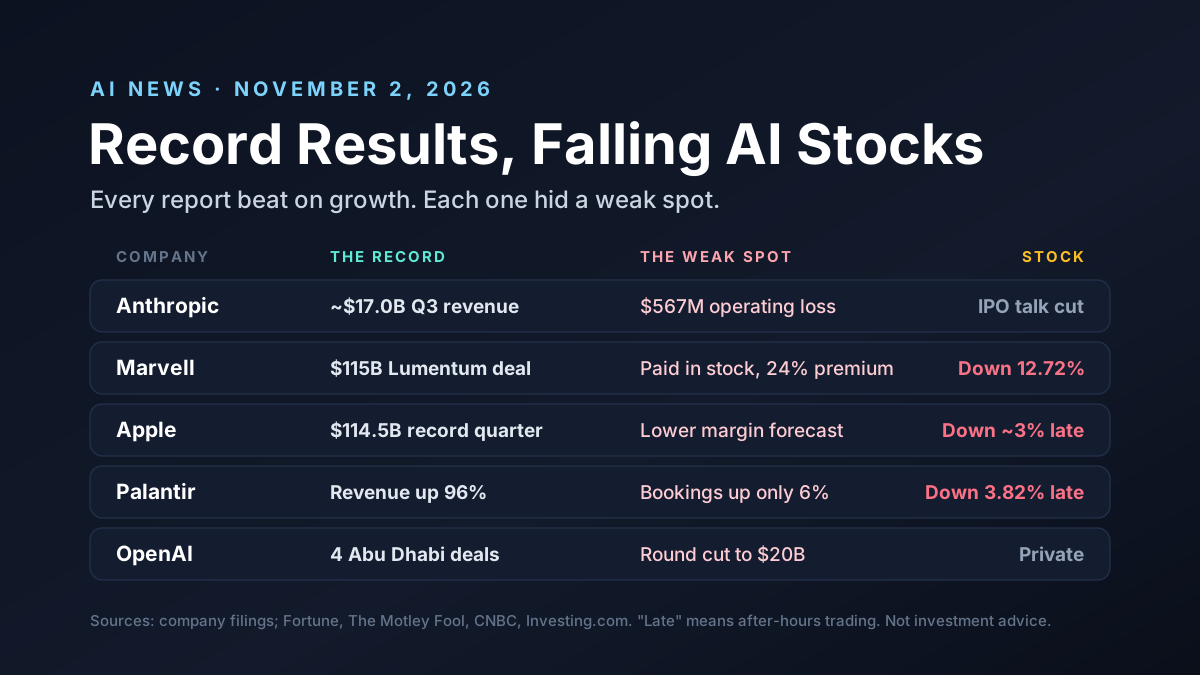
AI stocks fell on November 2, 2026, a day of record numbers. Anthropic showed about $17 billion in sales for one quarter, Apple posted its best September quarter and Palantir grew 96%. Yet investors sold, because each report hid a weak spot: rising compute costs, a pricey deal, thinner margins or slower bookings.
Marvell dropped almost 13%. Apple and Palantir slid after hours. Even Anthropic's future investors pushed for a lower IPO price.
This guide walks through each report on this AI earnings day. Then it shows what the numbers mean for companies that buy AI tools, models and computing power, which is the part most stock news skips.
Disclosure and scope: Van Data Team builds data and AI systems for clients. We use models from several providers, including Anthropic's Claude, and we drafted this article with help from Claude. We have no business ties to Marvell, Lumentum, Apple or Palantir.
Facts come from company filings and from news reports by Fortune, the Wall Street Journal, CNBC and others. We label our own math. This isn't investment advice.
Key Takeaways
- Anthropic: revenue hit about $17 billion in the third quarter, but growth slowed to 47% and the company swung to a $567 million operating loss.
- Marvell: it agreed to buy Lumentum, the laser maker, for $115 billion in stock. Its shares closed down 12.72%.
- Apple: revenue rose 12% to a record $114.5 billion. A lower margin forecast sent the stock down about 3% after hours.
- Palantir: revenue nearly doubled, to $2.313 billion, but the value of new contracts it signed grew only 6%, and investors sold the stock anyway.
- OpenAI: four deals in Abu Dhabi, and a smaller funding round than planned.
- For buyers: AI costs are rising at the supplier level, so expect pricing changes and check your vendors' health.
AI Stocks on November 2 at a Glance
| Company | The record | The weak spot | Stock move |
|---|---|---|---|
| Anthropic | About $17 billion in third-quarter revenue | A $567 million operating loss | Not listed yet; price talk cut to $1.5 to $1.6 trillion |
| Marvell | A $115 billion deal for Lumentum | A 24% premium paid in shares | Down 12.72% at the close |
| Apple | $114.5 billion, a September-quarter record | A lower margin forecast | Down about 3% after hours |
| Palantir | Revenue up 96% to $2.313 billion | New bookings up only 6% | Down 3.08%, then 3.82% after hours |
| OpenAI | Four deals in Abu Dhabi | A funding round cut to $20 billion | Private company |
Sources: Fortune, The Motley Fool, CNBC, Investing.com and company filings.
Why Did AI Stocks Fall on a Day of Record Numbers?
The records were already priced in. Investors had bid AI stocks up for months on the hope of fast growth. So when the growth showed up, they went looking for the next problem. They found one in almost every report, from Anthropic's compute bill to the slower flow of new contracts at Palantir.
The mood was fragile anyway. The Nasdaq had fallen about 10% from its recent high, the Wall Street Journal reported. Doubts about when AI spending pays off had been building for weeks, as we covered in our look at AI bubble fears.
Each report fed those doubts its own way:
- Costs rose faster than sales at Anthropic.
- Marvell paid a rich price, in shares.
- Apple warned about memory costs.
- Palantir's pipeline of new contracts slowed sharply, even as revenue nearly doubled and profit topped $1 billion.
None of that means these companies are weak. The bar is just very high.
The Anthropic S-1/A: $17 Billion and a Swing to a Loss
The Anthropic S-1/A, filed on November 2, is the updated paperwork for its stock market listing. It gives the first audited look at the quarter that ended September 30. That's new.
Revenue reached about $17 billion, up from $11.6 billion in the second quarter and $1.4 billion a year earlier, Fortune reported. That's a jump of about 1,127% in a year, by our math. Huge.
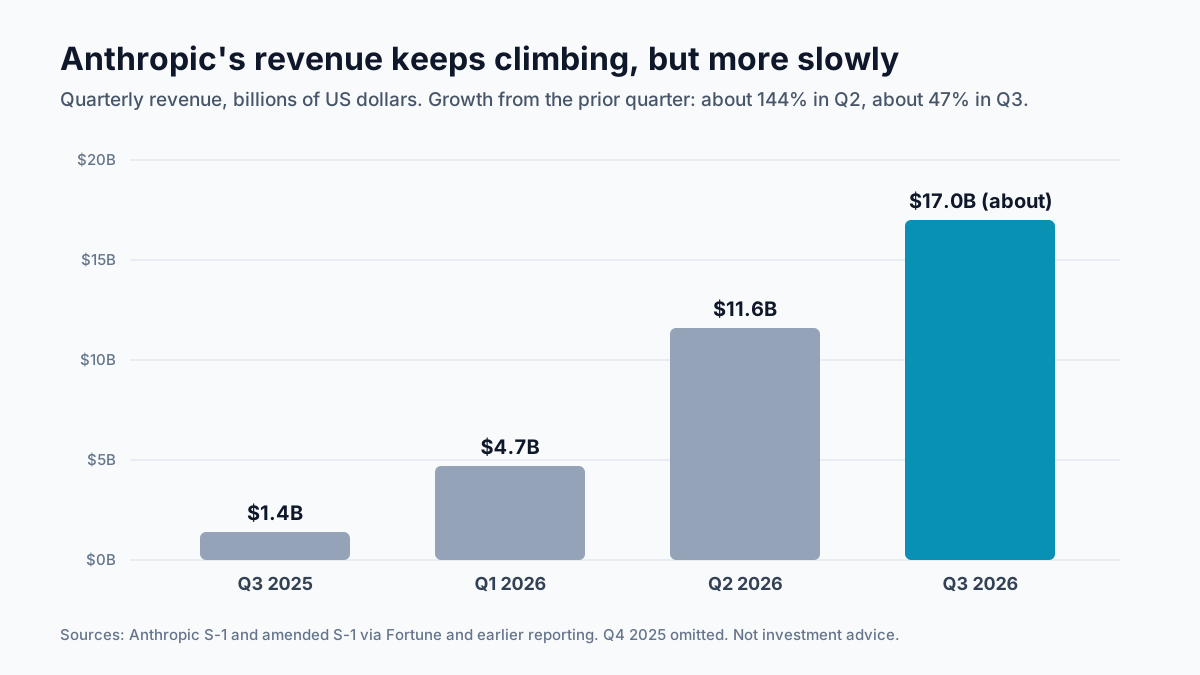
But growth from the prior quarter slowed to about 47%, from about 144%. And costs grew faster than sales.
| Measure | Second quarter 2026 | Third quarter 2026 |
|---|---|---|
| Revenue | $11.6 billion | About $17.0 billion |
| Growth from the prior quarter | About 144% | About 47% |
| Total operating costs | $10.6 billion | $17.5 billion |
| Operating result | $974 million profit | $567 million loss |
| Adjusted operating margin | 19% | 15% |
The result was a $567 million operating loss, after a $974 million profit in the second quarter. One outlet, SiliconANGLE, gives the loss as $536 million, so check the filing before you quote an exact figure.
Why the swing? The filing blames compute bought on short notice, which it says "currently costs significantly more" than compute under long-term deals. Demand simply ran ahead of plan. A $2 billion non-cash charge for an employee donation program added to the loss. Costly.
Two more details matter for buyers:
- Prices fell while costs rose. Price cuts took about $600 million off sales between the second and third quarters, Fortune reported.
- Most of it was paper. The $23.3 billion net loss came largely from an accounting charge on convertible notes. We explained that kind of loss in our review of the first Anthropic S-1 draft.
Still, Anthropic made money on an adjusted basis, a measure that leaves out stock-based pay and the donation charge. Its adjusted margin was 15%, down from 19%.
The $895 Billion Compute Bill
The biggest number in the filing isn't revenue. It's commitments.
Anthropic has promised to spend about $895.4 billion, mostly on computing power and data centers, SiliconANGLE reported. Where does it go? Here's the split, as reported, with the biggest deals listed first:
- Google and Broadcom leases: nearly a third of the total.
- Amazon, Oracle and SpaceX: more than $100 billion each.
- Purchase deals: about $314 billion, up from about $55 billion at the end of 2025.
That's more than 13 times its yearly sales pace, by our math. A lot. Deals like these are paid over many years, and they buy the capacity growth needs. So the figure isn't reckless. But it locks in a large fixed cost that has to be paid even if demand slows, and investors know it.
The cushion is real, too. Anthropic held about $146.6 billion in cash, short-term investments and an open credit line, Fortune said.
The Risk Factor Few Companies Write: Self-Improving AI
The filing also added an unusual risk. It warns that Anthropic's future models may soon reach its own threshold for AI that speeds up AI research. That idea is called recursive self-improvement, or RSI. We covered it in our piece on the AI slowdown debate.
According to Gizmodo and other coverage, the filing makes three points:
- No model has crossed the line yet. Anthropic hasn't designated any current model as past its threshold.
- It could come soon. Future models may meet that definition imminently.
- It has missed speed-ups before. The company admits it didn't notice one big acceleration until after it happened, and it warns that the same thing could happen again with a future model.
Anthropic says it may require human review of some research tasks its models now run alone. Read all of this with care. The estimate is Anthropic's own, and no outside body has checked it. Skeptics also note that an IPO filing is a sales pitch as much as a warning.
What the Anthropic IPO Price Talk Says About AI Stocks
Big investors want to pay less. Much less. They're pushing for about $1.5 trillion to $1.6 trillion, below the roughly $2 trillion talked about in recent months, the Wall Street Journal reported.
Bankers may start pitching the stock to funds next week. The listing is aimed at the week before Thanksgiving, on November 26. No price range yet.
Here's a quick check. Our math only.
Take the latest quarter and multiply by four, and you get a yearly sales pace of about $68 billion for the whole company. At $1.5 trillion, the stock would trade at about 22 times that. At $1.6 trillion, it's about 24 times.
That's high, but not strange for a company that grew more than tenfold in a year. The real question is how long that pace lasts. Slowing growth, a swing to a loss and a huge compute bill all tell investors to ask for a margin of safety.
Why Did Marvell Pay $115 Billion for Lumentum?
Marvell, which designs chips, agreed to buy Lumentum on November 2, Marvell said. TechCrunch calls it one of the largest deals in tech history.
| Term | What Marvell announced |
|---|---|
| Price | About $115 billion including debt, or about $1,132 a Lumentum share |
| Payment | All stock: 4.5 Marvell shares for each Lumentum share |
| Premium | About 23.9% over the October 28 close |
| Ownership after | About 67% Marvell holders, 33% Lumentum holders |
| Savings target | More than $1 billion a year |
| Expected close | First half of 2028 |
Why would a chip company want a laser maker? Lumentum makes lasers and light-based parts that move data between GPUs in AI data centers. As clusters grow, copper wires can't keep up. Light takes over.
Nvidia saw the same thing. It invested $2 billion in Lumentum in March, along with a multiyear supply deal, Lumentum said. The companies now say the combined business targets a $550 billion market, a company estimate.
How AI Stocks Judged the Lumentum Deal
Badly. Marvell closed down 12.72% at $171.41, and Lumentum fell 18.59%, The Motley Fool reported. The main fear was that Marvell is buying at the top, after Lumentum's stock rose more than fivefold in a year.
There's a telling gap, by our math. At Marvell's closing price, 4.5 shares were worth about $771, well above Lumentum's close of $684.40.
When a target trades that far below the deal price, the market is doubting something. But what? Two things, mainly:
- The deal itself. It may close on worse terms, or not at all.
- Marvell's shares. They may not hold their value through 2028, since the deal won't close for well over a year and chip stocks can swing hard in that time.
Apple's Record Quarter and the Memory Squeeze
Apple's results looked strong. Revenue rose 12% to $114.5 billion in the quarter that ended September 26, a record for that quarter, per Apple's filing. It was John Ternus's first earnings call as chief executive.
| Product line | September quarter 2025 | September quarter 2026 | Change |
|---|---|---|---|
| iPhone | $49.03 billion | $57.58 billion | +17.5% |
| Mac | $8.73 billion | $10.79 billion | +23.7% |
| iPad | $6.95 billion | $6.23 billion | -10.4% |
| Wearables, Home and Accessories | $9.01 billion | $8.30 billion | -7.9% |
| Services | $28.75 billion | $31.57 billion | +9.8% |
| Total | $102.47 billion | $114.48 billion | +11.7% |
Growth rates are our math from Apple's figures. A few points stand out:
- iPhone sales rose 17.5%, with only about eight days of iPhone 18 Pro sales in the quarter.
- The iPhone Duo, Apple's first foldable, went on sale October 23, after the quarter closed.
- Full-year revenue reached $478.8 billion.
So why did the stock fall? Margins. The gross margin was 47.9%, including about one point from tariff refunds. For the December quarter, Apple guided to 45% to 46%, below the 46.3% analysts expected, CNBC reported.
The cause is memory. Ternus called memory prices "unprecedented" and said costs would keep rising.
AI data centers are buying huge amounts of memory chips, and that pushes up prices for everyone else, phones included. Its sales forecast, 7% to 10% growth, beat hopes. It didn't matter.
Palantir Bookings Slow as Revenue Nearly Doubles
Palantir sells data and AI software to firms and governments. Its third quarter was its biggest ever, per Palantir's release.
| Measure | Third quarter 2026 | Change from a year earlier |
|---|---|---|
| Revenue | $2.313 billion | +96% |
| US commercial revenue | $984 million | +148% |
| US government revenue | $953 million | +96% |
| New contract value (TCV) | $2.918 billion | +6% |
| Net income | $1.128 billion | 49% margin |
US commercial revenue passed US government revenue for the first time. The company also raised its full-year forecast to about $8.53 billion.
Then why the selloff? Palantir bookings. The value of new contracts, which it calls TCV, rose just 6%, after growing 49% in the second quarter, per Palantir's Q2 release.
Bookings matter because they lead revenue. A contract signed today turns into sales over the next few years. So slower bookings can mean slower sales later, even after a great quarter.
The stock fell 3.08% in regular trading and 3.82% more after hours, to $171.52, Investing.com reported. Harsh, but normal.
OpenAI Funding and the Abu Dhabi Deals
OpenAI isn't public, but its day fit the same pattern. Sam Altman met Abu Dhabi's crown prince, and the two sides signed four agreements at the ADIPEC energy conference, CNBC reported. They include:
- ADNOC, the state oil company, which says it's the first energy company to use OpenAI Frontier, a platform for AI agents, with G42.
- Mubadala and Inception42, a G42 unit, which will use OpenAI models for investment analysis.
- Abu Dhabi's government, which is turning its rules into a form AI systems can read directly.
The timing isn't random. Here's what reports say about OpenAI funding:
- Size: up to $20 billion, down from about $30 billion.
- Value: about $1.25 trillion, down from $1.4 trillion floated earlier.
- Lead: UAE investors, with Coatue among the backers.
Like Anthropic, OpenAI is finding that investors want a lower price.
Five Signals AI Stocks Sent This Week
Put the five reports side by side, and a pattern appears:
| Signal | Where it showed up | What it tells a buyer |
|---|---|---|
| Compute costs bite | Anthropic's swing to a loss | AI prices may not keep falling as fast |
| Bookings lead revenue | Palantir's 6% bookings growth | Ask vendors about pipeline, not only sales |
| Memory is scarce | Apple's margin forecast | Hardware and GPU costs stay high |
| Big deals take years | Marvell's 2028 close | Supplier roadmaps can shift mid-contract |
| Capital gets pricier | OpenAI's smaller round | Vendors will push harder for revenue |
The common thread is cost. Computing power, memory and capital all got more expensive at once. AI companies can't pass all of that on yet, because they're still fighting for market share. They'll try.
What Do AI Stocks Mean for Companies Buying AI?
You don't need to own AI stocks to feel this. The same pressures land on your invoices:
- Prices may stop falling as fast. Anthropic cut prices while its costs rose, which can't last. Expect new tiers, usage caps and changes to how plans count tokens, as in the AI model price war.
- Hardware stays expensive. Apple's memory warning applies to servers, laptops and GPU time too.
- Vendor health matters. Public AI companies get pushed hard on margins every quarter, and that pressure can change products, support and terms.
- Portability is insurance. Keep a tested second option, as we explained in our guide to model portability.
A Worked Example: Reading a Vendor's Numbers
Picture a 40-person software company that spends about $9,000 a month on AI, mostly on one model provider's API.
After this week's news, the finance lead spends an afternoon reading that provider's latest results. Margins fell. Compute costs rose. Prices were cut, and that mix suggests price changes within a year.
So the team takes three steps:
- It moves its biggest workload to a fixed six-month commitment.
- It tests its 30 most common tasks on a second model. 24 work well enough.
- It sets an alert for any month where spending jumps more than 20%.
Total cost: about two days of work. If prices rise 15% next year, the team already has a plan, a tested backup and a budget that won't surprise anyone. Our guide to token efficiency covers the alerts.
What Not to Read Into One Day of AI Stocks
- A stock drop isn't a business failure. Palantir nearly doubled its sales, and Apple set a record.
- Price talk isn't a price. Anthropic hasn't set a range.
- Company estimates aren't facts. The RSI warning and the $550 billion market are both company claims, and no one outside the companies that made them has checked either one.
- Don't switch vendors in a panic. Test first.
- Don't trade on this article. We're a data and AI firm, not financial advisers.
What to Watch Next
- Anthropic's roadshow and price range, expected as soon as next week, and the listing before Thanksgiving.
- Regulators' view of Marvell and Lumentum, given the deal's size and its 2028 close.
- Memory prices. They hit Apple's margins first. Server budgets come next.
- Palantir's next bookings, to see whether 6% growth was a one-quarter blip or the start of a slower run for its US business.
- OpenAI's round, and whether it closes at $1.25 trillion.
AI Stocks: Our Take
November 2 didn't show an AI collapse. It showed AI businesses growing fast while their costs grow fast too, and investors who have stopped paying for growth alone.
For buyers, that's useful news, because it tells you where prices and terms are likely to go. Know your vendors' numbers. Keep a second option tested, and budget for AI costs that don't only fall.
How Van Data Team Helps Teams Control AI Costs
We help teams build AI systems that stay affordable and portable as the market shifts:
- Cost tracking by model, feature and team.
- Model routing, so you can move work between providers by config.
- Test sets that score a second model on your real tasks.
- Cloud cost reviews for GPU, storage and data pipeline spend.
Explore our AI agent development and cloud cost optimization services, or get in touch for a quick review of your AI spend.
AI Model Brief
The AI models worth knowing, once a week
What shipped, how it scores on independent benchmarks, what it costs per million tokens and what was deprecated, from the data behind our AI model benchmarks.
We use your address only to send the brief. See our privacy policy.
See this week’s brief
Founder of Van Data Team. Builds Vanaxity, the AI agent system for SEO, GEO, and AEO, and leads data engineering delivery for B2B teams.
About the authorArticle FAQ
Questions readers usually ask next.
These short answers clarify the practical follow-up questions that often come after the main article.
Need a similar system?
If this article maps to a workflow your team already operates, the next step is usually a scoped review of the system, constraints, and rollout path.
Consultation
Scope your next AI workflow.
Share the system and blockers. We will map fit, gaps, and the next step.