GPT-6.2 Usage Limits: Why Astra Now Runs Out 40% Faster
GPT-6.2 usage limits explained: why OpenAI's billing fix makes Astra hit limits 40% faster and Sol 25% faster, what the reset covers and what changes next.
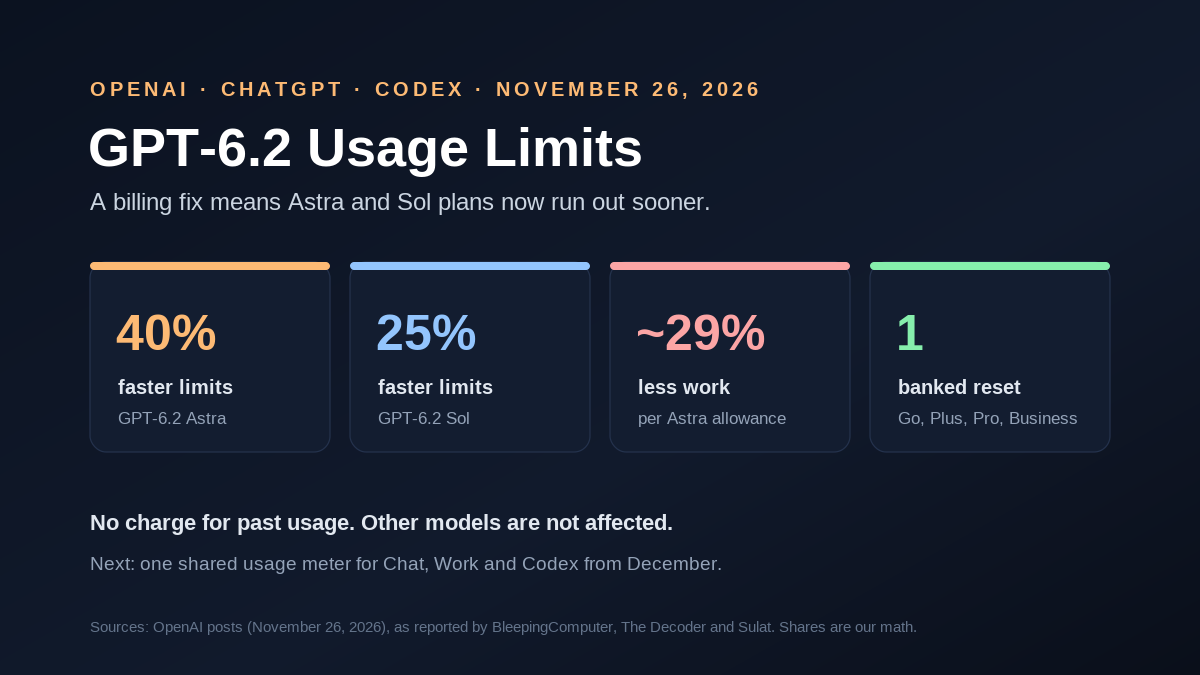
Running out of ChatGPT or Codex usage sooner this week? You're not imagining it. GPT-6.2 usage limits got tighter on November 26, 2026, when OpenAI fixed a billing mistake that had quietly been counting a big share of Astra and Sol usage at a discount since the models launched nine days earlier.
The result: paid users now hit limits 40% faster on GPT-6.2 Astra and 25% faster on GPT-6.2 Sol than they did the week before.
Below: what went wrong, what OpenAI is giving back, what the numbers really mean and how to plan your work around the new limits.
Key Takeaways
- The fix: OpenAI says a billing mistake wrongly discounted GPT-6.2 Astra and Sol usage for most users. It's now fixed.
- The impact: you reach limits 40% faster on Astra and 25% faster on Sol. Other models aren't affected.
- The math: 40% faster means about 29% less work per allowance, not 40% less (our math).
- The make-good: no charge for past usage, plus one banked reset for Go, Plus, Pro and Business users.
- Next up: from December, Plus, Pro and Business move to one shared meter for Chat, Work and Codex.
- Our view: route routine work to lighter models, save the reset and price the API if you're a heavy user.
GPT-6.2 Usage Limits at a Glance
Here's the short version, as of November 28, 2026:
| Item | Details |
|---|---|
| Announced | November 26, 2026, on X |
| Who announced | Tibo Sottiaux, who works on Codex and ChatGPT |
| The problem | A billing mistake discounted GPT-6.2 usage for most users |
| Models affected | GPT-6.2 Astra and GPT-6.2 Sol only |
| Astra limits | Reached 40% faster than the week before |
| Sol limits | Reached 25% faster than the week before |
| Make-good | No charge for past usage, plus one banked reset |
| Next change | A shared usage meter from December |
Our main sources are BleepingComputer's report, The Decoder and Sulat's coverage, which quotes OpenAI's posts and help pages. Where they disagree, we say so.
What Went Wrong With GPT-6.2 Billing
OpenAI launched GPT-6.2 Astra and Sol on November 17, 2026. From that day, a billing mistake counted their usage at a discount for most users, which meant the same prompt, the same coding task or the same agent run used less of each plan's allowance than OpenAI had meant it to. Nobody outside OpenAI noticed.
Nine days later, Tibo Sottiaux, who works on Codex and ChatGPT, explained the fix on X. "We've fixed this now, so the same work will use more of your plan's usage allowance," he wrote.
Three details from his post matter most:
- Scope: only GPT-6.2 Astra and Sol were affected. Other models weren't.
- Comparison: the 40% and 25% figures compare this week with last week, when the discount was still in place.
- Still better: Sottiaux said both models should still go further than GPT-6 Astra and GPT-6.1 Sol did.
That last point is easy to miss:
- Against last week: limits are tighter.
- Against GPT-6 and GPT-6.1: OpenAI says they're still looser.
Here's how the week unfolded:
| Date | What happened |
|---|---|
| November 17, 2026 | GPT-6.2 Astra and Sol launch, with the billing mistake in place |
| November 24, 2026 | Business teams get a free Fast Mode offer through December 31 |
| November 24, 2026 | A merged Chat and Work view starts testing with some Pro users |
| November 26, 2026 | OpenAI fixes the mistake and adds one banked reset |
| December 2026 | One shared meter starts for Plus, Pro and Business |
What 40% Faster Really Means for Your Plan
"40% faster" sounds like a 40% cut, but it isn't. Here's the math in plain terms.
If you used to hit your limit in 10 hours, you now hit it in about 7.1 hours on Astra. Your work burns the allowance 1.4 times as fast, so the same allowance covers about 71% of what it did:
| Model | Limits arrive | Work per allowance (our math) |
|---|---|---|
| GPT-6.2 Astra | 40% faster | About 71% of last week, or 29% less |
| GPT-6.2 Sol | 25% faster | About 80% of last week, or 20% less |
| Other models | No change | Same as before |
Here's the same change in one picture:
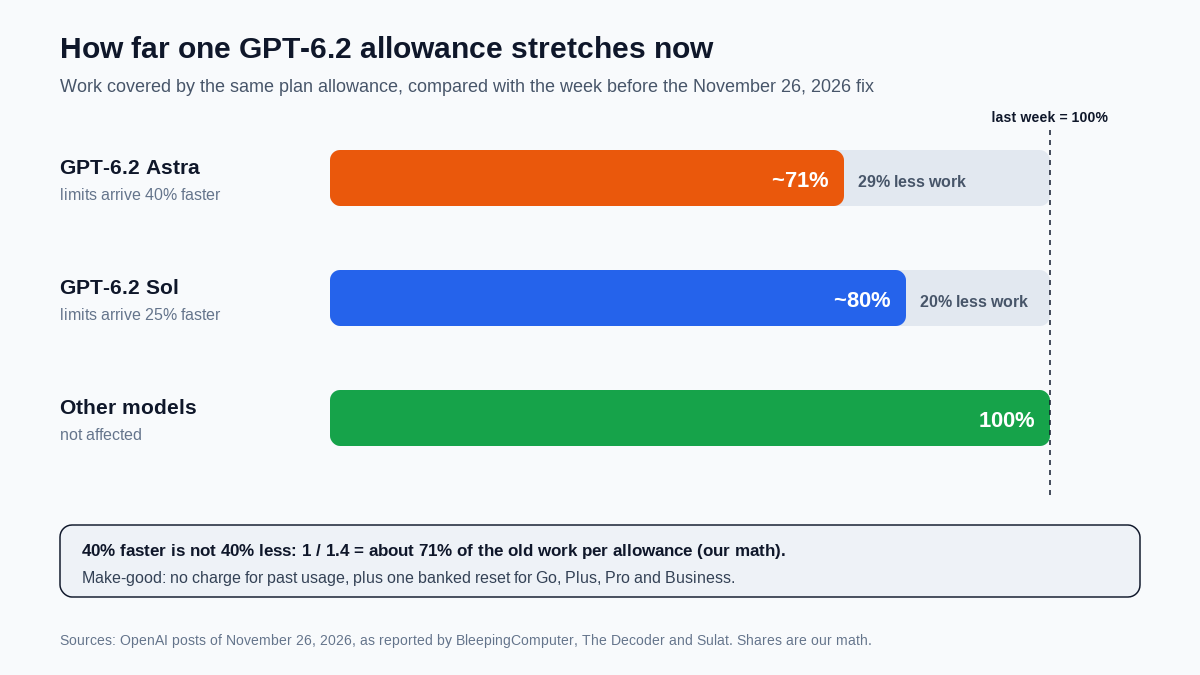
Dataconomy made the same point: reaching a limit 40% faster isn't a 40% smaller limit. OpenAI hasn't turned the change into message counts, so treat our numbers as estimates, not official figures.
GPT-6.2 Usage Limits in Messages
OpenAI's pricing page gives rough message ranges per five-hour window. Sulat captured the Plus figures on November 25, the day before the fix:
| Model | Plus, per 5 hours (before fix) | Rough range after fix (our math) |
|---|---|---|
| GPT-6.2 Astra | 6 to 50 messages | About 4 to 36 |
| GPT-6.2 Sol | 17 to 180 messages | About 14 to 144 |
| GPT-6.1 Terra | 35 to 285 messages | Unchanged |
| GPT-6 Luna | 350 to 3,000 messages | Unchanged |
How to read it:
- Why so wide: a message can be a one-line question or a long coding task.
- The last column: our rough math, applying the 71% and 80% shares to the old ranges. OpenAI hasn't published new figures yet.
Two things stand out:
- Astra is expensive: even before the fix, Astra gave far fewer messages than Sol, Terra or Luna.
- Light models are untouched: GPT-6.1 Terra and GPT-6 Luna weren't part of the mistake, so their ranges stay the same.
What OpenAI Is Giving Back
OpenAI paired the fix with three make-goods:
| What you get | Who gets it | Details |
|---|---|---|
| No back-charge | Everyone affected | Past discounted usage stays free |
| One banked reset | Go, Plus, Pro and Business | Expires a month later, per BleepingComputer |
| Free Fast Mode | Business teams | Through December 31, 2026 |
How to use the banked reset, based on the help page Sulat cites:
- Where: in Settings, then Usage, in ChatGPT on desktop or the web. It isn't in the mobile app.
- How: pick the usage summary that shows a reset, check which limits it covers, then confirm.
- Careful: usage can take a while to update, so don't burn a second reset to test the first.
Some users weren't impressed. Dataconomy reported complaints that one reset doesn't make up for Astra limits arriving 40% sooner, and that it's hard to tell how much each request uses.
The Fast Mode Offer: Part of the Fix or Not?
This is where the reports split.
- The Decoder listed free Fast Mode for Business users alongside the fix.
- Sulat says it was a separate offer posted on November 24 for ChatGPT Business teams, two days before the fix.
For Business customers, the practical result is the same either way, because their teams get Fast Mode at no extra charge through December 31, 2026, whichever post you read it in. But it isn't really pay-back for the billing mistake. And Plus and Pro users don't get it.
The Shared Usage Meter Coming in December
The billing fix lands just before a bigger change. Starting in December, Plus, Pro and Business plans move to one shared meter, according to Sulat's summary of OpenAI's help pages:
| On the shared meter | Off the meter |
|---|---|
| ChatGPT Chat | Instant chat |
| ChatGPT Work | Models not covered by plan limits |
| Codex | API usage, billed per token |
So far, OpenAI says it expects most users won't wait for a reset more often than they do now. That's careful wording. "Most users" leaves room for the heaviest users to wait longer between resets than they do today, and TechCrunch reported that heavy users may hit limits sooner once Chat, Work and Codex share a single pool.
Plan windows differ too:
- Plus and standard Business: keep a five-hour window plus weekly limits.
- Pro: has no five-hour limit today, per OpenAI's pricing page as Sulat reports it.
If you lean on Codex for long agent runs, the shared meter matters most. Those runs will draw from the same pool as your everyday chats.
What Is Known About GPT-6.2 Usage Limits, and What Isn't
Here's a clean split of the facts so far:
| Known | Not known |
|---|---|
| Astra limits arrive 40% faster, Sol 25% | Exact allowance sizes in tokens |
| The mistake started at the November 17 launch | How many users were affected |
| Past usage won't be charged | Whether limits will change again |
| Go, Plus, Pro and Business get one reset | Whether Free or Enterprise users got anything |
| A shared meter starts in December | Exact allowance per plan on the new meter |
You can check the latest wording on OpenAI's help center, since limits have changed several times this year.
Why This Matters Beyond One Bug
On its own, this is a billing fix. Small. But it's part of a wider pattern in 2026, where the flat-fee AI plans that teams budget around keep changing shape every few weeks, often with little warning and no simple way to compare old limits with new ones.
- Limits move often: plan allowances have shifted several times in 2026, as we covered in our post on the ChatGPT Pro plan change.
- Users push back: on the Anthropic side, a proposed class action argues that Claude Max usage claims overstate what buyers get.
- Tokens drive cost: fewer tokens per task means more work per allowance, the theme of our post on token efficiency.
For teams, the lesson is simple. A flat-fee plan is only as predictable as its limits, and those limits are set by the vendor.
How to Plan Around the New GPT-6.2 Usage Limits
You can't change the limits, but you can change how you spend them. Start by matching each task to the lightest model that does the job well:
| Task | Model to try first | Why |
|---|---|---|
| Hard reasoning or a big refactor. | GPT-6.2 Astra | Worth the higher usage when quality matters most, especially on work that would take a person hours to check. |
| Everyday coding and drafting. | GPT-6.2 Sol | About three times the messages of Astra in OpenAI's own ranges, for most daily work. |
| Quick edits and lookups. | GPT-6.1 Terra or GPT-6 Luna. | Far more messages per window and no change from the fix. |
| Long batch jobs | The API | Pay per token with no five-hour window. |
If you're unsure which model fits, our comparisons of GPT-6.2 Astra and GPT-6.2 Sol against rival models show where each one is worth its cost.
Then run through this quick checklist:
| Step | What to do | Why it helps |
|---|---|---|
| 1. Check your reset. | Look in Settings, then Usage, on desktop or web. | Make sure the banked reset actually shows up on your account, and write down the date it expires so it doesn't lapse unused. |
| 2. Save the reset. | Keep it for a deadline or a long agent run. | A reset on a quiet day is wasted. |
| 3. Pick models by task. | Use Sol, Terra or Luna for routine work. | Astra now costs about 40% more of your allowance per task than last week, so save it for the hard problems where its extra quality actually pays off. |
| 4. Watch the meter. | Check usage after big Codex sessions. | Long agent runs burn it fastest. |
| 5. Price the API. | Compare plan cost with per-token cost. | Heavy, steady use is often cheaper and far more predictable on the API, where each token has a published price and no five-hour window applies. |
Should Heavy Users Move to the API?
For some teams, yes. The plans are flat-fee with moving limits. The API charges per token with no five-hour window, so cost tracks use.
A quick way to decide:
- Stay on the plan if your use is spiky and mostly chat, since a flat fee covers the quiet weeks.
- Test the API if you run long Codex jobs most days, since steady heavy use is where plan limits bite hardest.
- Mix both if a few people drive most of the usage, so they move to the API while everyone else stays on the plan.
The reports describe plan allowances in ChatGPT and Codex. None of them say API token prices changed.
GPT-6.2 Usage Limits: Our Take
OpenAI did the right thing in two ways. It explained the mistake in public, and it chose not to charge anyone for the usage it had undercounted.
But the episode shows how little control buyers have over a flat-fee AI plan. A single fix made Astra about 29% less generous overnight (our math), and a new shared meter is weeks away.
Our view: treat plan limits as a moving target. Route routine work to lighter models, keep heavy and steady workloads on the API where you can see the cost, and recheck your usage after each change OpenAI announces.
How Van Data Team Helps
We help teams get more work out of every AI dollar:
- Usage tracking that shows which tasks and people burn the most, through data pipeline development.
- Model routing that sends each task to the cheapest model that handles it well, via AI agent development.
- Cost reviews that compare plans with API pricing, through cloud cost optimization.
This article is based on OpenAI's November 26, 2026 posts as reported by BleepingComputer, The Decoder, Dataconomy and Sulat, as of November 28, 2026.
Van Data Team uses AI tools from several vendors, including OpenAI, but has no business relationship with OpenAI. Want help sizing plans against API spend? Get in touch and we'll run the numbers with you.
AI Model Brief
The AI models worth knowing, once a week
What shipped, how it scores on independent benchmarks, what it costs per million tokens and what was deprecated, from the data behind our AI model benchmarks.
We use your address only to send the brief. See our privacy policy.
See this week’s brief
Founder of Van Data Team. Builds Vanaxity, the AI agent system for SEO, GEO, and AEO, and leads data engineering delivery for B2B teams.
About the authorAI model benchmarks
Models in this article
Current pricing, context window and independent scores for each model.
Side by side
Article FAQ
Questions readers usually ask next.
These short answers clarify the practical follow-up questions that often come after the main article.
Need a similar system?
If this article maps to a workflow your team already operates, the next step is usually a scoped review of the system, constraints, and rollout path.
Consultation
Scope your next AI workflow.
Share the system and blockers. We will map fit, gaps, and the next step.