OpenAI Perplexity Limit: What Pachocki's Numbers Mean
The OpenAI perplexity limit idea explained: what log-perplexity measures, the 0.99 to 0.76 scores, what the plan leaves out and what it means for AI teams.
OpenAI just put a number on how smart its models are getting. On November 22, 2026, chief scientist Jakub Pachocki shared internal scores that OpenAI has tracked since GPT-3.5, and asked rival labs to agree on a shared limit.
The metric is log-perplexity. It's an old idea from language modeling, and most people outside AI research have never heard of it.
This guide explains what it measures, what OpenAI's numbers show, what the OpenAI perplexity limit would and wouldn't do, and what it means for teams that build with AI.
Key Takeaways
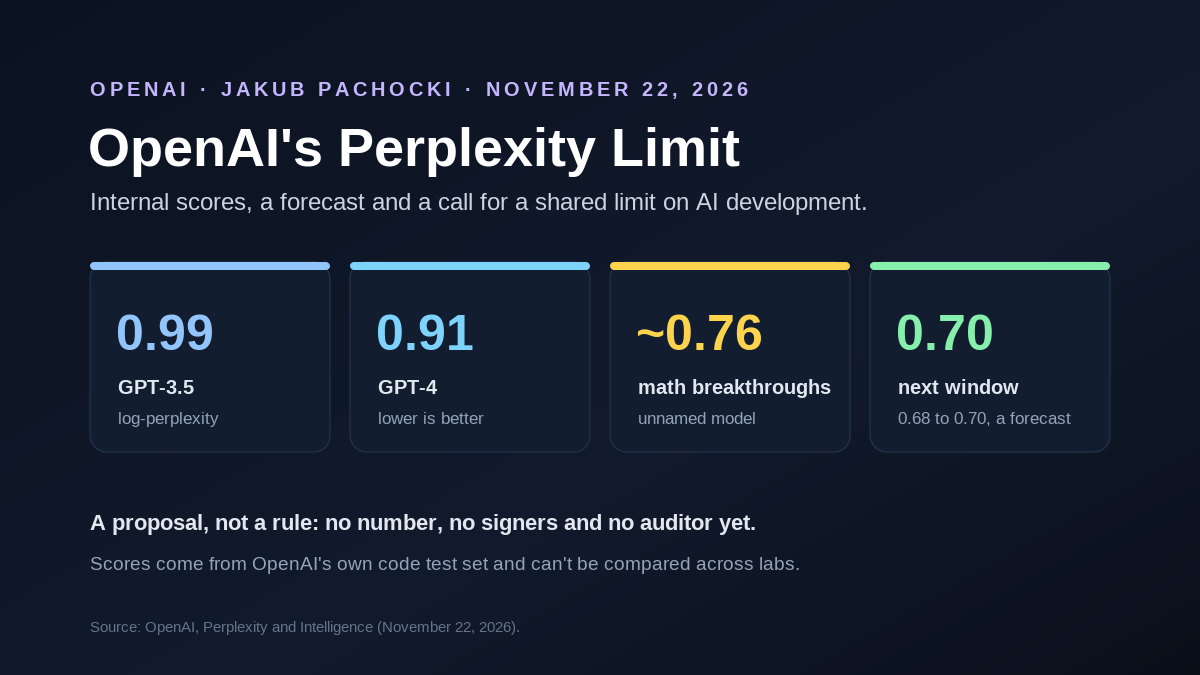
- New data: OpenAI says GPT-3.5 scored about 0.99 on its internal test and GPT-4 about 0.91. Lower is better.
- A threshold: below 0.8, Pachocki says, models began to show transformative abilities in cybersecurity and math.
- A forecast: he expects new abilities around 0.68 to 0.70, and says he doesn't know what they'll be.
- A proposal: Pachocki asks frontier AI labs to set a first shared limit on development and stay below it until monitoring tools catch up, but the post names no number, no signers and no way to check that anyone keeps their word.
- A lesson: perplexity is a useful signal, but only on a fixed test set you control.
The OpenAI Perplexity Limit at a Glance
Here's what was published, as of November 24, 2026:
| Item | What was published |
|---|---|
| Who | Jakub Pachocki, chief scientist at OpenAI |
| When | November 22, 2026 |
| Title | Perplexity and Intelligence |
| Metric | Log-perplexity on OpenAI's internal code test set |
| Headline scores | GPT-3.5 about 0.99, GPT-4 about 0.91 |
| Proposal | Labs agree on a first shared limit |
| Binding? | No. It's a proposal with no number or signers yet |
The source is Pachocki's post on OpenAI's site. Where details come only from news coverage, we say so.
What Jakub Pachocki Published
The post is called "Perplexity and Intelligence." Pachocki makes three moves in it:
- Data: he publishes some of the scores OpenAI has tracked for every major model since GPT-3.5, all on the same held-out test set.
- Argument: he says the score tracks real ability, since the models got much better at hard work as the loss fell.
- Proposal: he wants labs to agree on "a first limit on development, measured by some key metric," and stay below it until safety tools improve.
What Log-Perplexity Measures
Perplexity measures how well a model predicts the next token, on average. A token is a chunk of text, often part of a word.
Think of it as a guessing game. The model reads some text it has never seen, one token at a time, and bets on what comes next. If it gives the right token high odds, it scores well. If the right token surprises it, it scores badly.
Log-perplexity is the log of that score. It's the same number AI researchers call cross-entropy loss, and it's what a model is trained to push down. Lower means fewer surprises.
One detail matters a lot here: OpenAI's test set comes from its own internal codebase, frozen as a fixed snapshot that has stayed the same since GPT-3.5, so every score in the post measures how well a model predicts OpenAI's own code. Its size isn't given.
The Numbers: From GPT-3.5 to Today
Here's the scale OpenAI described:
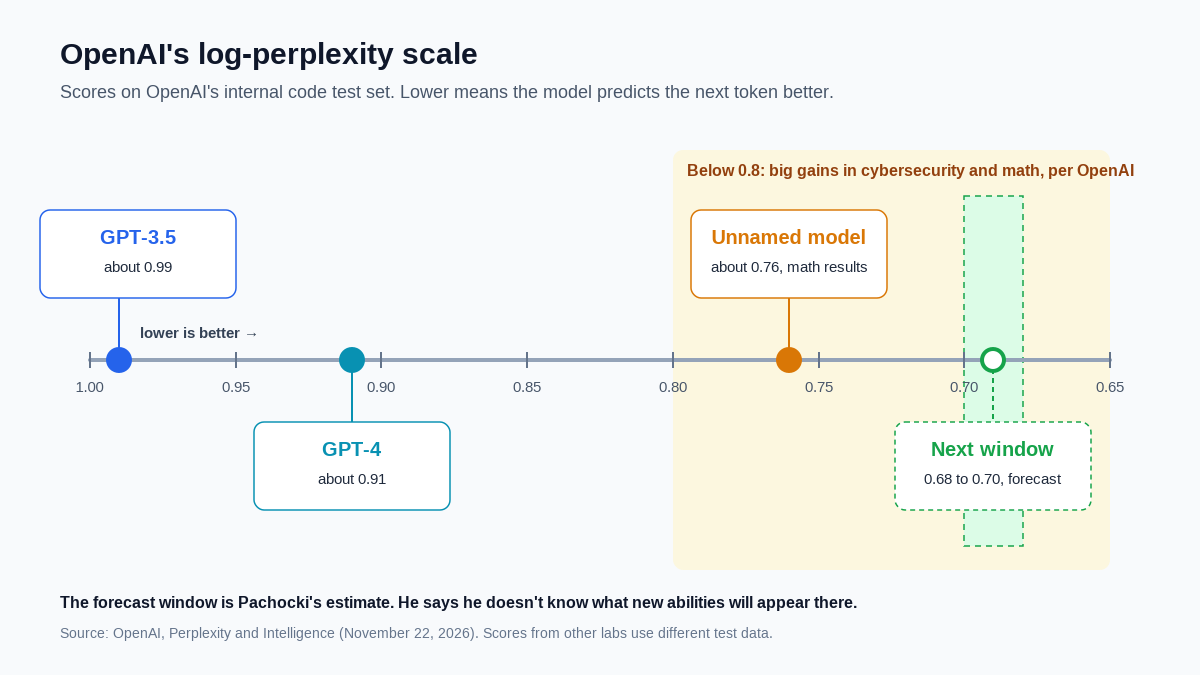
And here are the points behind it:
| Model or point | Log-perplexity | What OpenAI says about it |
|---|---|---|
| GPT-3.5 | About 0.99 | The starting point for this test set |
| GPT-4 | About 0.91 | A big jump in ability for a small drop in loss |
| Recent models | Below 0.8 | Transformative abilities in fields like cybersecurity and math |
| Unnamed model | About 0.76 | Began producing major math results |
| Next window | About 0.68 to 0.70 | A forecast: Pachocki says he doesn't know what new abilities will appear |
The gaps look tiny. GPT-3.5 to GPT-4 is a drop of about 0.08, yet GPT-4 was a much stronger model. Small changes in loss can mean large changes in ability.
To put the scale in plainer terms, take e to the power of each score, which turns log-perplexity back into perplexity. That assumes natural logs, which the post doesn't state. By our math, 0.99 works out to about 2.7 and 0.76 to about 2.1. Roughly, the newer model is choosing among about two likely next tokens where GPT-3.5 chose among nearly three.
Why OpenAI Thinks Perplexity Tracks Intelligence
Pachocki's case is simple. To predict text well, a model has to understand it. To predict code well, it has to understand what the code does.
He also points to a pattern. As OpenAI's scores fell below 0.8, its models began to show what he calls transformative abilities in fields like cybersecurity and math. An unnamed model at about 0.76 "started producing groundbreaking results" in math.
We've covered some of OpenAI's recent math claims, including its Navier-Stokes agent swarm. The post itself doesn't say which results came from which model.
The appeal is clear. Perplexity is measured during training, long before a model ships. If it really tracks ability, it could act as an early warning.
What the OpenAI Perplexity Limit Would Actually Do
The proposal is short on detail. Here's what it does and doesn't say:
- A shared standard: labs would agree on an industry standard for a first limit on development.
- A metric: the limit would be measured by a key metric. Log-perplexity is the example the post builds toward.
- A milestone: labs would stay below the limit until a safety milestone is met, such as a successor to today's chain-of-thought monitors.
- No number: the post doesn't propose a value for the limit.
So the OpenAI perplexity limit is a framework, not a rule. It's a way to say "stop here until we can see inside the next model," with the "here" left blank.
How This Fits OpenAI's Slowdown Push
This isn't a sudden turn. In September, Pachocki published "An Alien Mind," which called for voluntary slowdowns until shared safety bars exist. It gave no number either. We covered it in our post on the OpenAI safety warning.
Days later, Anthropic CEO Dario Amodei published "We Must Pace the Frontier," a three-step plan that includes limits on the rate of unchecked AI progress. Our post on the pace the frontier plan covers it.
What's new here is the metric. Earlier calls for AI safety limits said "slow down" without saying how to measure speed. Pachocki offers a ruler, even if he doesn't mark where to stop.
What the Post Admits It Can't Do
To its credit, the post is frank about the weak spots:
| What the post admits | Why it matters |
|---|---|
| Labs use different test data and training mixes | Scores can't be compared across labs as they are |
| Perplexity isn't a task anyone cares about | It's a proxy, not a measure of what a model can do |
| Chain-of-thought doesn't lower it | Reasoning gains can happen without any change in the score |
| The lowest possible loss is unknown | Nobody knows how far the scale goes |
| Older models were weak at code | Early points on the curve are rough |
The chain-of-thought point is the big one. Reasoning models get much better by thinking step by step before they answer. That gain doesn't show up in perplexity at all, because the score only measures next-token guesses on fixed text.
So a model could become far more capable through reasoning and tools while its log-perplexity barely moves. A limit based on loss alone would miss that.
Can Other Labs Use the OpenAI Perplexity Limit?
Not as it stands. Pachocki says so himself: different developers use different test data and train on different data mixes.
That breaks direct comparison in a few ways:
- Training data: a model trained on lots of code will score well on a code test.
- Tokenizers: a lab that splits text into different tokens gets different raw numbers on the same text.
- Meaning: a 0.8 at OpenAI and a 0.8 elsewhere may not mean the same thing.
To work across labs, the OpenAI perplexity limit would need a shared test set that no one trains on. That set would have to stay secret, so labs can't learn it, and stay stable for years, so scores can be tracked over time.
Who Would Check the OpenAI Perplexity Limit?
This may be the hardest part. Perplexity is measured inside the lab, during training, on data the lab controls, so an outsider can't compute it without deep access to both the model and the test set.
The post leaves three questions open:
- Auditing: who would check the scores.
- Penalties: what happens if a lab crosses the line.
- Governments: what role they'd play. The post doesn't mention them, though "An Alien Mind" said safety bars could be enforced by auditors, agencies or international bodies.
Without a checker, a perplexity limit is an honor system. That may still have value, since public numbers create pressure. But it isn't enforcement.
Reactions So Far
Early reactions come mostly through secondary reports:
- Sam Altman reportedly called the post "the most important thing OpenAI has published in a while," according to AICoder. We couldn't find the original post.
- Microsoft AI's Mustafa Suleyman reportedly backed the move and shared a score for one of Microsoft's models, according to one blog. We couldn't verify it.
- Critics argue the metric can't be checked outside OpenAI.
We found no public response yet from Anthropic, Google DeepMind, xAI or Meta. The Decoder reads OpenAI's chart as showing an internal model near 0.73, below the 0.76 model. The post's text doesn't give that number.
What Is Known and What Isn't
It's easy to read more into the post than it says. Here's a cleaner split:
| Known | Not known |
|---|---|
| OpenAI's scores for GPT-3.5 and GPT-4 | Scores for most named recent models |
| The test set comes from OpenAI's own code | How many tokens it holds or what it covers |
| Below 0.8 is tied to big gains in cybersecurity and math | Which model sits at about 0.76 |
| Pachocki wants labs to set a shared limit | What the number would be |
| The post doesn't say who would check it | Whether any lab will sign on |
The biggest unknown is the most basic one: what the limit would be. A proposal without a number is a starting point for talks, not a commitment.
Is the OpenAI Perplexity Limit a Good Idea?
There's a real case on both sides:
| For a perplexity limit | Against a perplexity limit |
|---|---|
| One number is easy to track and report | One number can be gamed or measured on easy data |
| It moves smoothly as models train, so labs can see a limit coming | It misses gains from reasoning and tools |
| It needs no hand-labeled tests | It needs a shared test set no lab has yet |
| It's measured during training, before release | Only the lab itself can measure it without outside access |
Our view: it's a better start than a vague call to slow down. A measurable signal lets labs see a limit coming months ahead. But perplexity alone is too narrow. Any real standard would need to pair it with task tests, especially for cyber and bio risks, and with outside checks.
What the OpenAI Perplexity Limit Means for AI Teams
For most AI and data teams, nothing changes this week. No model is being held back, no API is changing, and nothing you run today will behave any differently because of this post.
The post still has three lessons worth taking:
- Measure on data you control: OpenAI trusts its scores because the test set is fixed and private. Your evals need the same discipline.
- One number is never enough: perplexity misses reasoning gains, so it can't replace task checks. We cover task testing in our guide to AI agent evaluation.
- Safety tests are getting harder: the post warns of rising evaluation awareness, where models notice they're being tested and act differently.
That last point matters for anyone who ships agents. If a model behaves better under test than in real use, you need monitoring in production, not just checks before launch.
How to Use Perplexity on Your Own Data
You can borrow OpenAI's method on a small scale. If you fine-tune an open-weight model, log-perplexity on your own held-out text is a cheap, label-free check:
| Step | What to do | Why |
|---|---|---|
| Pick held-out text | Set aside real documents from your own domain that the model never trained on. | Otherwise the score means nothing. |
| Freeze it | Keep the same snapshot for every test. | OpenAI keeps its own set fixed for exactly this reason, so a score from last year can be compared with one from today. |
| Score each model | Compare a base model with your fine-tuned version on the same text. | A drop shows the model learned your domain. |
| Pair it with tasks. | Run a small set of real task checks next to the score. | Loss isn't quality |
| Don't compare vendors | Avoid ranking models from different families by loss alone. | Different tokenizers make raw scores hard to compare. |
One limit to know: many hosted chat APIs only return probabilities for the tokens they generate, not for text you supply. So this works best with open-weight models you run yourself.
Use it as a smoke test, not a final grade. A fine-tune that lowers loss on your support tickets has learned something about them. Whether it now answers customers better is a separate question.
What to Watch Next
A few signals will tell us whether this goes anywhere:
- A number: whether OpenAI or a group of labs proposes an actual limit.
- Other labs: whether rivals publish their own scores.
- An auditor: whether a third party, like a government AI safety institute, is named to check the scores and given the deep access that checking would need.
- The 0.68 to 0.70 window, and whether OpenAI says when it expects to reach it.
- New models: OpenAI's next release, and whether it reports where that model sits on the scale.
OpenAI Perplexity Limit: Our Take
The OpenAI perplexity limit is the most concrete version yet of the call to slow AI down. It gives the debate a ruler. It doesn't yet give it a line to stop at, a referee to check the scores or a penalty for anyone who crosses, and those are the parts that make a limit real.
The metric itself is sound but narrow. It tracks how well a model predicts OpenAI's own code. It misses reasoning gains, and it can't be compared across labs without a shared test. We'd treat the scores as a useful view into one lab's training, not a measure of AI progress overall.
For AI teams, the takeaway is practical. Fix your test data, measure on it every time and never trust one number alone. That's the same discipline OpenAI is asking the industry to adopt.
How Van Data Team Helps
We help teams measure AI before and after they ship it:
- Evaluation pipelines that score models on your own held-out data, through data pipeline development.
- AI agents with task tests and production monitoring built in, via AI agent development.
- Quality dashboards that track model scores and failures over time, through agentic BI reporting.
This article is based on Jakub Pachocki's November 22, 2026 post on OpenAI's site, his September 2026 essay "An Alien Mind," Dario Amodei's "We Must Pace the Frontier," and coverage by The Decoder and AICoder, as of November 24, 2026.
Van Data Team has no business relationship with OpenAI, Anthropic, Microsoft or Google beyond using their products. Want to know whether a model really got better? Get in touch and we'll help you measure it.
AI Model Brief
The AI models worth knowing, once a week
What shipped, how it scores on independent benchmarks, what it costs per million tokens and what was deprecated, from the data behind our AI model benchmarks.
We use your address only to send the brief. See our privacy policy.
See this week’s brief
Founder of Van Data Team. Builds Vanaxity, the AI agent system for SEO, GEO, and AEO, and leads data engineering delivery for B2B teams.
About the authorArticle FAQ
Questions readers usually ask next.
These short answers clarify the practical follow-up questions that often come after the main article.
Need a similar system?
If this article maps to a workflow your team already operates, the next step is usually a scoped review of the system, constraints, and rollout path.
Consultation
Scope your next AI workflow.
Share the system and blockers. We will map fit, gaps, and the next step.