Applied Compute Deal: Palo Alto's $4.5B Open-Model Bet
Palo Alto Networks will buy Applied Compute for $4.5B in stock to secure open-weight AI models. What the deal is, what it costs and what it means for AI teams.
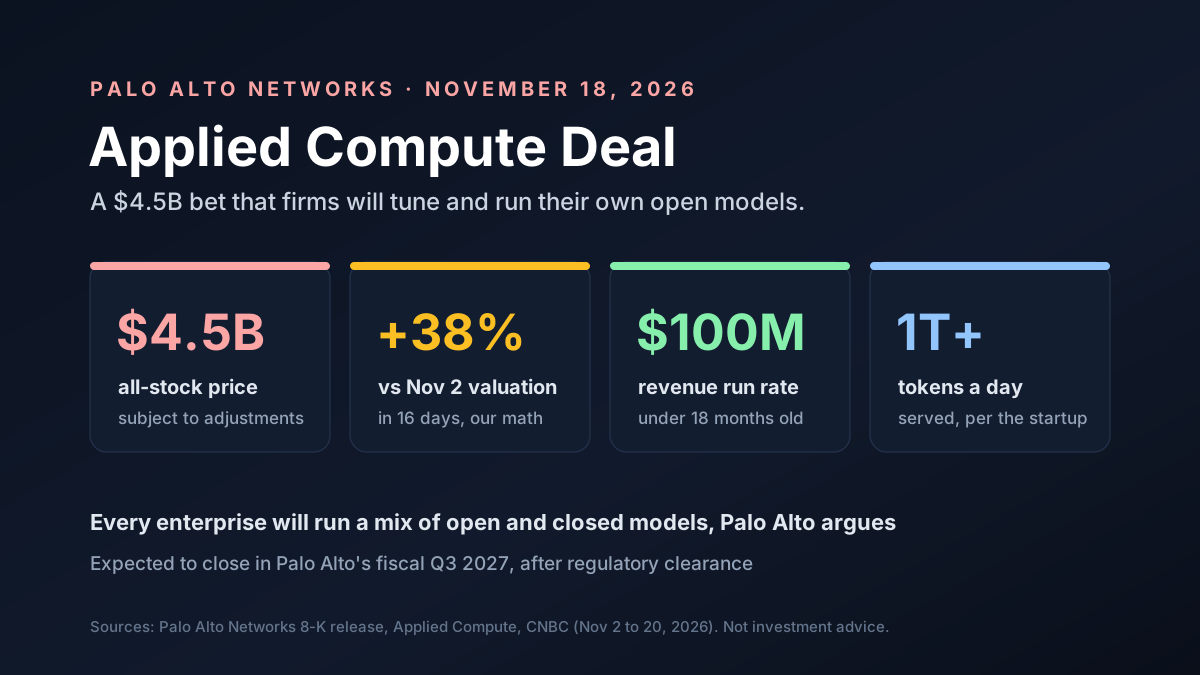
Palo Alto Networks just made a big bet on open AI models. On November 18, 2026, the cybersecurity company agreed to buy Applied Compute, a startup that helps companies train and run their own AI models, for about $4.5 billion in stock.
Applied Compute is young. It was founded less than 18 months ago by former OpenAI researchers. Yet it already reports $100 million in yearly revenue and customers such as Microsoft, Shopify and Harvey.
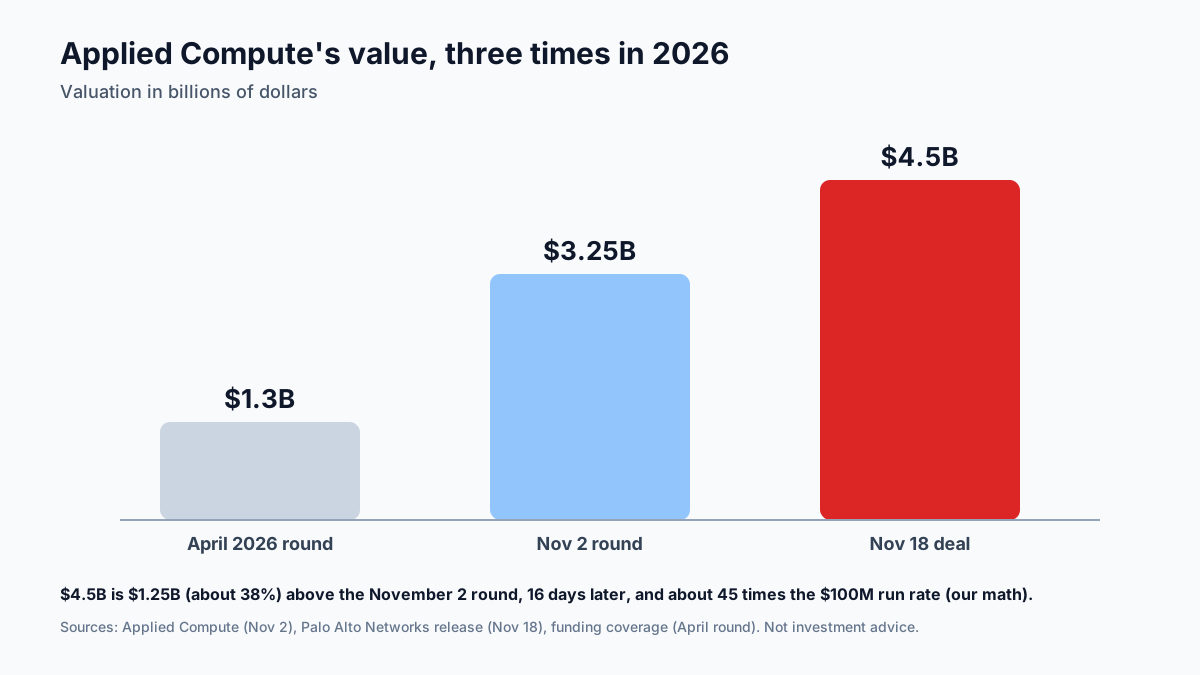
The price is striking too. Just 16 days earlier, investors valued the company at $3.25 billion.
This guide explains what Applied Compute does, why a security company wants it, what the price tells us and when open-weight models make sense for your own team.
Key Takeaways
- A $4.5 billion all-stock deal. Palo Alto Networks is buying Applied Compute, pending regulatory clearance, and expects to close it in the first half of 2027 by the calendar.
- A bet on open-weight models. Applied Compute helps companies tune and run models whose weights are public.
- Security plus AI. Palo Alto wants to secure both open and closed models inside companies.
- A fast markup. The price is about 38% above a valuation set just 16 days earlier, by our math.
- A signal for buyers. More enterprises are expected to run their own tuned models, not only closed APIs.
The Applied Compute Deal at a Glance
Here's what's been reported, as of November 20, 2026:
| Item | What's reported |
|---|---|
| Buyer | Palo Alto Networks |
| Target | Applied Compute |
| Price | About $4.5 billion, all in stock |
| Announced | November 18, 2026, with fiscal Q1 2027 results |
| Expected close | Palo Alto's fiscal Q3 2027, after regulatory clearance |
| Applied Compute CEO after close | Yash Patil becomes Co-Chief AI Officer |
| Market reaction | Palo Alto shares up about 6% the next day |
Palo Alto announced the deal alongside its fiscal first-quarter results, as SecurityWeek and others reported. Its shares rose about 6% the next day, as CNBC reported, helped by a beat on earnings and the AI story.
What Applied Compute Does
Applied Compute builds tools for firms that want their own AI models instead of renting someone else's. It starts from open-weight models, the kind whose trained weights anyone can download, and helps companies adapt them.
Its main product, the AC2 Agent Cloud, covers three jobs:
- Training: tuning an open-weight model on a company's own tasks and data.
- Inference: running that model at scale, fast and cheaply.
- Improvement: testing and retraining the model as work and data change.
Think of it as a workshop for models. You bring a base model and your data. It helps you shape the model for your job, then runs it for you.
The firm says its founding idea was that firms would want to own and improve the AI behind their products. It also offers routing, which sends each request to the cheapest model that can handle it.
Applied Compute by the Numbers
The startup's growth is the main reason for the price. Here's what it reported in early November, in its own funding post:
| Figure | What Applied Compute reports |
|---|---|
| Annual revenue run rate | $100 million |
| Time since founding | Under 18 months |
| Tokens served per day | Over 1 trillion |
| Training runs since July | Over 1,700 |
| Customers using training and inference | 40% |
| Named customers | Microsoft, Shopify, Mercor, Harvey, DoorDash, Cognition, Clay, Decagon |
Two client results stand out, both from Applied Compute itself:
- Harvey, the legal AI company, got better answer and citation quality from a custom model at under half the inference cost of a frontier model.
- Clay, a sales data company, used a custom router to cut its inference costs by up to 47% without losing quality.
These are vendor claims, not independent tests. But they show the pitch: a tuned open model can match a top closed model on a narrow job, for much less money.
Why Palo Alto Networks Wants Applied Compute
Palo Alto Networks sells security for networks, clouds and, more and more, AI. Its CEO, Nikesh Arora, put the logic in one line: "Every enterprise is going to run a mix of open and closed models, and every one of those models needs to be secured."
Owning Applied Compute gives Palo Alto a place inside that work. When a company trains or runs a model on the platform, security can be built in from the start, instead of added later.
The deal also fits a bigger shift. Palo Alto says companies will be able to run open-weight models in public clouds or in sovereign setups, meaning infrastructure kept inside a country or a company's own walls for legal and security reasons. That's a growing need for banks, governments and health care.
Applied Compute's CEO, Yash Patil, will become Palo Alto's Co-Chief AI Officer after the deal closes.
The Applied Compute Price in Context
The price looks high, and it rose fast. Here's our own math on the reported figures:
| Measure | Our math |
|---|---|
| Jump from the November 2 round | $1.25 billion, about 38% |
| Jump from the April round ($1.3 billion) | About 3.5 times |
| Price per dollar of annual run rate | About 45 times |
| Days between the round and the deal | 16 |
A 45 times multiple of yearly revenue is very high, even for AI. It makes sense only if Applied Compute keeps growing very fast, or if the platform makes Palo Alto's other products more valuable.
Paying in stock matters too, for both sides. It means Applied Compute's owners share in Palo Alto's future, and Palo Alto doesn't spend cash. It also means the final value moves with Palo Alto's share price until the deal closes.
Applied Compute and the Open-Weight Model Shift
Why would so many firms want their own models? Because the trade-offs have changed. Open models have closed much of the gap with closed ones, and running them has gotten cheaper.
Here's how the two approaches compare for most teams:
| Open-weight model you tune | Closed model through an API | |
|---|---|---|
| Control over behavior | High | Limited to prompts and settings |
| Where data goes | Your own cloud or servers | The vendor's servers |
| Cost at high volume | Often lower | Often higher |
| Effort to run | High: training, hosting, updates | Low |
| Top-end quality | Usually a step behind | Usually the best available |
| Security work | Yours | Shared with the vendor |
Neither choice is right for everyone. Most firms will mix them: a closed frontier model for hard, varied work, and tuned open models for narrow, high-volume tasks. That mix is Palo Alto's bet. We looked at how model prices keep moving in our post on the AI model price war.
When to Tune an Open-Weight Model
Fine-tuning your own model is real work. It pays off in some cases and not in others, and the difference usually comes down to volume, the shape of the task and the data you already have. It tends to make sense when:
- Volume is high. You make millions of calls a month, so small savings per call add up.
- The task is narrow. One job, like sorting tickets or pulling fields from forms, done the same way each time.
- Data must stay inside. Rules or contracts say your data can't leave your own systems, which is common in banking, health care and government work.
- You have good examples. A few thousand clean, labeled examples of the job done right.
- You can test it. A fixed test set.
It usually doesn't pay when volume is low, the work is broad and creative, or you lack clean data. In those cases, a closed model through an API is simpler and often better. Our guide to zero data retention covers how to keep data safe with closed models too.
Who Else Is Chasing Open-Weight Models
Palo Alto isn't alone. Interest in running and tuning open models has grown across the industry:
- Cloud providers host open-weight models next to their own and partners' closed models.
- Chip makers such as Nvidia invest in the tools that make open models cheaper to run. Nvidia was also an investor in Applied Compute.
- Model labs keep releasing stronger open-weight models, which raises the ceiling for tuned versions.
- Security firms now want a seat in the model workflow, not just at the network edge.
That crowd is a sign the market is real. It also means Applied Compute will face strong competition, even with Palo Alto behind it.
The Security Side of Open-Weight Models
Open models give you control, but they also hand you the security job. Here are the main risks and what helps:
| Risk | What it looks like | What helps |
|---|---|---|
| Tampered weights | A model file changed to misbehave on a trigger | Download from trusted sources and check hashes |
| Training data leaks | A tuned model repeats private data it learned | Clean and test training data first |
| License limits | Terms that ban some commercial uses | Read the license before you build |
| Weak guardrails | Fewer built-in safety filters than closed models | Add your own filters and tests |
| Drift over time | Quality slips as data changes | Re-test on a fixed set of tasks |
These risks are a big part of why Palo Alto wants this deal. A firm that tunes and runs its own models needs the same kind of checks it already runs on code and cloud setups. We covered the wider threat picture in our guide to agentic AI security.
What the Applied Compute Deal Means for Data Teams
For most data and AI teams, the deal doesn't change anything this quarter. It's a signal, though. Here's what to do now:
- List your AI workloads by volume, task type and data rules.
- Mark the candidates for a tuned open model: high volume, narrow task, strict data rules.
- Build a test set for each one, so you can compare models fairly and repeat the test later.
- Price both options at your real volume, including hosting and staff time.
- Plan security early.
Start with one workload, not ten. Teams that do this homework will be ready to switch the right workloads when the savings are real, and to say no when they aren't.
Worked Example: When Tuning Pays Off
Here's an illustrative example with made-up numbers, to show how the math works.
Say a support team sends 200 million tokens a month to a closed model at $10 per million tokens. That's $2,000 a month. A tuned open model might cost $4 per million to run, or $800, saving $1,200 a month. But if tuning and upkeep take a week of an engineer's time each quarter, the savings may not cover the cost.
Now raise the volume to 20 billion tokens a month, a level that big support and search products reach. The closed model costs $200,000, the tuned one $80,000. The $120,000 a month in savings easily pays for the work.
The lesson: volume decides. Fine-tuning your own model is a scale play, and below a certain volume the closed API is almost always the cheaper and calmer choice.
Risks and Open Questions
There's still a lot we don't know:
- Regulators: whether the deal clears review on time
- Customers: whether Applied Compute's clients stay on after a security company owns it
- Neutrality: whether the platform keeps supporting every cloud and model
- Price: whether the high multiple pays off for Palo Alto shareholders
- Talent: whether the research team stays inside a large security company
What to Watch Next
A few signals will show how the deal plays out:
- The close, expected in Palo Alto's fiscal third quarter of 2027
- Product plans, such as security features built into Applied Compute's platform
- Customer moves, including whether big names like Microsoft stay
- Rival deals, as other security and cloud firms look for AI model platforms
- Open model quality, which decides how many workloads can move off closed APIs
Applied Compute Deal: Our Take
The Applied Compute deal is a clear bet that companies will run their own tuned models, not only rent closed ones. Palo Alto wants to be the security layer for that world, and it paid a high price to get there fast.
It won't be the last deal like this. Expect more security and cloud firms to buy model tools in 2027.
For data teams, the practical lesson is simple. Don't pick open or closed on principle. Pick by workload: volume, task, data rules and the ability to test. Then secure whatever you run.
How Van Data Team Helps
We help teams choose, tune and run the right models for each job:
- AI agents built on the right mix of open and closed models, through AI agent development.
- Data pipelines that prepare clean training and test data, via data pipeline development.
- Cost dashboards that compare model spend by workload, through agentic BI reporting.
- Cost reviews for inference and hosting, through our cloud cost optimization service.
This article is based on Palo Alto Networks' November 18, 2026 announcement, Applied Compute's own posts and coverage by CNBC and SecurityWeek, as of November 20, 2026. It is not investment advice. Weighing open or closed models? Get in touch and we'll help you compare them.
AI Model Brief
The AI models worth knowing, once a week
What shipped, how it scores on independent benchmarks, what it costs per million tokens and what was deprecated, from the data behind our AI model benchmarks.
We use your address only to send the brief. See our privacy policy.
See this week’s brief
Founder of Van Data Team. Builds Vanaxity, the AI agent system for SEO, GEO, and AEO, and leads data engineering delivery for B2B teams.
About the authorArticle FAQ
Questions readers usually ask next.
These short answers clarify the practical follow-up questions that often come after the main article.
Need a similar system?
If this article maps to a workflow your team already operates, the next step is usually a scoped review of the system, constraints, and rollout path.
Consultation
Scope your next AI workflow.
Share the system and blockers. We will map fit, gaps, and the next step.