Riemann Hypothesis Proof With Claude: What's Verified So Far
A Riemann Hypothesis proof made with Claude is out as Lean code. What has been checked, what hasn't and what it means for AI, math and teams that use AI.
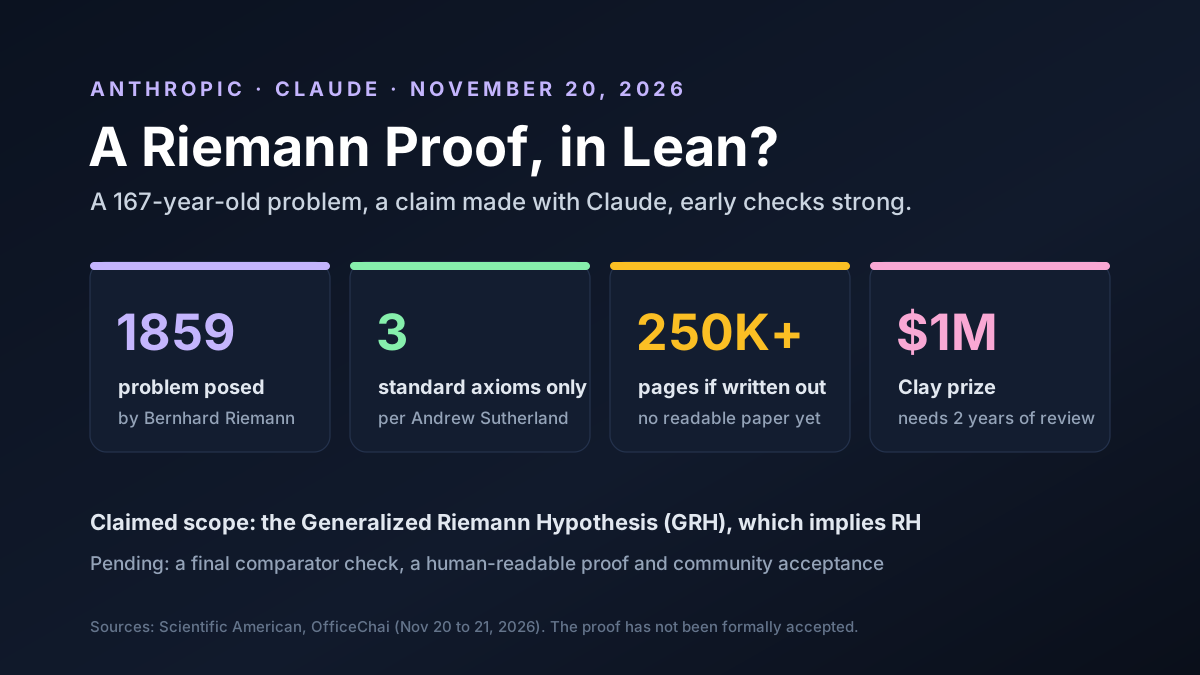
A Riemann Hypothesis proof may have arrived from an unexpected place. On Friday, November 20, 2026, Levent Alpöge, a math expert at Anthropic, wrote: "I believe I have, working with Claude, discovered a proof of the Riemann Hypothesis."
It's a huge claim. The problem has stood unsolved since 1859. It's also one of seven Millennium Prize Problems, each with a $1 million reward from the Clay Mathematics Institute. Alpöge says his method proves a broader version too, the Generalized Riemann Hypothesis, or GRH.
What makes this claim different is the proof itself. It isn't a paper for people to read, the way almost every big proof in history has been, with pages of ideas that experts can follow and argue about. It's code in Lean, a language that lets a computer check every step. Within a day, outside experts said the code works.
This guide covers what was claimed, what has been checked, what hasn't, the rival human proof posted the same day and what it all means for AI and for teams that rely on AI output.
Key Takeaways
- A big claim. Alpöge says he and Claude proved the Riemann Hypothesis, and GRH with it, after 167 years in which no one could.
- Code, not a paper. The proof comes as Lean files that a machine can check.
- Early checks look good. Experts say it compiles using only the standard axioms.
- Not done yet. One more check was still pending, and no version for people to read exists.
- A rival claim. A human-written draft proof of GRH appeared the same day. It's also unchecked.
The Riemann Hypothesis Proof Claim at a Glance
Here's what's been reported, as of November 21, 2026:
| Item | What's reported |
|---|---|
| Who | Levent Alpöge, a mathematician at Anthropic |
| When | Friday, November 20, 2026 |
| Claim | A proof of the Riemann Hypothesis, found while working with Claude |
| Scope | Also the Generalized Riemann Hypothesis (GRH) |
| Format | A short note plus a large set of Lean files |
| Human-readable paper | Not yet written |
| Anthropic's comment | None as of November 21 |
The timing was striking. The news came a day after Anthropic's record stock market debut, which we covered in our post on the Anthropic IPO.
What Is the Riemann Hypothesis?
The Riemann Hypothesis is about prime numbers. Those are numbers like 2, 3, 5 and 7 that only 1 and the number itself can divide. Primes look random. They aren't.
In 1859, Bernhard Riemann tied those patterns to a function now called the zeta function. He guessed that all of its key zeros sit on one straight line. That guess is the Riemann Hypothesis, or RH.
If RH is true, experts can say how primes are spread out with great precision. Hundreds of results in math already assume it. A proof would turn all of those from "if" into "yes."
GRH stretches the same idea to a wider family of functions, the ones that describe primes in many other settings. A proof of GRH would prove RH as well.
What Alpöge Actually Claimed
Alpöge posted the claim on his own website. Reports describe a four-page note plus a very large set of Lean files. There was no long preprint and no journal paper.
He calls it teamwork. Reports quote him saying he guided it while Claude supplied key steps, and that near the end Claude moved far faster than he could.
The size is the strangest part. Written out for people, the argument would run past 250,000 pages.
That figure is attributed to Alpöge, and experts such as Thomas Bloom of the University of Manchester shared it with some awe. Alpöge has said he wants to understand the argument himself, cut it down and write it up. There's no date for that yet.
Who Has Checked the Riemann Hypothesis Proof
The good news came fast. Here's where each check stood, based on reports in Scientific American and elsewhere:
| Check | Who | Status |
|---|---|---|
| The Lean code compiles | Andrew Sutherland (MIT) and others | Reported done |
| Kernel recheck with only the three standard axioms | Andrew Sutherland | Reported done |
| The formal statement really is GRH | Elliot Glazer | Says yes |
| Comparator run against a trusted statement | Lean community, per Kevin Buzzard | Pending |
| A human-readable write-up | Levent Alpöge | Not written yet |
| Publication and two years of scrutiny | The math community | Not started |
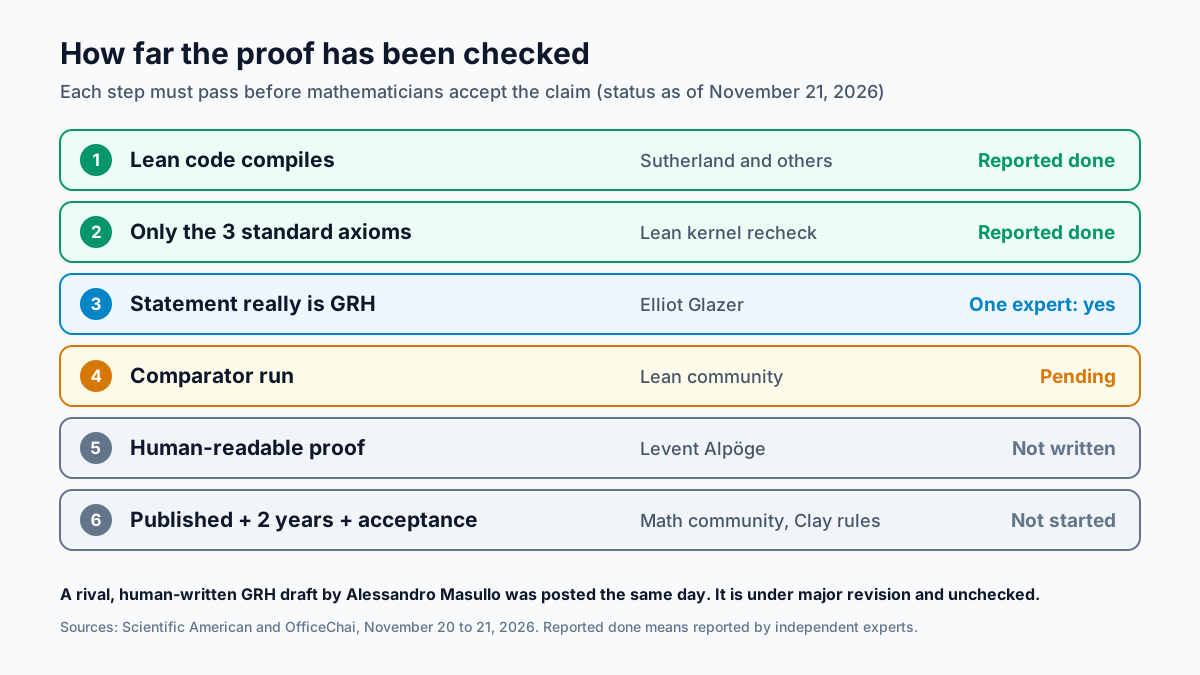
MIT's Andrew Sutherland said "the Lean proof has been compiled and independently rechecked by the Lean kernel with only the three standard axioms." He put the chance that anything is "fishy" at about zero.
Elliot Glazer looked at a different question: is the theorem in the code really GRH? He wrote that the stated theorem "is in fact GRH." He also put the odds of a bug in Lean itself at under 1%.
Kevin Buzzard, a top Lean expert, urged care. He said the community still awaited a clean "comparator" run, a last check against a trusted copy of the statement. That check often takes hours, so a result may come soon.
How Lean Checks a Proof
Lean is a programming language built for math. You write each step of a proof as code. A small, trusted core, called the kernel, checks that each step follows the rules.
A Lean check answers several separate questions:
| Part of the check | What it answers |
|---|---|
| Compiling the code | Does every step follow from the last? |
| Checking the axioms | Did the proof sneak in any extra assumptions? |
| Checking the statement | Is the theorem in the code the one we care about? |
| Independent rebuilds | Does it work on someone else's machine too? |
The statement question is the one experts care about most. A proof can be flawless and still prove the wrong thing, if the theorem was typed in slightly wrong. Hence the fuss over Glazer's check.
The Rival Human Riemann Hypothesis Proof
The same day brought a twist. Stanford's Ravi Vakil, head of the American Mathematical Society, posted about a draft proof of GRH by Alessandro Masullo. No AI, it said.
Reports describe a 940-page draft titled The Music of the Primes. Its opening calls it the fruit of about twelve years of work. Here's how the two claims compare, based on Scientific American's report and other coverage:
| Alpöge's claim | Masullo's claim | |
|---|---|---|
| Made with AI? | Yes, with Claude | No, described as all human |
| Format | Lean code plus a short note | A long written manuscript |
| Checked by a computer? | Yes, Lean compile reported | No Lean version |
| Human-readable? | Not yet | Yes, but under major revision |
| Verified? | Partly, checks continue | No |
Stanford's Brian Conrad, who has given Masullo feedback, said the draft is "undergoing major revision." The magazine noted that no one has checked it yet, and that some experts are already doubtful.
Claude's Earlier Step on the Zeta Function
This claim didn't come out of nowhere. In August 2026, Anthropic said an unreleased research version of Claude had raised a long-standing bound on how many zeta zeros sit on the key line, from 41.6% to 67.2%.
That was progress on a related question, not a proof. Anthropic said then that it didn't expect those methods to lead to a full proof. Outside experts reviewed that paper.
Three months later, an Anthropic expert says Claude helped with the whole problem. That's a fast jump, and it's one reason careful checks matter so much.
What It Takes to Win the Clay Prize
Even if every check passes, the $1 million prize won't come fast. The Clay Mathematics Institute pays only when:
- The proof is published in a qualifying journal or outlet.
- At least two years pass after it's published.
- Experts broadly accept that it's right.
It isn't published yet. By our rough math, even if a paper came out in early 2027, the prize couldn't be paid before 2029. There's also a question no rule has faced yet: who gets credit when an AI did much of the work?
What a Riemann Hypothesis Proof Would Mean for AI
Scientific American argued that the biggest meaning may not be in math at all. If it holds up, a proof of GRH would be the best evidence yet that AI can do more than explain or help with known ideas. The magazine called it a sign of AI's capacity for "profoundly superhuman" discovery.
Three points stand out:
- New ideas, not just speed. Experts thought a proof would need new methods that no one had found in more than a century and a half of trying. If AI found them, it's doing real research.
- From helper to researcher. The magazine described a possible shift from tools that help to systems that run whole lines of research on their own.
- Proofs nobody can read. A correct proof that no person understands is a new kind of knowledge. It raises hard questions about what it means to understand something.
One fear can be set aside. The magazine noted that GRH gives no known shortcut for breaking common encryption, so RSA isn't directly at risk.
We wrote about a similar AI math claim, and the debate around it, in our post on OpenAI's Navier-Stokes agents.
What the Riemann Hypothesis Proof Teaches AI Teams
Most teams will never prove a theorem. But the way this claim is being checked is a model for any team that uses AI output:
| What happened with the proof | The lesson for AI teams |
|---|---|
| A machine checked every step | Pair AI output with automatic checks |
| Experts asked whether the statement was right | Check that your tests test the right thing |
| Others rebuilt the proof themselves | Make results reproducible on another machine |
| Nobody can read 250,000 pages | Big AI outputs need tools, not just reviewers |
| The claim came with its evidence | Ship AI work with the proof that it works |
The biggest lesson is the second one. Experts didn't stop at "the code runs." They asked if the code proves the right thing. In business terms, that's the gap between "the tests pass" and "the tests check what matters."
If your team uses AI to write code, reports or data jobs, the same rule applies. Build checks a machine can run. Then make sure those checks test the right thing. We covered how in our guide to AI agent testing and security.
Why the Riemann Hypothesis Matters Outside Math
It's fair to ask why a problem about primes makes headlines. There are a few reasons:
- Prime numbers run the internet. Encryption depends on facts about primes, so better theory about them gets attention, even when it doesn't break anything.
- It's a benchmark for genius. For more than a century, solving RH was seen as the peak of human math.
- It tests AI claims. A machine-checked proof is a clean way to judge if AI can do original work.
- It shows a new way to do science. Proofs written as code could change how all of math is checked.
That last point may matter most in the long run. If more results arrive as Lean code, trust in math could shift from reputation to machine checks.
Risks and Open Questions
There's still a lot we don't know:
- The comparator run: whether the last check against a trusted statement passes
- The statement: whether all experts agree the code proves GRH exactly
- Understanding: whether anyone can turn 250,000 pages of logic into ideas people can follow
- Claude's role: how much came from the model, and which version was used
- Credit: how prizes and journals treat a proof found with AI
What to Watch Next
A few signals will show where this goes:
- The comparator result, expected within hours or days of the claim
- Word from Anthropic about Claude's role and the model used
- Expert write-ups from Lean experts and number theorists
- A paper people can read, which Alpöge has said he wants to write
- Masullo's revised draft, and whether it gets a Lean version too
Riemann Hypothesis Proof: Our Take
This may be one of the most important moments in the history of math, and of AI. It has a 167-year-old problem, a proof checked by a machine and an AI model at its center. The early checks are strong.
But "very likely" isn't "accepted." One check was still pending, no one can read the proof in full and the wider math world hasn't had time to weigh in. The right stance for now is careful excitement.
For teams that use AI, the story already has a clear lesson. The most trusted AI result in the world right now is trusted because a machine checked it, and people checked the checker. That's the bar to aim for.
How Van Data Team Helps
We help teams put checks around AI output, so it can be trusted in production:
- AI agents with built-in tests, reviews and approvals, through AI agent development.
- Data pipelines with automatic data quality checks, via data pipeline development.
- Dashboards that track AI accuracy and failures over time, through agentic BI reporting.
- Cost reviews for AI and compute spend, through our cloud cost optimization service.
This article is based on reports in Scientific American and OfficeChai, plus Anthropic's August 2026 post and other coverage, as of November 21, 2026. The proof has not been formally accepted. Want to make your AI output easier to trust? Get in touch and we'll help you build the checks.
AI Model Brief
The AI models worth knowing, once a week
What shipped, how it scores on independent benchmarks, what it costs per million tokens and what was deprecated, from the data behind our AI model benchmarks.
We use your address only to send the brief. See our privacy policy.
See this week’s brief
Founder of Van Data Team. Builds Vanaxity, the AI agent system for SEO, GEO, and AEO, and leads data engineering delivery for B2B teams.
About the authorArticle FAQ
Questions readers usually ask next.
These short answers clarify the practical follow-up questions that often come after the main article.
Need a similar system?
If this article maps to a workflow your team already operates, the next step is usually a scoped review of the system, constraints, and rollout path.
Consultation
Scope your next AI workflow.
Share the system and blockers. We will map fit, gaps, and the next step.