Anthropic IPO: What the $1.4 Trillion Pricing Week Means
The Anthropic IPO prices November 18 at $70 to $78 a share, up to $64.4B at a $1.4T valuation. The terms, the demand, the risks and what it means for buyers.
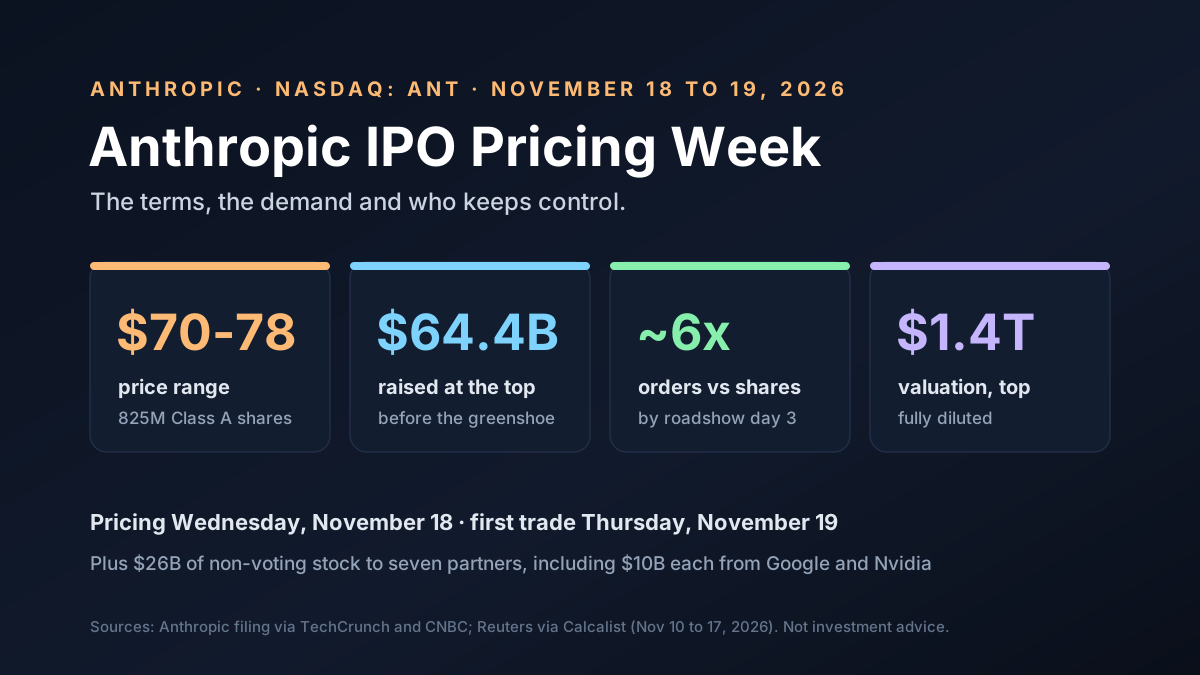
This is the week the Anthropic IPO becomes real. The company behind Claude plans to set its share price on Wednesday, November 18, 2026, and start trading on Nasdaq the next day under the ticker ANT.
The numbers are huge. Anthropic is selling 825 million shares at $70 to $78 each. At the top of that range, it would raise $64.4 billion and be valued at about $1.4 trillion. That would make it the second largest IPO ever, behind only SpaceX.
We've covered Anthropic's draft S-1 and its Q3 revenue before. This guide focuses on the deal itself: the terms, the demand, who keeps control and what the listing means for teams that build on Claude.
This is an explainer, not investment advice. We don't recommend buying or selling any stock.
Key Takeaways
- Big deal, big range. Anthropic could raise $57.75 billion to $64.35 billion at $70 to $78 a share.
- Strong demand. Orders reached about six times the shares on offer by day three of the roadshow.
- Big backers. Seven tech partners, including Google and Nvidia, will buy $26 billion of stock at the IPO price.
- Founders keep control. Public shareholders get limited votes, by design.
- A market test. Many see the Anthropic IPO as a vote on the whole AI investment wave.
Anthropic IPO at a Glance
Here's what's been reported, as of November 17, 2026:
| Item | What's reported |
|---|---|
| Shares offered | 825 million Class A shares |
| Price range | $70 to $78 per share |
| Money raised | $57.75 billion to $64.35 billion |
| Valuation | About $1.404 trillion, fully diluted, at the top |
| Exchange and ticker | Nasdaq, ANT |
| Pricing | Expected Wednesday, November 18, 2026 |
| First trade | Expected Thursday, November 19, 2026 |
| Lead banks named | Goldman Sachs and Morgan Stanley, among others |
Nothing is final until Wednesday night. The price could land inside the range, above it or below it, and the share count can change too.
How IPO Pricing Works
If you've never followed an IPO closely, the process can look mysterious. It's simpler than it seems:
| Step | What happens |
|---|---|
| Filing | The company files its prospectus and sets a price range |
| Roadshow | Executives and bankers pitch big investors for about a week |
| Book building | Investors place orders for shares at chosen prices |
| Pricing | The night before trading, the final price is set |
| Allocation | Shares go out, often far fewer than each investor asked for |
| Trading | The stock opens on the exchange the next morning |
Anthropic is between book building and pricing right now. Strong demand gives it room to price at the top of the range, or even raise it. Companies sometimes leave some money on the table, though, so the stock has room to rise on day one.
How Strong Is Demand for the Anthropic IPO?
Very strong, by every report so far. Here are the main signals:
| Signal | What's reported | Source |
|---|---|---|
| Day one of the roadshow | Orders about 2 times the shares | Reuters, via Calcalist |
| Day three | Orders about 6 times the shares | Reuters and Bloomberg |
| Altimeter Capital | Aims to invest $5 billion | CNBC |
| Strategic partners | $26 billion of non-voting stock at the IPO price | Anthropic's filing |
| Retail investors | Up to 20% of the shares | TechCrunch |
The order book grew fast. It was about two times covered after the first day and about six times covered two days later, according to Reuters reporting cited by Calcalist.
The biggest single order made headlines. Brad Gerstner of Altimeter Capital told CNBC he aims to put $5 billion into the deal. That's five times more than he has ever put into one IPO. He called Anthropic "a cornerstone compounder."
One caution. An order isn't an allocation. In a deal this oversubscribed, most investors get only part of what they ask for, so a $5 billion order may become a much smaller stake.
The Anthropic IPO Next to History's Biggest Listings
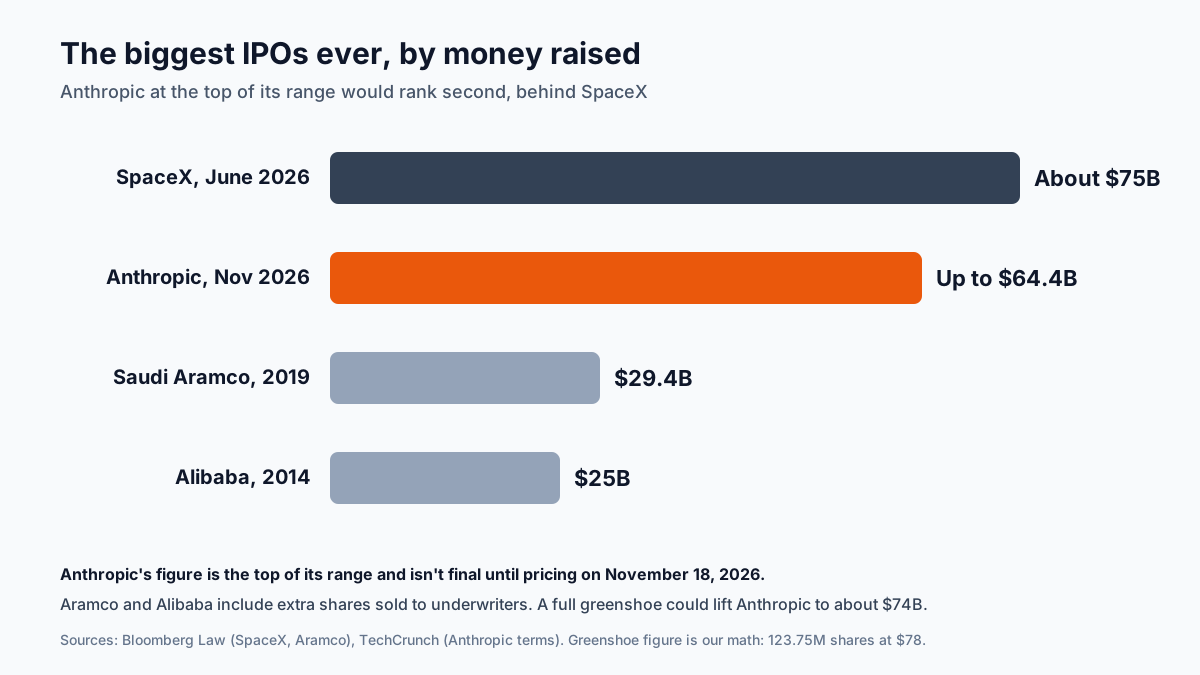
If it prices at the top of the range, the Anthropic IPO would rank second of all time:
| IPO | Year | Money raised |
|---|---|---|
| SpaceX | 2026 | About $75 billion |
| Anthropic, top of range | 2026 | Up to $64.4 billion |
| Saudi Aramco | 2019 | $29.4 billion |
| Alibaba | 2014 | $25 billion |
SpaceX set the record in June 2026, raising about $75 billion, according to Bloomberg Law. Before that, Saudi Aramco held the top spot for almost seven years.
There's one wrinkle. Anthropic's banks can buy up to 123.75 million extra shares, an option known as a greenshoe. If they use all of it at $78, the total could reach about $74 billion. That would come close to SpaceX's base deal, though SpaceX had a greenshoe of its own.
The Anthropic IPO vs the SpaceX IPO
The obvious comparison is SpaceX, which listed in June. Here's how the two deals line up so far:
| SpaceX | Anthropic | |
|---|---|---|
| Listed | June 12, 2026 | Expected November 19, 2026 |
| Exchange and ticker | Nasdaq, SPCX | Nasdaq, ANT |
| Money raised | About $75 billion | Up to $64.4 billion |
| Valuation at IPO | About $1.77 trillion | Up to about $1.4 trillion |
| Demand reported | About 2 times after day two | About 6 times after day three |
SpaceX sold its shares at $135 each, valuing it at about $1.77 trillion. The stock rose 19% on its first day.
Anthropic's book filled faster. Calcalist reports that SpaceX was about two times covered after two days, while Anthropic was six times covered after three. Its valuation case also rests on revenue expected in 2028, a year sooner than the 2029 figures behind SpaceX's pitch. That makes Anthropic's story a little less dependent on the distant future, though still very dependent on growth.
Who Is Buying: Strategic Partners and Big Funds
Alongside the public offering, Anthropic agreed to sell $26 billion of stock privately to seven companies at the IPO price:
- AMD
- Broadcom
- Micron
- Microsoft
- Nvidia
- TSMC
Google and Nvidia are each putting in $10 billion, according to TechCrunch. The other five split the rest.
Notice who's on that list. Most of them sell Anthropic the chips, memory or cloud space it needs to train and run Claude. That cuts both ways:
- Good for supply: a partner with a stake has a reason to keep Claude's compute flowing.
- Money in a circle: investors fund Anthropic, and Anthropic pays some of the same firms for compute.
- Harder to read: it's not always clear how much demand is new money and how much is partners backing a big customer.
Who Controls Anthropic After the IPO
Public investors will own part of Anthropic, but they won't run it. The company set up its shares to keep control with its founders and a special trust:
| Share class | Who holds it | Voting power |
|---|---|---|
| Class F | Anthropic's founders | 50.1% of the votes |
| Class A | Public investors in the IPO | Limited |
| Class N | Seven strategic partners | None |
| Long-Term Benefit Trust | An independent trust | Elects a board majority |
Anthropic is a public benefit corporation. That means its board must weigh its stated mission, not just profits.
The Long-Term Benefit Trust is the unusual part. It's a group meant to stay independent of investors, and it elects most of the board.
Supporters see it as a safety guardrail. Critics see it as a way to limit shareholder power. Either way, buyers of ANT shares are signing up for a company they can't easily steer, no matter how many shares they end up owning after the listing.
Seven co-founders are also selling a small number of shares, nearly 3.4 million each, per TechCrunch. At the $74 midpoint, that's about $250 million apiece.
The Financials Behind the Anthropic IPO
The valuation rests on very fast growth and very large costs. Here are the main reported figures:
| Figure | Amount | Period |
|---|---|---|
| Revenue | $16.3 billion | First half of 2026 |
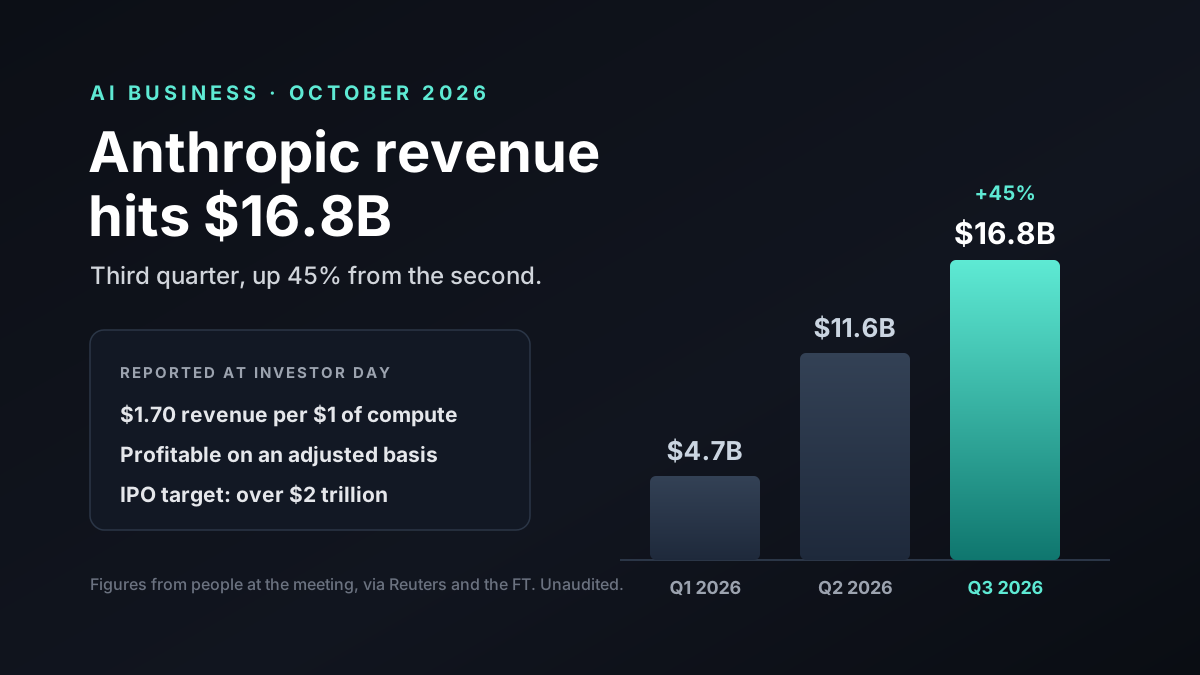
| Revenue | About $17 billion | Third quarter of 2026 |
| Annualized revenue run rate | $81 billion | End of October 2026 |
| Net loss | $104 billion | First nine months of 2026 |
| Cash and short-term investments | Nearly $132 billion | Latest filing |
| Compute and infrastructure commitments | $900.9 billion | Latest filing |
The revenue growth is real. First-half revenue was about 15 times the same period of 2025, as we covered in our S-1 post. The losses are real too. Our S-1 post found that much of the first-half loss was on paper rather than cash going out the door, and the same questions apply to the nine-month figure.
The compute bill is the big long-term question. Anthropic has committed to about $900 billion for computing and infrastructure. That's why investors care so much about whether revenue can keep up.
Worked Example: The Anthropic IPO in Numbers
Here's our own math, based on the reported terms. These are rough estimates, not Anthropic's figures:
- Money raised: 825 million shares times $70 is $57.75 billion, and times $78 is $64.35 billion.
- Order book: six times covered at the $74 midpoint suggests orders worth roughly $366 billion.
- Altimeter's share: about 8% of the deal.
- Valuation multiple: $1.404 trillion divided by an $81 billion run rate is about 17 times annual revenue.
- Founder sales: seven founders times 3.4 million shares is about 24 million shares, under 3% of the offering.
A 17 times revenue multiple is high for a large company. It only makes sense if investors expect growth to stay very fast for years.
Why the Market Sees a Test of the AI Boom
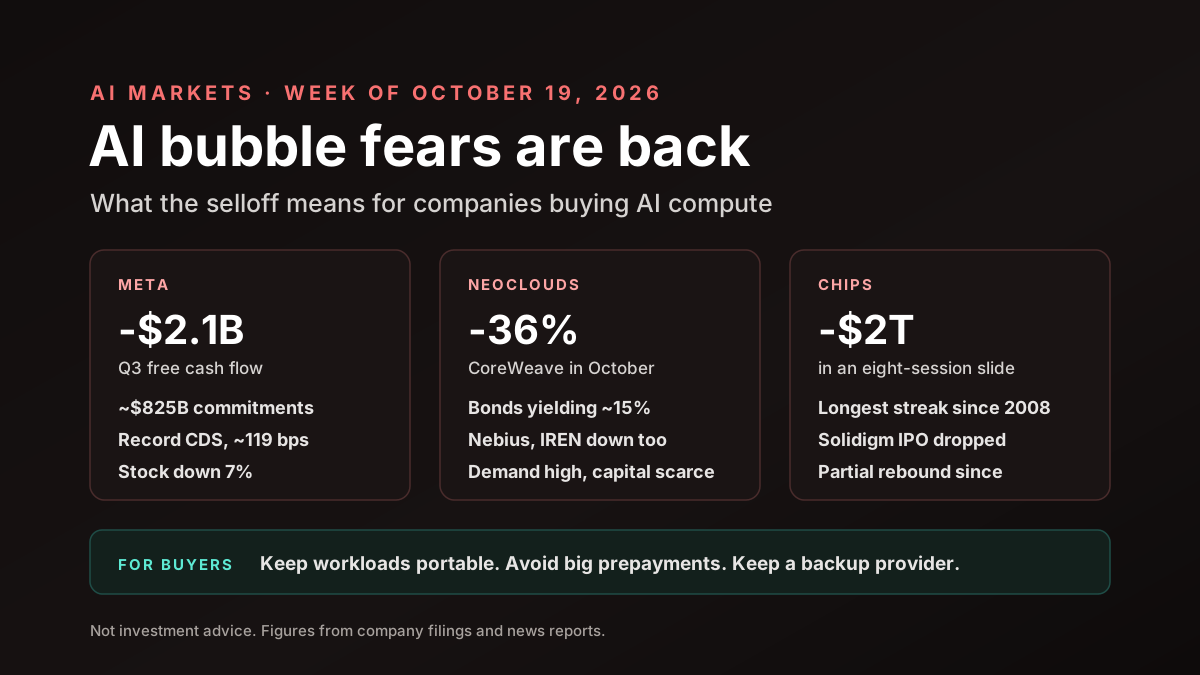
The timing is tense. AI stocks have been falling, and the Nasdaq dropped more than 2% on Monday, November 16, with Nvidia leading the decline.
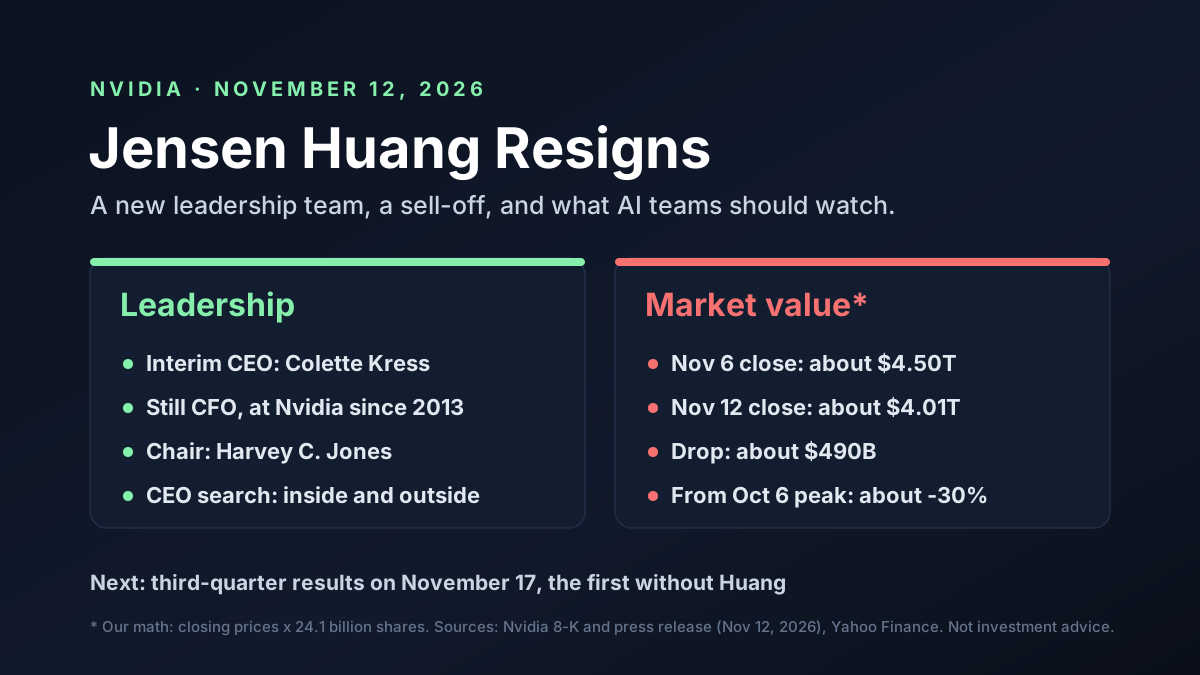
Nvidia is also dealing with leadership turmoil after Jensen Huang stepped down. Coverage based on Bloomberg reporting has framed the IPO as a test that could either cement or shake Wall Street's confidence in the AI boom.
The deal is also pulling cash away from other listings. Bank of America CEO Brian Moynihan said on November 16 that some IPOs are being pushed into early 2027. His point is simple. Investors need time to absorb a deal this size before they turn to smaller companies.
What Investors Are Still Asking
Demand is strong, but not every question has a clear answer. According to Calcalist, investors raised several concerns on the roadshow:
- Competition: can Claude stay ahead as Google and others catch up?
- Beyond coding: can Anthropic grow outside software developers into other office work?
- Pricing power: can it keep premium prices if rivals offer similar models?
- Disclosure: some questions went unanswered.
Banks' models reportedly assume about $270 billion to $280 billion of revenue in 2028. At least one investor who passed on the deal sees that figure about 30% lower.
What the Anthropic IPO Means for AI Buyers
If your team builds on Claude, the IPO won't change your API keys next week. But being a public company changes how a vendor behaves over time:
- More disclosure. Quarterly reports will show revenue, costs and how much comes from the biggest customers, which helps you judge the vendor's health.
- More pressure on margins. Shareholders will push for profit, which can affect prices and free tiers.
- More money for compute. Fresh cash can mean more capacity and fewer rate limits.
- More scrutiny of outages. Reliability issues, like the ones in our Claude and Microsoft outages post, become investor news.
The practical move is the same as with any key vendor. Know your usage costs, keep a fallback model tested and avoid building in a way that makes switching impossible.
Risks and Open Questions
There's still a lot we don't know:
- The final price: whether it lands at, above or below the range
- Day one trading: whether the stock rises, falls or stays flat
- Lockups: when insiders and early investors can sell
- Growth: whether revenue can keep pace with a roughly $900 billion compute commitment
- The AI market: whether the recent sell-off deepens or reverses
What to Watch This Week
Here's the calendar:
- Wednesday, November 18: final pricing, expected in the evening US time
- Thursday, November 19: first trades on Nasdaq under ANT
- The opening price: how far it moves from the IPO price
- The greenshoe: whether banks buy the extra 123.75 million shares
- Other IPOs: whether delayed deals start coming back into the calendar
Anthropic IPO: Our Take
The Anthropic IPO is a landmark for the AI industry. Strong demand, huge strategic backers and fast revenue growth make a strong case. High losses, a giant compute bill and tight founder control make a cautious one.
For most of our readers, the real story isn't the stock price. It's that the company behind Claude is about to face the discipline of public markets, with quarterly reports, analyst calls and a share price that reacts to every outage, price change and product launch. That will shape its prices, its products and its priorities for years.
We'll update this post after pricing.
How Van Data Team Helps
We help teams build on AI without betting everything on one vendor:
- AI agents with tested fallbacks across model providers, through AI agent development.
- Data pipelines that keep your data portable between tools, via data pipeline development.
- Cost dashboards that track AI spend by team and task, through agentic BI reporting.
- Cloud and AI cost reviews, through our cloud cost optimization service.
This article is based on Anthropic's filings as reported by TechCrunch and CNBC, plus coverage by Calcalist, Bloomberg and Bloomberg Law, as of November 17, 2026. It is not investment advice. Want to reduce your AI vendor risk? Get in touch and we'll help you plan it.
AI Model Brief
The AI models worth knowing, once a week
What shipped, how it scores on independent benchmarks, what it costs per million tokens and what was deprecated, from the data behind our AI model benchmarks.
We use your address only to send the brief. See our privacy policy.
See this week’s brief
Founder of Van Data Team. Builds Vanaxity, the AI agent system for SEO, GEO, and AEO, and leads data engineering delivery for B2B teams.
About the authorArticle FAQ
Questions readers usually ask next.
These short answers clarify the practical follow-up questions that often come after the main article.
Need a similar system?
If this article maps to a workflow your team already operates, the next step is usually a scoped review of the system, constraints, and rollout path.
Consultation
Scope your next AI workflow.
Share the system and blockers. We will map fit, gaps, and the next step.