Jensen Huang Resigns: What It Means for Nvidia and AI Teams
Jensen Huang resigns as Nvidia CEO after a sell-off of nearly $500 billion. What changed, why AMD and Broadcom rose, and what AI teams should watch on Nov 17.
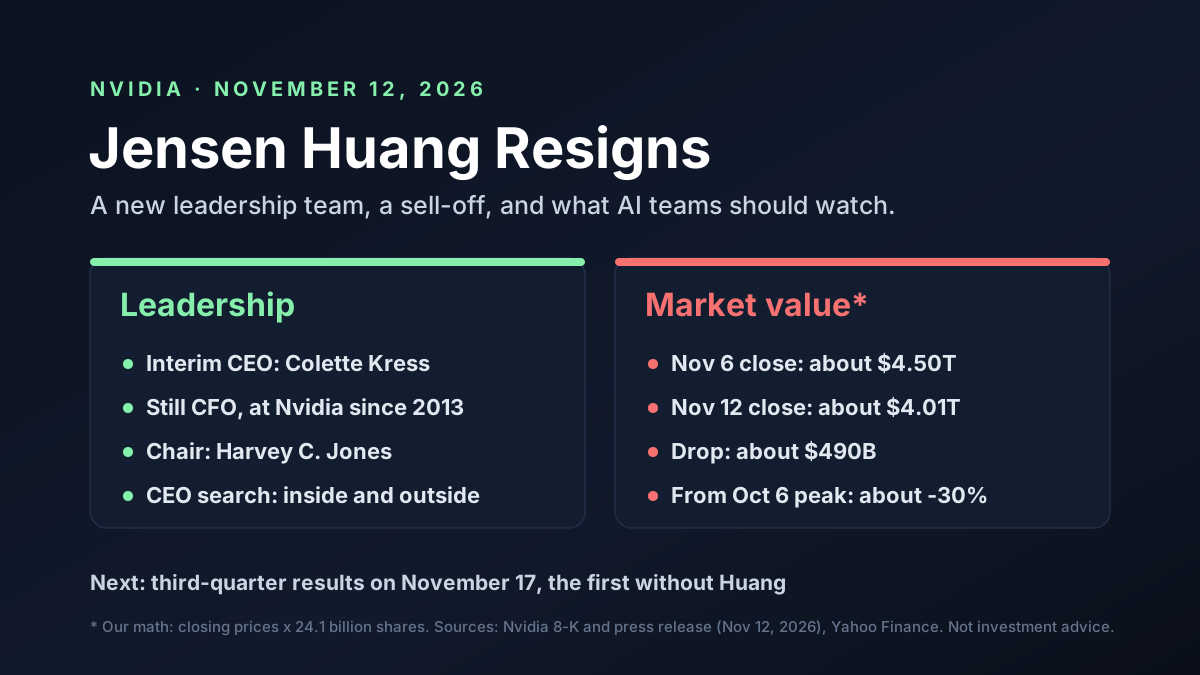
It took four days. On November 8, 2026, Jensen Huang admitted an affair, and Nvidia's board opened an inquiry. On November 12, Nvidia said he had resigned as CEO, in a press release that named CFO Colette Kress as interim chief.
In between, Nvidia lost nearly $500 billion in market value. Rivals AMD and Broadcom rose. A shareholder sued, and Congress asked questions. Jensen Huang resigns, and for the first time in 33 years Nvidia has someone else at the top.
We covered the start of this story in our Jensen Huang investigation guide. This update covers what changed since, what the market did and what AI teams should check now.
Key Takeaways
- He's out. The board accepted Huang's resignation on November 11, effective immediately, per Nvidia's 8-K.
- Kress is in. CFO Colette Kress is interim CEO, and longtime director Harvey C. Jones becomes the board's first-ever chair, a role Nvidia never had while its founder ran it.
- The sell-off was huge. Nvidia lost about $490 billion in market value from the November 6 close to the November 12 close, by our math.
- Money moved to rivals. AMD rose about 30% and Broadcom about 24% over the same days.
- Earnings come first. Nvidia reports on November 17, its first results without Huang.
- For AI teams: nothing changes in your racks today, but the next quote, the next GPU cloud contract and the next roadmap call deserve a closer look.
Jensen Huang Resigns: The Facts at a Glance
Here's what Nvidia has confirmed in writing, as of November 13, 2026:
| Item | What's confirmed |
|---|---|
| Resignation | Accepted by the board on November 11, 2026, effective immediately |
| Announced | November 12, 2026, in a press release and 8-K filing |
| Roles left | President, CEO and board member |
| Interim CEO | Colette Kress, who stays CFO |
| Board chair | Harvey C. Jones, the first-ever chair |
| CEO search | Internal and external candidates |
| Next results | Third quarter, November 17, after the close |
The 8-K filing is short and formal. The press release adds one line that matters to customers. Board chair Harvey Jones said Nvidia expects "operations, customer commitments and product roadmap to continue without interruption."
Jensen Huang Resigns: What Happened, Day by Day
The week moved fast. It started on November 8, when Huang told staff he'd had an affair with a businesswoman US officials reportedly suspect of spying for China. She hasn't been charged, and China calls the claim groundless.
Here's what followed:
- November 8: the board opened its own inquiry
- November 9: Nvidia fell 4.27% in the first session after the news
- November 10: it fell another 5.47%, and a shareholder filed a proposed class action in federal court in San Jose
- November 11: the board accepted Huang's resignation
- November 12: Nvidia announced it, and the stock fell as much as 14% at the open before closing down 4.34%
Several more reports came out during the week, including new personal allegations. We aren't repeating them here, because they aren't confirmed and don't change what AI teams need to know.
Who Is Colette Kress?
Kress isn't a new face to Nvidia's customers or investors. She joined as CFO in September 2013, and the press release says she has played a key role in the company's growth since then. Before Nvidia, she spent nearly 25 years in finance roles at companies including Cisco and Microsoft.
She keeps both jobs. That's a heavy load in a hard week, with earnings five days after her appointment. KeyBanc analyst John Vinh called the choice constructive, citing her long tenure, per Yahoo Finance's live coverage.
What she isn't, at least publicly, is a product visionary in Huang's mold. Expect her to talk about execution, supply and customer commitments rather than bold new bets. For buyers, that steadiness may be welcome.
How Much Value Nvidia Lost as Jensen Huang Resigns
Here are the daily closes, from Yahoo Finance's price history:
| Date (2026) | Nvidia close | Daily move | What drove it |
|---|---|---|---|
| November 6 | $186.64 | +2.78% | Last close before the weekend news |
| November 9 | $178.67 | -4.27% | First session after Huang admitted the affair |
| November 10 | $168.89 | -5.47% | New reports and a shareholder lawsuit |
| November 11 | $173.73 | +2.87% | A brief rebound |
| November 12 | $166.19 | -4.34% | Resignation announced; down as much as 14% at the open |
To turn prices into market value, we used Nvidia's last reported share count of 24.1 billion shares. That's our math, not Nvidia's:
| Point | Close | Market value, our math |
|---|---|---|
| October 6 peak | $239.24 | About $5.77 trillion |
| November 6 | $186.64 | About $4.50 trillion |
| November 10 | $168.89 | About $4.07 trillion |
| November 12 | $166.19 | About $4.01 trillion |
So the first two sessions took about $430 billion, in line with The Globe and Mail's tally. By Thursday's close, the loss from the prior Friday was about $490 billion, which is why NBC News and CBS put it at nearly $500 billion.
At the open on November 12, Nvidia's value dipped below $4 trillion for the first time since 2025, Bloomberg reported. From its October 6 peak, the stock is down about 30%, or roughly $1.76 trillion.
Why AMD and Broadcom Rose
The most telling part of the week wasn't Nvidia's drop. It was where the money went.
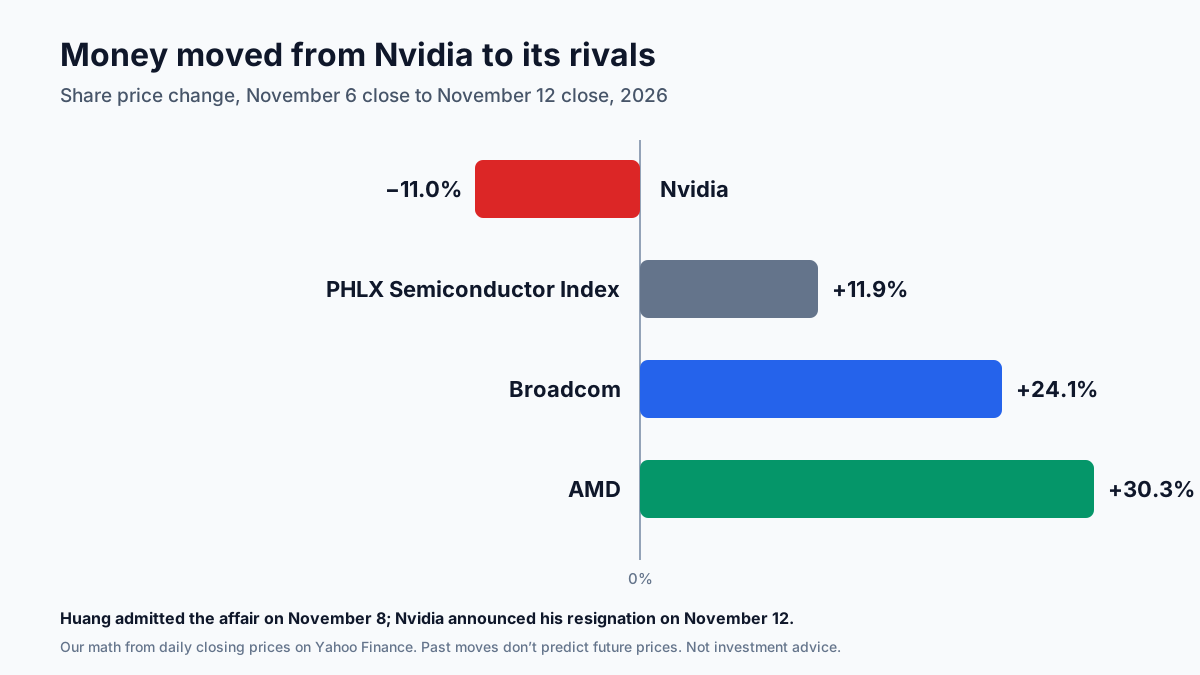
On November 9, Nvidia fell 4.27% while the PHLX Semiconductor Index rose 6.85%. From the November 6 close to the November 12 close, Nvidia fell about 11%. AMD rose about 30%, and Broadcom about 24%.
The reason is simple. Buyers who want a second GPU source tend to look at AMD. Those who want their own custom chips tend to look at Broadcom, which designs them for large clouds. When investors think customers might spread their bets, those two benefit first.
It's worth being careful here. Stock prices move on fear and hope, not on signed orders, and a week of trading doesn't mean a single customer has switched. But it does show what investors expect buyers to consider.
The $500 Billion AI Financing Question
There's a second $500 billion number in this story, and it matters more to AI teams. In August, Nvidia signed preliminary deals with Apollo, BlackRock, Blackstone, Brookfield, Goldman Sachs and KKR to raise more than $500 billion for AI infrastructure, CNBC reported.
The plan uses Nvidia chips as collateral, a bit like loans backed by buildings. That's how many data centers and GPU clouds get built.
Analysts don't expect the money to vanish. But Raymond James's Sunaina Sinha Haldea told CNBC that lenders "could want to be paid more for the uncertainty." If borrowing costs go up for GPU clouds, some of that can show up in rental prices later.
Yahoo Finance's analysis also flagged GPU cloud providers such as CoreWeave and Nebius as among the most exposed, per its live coverage. Those firms rent out Nvidia chips and rely on Nvidia's backing. If you rent GPUs from a smaller cloud, this is the part of the story to follow.
Jensen Huang Resigns, but Washington and the Courts Aren't Done
Pressure isn't only coming from the market:
- The lawsuit: a proposed class action filed in San Jose claims Nvidia and Huang misled shareholders. No class has been certified, and the claims haven't been tested in court.
- Congress: three House committee chairs had asked Huang for a closed-door briefing on November 18, CNBC reported. Rep. Brian Mast later said Huang agreed to appear before Congress before Thanksgiving, according to Yahoo Finance's live coverage.
- The FBI: President Trump said the FBI is looking into Huang's ties to the businesswoman, according to CBS News.
None of this has led to charges. But each thread can produce new headlines, and new headlines move the stock and the mood around Nvidia.
Jensen Huang Resigns, and the Export Control Questions Stay
The political side of this story is about chips and China, not just one person. Sen. Elizabeth Warren said Huang, Nvidia's executives and its board "still owe Congress answers" on export controls, CBS News reported.
That thread started before this week, with questions about how Nvidia chips reached Chinese buyers through third parties. We covered it in our post on the Nvidia Megaspeed probe. The leadership change doesn't close those questions. It may even sharpen them, because a new leader has less reason to defend past choices.
For AI teams outside China, the practical risk is tighter rules. If Washington adds new limits on where chips can ship or who can rent them, cloud providers will pass on the paperwork, and sometimes the cost.
Jensen Huang Resigns: What It Means for AI Teams
Here's the honest answer: your GPUs work the same today as they did last week. CUDA, your drivers and your contracts haven't changed. The board says the roadmap continues.
What can change is the business around the chips. Three things are worth watching:
- Pricing: a new leader may push harder on margins, or ease them to keep customers close
- Partner deals: big commitments to clouds and labs may be reviewed
- Speed: fewer bold bets until a permanent CEO is named
Founder-led companies often move faster than committee-led ones. Huang made big, early calls, from CUDA to the AI data center. An interim leader is more likely to protect what exists than to bet big. That's not bad for buyers, but it's different.
What Changes for Nvidia Customers, and What Doesn't
It helps to separate the noise from the parts that touch your work:
| Doesn't change now | Could change in the coming months |
|---|---|
| Your installed GPUs and drivers | Pricing and discounts on new orders |
| CUDA and your software stack | Terms of big partner and cloud deals |
| Existing contracts | Financing costs for GPU clouds |
| The published roadmap | How boldly Nvidia bets on new markets |
The left column is why there's no reason to panic. The right column is why it's worth paying attention for the next few months, especially if you sign big GPU contracts or rely on a smaller GPU cloud.
What to Watch at Nvidia Earnings on November 17
The November 17 report is the first test for the new team. Earnings land at about 1:20 p.m. Pacific time, with the call at 2 p.m. Here's what matters to buyers, not investors:
| Topic | What to listen for | Why it matters to buyers |
|---|---|---|
| Supply | Any change to shipment timing | Your delivery dates |
| Roadmap | Vera Rubin timing and volume | When to buy or wait |
| Pricing | Gross margin and discount talk | What your next quote looks like |
| Commitments | Status of large partner deals | Health of GPU clouds you rent from |
| Leadership | CEO search timeline | How long uncertainty lasts |
Listen for how Kress answers questions on supply. She's been the CFO since 2013, so she knows the numbers well. If she sounds steady on shipments and the Vera Rubin roadmap, buyers can relax a bit. If answers turn vague, plan for more slack in your timelines.
Questions to Ask Your GPU Cloud Provider
If you rent GPUs rather than own them, your provider's health matters as much as Nvidia's. Here are five fair questions to ask this month:
- How is your GPU fleet financed, and does any of it depend on Nvidia-backed deals?
- Have your capacity plans for the next two quarters changed?
- What happens to my reserved capacity if a supplier delays shipments?
- Can I move part of my reservation to other chip types without a penalty?
- When are rates reviewed?
A good provider will answer plainly. A vague answer isn't proof of trouble, but it's a reason to keep a backup.
A 7-Day Plan for GPU-Reliant Teams
Our earlier guide has a full vendor risk checklist. Here's a shorter plan for this week. Start with what you've already signed:
- Day 1: list every Nvidia-dependent commitment, from cloud reservations to hardware orders and support contracts
- Day 2: ask your GPU cloud provider how it's funded
- Day 3: check renewal dates on any GPU reservation expiring in the next six months
Then build options and use the earnings call:
- Days 4 to 5: test one small workload on an AMD GPU or a cloud's own chip
- Day 6: listen to the earnings call
- Day 7: decide whether to lock in prices now or wait
Step 4 is the one with lasting value. A tested second option makes every future negotiation easier, whoever runs Nvidia.
Worked Example: What a Price Change Could Cost
Here's a made-up case to show the stakes. These are our numbers, not market data.
Say a team rents 64 GPUs at $2.50 an hour each, around the clock. That's about $1.4 million a year. If tighter financing pushes its GPU cloud to raise prices by 10% at renewal, the bill grows by about $140,000.
Now say the team had tested a second platform and can move a quarter of its work. That gives it real leverage at renewal, even if it never moves. A credible option is often worth more than the switch itself.
The point isn't that prices will rise. It's that a leadership change is a good moment to know your exposure before your next renewal arrives.
Risks and Open Questions
There's a lot we still don't know:
- The CEO search: no timeline, and no named candidates
- The board inquiry: no findings have been published
- Congress: the date and format of Huang's appearance aren't confirmed
- The lawsuit: early, and could take years
- Partners: how financing deals and big customer commitments hold up
Each of these can move the story. None of them changes your hardware today.
What to Watch Next
A few dates and signals to track:
- November 17: third-quarter results and the first call led by Kress
- Late November: Huang's appearance before Congress, if it happens before Thanksgiving
- December 1: GTC DC, where it's unclear who will speak for Nvidia
- The CEO search: any shortlist or named successor
- GPU cloud pricing: any change in reserved or on-demand rates
Jensen Huang Resigns: Our Take
Jensen Huang resigns, and an era ends. He built Nvidia from a graphics chip startup into the center of the AI boom, and the market's reaction shows how much of that value investors tied to him.
For AI teams, the lesson is the one we gave last week, now with more weight. Don't panic, and don't assume nothing will change. Keep your code portable, know your commitments and test a second option. Then let the next few months show whether Nvidia without Huang behaves differently.
How Van Data Team Helps
We help AI and data teams stay flexible when vendors change:
- GPU spend and contract reviews, by provider and renewal date, through our cloud cost optimization service.
- Portable AI systems that can run on more than one GPU platform, via AI agent development.
- Pipelines that move between clouds and GPU providers without a rewrite when prices, terms or vendors change, via data pipeline development.
- Vendor risk dashboards that track commitments and prices, through agentic BI reporting.
This article is based on Nvidia's filings and public reporting as of November 13, 2026. It isn't investment or legal advice. Want to check your GPU exposure before renewal season? Get in touch and we'll help you map it.
AI Model Brief
The AI models worth knowing, once a week
What shipped, how it scores on independent benchmarks, what it costs per million tokens and what was deprecated, from the data behind our AI model benchmarks.
We use your address only to send the brief. See our privacy policy.
See this week’s brief
Founder of Van Data Team. Builds Vanaxity, the AI agent system for SEO, GEO, and AEO, and leads data engineering delivery for B2B teams.
About the authorArticle FAQ
Questions readers usually ask next.
These short answers clarify the practical follow-up questions that often come after the main article.
Need a similar system?
If this article maps to a workflow your team already operates, the next step is usually a scoped review of the system, constraints, and rollout path.
Consultation
Scope your next AI workflow.
Share the system and blockers. We will map fit, gaps, and the next step.