Tesla FSD v15: What Reality View and the 25x Claim Mean
Tesla FSD v15 is rolling out with Reality View and a 25x claim. What's new, who gets it, what the numbers don't show and what AI teams can learn from it.
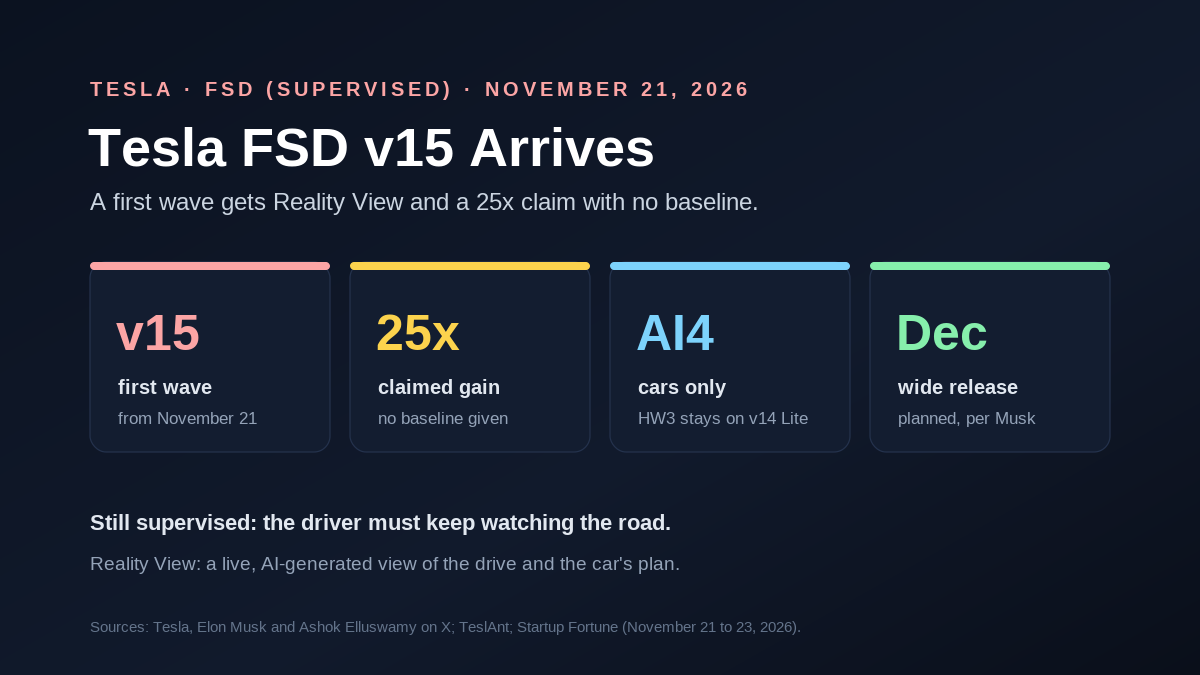
Tesla has started rolling out its biggest driving software update in years. On Saturday, November 21, 2026, Tesla said on X that FSD v15 was "now starting to roll out," at 2:24 p.m. Eastern.
The headline feature is Reality View, a new screen that shows an AI-generated view of the drive from above the car. Tesla also claims a 25x gain in one key measure. It hasn't said 25x compared to what.
So what is actually new in Tesla FSD v15, who gets it, and how much should anyone read into the numbers? This guide covers the facts and the open questions. It also looks at what teams that build AI products can learn from the release, from how to read a big ratio to why showing a model's plan builds trust.
Key Takeaways
- A first wave: a small group gets it first.
- AI4 only: cars with Tesla's older HW3 computer stay on a cut-down v14 Lite, and Musk says everyone else with AI4 hardware should get v15 in a wide release next month.
- Reality View: a live, generated top-down view that shows what the car plans to do.
- A 25x claim with no baseline: Tesla says a new vision encoder improves the critical intervention rate by 25x, but it shared no data.
- Still supervised: drivers must keep watching the road.
Tesla FSD v15 at a Glance
Here's what has been reported, as of November 23, 2026:
| Item | Detail |
|---|---|
| Announced | Tesla on X, November 21, 2026, 2:24 p.m. Eastern |
| Version | FSD (Supervised) v15.0.1, per owner trackers |
| First wave | Small, reportedly Early Access members |
| Hardware | AI4 (HW4) cars only |
| HW3 cars | Stay on v14 Lite |
| Headline feature | Reality View |
| Wide release | "Next month," per Musk |
| Still supervised? | Yes |
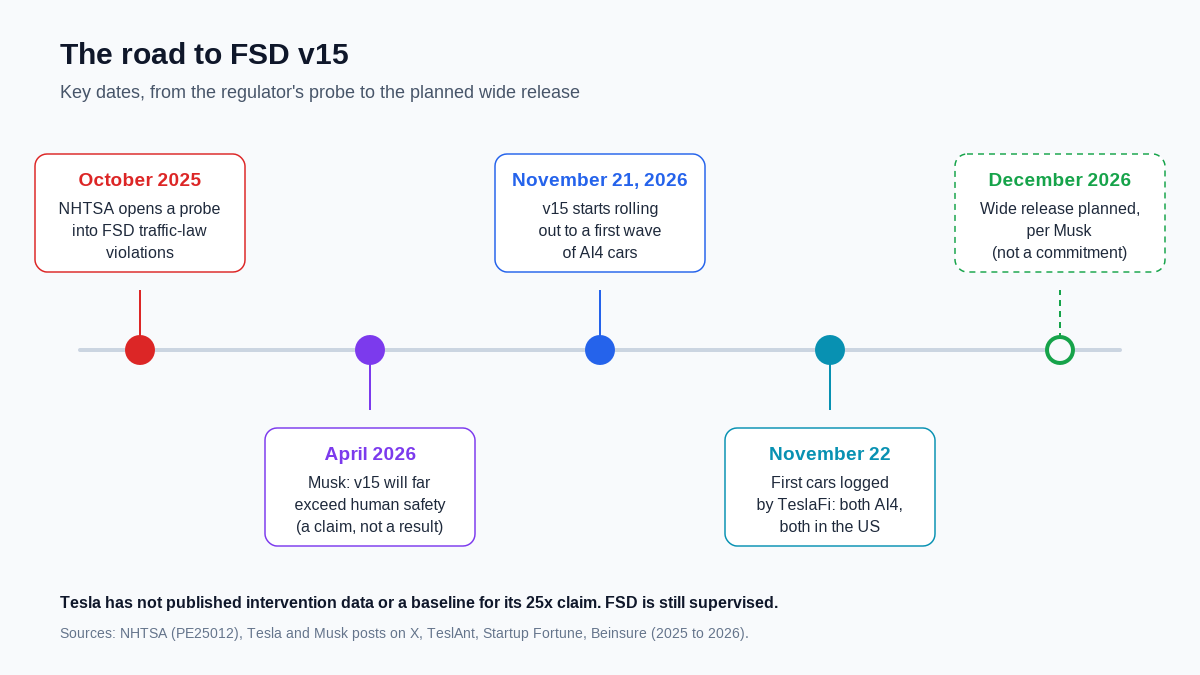
Tesla hasn't published a build number. Owner trackers list the update as v15.0.1, and TeslaFi logged its first two cars on November 22, both AI4 cars in the US, according to TeslAnt.
What Tesla Announced on November 21
Three posts on X told the story:
- Tesla, at 2:24 p.m. Eastern: "FSD v15 now starting to roll out."
- Ashok Elluswamy, who leads Tesla's AI software: v15 was "releasing to the first wave of customers today."
- A fan account, about half an hour later: the full release notes, which say v15 "upgrades every part of the end-to-end driving network," meaning the single AI model that turns camera images into steering and speed.
Tesla didn't say how many cars are in the first wave, or which regions. Reports say early access members got it first.
Here's how v15 got here:
What Is Reality View?
Reality View is the part most owners will notice first. Tesla's release notes describe it as a "real-time generative driving visualization." In plain terms, the car draws a live picture of the road from a virtual camera above and behind the car.
It's not a map. It's generated by AI from what the cameras see, and it shows what FSD plans to do next. Tesla's own pitch is that you can "see and control" the car's plan.
Owners can choose how much of it to see:
- Full screen, for the biggest view.
- Next to the map, for normal driving.
- Split view, with both side by side.
- Quiet mode, to hide it.
Musk's description was blunt: "It's like GTA." Reactions were mixed. Some owners said the overhead view helped with curbs and tight spots, while one popular account called it "messy."
What Else Is New in Tesla FSD v15
Reality View gets the attention, but the release notes list many smaller changes:
| Feature | What it does, per the release notes |
|---|---|
| Reality View | Shows a live generated view of the drive and the car's plan. |
| Speed Camera Slowdown | Slows for speed cameras; after you cancel it twice at one camera, it stops slowing there. |
| Bike Rack Mode | Pulls over instead of reversing. |
| Driver monitoring | Works more often with hats and sunglasses, and is less strict in faster driving profiles. |
| Learned navigation | Uses fleet habits at the start and end of trips. |
| Parking | Picks spots from your history. |
| Road hazards | Better at spotting animals, debris, potholes and standing water. |
Several of these fix real complaints. Speed camera slowdowns were a common gripe, and the new rule lets drivers teach the car to skip a camera they know. Bike Rack Mode solves a simple problem: reversing with a bike rack on the back can hit things the cameras can't judge well.
The driver monitoring change is the one to watch. Being less strict at higher speeds is convenient. It also means the system leans more on the driver to stay alert without being reminded.
How to Read the 25x Claim
This is the number in most headlines, so it's worth reading slowly. Tesla's release notes say the new vision encoder "improves the critical intervention rate by 25x." A critical intervention is when a driver has to take over to avoid a problem.
What Tesla didn't share:
- The baseline: 25x better than v14, or than an early v15 build? Tesla doesn't say.
- The data: there are no miles, no intervention counts and no time period, so nobody outside Tesla can check how often drivers actually had to step in, on which roads or in what weather.
- The method: it isn't clear whether this comes from road driving, simulation or a test set.
Later, Elluswamy went further and wrote that "v15 is 25x safer than v14 across the fleet," adding that the difference shows up only across millions of miles. He gave no figures. "Safer" is also a bigger claim than "fewer critical interventions," since safety covers crashes, injuries and near misses.
None of this means the claim is false. It means it can't be checked yet.
Is the Tesla FSD v15 Model 10x Bigger?
Some coverage says the v15 model has about 10 times the parameters of v14, roughly 10 billion against 1 billion, according to Startup Fortune, which cited other Tesla news sites. Tesla itself hasn't confirmed that figure.
A bigger model can learn more patterns. It also needs more computing power in the car, which helps explain why v15 runs only on the newer AI4 computer.
Here's how the main claims stack up:
| Claim | Who made it | What's missing |
|---|---|---|
| The new vision encoder improves the critical intervention rate by 25x. | Tesla's release notes | A baseline, the raw data, the test method and whether the result came from real roads or from simulation. |
| v15 is 25x safer than v14 across the fleet. | Ashok Elluswamy, on X. | Miles driven and intervention counts. |
| About 10x more parameters, roughly 10 billion against 1 billion. | Third-party coverage | Confirmation from Tesla |
| It's like GTA | Elon Musk, on X. | Nothing; it's a description. |
Who Gets Tesla FSD v15 First
Rollouts at Tesla usually go in waves:
- First: employees and early access testers.
- Next: a wider group of owners, often by region.
- Last: everyone with an eligible car.
v15 seems to follow that pattern. The first wave is small, and Musk said on X: "FSD V15 goes to wide release next month. It will be something special." That points to December, though Tesla's timelines often slip. Some outlets expect it to arrive with Tesla's yearly holiday software update, but Musk hasn't said so.
Here's where each group of cars stands:
| Car | FSD version | Notes |
|---|---|---|
| AI4 (HW4), US | v15, first wave | The hardware v15 was built for |
| HW3 | v14 Lite | Needs a hardware upgrade for v15, per Musk; no program or price announced |
| Europe, Tesla Assisted Driving | v14.2.2.7 | Waits for the Dutch regulator to approve a change |
Why HW3 Owners Are Left Out
HW3 is the car computer Tesla shipped from 2019 until AI4 replaced it in 2023. Millions of cars still use it, and many of their owners paid for Full Self-Driving years ago.
Musk said on Tesla's first-quarter 2026 earnings call that v15 would run only on AI4 hardware. HW3 owners, he said, would need an upgrade. Tesla hasn't said what that upgrade will cost or when it will start.
For those owners, v15 is a reminder that "full self-driving" depends on the hardware in the car, not only on software updates.
What Is Known and What Isn't
It's easy to fill the gaps with hype or doubt. Here's a cleaner split:
| Known | Not known |
|---|---|
| v15 started rolling out on November 21 | How many cars have it |
| It runs on AI4 cars only | When HW3 owners get an upgrade path |
| Tesla claims a 25x gain on one measure | What the baseline was |
| Musk expects a wide release next month | The exact date |
| It is still supervised | When, or whether, supervision ends |
The most useful data would be simple: interventions per thousand miles, by version, on the same roads. Tesla has that data. It hasn't published it.
Tesla FSD v15 and Regulators
Regulators are still watching FSD closely. Here's where things stand:
| Where | What's happening | Status |
|---|---|---|
| US, NHTSA | A probe opened in October 2025 into FSD running red lights and driving on the wrong side of the road, covering about 2.9 million cars. | No public outcome found as of November 23, 2026. |
| Netherlands, RDW | Approved Tesla Assisted Driving, with hands on the wheel required above 130 km/h. | v15 needs a new approval. |
| Other EU countries | Several follow the Dutch approval. | Wait for the RDW. |
NHTSA's opening notice lists the incidents behind its probe. A new version doesn't close an old probe. If v15 drives better, regulators will want to see data, not claims.
Europe moves slower by design. Each change to the software there needs a fresh sign-off before owners can get it.
What Tesla FSD v15 Means for Robotaxis
v15 matters beyond customer cars:
- Testing: Tesla's Model Y robotaxis were reportedly already running early v15 builds, according to remarks on Tesla's second-quarter earnings call, as reported by Startup Fortune.
- The promise: in April, Musk said v15 would "far exceed human levels of safety, even in completely unsupervised and complex situations." That's a claim about the future, not a result.
- The stakes: if v15 is as good as Tesla says, it helps the case for robotaxis with no one behind the wheel.
If it isn't, the gap will show up in data that regulators can see. The next few months of owner reports will be the first real test.
Why Showing the Plan Matters
Reality View is more than eye candy. It's a way for an AI system to show its plan before it acts, and that helps in three ways:
- Earlier fixes: a driver who sees that the car plans to change lanes can step in before the move, not after it.
- Less guessing: without a view, the driver has to guess.
- Better trust: when people can see what a system intends, they catch mistakes sooner and trust it for the right reasons.
It's the same idea behind good AI tools at work. Show the steps, not just the answer.
What Tesla FSD v15 Teaches AI Teams
Most of our readers don't build cars. But the release has lessons for anyone shipping AI:
- Ratios need baselines: "25x better" means nothing until you know the starting point.
- Measure what users feel: interventions per mile is closer to real life than a score on a test set, because it counts the moments when a person had to step in, which is what users actually remember.
- Show intent: let people see the plan.
- Roll out in waves: a small first group finds problems before everyone does.
- Hardware limits software: new models may not run on old devices, and the users left behind notice right away.
We cover how to test AI systems properly in our guide to AI agent evaluation. The same rules apply to cars, chatbots and agents.
A Checklist for Judging AI Performance Claims
Vendors use big ratios because they're easy to remember. Use this checklist the next time you see one:
| Question | Why it matters | What to ask for |
|---|---|---|
| 25x compared to what?. | A ratio means nothing without a starting point. | The baseline number |
| Measured how? | Different tests give very different results, even on the same model. | The method, the data set and who ran the test. |
| On which cases? | Hand-picked examples can make almost any model look good, so a claim built on them says little about daily use. | A random sample of real use. |
| Is the gap real?. | Rare events need huge samples to measure. | The sample size and the margin of error, since rare events like crashes need millions of miles before a gap means anything. |
| Who checked it? | Self-reported results are a start, not proof. | An outside review |
The same questions apply to model benchmarks, as we showed in our look at Claude Opus 5.5 benchmarks. A good claim survives all five.
What to Watch Next
A few signals will tell us more:
- The wide release, and whether it lands in December as Musk said.
- Owner data from trackers on interventions and disengagements, which will show up within weeks once more cars have v15.
- An HW3 upgrade plan, with a price.
- Any NHTSA update on the October 2025 probe.
- Robotaxi use, since Tesla's Model Y robotaxis were reportedly already testing early v15 builds.
Tesla FSD v15: Our Take
Tesla FSD v15 looks like a real step forward in how the system shows its thinking. Reality View is a smart idea, and several small fixes address long-standing complaints.
The 25x claim is another story. Without a baseline, it's marketing, not measurement. We'd wait for owner data and, ideally, independent tests before drawing conclusions about safety.
For AI teams, the lesson is to be the kind of vendor whose numbers can be checked. Publish the baseline, show the method and let people see the plan.
How Van Data Team Helps
We help teams build AI they can measure and trust:
- AI agents with clear plans and logs, through AI agent development.
- Evaluation dashboards that track real-world error rates, via agentic BI reporting.
- Data pipelines that capture the events you need to measure AI, through data pipeline development.
This article is based on posts by Tesla, Elon Musk and Ashok Elluswamy on X, Tesla's v15 release notes as reported by TeslAnt, Startup Fortune and others, and NHTSA records, as of November 23, 2026.
It is not investment, safety or driving advice. Van Data Team has no business relationship with Tesla. Want to measure your own AI properly? Get in touch and we'll help you set up the numbers.
AI Model Brief
The AI models worth knowing, once a week
What shipped, how it scores on independent benchmarks, what it costs per million tokens and what was deprecated, from the data behind our AI model benchmarks.
We use your address only to send the brief. See our privacy policy.
See this week’s brief
Founder of Van Data Team. Builds Vanaxity, the AI agent system for SEO, GEO, and AEO, and leads data engineering delivery for B2B teams.
About the authorArticle FAQ
Questions readers usually ask next.
These short answers clarify the practical follow-up questions that often come after the main article.
Need a similar system?
If this article maps to a workflow your team already operates, the next step is usually a scoped review of the system, constraints, and rollout path.
Consultation
Scope your next AI workflow.
Share the system and blockers. We will map fit, gaps, and the next step.