Black Friday 2026: AI Shopping Traffic Converted 68% Better
AI shopping traffic converted 68% better than other visits on Black Friday 2026, per Adobe. What the $13.1 billion record shows and what retailers should do.
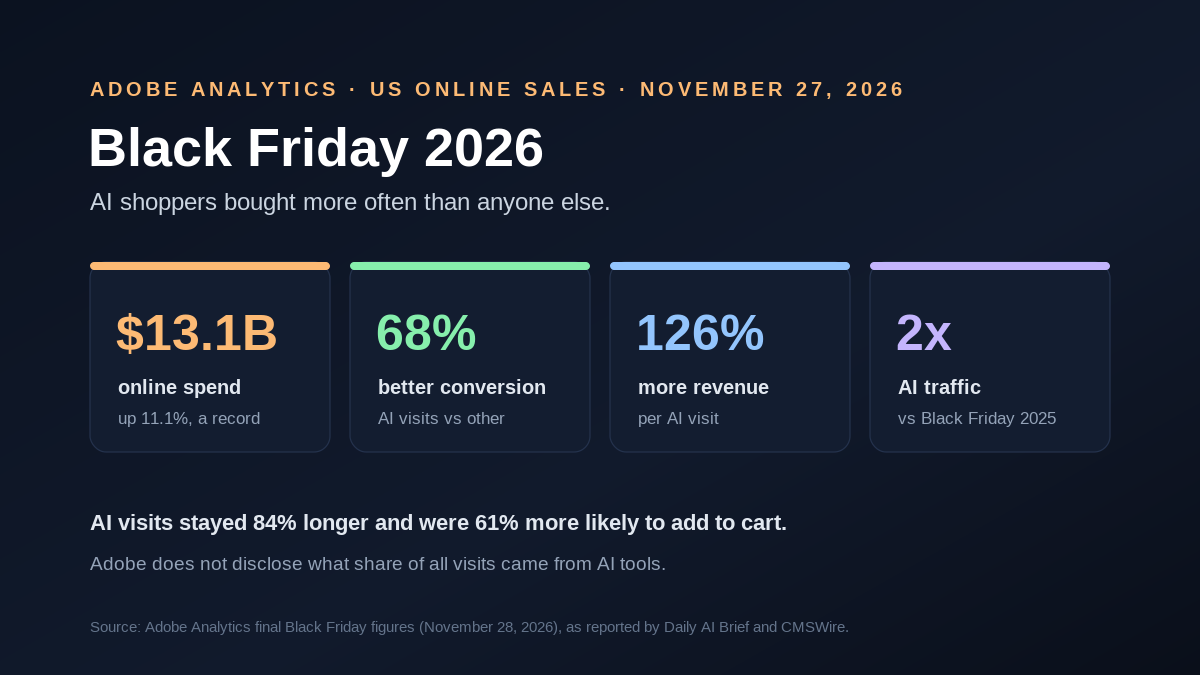
Black Friday 2026 set a new online record, and AI shopping traffic was the standout. US shoppers spent $13.1 billion online on November 27, Adobe says, and visitors who reached a store by clicking a link in an AI tool were 68% more likely to buy than visitors from search ads, social media and every other channel.
A year ago, that gap was 38%. Now it's close to double.
Below, we walk through what Adobe's final numbers show, where they fall short, and what retailers can do with them in the few days left before Cyber Monday. Short version? Real signal. Small channel.
Key Takeaways
- The record: $13.1 billion online.
- The headline: visits from AI tools converted 68% better than visits from search, social, email and every other channel, up from a 38% gap on Black Friday 2025, according to Adobe's final figures.
- The money: each AI visit brought in 126% more revenue on average, up from 74% a year earlier.
- The growth: AI traffic to US retail sites doubled from last Black Friday, and rose 162% on Thanksgiving Day.
- The catch: Adobe doesn't say what share of visits came from AI, so the channel's total size is unknown.
- Our view: AI is now a real sales channel worth measuring on its own, but it's still small, and the gap partly reflects who uses it.
Black Friday 2026 at a Glance
Here's the short version, as of November 29, 2026:
| Item | Black Friday 2026 |
|---|---|
| Date | Friday, November 27, 2026 |
| US online spend | $13.1 billion, a record |
| Growth | Up 11.1% from about $11.8 billion in 2025 |
| Adobe's forecast | $12.9 billion, beaten by about $200 million |
| AI traffic growth | Up 100% from Black Friday 2025 |
| AI conversion gap | 68% better than other visits, up from 38% |
| Revenue per AI visit | 126% higher, up from 74% |
| Source | Adobe Analytics, final figures released November 28 |
Adobe tracks more than 1 trillion visits to US retail sites, across 100 million products and 18 categories, according to Digital Commerce 360. Big, but still one company's data.
How AI Shopping Traffic Beat Other Channels
The conversion gap is the number most people will quote. But the other signals tell the same story, and most of them grew even faster than conversion did:
| How AI visits compared with other visits | Black Friday 2025 | Black Friday 2026 |
|---|---|---|
| Conversion rate | 38% better | 68% better |
| Revenue per visit | 74% higher | 126% higher |
| Time on site | 44% longer | 84% longer |
| Pages per visit | 17% more | 43% more |
| Leaving right away | 35% less likely | 51% less likely |
| Adding to cart | Not reported | 61% more likely |
In plain terms, a shopper who came from an AI tool:
- Stayed longer and looked at more pages.
- Left less often right after landing.
- Bought more often, and spent more when they did.
Here's the same comparison as a chart:
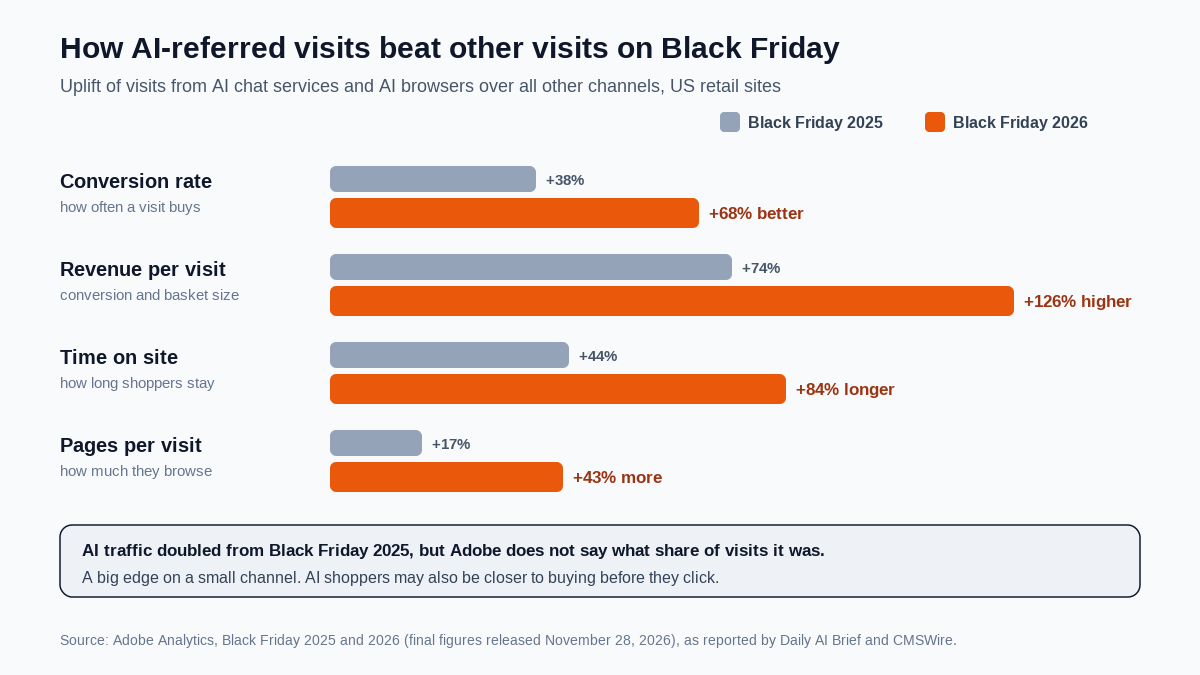
Watch revenue per visit. It folds in both how often a visitor buys and how much they spend, so it sits much closer to what a store actually earns from each click than conversion alone does, and on Black Friday an AI visit was worth about 2.3 times a typical visit by Adobe's figures.
What Counts as AI Shopping Traffic
Definitions matter here, because "AI shopping" can mean very different things.
Adobe's rule, as Daily AI Brief reports:
- AI traffic: a shopper clicks a link from an AI chat service or AI browser, such as ChatGPT, Gemini or Claude, to a US retail site.
- Non-AI traffic: everything else, including email, paid search and social media.
What that leaves out:
- Retailer assistants: chatbots inside a store's own app or site, like Amazon's or Walmart's, aren't counted as AI referrals.
- Agent checkout: purchases an AI agent completes inside a chat, without a click to the store, don't show up as visits at all.
- Research without a click: a shopper who asks an AI tool for advice, then types the store's name into a browser, counts as direct traffic.
So Adobe's number is narrow and clean. It likely understates AI's full role in holiday shopping.
Thanksgiving Set the Pace
The pattern started a day earlier. Thanksgiving Day brought a record $7.1 billion in US online spend, up 10.4%, and AI shopping traffic grew even faster than it did on Black Friday:
| Measure | Thanksgiving 2026 | Black Friday 2026 |
|---|---|---|
| US online spend | $7.1 billion, up 10.4% | $13.1 billion, up 11.1% |
| Adobe's forecast | $6.9 billion | $12.9 billion |
| AI traffic growth | Up 162% | Up 100% |
| AI conversion gap | 74% better | 68% better |
| Adding to cart | 72% more often | 61% more likely |
| Time on site | 105% longer | 84% longer |
Two details from the Thanksgiving data stand out:
- Bigger growth: AI traffic rose 162% on Thanksgiving, slightly above Adobe's 159% forecast.
- Bigger gap: AI visits converted 74% better, and shoppers spent 105% longer on the site.
Other Thanksgiving numbers from Adobe:
- Discounts: peaks of 29% on electronics, 26% on toys and 23% on apparel, bigger than Adobe expected.
- Mobile: phones drove a record 63.2% of online sales.
AI Traffic Growth Is Slowing, but the Base Is Bigger
A 100% jump sounds huge. It's actually a big slowdown from last year, when AI traffic grew from almost nothing:
| Period | AI traffic growth, year over year | Type |
|---|---|---|
| Black Friday 2025 | Up 805% | Actual |
| Full 2025 season | Up about 693% | Actual |
| Thanksgiving 2026 | Up 162%, forecast was 159% | Actual |
| Black Friday 2026 | Up 100%, forecast was 95% | Actual |
| Cyber Monday 2026 | Up 88% | Forecast |
| Full 2026 season | Up 130% | Forecast |
That's normal for a new channel:
- Last year: 805%, from a tiny base.
- This year: a 100% rise from a base that was already about nine times bigger than it was a year earlier, so each point of growth now stands for far more real shopper visits.
- Next: 88% on Cyber Monday, forecast.
What the 68% Number Doesn't Tell You
This is where we'd urge some care. The data is real, but three things limit what it proves.
- Channel size is unknown: Adobe doesn't say what share of visits came from AI tools, as CMSWire notes. A 68% edge on a small channel can move less money than a 5% gain on paid search.
- The shoppers aren't random: someone who asks an AI tool which blender to buy, compares three options and then clicks has already done most of the research, so part of the gap reflects who uses AI, not only what it does.
- Vendors supplied the data: Adobe sells analytics tools, and the Amazon and Walmart figures are company-reported. Nobody outside these firms has checked them.
It isn't new, either. AI visits converted 38% better on Black Friday 2025, 31% better across that season, and 60% better in July 2026, per CMSWire citing EMARKETER. What 2026 adds is a bigger edge on the biggest day.
What AI Shopping Traffic Could Be Worth
Since Adobe won't share the size of the channel, here's a rough way to think about it. If AI visits bring in about 2.26 times the revenue of other visits, as Adobe's 126% figure implies, then a small share of traffic turns into a larger share of revenue:
| If AI visits were this share of traffic | AI share of online revenue (our math) |
|---|---|
| 1% of visits | About 2.2% |
| 2% of visits | About 4.4% |
| 5% of visits | About 10.6% |
These shares are hypothetical. They assume the 126% gap applies evenly across all visits, which it may not.
Still, the point holds. Even at a few percent of visits, AI referrals could carry several percent of revenue on a big sales day.
What Other Data Shows
Adobe isn't the only one tracking this. Other sources point the same way, with different methods:
| Source | What it reported | Note |
|---|---|---|
| Salesforce | US online sales of $8.8 billion on Thanksgiving, up 5.1% | Uses its own set of retail sites |
| Salesforce | 23% of holiday orders through Thanksgiving were influenced by AI | Counts AI on retail sites too, not only referrals |
| Salesforce | Gemini now passes ChatGPT in AI referrals worldwide | ChatGPT still leads in the US |
| Amazon | Shoppers using its AI assistant are about 60% more likely to buy | Company figure, per CMSWire |
| Walmart | Sparky users place orders worth 35% more on average | Company figure, per CMSWire |
| PassBy | In-store visits down 2.2% from Black Friday 2025 | Foot traffic, not sales |
How to read it:
- Salesforce's 23% is far higher than anything Adobe implies, because it counts AI anywhere in the journey, including chatbots on retail sites. The two can't be compared directly.
- PassBy's drop is a reminder that part of the online gain is a shift from stores, not all new spending.
What Is Known About AI Shopping Traffic, and What Isn't
Here's a clean split of the facts so far:
| Known | Not known |
|---|---|
| US online spend hit a record $13.1 billion | What share of visits came from AI tools |
| AI visits converted 68% better | How much of that gap comes from shopper intent |
| AI traffic doubled from Black Friday 2025 | Which AI tools sent the most shoppers |
| Revenue per AI visit was 126% higher | Total dollars that came through AI referrals |
| Adobe counts link clicks from AI tools | Sales made inside AI apps or by agents |
You can follow Adobe's updates on its holiday shopping report. Adobe forecasts $15.1 billion in US online spend for Cyber Monday, up 6.2%, and $275.1 billion for the full season, up 6.7%.
How AI Changes the Path to Purchase
The bigger shift is in how shoppers find products. Each channel rewards something different:
| Channel | What the shopper does | What wins the sale |
|---|---|---|
| Search ads | Types a query and scans a page of results. | A strong bid, a clear price and a fast product page. |
| Social | Sees a product while scrolling through a feed of videos and posts from friends and creators. | A good video |
| AI referral | Asks a question, compares options in a chat, then clicks one link. | Clean product data that the AI tool can read, trust and quote back correctly. |
| AI agent checkout | Lets an agent buy inside the chat. | Payment and catalog links built for agents. |
In search, a retailer can buy the top spot. In an AI answer, there's no ad slot to buy yet. The tool picks what it can read and trust, so clean product data becomes the new shelf placement.
Agent checkout is next:
- Paying in chat: our post on ChatGPT Wallet covers how AI agents can now pay inside a chat, with no store visit for click data to catch.
- Driving a browser: our guide to computer-use agents explains how agents shop on a person's behalf today.
What Retailers Should Do About AI Shopping Traffic
You don't need to rebuild your store. But you do need to see this channel clearly before you invest in it. A practical order of work:
| Step | What to do | Why it matters |
|---|---|---|
| 1. Split the channel. | Tag visits from ChatGPT, Gemini, Claude and AI browsers. | Most analytics setups lump these visits into referral or direct traffic, so the channel stays invisible until you split it out. |
| 2. Fix product data. | Keep prices, stock levels, sizes, colors and specs clean and current in every feed and on every product page. | AI tools quote what they read. |
| 3. Check AI answers. | Ask the top tools about your best sellers. | You'll see which products they recommend, which rival shops they name instead and whether the prices and stock levels they quote are still right. |
| 4. Compare fairly | Match AI visitors with similar high-intent visitors, such as people arriving from branded search or your own email list. | A raw gap overstates it. |
| 5. Track returns | Follow AI orders through to returns. | Adobe's survey hints at fewer returns, but you should confirm that on your own orders before you plan around it, since a few product types can skew the result. |
| 6. Watch the money. | Report revenue per visit by channel. | Conversion alone can mislead. |
Two notes:
- Step one gets skipped most. If ChatGPT visits sit under "referral" or "direct", you can't see whether the 68% gap holds for you.
- Fair beats big. Compare AI visitors with other ready-to-buy shoppers, such as branded search or email, not with all traffic.
Black Friday 2026 and AI: Our Take
This was the clearest holiday evidence yet that AI tools send shoppers who buy. Hard to wave away.
But it proves less than the headlines suggest. It doesn't show how big the channel is, it can't separate what AI does from who uses it, and most online spending still came through search, email, social and direct visits.
Our view: treat AI referrals as a real, fast-growing channel that deserves its own line in your reports. Measure it on your own numbers, fix the product data that AI tools read, and watch for agent checkout, which may soon move sales out of reach of today's analytics.
How Van Data Team Helps
We help retail and ecommerce teams see where sales really come from:
- Channel tracking that splits AI referrals from search and social, through data pipeline development.
- Reporting that shows conversion, revenue per visit and returns by channel, via agentic BI reporting, building on our guide to agentic BI for operations teams.
- Shopping agents and product data feeds built for AI tools, through AI agent development.
This article is based on Adobe Analytics data for Thanksgiving and Black Friday 2026, as reported by Daily AI Brief, CMSWire and Digital Commerce 360, as of November 29, 2026. Shares of revenue in the table above are our own math.
Van Data Team uses AI tools from several vendors but has no business relationship with Adobe, Salesforce, Amazon or Walmart. Want to know how much of your traffic comes from AI tools? Get in touch and we'll help you measure it.
AI Model Brief
The AI models worth knowing, once a week
What shipped, how it scores on independent benchmarks, what it costs per million tokens and what was deprecated, from the data behind our AI model benchmarks.
We use your address only to send the brief. See our privacy policy.
See this week’s brief
Founder of Van Data Team. Builds Vanaxity, the AI agent system for SEO, GEO, and AEO, and leads data engineering delivery for B2B teams.
About the authorArticle FAQ
Questions readers usually ask next.
These short answers clarify the practical follow-up questions that often come after the main article.
Need a similar system?
If this article maps to a workflow your team already operates, the next step is usually a scoped review of the system, constraints, and rollout path.
Consultation
Scope your next AI workflow.
Share the system and blockers. We will map fit, gaps, and the next step.