Tencent DFly2: How It Speeds Up Open-Model Inference
Tencent DFly2 explained: how the open-source draft model speeds up DeepSeek-V4.1-Flash and Hy4 Flash, what the 81% and 4.2x figures mean and who can use it.
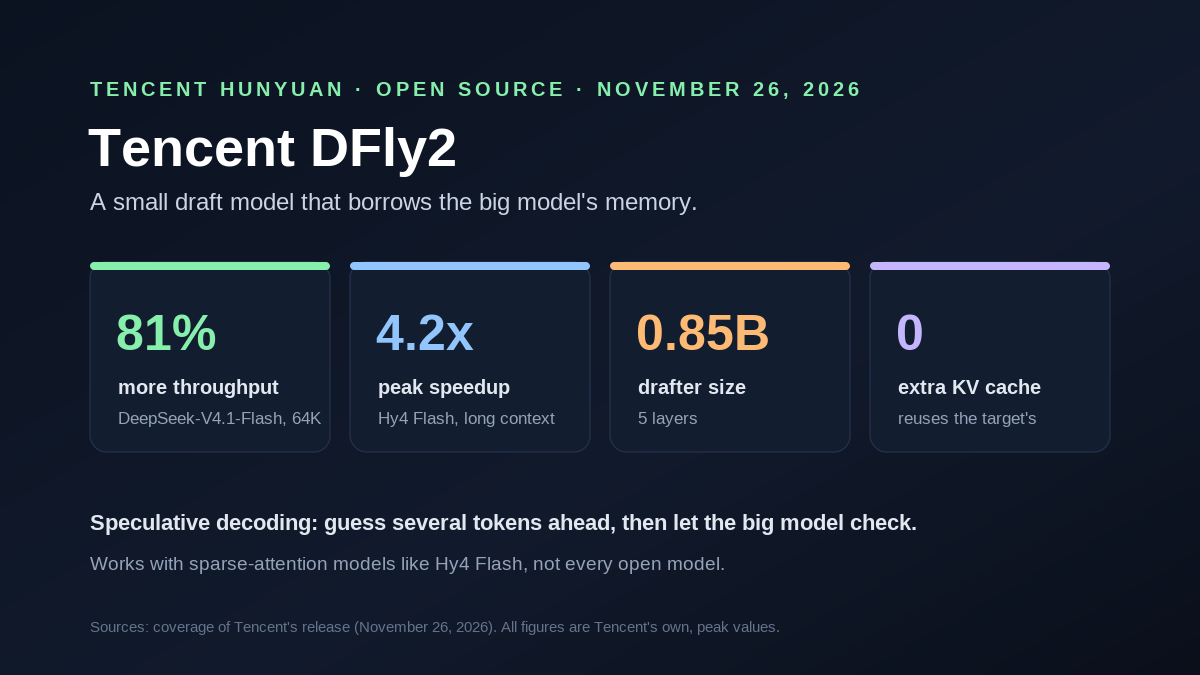
Big AI models are slow for a simple reason: they write one token at a time. Tencent DFly2, released as open source on November 26, 2026, attacks that bottleneck with a small helper model that guesses ahead.
Tencent says it lifts throughput for DeepSeek-V4.1-Flash by up to 81% on long prompts and makes agent work on its own Hy4 Flash up to 4.2 times faster.
Below: how it works in plain terms. Then what those numbers really cover, which teams can actually use DFly2 today, and how to test it on your own prompts before you trust a single vendor benchmark.
Key Takeaways
- The release: Tencent's Hunyuan team open-sourced DFly2, a 0.85-billion-parameter draft model, with weights, training code and a technical report.
- The trick: the drafter reuses the big model's own memory cache instead of keeping one of its own.
- The claims: up to 81% more throughput on DeepSeek-V4.1-Flash at 64,000 tokens, and up to 4.2x faster generation on Hy4 Flash.
- The fine print: both are peak figures from Tencent's own tests.
- The fit: it works with sparse-attention models like Hy4 Flash, not with any open model.
- Our view: worth testing if you self-host these models for long-context work, and a sign that inference costs keep falling.
Tencent DFly2 at a Glance
Here's the short version, as of November 28, 2026:
| Item | Details |
|---|---|
| Released | November 26, 2026 |
| By | Tencent's Hunyuan AI Infra team |
| What it is | A small draft model for speculative decoding |
| Drafter size | About 0.85 billion parameters, 5 layers |
| Main target | Hy4 Flash, with tests on DeepSeek-V4.1-Flash and GLM-5.3-Flash |
| Headline claims | Up to 81% more throughput, up to 4.2x faster generation |
| Serving | vLLM, with SGLang support |
| Released with it | Weights, the AngelSpec training code and a technical report |
Our main sources are AlphaSignal's write-up and Emergent's report, plus other coverage of Tencent's release. Where they disagree, we say so.
What Is Speculative Decoding?
A large language model writes text one token at a time. Each token needs a full pass through billions of weights, and on modern GPUs that pass is limited more by memory than by math. So the chip often sits waiting.
Speculative decoding fills that gap. The idea, laid out in a 2022 Google paper, works like this:
| Step | What happens |
|---|---|
| 1. Draft | The small model guesses the next few tokens |
| 2. Check | The big model scores all the guesses in one pass |
| 3. Keep | Tokens the big model agrees with are kept |
| 4. Fix | At the first miss, the big model writes its own token |
| 5. Repeat | Drafting starts again from there |
What that means in practice:
- Good guesses: the big model approves several tokens for the price of one pass.
- Bad guesses: you lose a little time and fall back to normal speed.
- Same answers: the big model checks every token and has the final say, so the method is designed to speed things up without changing what the model writes.
How Tencent DFly2 Works
Most draft models have a hidden cost. To guess well, they need to remember the conversation, so they keep their own memory cache, called a KV cache. On long prompts, that cache eats GPU memory that could serve more users.
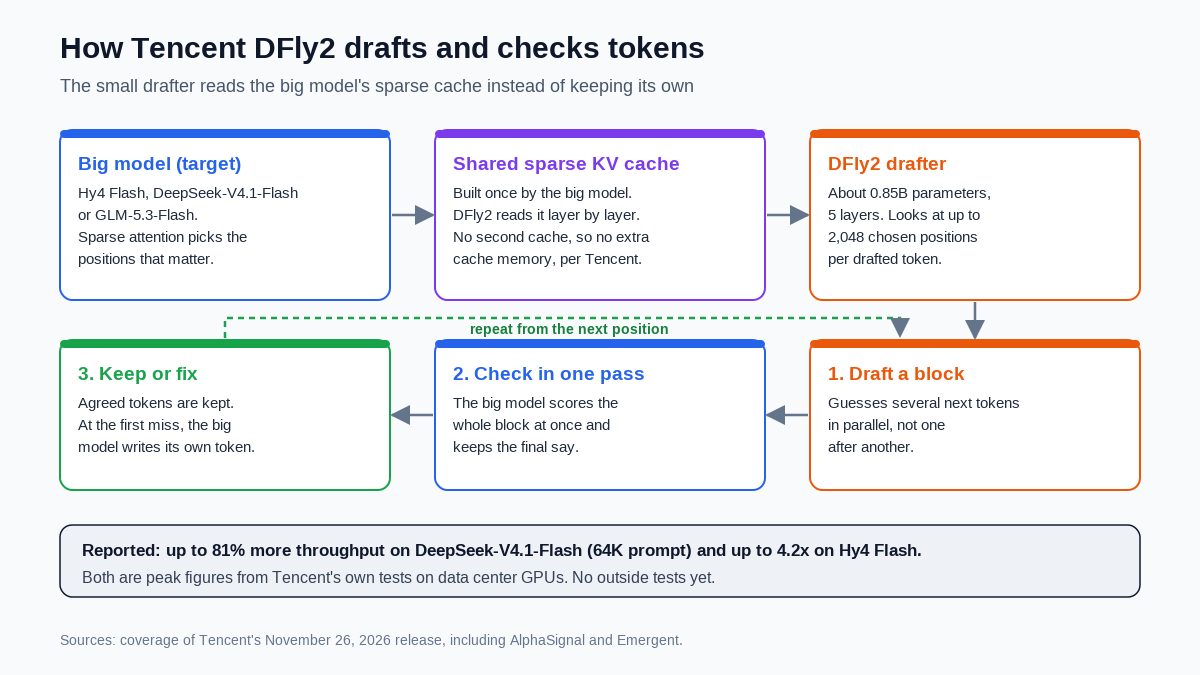
DFly2 skips it. Each of its five layers reads the matching layer of the big model's cache directly. Here's how that compares:
| Feature | A typical drafter | DFly2 |
|---|---|---|
| Memory cache | Keeps its own KV cache | Reuses the big model's sparse cache |
| Extra cache memory | Grows with context length | None, per Tencent |
| Drafting | Often one token at a time | Blocks of tokens in parallel |
| Attention per token | Can grow with the full context | Capped at 2,048 chosen positions |
| Prefill stage | Often involved | Stays out of it |
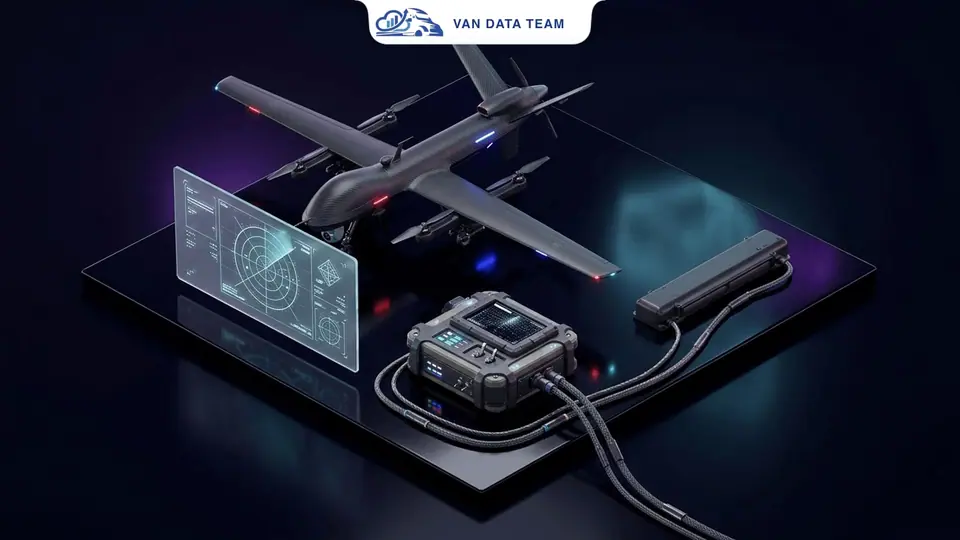
Here's the flow in one picture:
Why this works:
- Sparse attention: instead of looking at every earlier token, the target models pick a smaller set of positions to focus on, and DFly2 borrows those picks for free.
- A cap: each drafted token looks at no more than 2,048 chosen positions, so the drafter stays fast even on very long prompts.
- Split serving: when prompt reading and writing run on separate machines, DFly2 adds only one small piece of data to the hand-off, AlphaSignal notes.
The Tencent DFly2 Numbers, With Their Conditions
Here are the reported figures and the conditions attached to each:
| Claim | Model | Conditions reported |
|---|---|---|
| Up to 81% more throughput | DeepSeek-V4.1-Flash | 64K coding prompt, H20 GPUs, vLLM on 8 GPUs |
| 2.97x end to end | DeepSeek-V4.1-Flash | SWE-bench-style work |
| 2.36x end to end | GLM-5.3-Flash | Not stated in coverage |
| Up to 4.2x generation | Hy4 Flash | Peak, on long-context and agent work |
| About 30% faster | Hy4 Flash vs DSpark | Agent tasks, same training recipe |
| 10.4% more accepted tokens | vs open-source DSpark | Draft acceptance |
Three cautions apply to every row:
- Self-reported: all of these come from Tencent's own tests. No outside group has checked them.
- Peaks: the 81% and 4.2x figures are "up to" numbers, not averages.
- Missing baselines: coverage doesn't always say what each speedup is measured against.
Two more ways to read the table:
- Peak vs typical: another report gives a 3.19x end-to-end figure for Hy4 Flash, well below the 4.2x peak. That gap is normal, because end-to-end numbers include all the slower steps around the best case.
- Cost per token: if the same GPUs serve 81% more tokens, each token costs about 45% less to produce (our math), if that gain holds on your workload.
Which Models Tencent DFly2 Supports
DFly2 isn't a plug-in for every open model. It needs the big model's sparse attention data, cache layout and hidden states:
| Model | Maker | How it fits DFly2 |
|---|---|---|
| Hy4 Flash | Tencent | Main target; 220B total, about 12B active, sparse attention |
| DeepSeek-V4.1-Flash | DeepSeek | Tested by Tencent; up to 81% more throughput |
| GLM-5.3-Flash | Zhipu AI | Tested by Tencent; 2.36x end to end |
| Dense-attention models | Various | Need design changes and retraining |
AlphaSignal says models with different attention designs need changes to the drafter and new training. One report claims DeepSeek and GLM users need no retraining, but other coverage doesn't back that up, so check the repository before you plan around it.
If you're choosing between these models, our comparison of ERNIE 5.5 Flash Preview, DeepSeek-V4.1-Flash and Hy4 covers their scores, licenses and cost per task. Our post on DeepSeek V4.1 Flash 1017 covers DeepSeek's latest update.
What Tencent Released, and How to Run It
Tencent shipped more than a model file:
- Weights: the DFly2 drafter, published on Hugging Face alongside Hy4 Flash.
- Training code: AngelSpec v0.2.0, Tencent's framework, with seven drafter designs and a training recipe called DFly-OPD.
- Technical report: a paper on how DFly2 shares the big model's sparse attention.
How to run it:
- Serving: DFly2 is on by default in the Hy4 Flash recipe for vLLM, and SGLang supported it from day one.
- Hardware: Tencent tested on NVIDIA H20 GPUs with eight per instance, and the default Hy4 Flash recipe uses eight H200 GPUs. That's data center gear, not a workstation.
- License: one report says DFly2 ships under an AngelSpec license and Hy4 Flash under the Tencent Hy License. The coverage we read didn't confirm the terms, so read both before using them in a product.
Where DFly2 Fits Among Other Speed-Up Methods
DFly2 isn't the first drafter, and Tencent's AngelSpec framework ships several. Here's how they line up, based on coverage of the release:
| Method | How it drafts | Where it shows up |
|---|---|---|
| EAGLE-3 | A small model that drafts one token after another | One of seven designs in AngelSpec |
| MTP | A full extra model layer used as the drafter | Also in AngelSpec |
| DFlash and DSpark | Earlier drafters used as baselines | DFly2 beats both on accepted tokens, per Tencent |
| DFly (first version) | Tencent's earlier drafter | 1.98x to 2.40x on average on Hunyuan 3 |
| DFly2 | Blocks of tokens, reading the big model's sparse cache | Released November 26, 2026 |
The comparison that matters most is against DSpark. AlphaSignal reports that DFly2 runs about 30% faster than DSpark trained the same way on agent tasks, and accepts 10.4% more drafted tokens than the open-source DSpark.
Limits and Open Questions
Even if Tencent's numbers hold, DFly2 has clear limits:
- Batch size: speculative decoding helps most when the GPU has spare capacity. At very high load, gains can shrink, and coverage gives no batch-size data.
- Short prompts: DFly2 is built for long contexts. Nobody has published how much it helps on short chat replies.
- Drafter cost: the drafter has no cache, but its own weights and compute still use GPU time, as AlphaSignal points out.
- Narrow targets: only models with matching sparse attention fit without extra work.
- No outside tests yet: every figure so far comes from Tencent.
What Is Known and What Isn't
Here's a clean split of the facts so far:
| Known | Not known |
|---|---|
| Weights and training code are public | Results from outside testers |
| Up to 81% more throughput in one setup | Gains at different batch sizes |
| 4.2x is a peak, not an average | Typical gains on short prompts |
| The drafter keeps no KV cache | Whether outputs match bit for bit in tests |
| Hy4 Flash is the main target | How much work other models need |
What Tencent DFly2 Means for AI Teams
The bigger story is cost. Every speedup in serving lowers the price of running open models, and long-context agent work is where costs pile up fastest.
Three trends stand out:
- Long context is the new battleground: coding agents read whole repos, so the speed of long prompts matters more than short chat replies.
- Open models keep closing the gap: tools like DFly2 make self-hosting cheaper, which puts pressure on API prices too.
- Efficiency beats raw size: as with token efficiency, the cheapest token is often the one you don't waste.
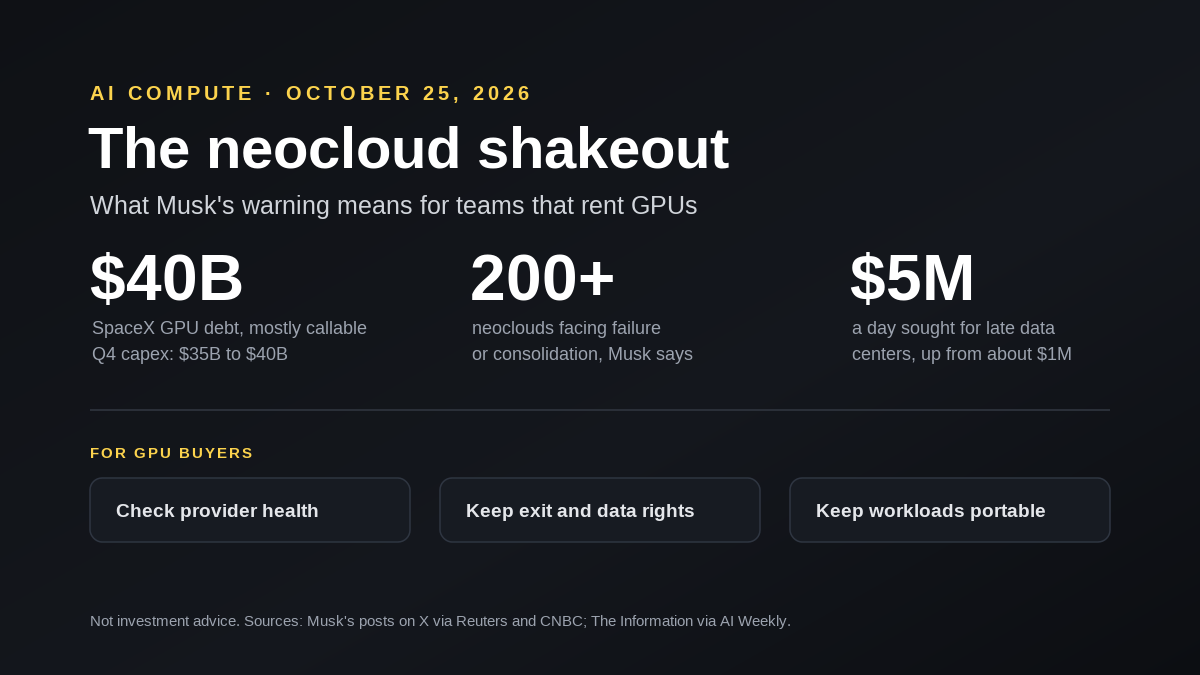
For teams that only call models through an API, the effect is indirect but real, because hosting providers that adopt tools like this can serve more users on the same GPUs and may pass part of that saving on as lower prices for open models. Our post on the neocloud shakeout covers how GPU providers are squeezed on margins.
Here's a quick way to judge fit:
| Good fit | Poor fit |
|---|---|
| Self-hosting Hy4 Flash or DeepSeek-V4.1-Flash | Calling models only through an API |
| Long prompts, such as coding agents with big repos | Short chat prompts |
| 8-GPU data center nodes | Single consumer GPUs |
| vLLM or SGLang already in place | A custom serving stack you can't change |
How to Test Tencent DFly2 on Your Own Workload
Vendor numbers are a starting point, not a promise. If you self-host one of the supported models, here's a simple test plan:
| Step | What to do | What to measure |
|---|---|---|
| 1. Pick real prompts. | Use logs from your own agents or apps. | Prompt length mix, since DFly2 targets long contexts and your gains will depend on how many of your requests actually run long. |
| 2. Set a baseline. | Serve the model with no drafter. | Tokens per second at your normal load. |
| 3. Turn DFly2 on. | Use the vLLM or SGLang recipe. | Throughput, latency and acceptance rate, measured at the same load and on the same GPUs as the baseline so the numbers compare fairly. |
| 4. Check outputs | Compare answers with the baseline. | Any change in quality or format. |
| 5. Price it | Turn the speedup into cost per million tokens. | Savings after the drafter's own compute, because the small model still uses some GPU time even with no cache of its own. |
Two rules matter most. Test at your real batch size, since speculative decoding helps most when the GPU has spare capacity. And check output quality yourself, even though the method is designed not to change answers.
Tencent DFly2: Our Take
Tencent DFly2 is a smart, focused piece of engineering. Reusing the big model's own memory instead of building a second cache is the kind of idea that seems obvious once someone ships it.
But the headline numbers need care. The 81% and 4.2x figures are Tencent's best cases on its own hardware, and the drafter only fits models built with sparse attention.
Our view: if you self-host Hy4 Flash or DeepSeek-V4.1-Flash for long-context agent work, DFly2 is worth a week of testing. If you don't, watch for hosting providers to pass the savings on.
How Van Data Team Helps
We help teams run AI models faster and cheaper:
- Model serving set up and tuned on your own GPUs, through AI agent development.
- Benchmarks on your real prompts before you switch models or tools, via data pipeline development.
- Cost reviews that turn speedups into real savings, through cloud cost optimization.
This article is based on Tencent's November 26, 2026 release as reported by AlphaSignal, Emergent, AI Daily Post and other coverage, as of November 28, 2026.
Van Data Team has no business relationship with Tencent, DeepSeek or Zhipu AI. Thinking about self-hosting an open model? Get in touch and we'll help you test it on your own workload.
AI Model Brief
The AI models worth knowing, once a week
What shipped, how it scores on independent benchmarks, what it costs per million tokens and what was deprecated, from the data behind our AI model benchmarks.
We use your address only to send the brief. See our privacy policy.
See this week’s brief
Founder of Van Data Team. Builds Vanaxity, the AI agent system for SEO, GEO, and AEO, and leads data engineering delivery for B2B teams.
About the authorAI model benchmarks
Models in this article
Current pricing, context window and independent scores for each model.
Article FAQ
Questions readers usually ask next.
These short answers clarify the practical follow-up questions that often come after the main article.
Need a similar system?
If this article maps to a workflow your team already operates, the next step is usually a scoped review of the system, constraints, and rollout path.
Consultation
Scope your next AI workflow.
Share the system and blockers. We will map fit, gaps, and the next step.