Amazon Decart Acquisition: Why AWS Would Pay $7.5B for AI
The Amazon Decart acquisition could reach $7.5B. What Decart builds, why AWS wants it for Trainium, what isn't confirmed and what it means for AI teams.
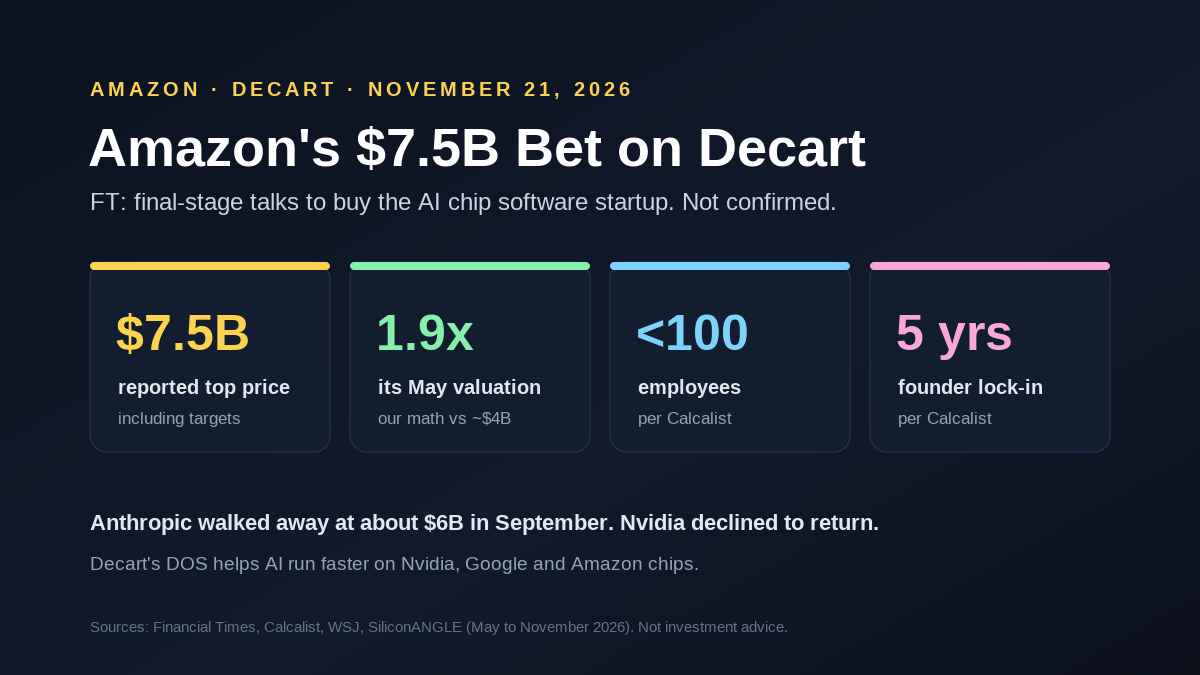
Amazon may be about to make one of its biggest AI bets. On Saturday, November 21, 2026, the Financial Times reported that Amazon is in the final stages of talks to buy Decart, a three-year-old AI startup, for about $7.5 billion.
That's a lot for a company with fewer than 100 people. It's also nearly twice what investors valued Decart at in May.
So why would AWS pay that much? This guide covers what has been reported, what Decart builds, why Amazon wants it, what isn't confirmed and what the Amazon Decart acquisition could mean for teams that pay for AI compute.
Key Takeaways
- A big price: Amazon would pay more than $7 billion, and up to about $7.5 billion if targets are met, according to reports.
- Not done yet: nothing is signed.
- A chip play: Decart's software helps AI models run faster on many chips, including Amazon's own Trainium.
- Two rivals passed: Anthropic walked away from a $6 billion deal in September, Nvidia reportedly declined to come back, and neither Amazon nor Decart has confirmed anything, so the FT's warning that talks could still collapse stands.
- A lesson for teams: if AWS makes Trainium easier to use, models that can run on more than one chip will save the most.
The Amazon Decart Acquisition at a Glance
Here's what has been reported, as of November 23, 2026:
| Item | What's reported |
|---|---|
| Buyer | Amazon, for its cloud unit AWS |
| Target | Decart, an AI software startup founded in 2023 |
| Price | More than $7 billion, up to about $7.5 billion with targets |
| Latest report | Financial Times, November 21, 2026 |
| Status | Final stages, not signed, could still fail |
| Confirmed by Amazon or Decart? | No |
| Founders | Reportedly staying five years |
All of this comes from news reports that cite people familiar with the talks. Amazon and Decart haven't commented.
What the Financial Times Reported
The FT's report on Saturday said Amazon is close to a deal worth about $7.5 billion, with an announcement possible within days. It also warned that the talks could still break down.
It wasn't the first report. The price has climbed with each one:
- October, The Wall Street Journal: first reported talks at about $7 billion.
- Mid-October, Calcalist: put the deal at $5.5 billion.
- November 18, Calcalist: said the deal was close to being signed at more than $7 billion, after most open issues were settled over the past week.
- November 21, the Financial Times: said Amazon is in the final stages, at about $7.5 billion.
What Is Decart?
Decart, often called Decart AI, is a startup founded in 2023 by Dean Leitersdorf, its chief executive, his brother Orian Leitersdorf and Moshe Shalev. It is based in San Francisco, was founded by Israeli engineers and has fewer than 100 people.
It works in two areas that look unrelated at first:
| Product | What it does | Reported claim |
|---|---|---|
| DOS | Speeds up AI training and inference on Nvidia GPUs, Google TPUs and Amazon Trainium. | DOS 2.0 runs AI agents at over 1,600 tokens a second, Decart says. |
| Oasis | Real-time 3D worlds | One million users in its first three days, per Calcalist, a sign of strong demand for AI worlds you can play in. |
| Lucy | Changes objects inside a live video stream as it plays. | Up to 4x faster frames on Trainium3 at half the cost of GPUs, per AWS. |
The common thread is speed. Decart got its start making AI video run in real time, which forced it to squeeze every bit of work out of the chips it used. Over time, it turned that skill into a product that other AI companies could license.
That product, DOS, is the part that matters most to Amazon. Decart says it earns "significant revenue" licensing DOS to cloud providers and AI labs, according to SiliconANGLE.
How the Amazon Decart Acquisition Came Together
Decart's value has climbed fast:
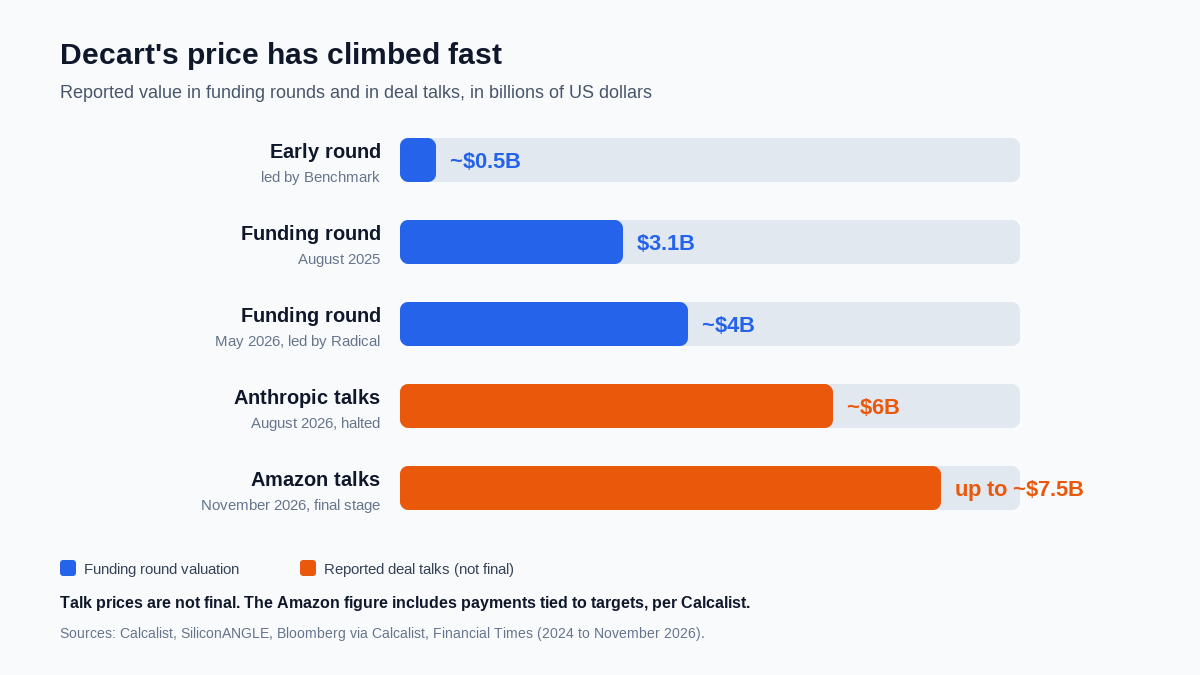
Here's the timeline behind those numbers:
| Date | Event |
|---|---|
| 2023 | Decart is founded by Dean Leitersdorf, Orian Leitersdorf and Moshe Shalev |
| August 2025 | Raises $100 million at a $3.1 billion valuation |
| December 2025 | AWS cites Decart when it launches Trainium3 |
| May 2026 | Raises $300 million at nearly $4 billion |
| August 2026 | Bloomberg reports Anthropic talks at about $6 billion |
| Early September | Anthropic halts the talks, per Calcalist |
| October 2026 | The WSJ reports Amazon talks at about $7 billion |
| November 21 | The FT says Amazon is in the final stages |
Amazon isn't a stranger here. It gave Decart early access to its Trainium3 chip in 2025. When AWS made Trainium3 widely available in December 2025, it named Decart as a customer that was getting "4x faster" video inference at half the cost of GPUs, according to Amazon's announcement.
That's a vendor claim from a launch event, not an independent benchmark. Still, the ties run deep.
Why Anthropic and Nvidia Walked Away
Decart had other suitors first. Nvidia, which is also an investor, made the first serious offer to buy it, according to Calcalist.
Then in August, Bloomberg reported that Anthropic was in talks to buy Decart for about $6 billion. Calcalist says Anthropic halted those talks in early September, after draft agreements were exchanged and its checks were largely done.
The reason isn't clear. Decart said it didn't want to move to the United States, but Calcalist reported that few people found that convincing. When Decart tried to go back to Nvidia, the chipmaker declined to reopen talks.
That left Amazon as the most eager buyer.
Why Amazon Would Pay Nearly Twice the May Price
In May 2026, Decart raised $300 million at a value of nearly $4 billion. A $7.5 billion deal would be about 1.9 times that, by our math.
Why the jump? A few reasons stand out:
- Fewer buyers, more need. Amazon now has a clear use for Decart's software, and few other buyers are left.
- Talent. Teams that can tune AI models for new chips are rare. Buying one is faster than building one.
- Defense. If Decart's tools helped AI run better on any chip, a rival cloud could have bought them instead.
- Scale. A tool that cuts compute costs by a few percent is worth billions when spread across AWS's AI business.
There's also a timing factor. AWS is spending heavily on its own chips, and every month that customers hesitate to use them is money left on the table.
How the Amazon Decart Acquisition Could Help Trainium
Here's the problem Amazon is trying to solve. AI inference, the work of running a trained model to answer requests, is a fast-growing share of what AI chips do, and most of that code is written for Nvidia GPUs. Moving a model to another chip often means rewriting the most important parts, then tuning them for weeks.
That's why many developers pick Nvidia even when another chip is cheaper. The hardware may be fine. The switching cost isn't.
Decart's DOS is built to cut that cost. If it works as described, it could change three things:
- Porting time: a model could move to Trainium in weeks instead of months.
- Speed: it would run well once it gets there, without a team of chip experts.
- Choice: AWS's own chips would become a realistic option for customers who rent compute by the hour.
It would also help Amazon's margins. Every AI job that runs on Trainium instead of a rented Nvidia GPU keeps more of the profit inside AWS.
Why Chip Portability Matters
AI chips aren't one market anymore. Here are the main options teams can rent today:
| Chip family | Main software | Where you can rent it |
|---|---|---|
| Nvidia GPUs | CUDA | Every major cloud, plus your own servers |
| AWS Trainium | AWS Neuron SDK | AWS only |
| Google TPUs | JAX and XLA | Google Cloud |
| AMD GPUs | ROCm | Several clouds |
Each one has its own software, and code written for one doesn't move freely to another. We looked at one of these rivals in our post on Google's TPU 8 chips.
For buyers, more choice is good news, but only if switching is cheap. A tool that makes code portable turns a list of chips into a real market. That's the bet behind the Amazon Decart acquisition.
What Is Known and What Isn't
It's easy to treat a reported deal as a done deal. Here's a cleaner split:
| Known | Not known |
|---|---|
| The FT says talks are in the final stages | Whether a deal will be signed |
| Reported price: up to about $7.5 billion | How much is cash and how much is stock |
| Founders reportedly stay five years | What happens to Decart's other customers |
| Decart already runs on Trainium | Whether DOS stays open to other clouds |
| Revenue is in the low tens of millions, by estimates | Decart's exact revenue |
The biggest open question is DOS itself. Today, Decart says its software helps AI run faster on Nvidia, Google and Amazon chips alike. Under Amazon, it may tilt toward Trainium. Whether other clouds keep access is not known.
Inside the Amazon Decart Acquisition Terms
Calcalist has the most detail on how the money would be paid:
| Term | Reported detail |
|---|---|
| Base price | More than $7 billion |
| With targets met | Nearly $7.5 billion |
| Payment mix | Cash, Amazon stock and deferred payments |
| Founder lock-in | Five years, with a big part of the money paid only in year five |
| Non-compete | Founders agree not to start a rival firm |
The five-year lock-in is the key part. It shows Amazon is buying people as much as code. Paying a large share only in year five gives the founders a strong reason to stay and make the deal work.
The non-compete clause points the same way. Amazon doesn't want the same team building a rival tool for another cloud.
Risks That Could Sink the Amazon Decart Acquisition
The FT's warning that talks could collapse is worth taking seriously. Several things could still go wrong:
- Final terms: deals this size often stall over price, payment timing or legal structure in the last week.
- Regulators: large tech purchases now face closer review, though a startup this small may draw less attention.
- Customers: Decart's other clients may not want their tools owned by a cloud rival.
- Delivery: turning a startup's tool into a product that works across all of AWS, for thousands of customers with very different models, is hard, and many acquired tools quietly fade within a few years.
Even if the deal closes, the payoff isn't automatic. Amazon will need to show that Trainium really gets easier to use.
What It Means for Nvidia
Nvidia doesn't lose much today. Not yet. Its chips still run most AI work, and Nvidia CUDA, the software most AI code is written for, is a deep moat.
But the Amazon Decart acquisition aims straight at that moat. Nvidia's strength isn't only its chips. It's that developers already know CUDA and don't want to leave. Software that makes leaving cheaper erodes that edge, a little at a time.
It's also a bad month for Nvidia's image. The chipmaker is dealing with an interim CEO and a reported SEC probe, which we covered in our post on the Nvidia SEC probe. A cloud giant buying a startup Nvidia passed on adds to the sense that rivals are closing in.
What the Amazon Decart Acquisition Means for AI Teams
For most AI and data teams, nothing changes this week. Your models keep running where they run now.
Over the next year or two, though, the deal could matter in three ways:
- Lower prices on AWS. If more work moves to Trainium, AWS can price AI compute more aggressively.
- More real choice. Easier porting means you can follow the cheapest chip instead of staying on the one you started with.
- New lock-in risk. Tools that make Trainium easy may also tie you more tightly to AWS.
Inference costs are already falling fast, as we covered in our post on the AI model price war. Chip choice is the next lever.
An AI Chip Portability Checklist
You don't need to wait for the deal to close to get ready. Use this short checklist:
| Question | Why it matters | What to do |
|---|---|---|
| Which chip runs each model?. | You can't compare prices without a baseline. | List every model you serve, the chip it runs on and its cost per thousand requests. |
| Is the code CUDA-only?. | Custom kernels make moves slow. | Find them |
| Have you tried Trainium?. | Price gaps between chips can be large, and they change. | Run one inference job on Trainium or another non-Nvidia chip and measure speed and cost. |
| Do you need one cloud?. | A chip that only one cloud rents adds lock-in, since moving away later means porting your models a second time. | Weigh it |
| Who maintains the tools?. | Acquired tools can change course. | Keep a fallback path for anything built on a startup's software. |
Start with the baseline. Many teams don't know what each model costs to serve on the chip it uses today. Without that number, a cheaper chip is just a claim.
Then run one real test. A single inference job moved to a second chip will teach you more than any vendor slide.
What to Watch Next
A few signals will tell us more:
- An official announcement from Amazon or Decart, with the final price, the split between cash and stock, and any word on what happens to Decart's current customers and staff.
- What happens to DOS, and whether it stays available on other clouds.
- AWS re:Invent, Amazon's yearly cloud event.
- Trainium pricing, and whether AWS cuts it to win more AI work.
- Decart's customers, and whether any leave once the deal is public.
Amazon Decart Acquisition: Our Take
The Amazon Decart acquisition is a bet on software, not hardware. Amazon already makes capable chips. What it lacks is an easy way for developers to move their models onto them. Decart could fix that.
If Decart's tools close that gap, $7.5 billion could look cheap. If they don't, it will look like a high price for a small team. Either way, the deal isn't final, and we'd wait for an official announcement before planning around it.
For AI teams, the lesson is simple. Don't tie your models to one chip. Keep them portable, measure what they cost and be ready to move when prices shift.
How Van Data Team Helps
We help teams run AI with less cost and less lock-in:
- Compute cost reviews for GPU and cloud spend through our cloud cost optimization service.
- Portable data pipelines that can move between clouds, via data pipeline development.
- AI agents built to switch models and providers, through AI agent development.
- Spend dashboards that show AI compute by chip and cloud, through agentic BI reporting.
This article is based on reporting by the Financial Times, The Wall Street Journal, Calcalist, Bloomberg and SiliconANGLE, and on Amazon's December 2025 Trainium3 announcement, as of November 23, 2026.
It is not investment advice. Van Data Team builds on AWS and other clouds and has no business ties to Amazon, Decart, Anthropic or Nvidia beyond being a cloud customer. Want to know what your AI compute really costs? Get in touch and we'll help you measure it.
AI Model Brief
The AI models worth knowing, once a week
What shipped, how it scores on independent benchmarks, what it costs per million tokens and what was deprecated, from the data behind our AI model benchmarks.
We use your address only to send the brief. See our privacy policy.
See this week’s brief
Founder of Van Data Team. Builds Vanaxity, the AI agent system for SEO, GEO, and AEO, and leads data engineering delivery for B2B teams.
About the authorArticle FAQ
Questions readers usually ask next.
These short answers clarify the practical follow-up questions that often come after the main article.
Need a similar system?
If this article maps to a workflow your team already operates, the next step is usually a scoped review of the system, constraints, and rollout path.
Consultation
Scope your next AI workflow.
Share the system and blockers. We will map fit, gaps, and the next step.