Nvidia SEC Probe: What the Accounting Review Means for AI
The Nvidia SEC probe now reportedly covers possible accounting issues. What is known, what isn't, why the stock fell 14% and what it means for AI teams.
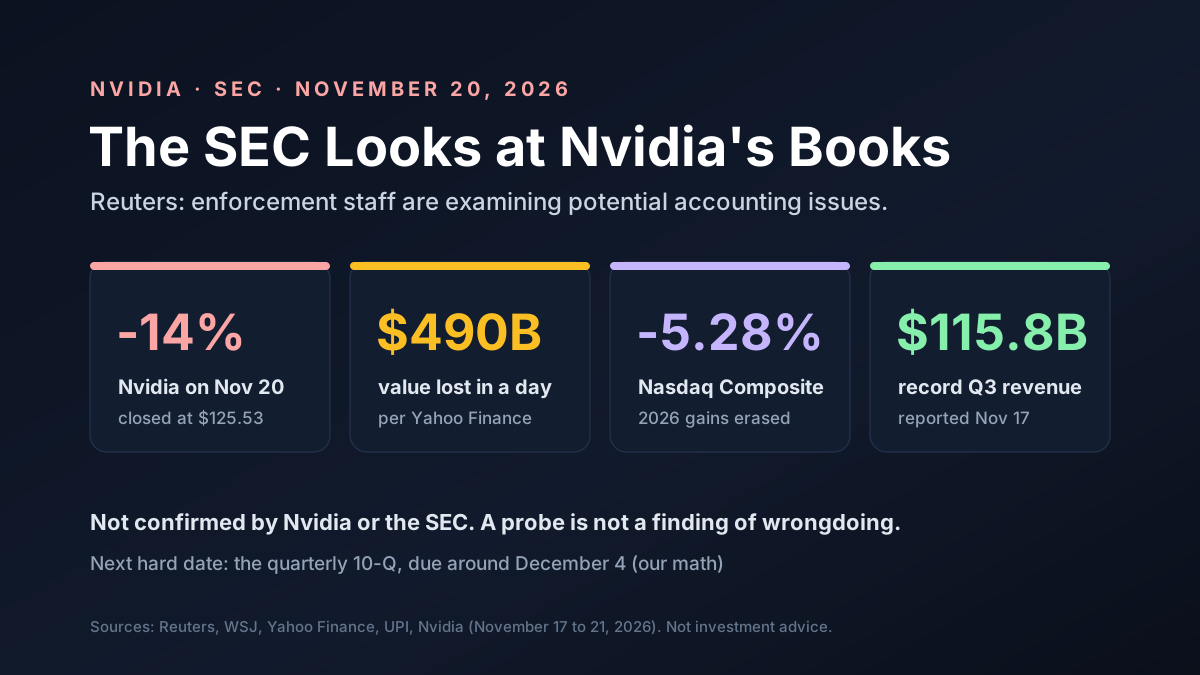
Nvidia's bad month just got worse. On November 20, 2026, Reuters reported that the Securities and Exchange Commission's probe of the chipmaker is looking at potential accounting issues. The stock fell about 14% that day, its worst drop since January 2025.
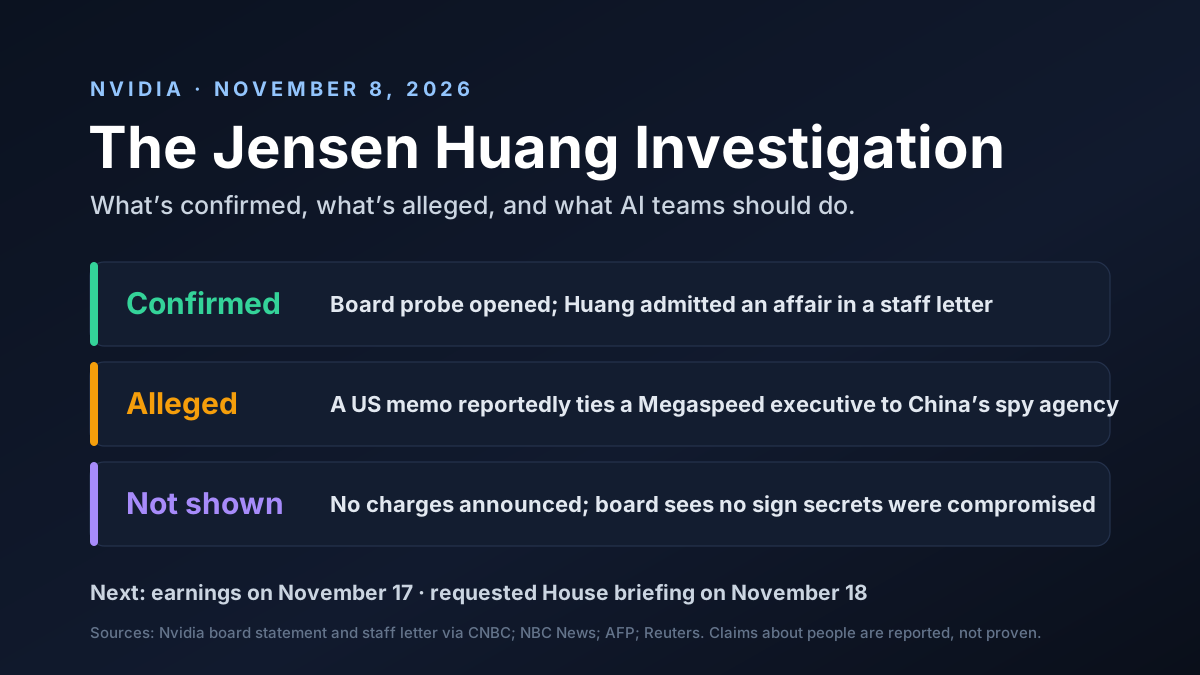
The timing was brutal. Nvidia's founder and CEO, Jensen Huang, resigned eight days earlier. Its shares have lost about $2.7 trillion in value since early October, as Yahoo Finance reported.
So what is the Nvidia SEC probe, and how worried should anyone be? This guide covers what has been reported, what hasn't, how SEC probes work and what the news means for teams that run AI on Nvidia chips.
Key Takeaways
- An accounting focus: Reuters says SEC enforcement staff are examining potential accounting issues at Nvidia, citing two people briefed on the matter.
- Not confirmed: neither Nvidia nor the SEC has confirmed the probe, and a probe, even a real one, is not proof that anyone broke a rule or that any number will change.
- A historic sell-off: Nvidia fell about 14% on November 20 and dragged the Nasdaq down 5.28%.
- Strong results, weak trust: the selloff came three days after Nvidia reported record revenue of $115.8 billion.
- A vendor risk test: for AI teams, the main lesson is to know how much of your work depends on one chip vendor.
The Nvidia SEC Probe at a Glance
Here's what has been reported, as of November 21, 2026:
| Item | What's reported |
|---|---|
| Who is probing | The SEC's Division of Enforcement, per Reuters |
| What is being examined | Potential accounting issues and whether disclosures misled investors |
| First report | The Wall Street Journal, November 17, 2026 |
| Accounting angle | Reuters, November 20, citing two people briefed |
| Confirmed by Nvidia or the SEC? | No. The SEC declined to comment |
| Stock move on November 20 | Down about 14%, to $125.53 |
| Other probe | California Attorney General subpoena, November 19 |
All of this comes from news reports that cite unnamed sources. The SEC doesn't usually confirm or deny its probes, and it declined to comment. Nvidia hasn't commented on the Reuters report.
What Reuters Reported on November 20
The new detail is the word "accounting." Earlier reports, led by The Wall Street Journal on November 17, said the SEC was looking at whether Nvidia's disclosures misled investors. That's serious, but it's about what Nvidia told the market.
Nvidia accounting questions go deeper. They're about how the numbers themselves were recorded, such as when revenue was counted or how sales were split by region.
Reuters didn't say which accounts or periods are under review. Or when it began. Those gaps matter, and they're why the market reacted so sharply. When investors can't size a risk, many sell first and ask questions later.
How the Nvidia SEC Probe Grew This Month
The story built up over five weeks. Here's the timeline:
| Date (2026) | Event |
|---|---|
| October 6 | Nvidia stock hits its record high |
| November 12 | Jensen Huang resigns; CFO Colette Kress becomes interim CEO |
| November 17 | Record quarterly results; WSJ reports the SEC probe |
| November 18 | Board chair Harvey Jones says Nvidia won't rehire Huang |
| November 19 | California's attorney general subpoenas Nvidia |
| November 20 | Reuters reports the accounting focus; stock falls about 14% |
| About December 4 | Quarterly 10-Q filing due, by our math |
Each step added doubt. Huang's exit came after reports about his personal conduct, which we covered in our post on Jensen Huang's resignation. The SEC reports then shifted the focus from one person to the company's books.
The California subpoena adds a second front. State Attorney General Rob Bonta is looking at whether Nvidia's advanced chips reached China and whether the company misled investors. "Companies cannot mislead their investors," Bonta said.
Treasury Secretary Scott Bessent added pressure too. "I think we need answers in the next 10 days," he said.
What Is Known and What Isn't
It's easy to fill the gaps with guesses. Here's a cleaner split:
| Known | Not known |
|---|---|
| SEC staff are reportedly looking at accounting | Which accounts or periods are in question |
| The WSJ says disclosures are part of it | When the probe began |
| Megaspeed is one disclosure question, per the WSJ | Whether any rules were broken |
| Nvidia's 10-Q is due within weeks | Whether the filing will be on time |
| Nvidia reported record revenue on November 17 | Whether any figures will be restated |
The 10-Q is the next hard date. Nvidia's quarter ended on October 25, and large public companies must file their quarterly report within 40 days. That puts the deadline around December 4, by our math.
A late filing would be a red flag, while an on-time filing with no changes to past numbers would calm a lot of nerves on Wall Street.
Why Accounting Questions Hit Harder
Markets can price bad news. They struggle with news they can't measure.
A weak quarter has a number, and a lawsuit has a claim amount that lawyers and analysts can argue over. An accounting probe has neither, at least at first. Investors start to ask a scary question: are the numbers we've been using to value the company right?
For Nvidia, that question is huge. Its value rests on fast growth in data center sales. If any part of that growth were counted too early, or in the wrong place, every forecast built on it would need a second look.
None of that has been shown. But the doubt alone is costly when a company is priced for near-perfect results.
The Singapore Revenue Question
One theme in the coverage is where Nvidia's sales come from. The Financial Times reported that Nvidia booked about $104 billion of revenue through its Singapore unit in 2025, roughly half its sales, as cited by Yahoo Finance.
That sounds odd for a small country, but it isn't new. Many firms bill through regional hubs. Nvidia has said in past filings that most of the revenue billed to Singapore came from customers based elsewhere.
Two things changed, though:
- The reporting: in fiscal 2026, Nvidia switched from showing revenue by billing address to showing it by where customers are based, so Singapore no longer appears as its own line.
- The customer: the Journal reported that the SEC's disclosure questions include Megaspeed, a Singapore firm that US officials suspect of rerouting Nvidia chips to China.
Megaspeed's role is covered in our post on the Nvidia Megaspeed probe.
Yahoo Finance also flagged a slower collection pace: bills from clients were outstanding for 64 days of sales, the most since 2022. Slow payments aren't proof of anything. They're one more number analysts will now read closely.
How a Nvidia SEC Probe Could Unfold
SEC probes follow a standard path, set out in the agency's enforcement manual. Here's the simple version:
| Stage | What it means |
|---|---|
| Inquiry | Staff gather facts, often by asking for documents |
| Formal order | Staff can issue subpoenas for documents and testimony |
| Wells notice | Staff tell a firm they plan to recommend charges |
| Outcome | The case is closed, settled or taken to court |
An SEC investigation usually takes a long time, often a year or more. Many end with no action at all. When the SEC does bring a case against a large company, it often ends in a settlement, where the company pays a fine without admitting or denying the claims.
There's no report that Nvidia has received a Wells notice. Without one, talk of charges is early.
Has Nvidia Faced the SEC Before?
Yes, twice that we know of. In May 2022, Nvidia agreed to pay $5.5 million to settle SEC charges that it didn't properly disclose how crypto mining drove its gaming sales in fiscal 2018, according to the SEC's announcement. Nvidia neither admitted nor denied the findings.
Much earlier, in 2002 and 2003, Nvidia restated some results after an internal review, and that SEC matter ended in a cease-and-desist order.
Neither case was close in size to what the market is now pricing. The 2022 fine was tiny for a company of Nvidia's scale. Today's fear is about trust.
How Markets Reacted to the Nvidia SEC Probe
The sell-off spread far beyond Nvidia. Here's how the main measures closed:
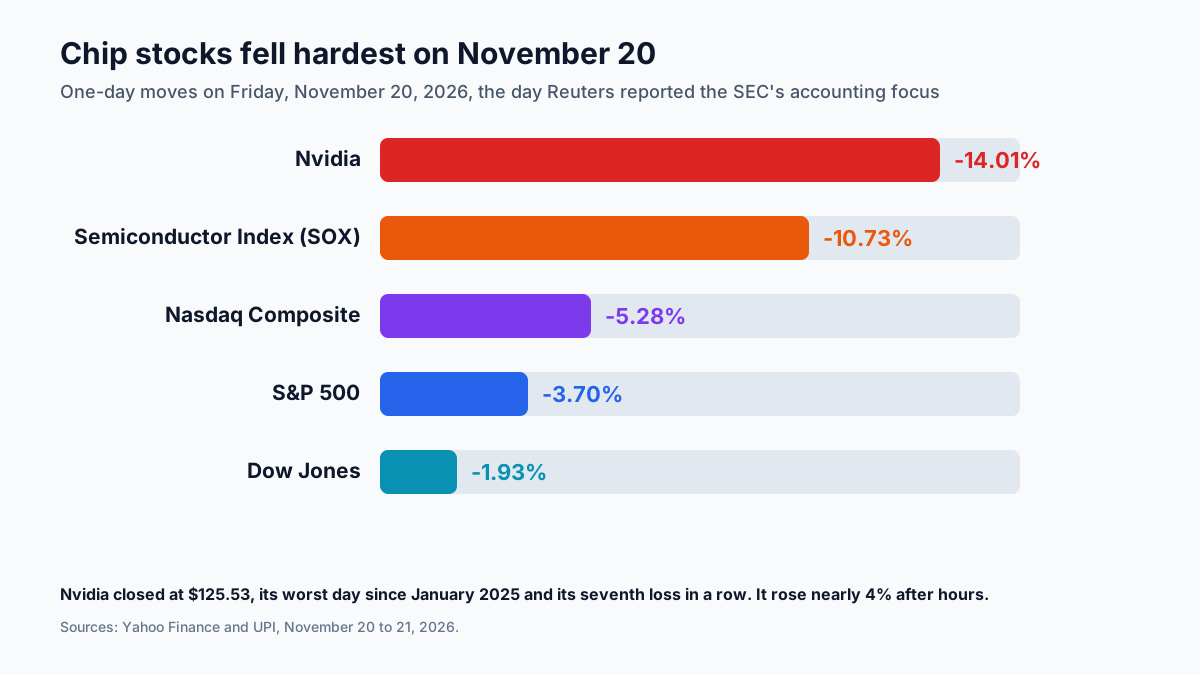
| Measure | November 20 move | Week |
|---|---|---|
| Nvidia | About -14%, to $125.53 | About -23%, worst since October 2008 |
| Philadelphia Semiconductor Index | -10.73% | About -17% |
| Nasdaq Composite | -5.28%, to 22,617.73 | About -10% |
| S&P 500 | -3.70%, to 6,910.39 | About -8.6% |
| Dow Jones | -1.93%, to 48,147.33 | In a correction |
| VIX fear gauge | Closed near 36 | Up from about 20 on Monday |
Nvidia shed about $490 billion in market value on Friday alone, and nearly $900 billion over the week, according to Yahoo Finance. The company that was the world's most valuable six weeks ago now ranks fourth in the US, behind Apple, Microsoft and Alphabet.
Other chip makers fell hard too, with AMD and Broadcom both down by double digits. The S&P 500 and the Dow entered a correction, meaning a drop of 10% or more from a recent high. Nvidia bounced nearly 4% in after-hours trading, a sign some buyers saw the drop as overdone.
Was It Only the Nvidia SEC Probe?
No. Several worries hit at once, and it's hard to say how much each one mattered:
- Leadership: Nvidia has an interim CEO and no permanent successor.
- Orders: an analyst reported that Google cut its 2027 orders for custom AI chips made with Broadcom. Neither firm confirmed it.
- Policy: President Trump threatened a "tremendous tax" on US firms that build data centers abroad, the same day.
- Rates and oil: both stayed high.
Some of this echoes the fears we covered in our post on AI bubble fears. The difference now is that the doubt is aimed at the market leader's own books.
Nvidia's Business Is Still Growing
The odd part is the gap between the stock and the business. On November 17, Nvidia reported record results for its quarter ending October 25:
- Revenue: $115.8 billion, up 103% from a year earlier.
- Data center sales: $107.6 billion, up 110%.
- Outlook: about $130 billion for the next quarter, with no data center chip sales to China assumed.
- Products: Vera Rubin systems began shipping.
Demand for AI compute hasn't vanished. Cloud firms and AI labs are still buying. What changed is trust.
What the Nvidia SEC Probe Means for AI Teams
For most AI and data teams, nothing changes this week. Your GPUs keep running.
The risks are indirect, and they build over months:
- Supply and price. A weaker Nvidia could change how chips are priced and shipped, in either direction.
- Cloud provider health. Smaller GPU clouds depend on loans backed by chips. Falling chip values can tighten that credit.
- Policy. Probes into chips reaching China could bring stricter export rules, which affect where clusters can run.
- Lock-in. Most AI code is tuned for Nvidia's CUDA software. Moving off it takes time.
None of these is a reason to panic, but all of them are good reasons to know exactly where your exposure sits before the next shock arrives. We covered the spending side of this in our post on AI capex.
A GPU Vendor Risk Checklist
GPU vendor risk is easy to ignore until something breaks. Use this short checklist to see where you stand:
| Question | Why it matters | What to do |
|---|---|---|
| How much is Nvidia?. | One vendor is one point of failure. | Map every AI workload to the chip, cloud and region it runs on, then mark the ones with no backup. |
| Which cloud? | Smaller GPU clouds rely on loans backed by chips. | Check funding |
| Can code move? | Moving later is slow and costly. | Test one workload on another chip, such as an AMD GPU or a cloud provider's own AI chip, before you need to. |
| Are prices locked? | Supply shocks move spot prices. | Fix prices |
| Where do GPUs sit?. | Export rules can change fast, and a cluster in the wrong country can be cut off. | Know each cluster's country. |
Start with the map. Many teams don't know how much of their AI work runs on one chip, one cloud and one region. Once you know, the next steps are easier to rank.
What to Watch Next
A few dates and signals will tell us more:
- The 10-Q, due around December 4, is the big one: an on-time filing with no restated numbers would go a long way to calm the market.
- Any Nvidia statement on the scope of the SEC's questions.
- A Wells notice or settlement, which would show the SEC's view.
- A permanent CEO, which the board is still searching for.
- Big buyers' spending plans, due with their next quarterly results in January.
Nvidia SEC Probe: Our Take
The Nvidia SEC probe is a trust problem first. The business behind the stock is still growing fast, and no wrongdoing has been shown. But an accounting question on top of a CEO crisis is a heavy load, and markets have priced in a lot of doubt.
We'd watch the 10-Q closely. It's the first chance for Nvidia to show its numbers hold up under scrutiny.
For AI teams, the lesson is not to drop Nvidia. It's to stop treating any single vendor as a sure thing. Know your exposure, keep one workload portable and lock in prices where you can.
How Van Data Team Helps
We help teams plan AI compute with less vendor risk:
- Cost reviews of GPU and cloud spend through our cloud cost optimization service.
- Data pipelines that run on more than one cloud, via data pipeline development.
- AI agents built to switch models and providers, through AI agent development.
- Spend dashboards that show compute by vendor and region, through agentic BI reporting.
This article is based on reporting by Reuters, The Wall Street Journal, the Financial Times, Yahoo Finance and UPI, Nvidia's November 17, 2026 results and SEC documents, as of November 21, 2026.
It is not investment advice. Van Data Team builds on cloud GPUs, including Nvidia's. Worried about vendor risk? Get in touch and we'll help you map it.
AI Model Brief
The AI models worth knowing, once a week
What shipped, how it scores on independent benchmarks, what it costs per million tokens and what was deprecated, from the data behind our AI model benchmarks.
We use your address only to send the brief. See our privacy policy.
See this week’s brief
Founder of Van Data Team. Builds Vanaxity, the AI agent system for SEO, GEO, and AEO, and leads data engineering delivery for B2B teams.
About the authorArticle FAQ
Questions readers usually ask next.
These short answers clarify the practical follow-up questions that often come after the main article.
Need a similar system?
If this article maps to a workflow your team already operates, the next step is usually a scoped review of the system, constraints, and rollout path.
Consultation
Scope your next AI workflow.
Share the system and blockers. We will map fit, gaps, and the next step.