Binance Hack: What a $6.3B Breach Teaches Engineering Teams
The Binance hack began with one engineer's laptop and drained about $6.3B in minutes. What happened, who's suspected and the lessons for engineering teams.
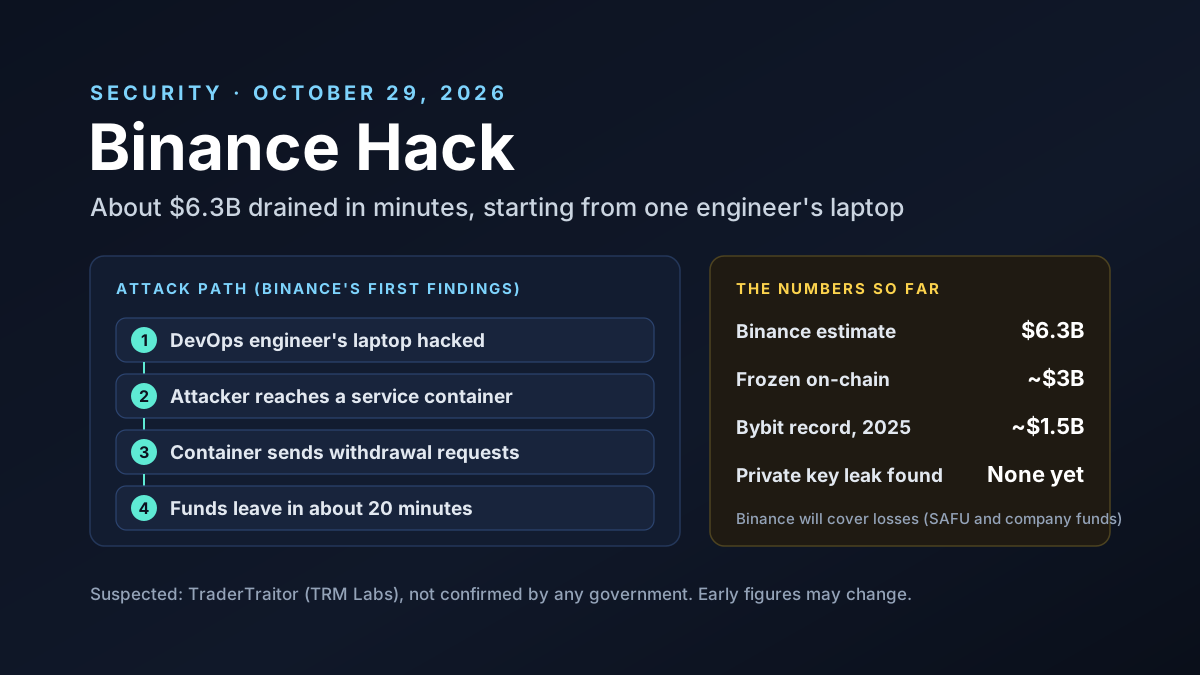
The Binance hack is now the largest crypto theft on record. On October 29, 2026, attackers moved billions of dollars out of Binance wallets across several blockchains, most of it in about 20 minutes. Binance puts the total impact at about $6.3 billion.
The most striking detail isn't the size. It's the starting point. Binance's first findings point to a single compromised laptop belonging to a DevOps engineer. Here's what's confirmed, what isn't, and the lessons every engineering team can use, whether or not it touches crypto.
Note: This story is still moving, and the numbers may change. We report what Binance and analysts say as their claims. We cover security lessons at a high level only. This isn't financial advice, and it doesn't explain how to attack any system.
Key Takeaways
- On October 29, 2026, attackers drained billions from Binance wallets, most of it in about 20 minutes.
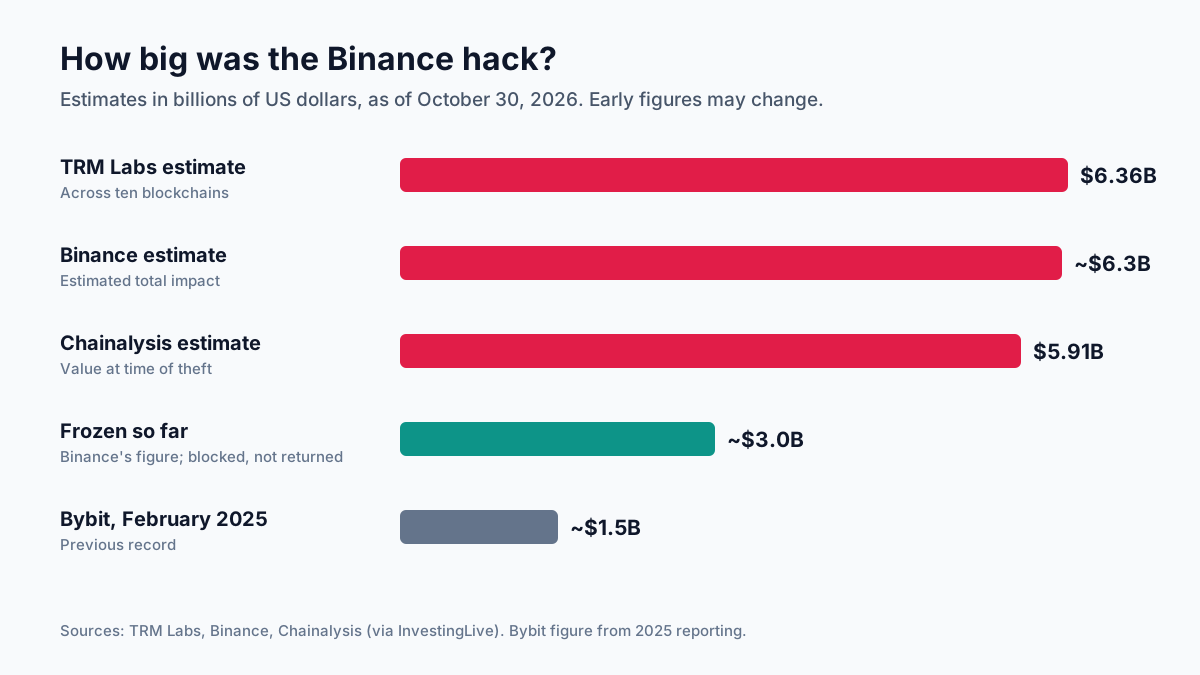
- Binance estimates the impact at about $6.3 billion. TRM Labs counts $6.36 billion and Chainalysis about $5.9 billion.
- About $3 billion had been frozen on-chain by Binance's count. Binance says it will cover all losses from its SAFU fund and company funds.
- Binance's first findings point to a compromised DevOps engineer's laptop, which gave access to a service container that sent unauthorized withdrawals. It found no evidence of a private key leak.
- TRM Labs attributes the attack to North Korea's TraderTraitor group. No government has confirmed that yet.
- The core lesson: one laptop shouldn't be able to move billions, so layered approvals and spending limits matter as much as protecting the keys themselves.
Binance Hack at a Glance
| Item | What's known so far |
|---|---|
| When | Evening of October 29, 2026 (UTC), most outflows within about 20 minutes |
| Estimated impact | About $6.3 billion (Binance); $6.36 billion (TRM Labs); about $5.9 billion (Chainalysis) |
| Frozen | About $3 billion on-chain, by Binance's count |
| Likely entry point | A compromised DevOps engineer's laptop |
| What the attacker reached | A service container that could submit withdrawals |
| Private keys | No evidence of a leak found so far, Binance says |
| Suspected group | TraderTraitor, linked to North Korea (TRM Labs; not confirmed by any government) |
| Binance's response | Paused deposits and withdrawals; will cover losses from SAFU and company funds |
What Happened in the Binance Hack
Late on October 29 (UTC), blockchain watchers saw huge sums leaving Binance wallets. The outflows ran across several blockchains at once. TRM Labs counts ten. Most of the money moved within about 20 minutes, TRM told reporters.
Binance paused withdrawals on several networks, then paused deposits and withdrawals more widely while it checked its systems. Early guesses swung from $2 billion to almost $6 billion as analysts traced the money.
By the next morning, Binance put the total at about $6.3 billion. It said it had cut off the access the attacker used, called in police and blockchain tracing firms, and would cover all losses.
How Much Did the Binance Hack Take?
The numbers differ. Each firm values the stolen tokens at a slightly different moment, and counts slightly different transfers.
| Source | Estimate | Note |
|---|---|---|
| TRM Labs | $6.36 billion | Across ten blockchains |
| Binance | About $6.3 billion | Estimated total impact |
| Chainalysis | About $5.9 billion | Value at the time of theft |
| Frozen so far | About $3 billion | Binance's figure; blocked, not returned |
For scale, the previous record was the Bybit theft in February 2025, at about $1.5 billion. Chainalysis says this one is nearly four times larger. By our math, if about $3 billion stays frozen, roughly $3 billion to $3.4 billion is still out of reach, depending on whose estimate you use.
How the Attack Worked, as Far as We Know
Binance's first account is short. Its early findings suggest that an attacker hacked a DevOps engineer's laptop. From there, the attacker got into a service container and used it to send withdrawals that Binance never approved.
Binance says it found no evidence that any wallet private key leaked. That matters. It suggests the attacker didn't steal the keys that control the wallets. Instead, they used a trusted internal service to ask for withdrawals, and the system said yes.
Two cautions apply. First, "no evidence found" is not the same as "proven safe." Second, this is a first finding, and Binance has promised a fuller report. The details may change.
The Attack Path in Four Steps
Based on what Binance has said so far, the attack moved through four steps:
- Step 1, a laptop is hacked: a DevOps engineer's laptop falls under the attacker's control, and Binance hasn't said how.
- Step 2, a service is reached: from the laptop, the attacker gets into a service container.
- Step 3, withdrawals are requested: the container sends withdrawal requests that look like normal internal traffic to the rest of Binance's systems, so nothing stops them at first.
- Step 4, the money moves: most of it within about 20 minutes.
Each step is a place where a control could have slowed things down. The lessons below follow the same path.
Hot Wallets, Cold Wallets and the Binance Hack
Exchanges keep most customer funds in cold wallets, which stay offline. A smaller share sits in hot wallets, which stay online so customers can withdraw quickly. Reports describe this attack as a drain of Binance's hot wallets.
| Wallet type | How it works | Trade-off |
|---|---|---|
| Hot wallet | Online, so withdrawals can be sent in seconds | Fast, but easier to attack |
| Cold wallet | Offline, so moving funds takes manual steps | Slow, but much safer |
Every system that handles money makes the same trade between speed and safety. The more you can move instantly, the more an attacker can move instantly too.
Who Is Behind the Binance Hack?
TRM Labs blames TraderTraitor, a hacking group linked to North Korea. Other trackers, including the well-known crypto sleuth ZachXBT, also pointed to North Korea early on. Still, no government had confirmed who did it as of October 30. Proof takes time.
If TRM is right, the pattern fits. US authorities linked the 2025 Bybit theft to the same group. That attack also began with a compromised developer machine, at a wallet software provider rather than the exchange itself.
Groups like this tend to target people, not just systems. Public warnings from US agencies describe fake job offers, poisoned coding tests and fake business contacts aimed at engineers who hold sensitive access. The goal is to get malicious code onto one trusted machine.
What Binance Did Next
Binance's response followed a familiar incident playbook, at very large scale:
- Stopped the bleeding. It paused deposits and withdrawals and revoked the affected authorization.
- Froze what it could. About $3 billion was frozen on-chain, with help from token issuers and other platforms.
- Called in help. It brought in law enforcement and blockchain analysis partners.
- Promised to cover losses. It said it would pay from SAFU, its emergency fund for users, and from company funds.
- Promised proof. It plans to publish updated proof of reserves once fixes are done.
Speed made a big difference. Freezing about half the estimated loss within hours is unusual. It shows why the first hour of a response matters so much.
Why the Binance Hack Matters Beyond Crypto
You don't need to run an exchange to learn from this. The pattern is common across industries: one trusted person, one trusted laptop, one trusted internal service and very few checks between them and something valuable.
Swap "withdrawals" for "customer data exports," "payments" or "production deploys," and the risk looks the same. The lessons below apply to any team that runs systems where a few commands can cause serious harm.
Lesson 1: Developer Laptops Are Part of Production
DevOps and platform engineers often have the widest access in a company. Their laptops hold sessions, tokens and tools that reach production. If an attacker controls that laptop, they can often act as that engineer.
So protect these machines like servers. Be strict. Use managed devices, fast patching and endpoint monitoring. Keep production access short-lived, tied to strong sign-in and granted only when needed. Don't leave long-lived passwords, keys or tokens sitting on disk, where any program that runs on the laptop, including malware, can quietly read and copy them.
Train people for the attacks they'll actually face. Fake recruiters are common. A simple rule helps: never run a stranger's project or "take-home coding test" on a machine that can reach production.
Lesson 2: No Single Path Should Move Money
Binance says the keys weren't leaked. That means the weak point was the path that asks for withdrawals, not the vault itself. This is a common blind spot. Teams spend heavily on protecting keys, then let one internal service request almost anything.
Risky actions need more than one check. For example, a large transfer can need a yes from a separate system with its own rules, plus a person for anything odd. The service that asks for an action shouldn't be the one that approves it.
Lesson 3: Rate Limits Are a Security Control
Most of the money moved in about 20 minutes. That's the clearest lesson of all. If a system can move billions in minutes, a single mistake or breach can too.
Velocity limits cap how much can move in a set time, per wallet, per service and in total. When the limit is hit, the system pauses and calls a human. This feels like friction on a normal day. On a bad day, it's the difference between a small loss and a record one.
Lesson 4: Watch Your Service Containers
The attacker reportedly worked through a service container, a normal building block of cloud systems. Containers often get wide access because it's easy.
Give each service only the access it needs, and nothing more. Log what it does, and alert when it does something new, like calling an endpoint it never used before or sending far more requests than usual. Unusual behavior from a trusted service is often the first visible sign of a breach.
Lesson 5: Plan the First Hour
Binance froze about $3 billion within hours. That's only possible when the right people, tools and outside contacts are ready well in advance, because nobody can build them during the first hour of a crisis.
Write down who can pause what. Test it. Keep a list of outside partners you'd call. Practice the first hour of a major incident at least once a year. Our AI agent incident response playbook shows how to plan this step by step.
What the Binance Hack Means for AI Agents
Here's where this connects to our work. More companies now give AI agents real powers: running code, calling internal APIs, moving data and even approving payments. An agent with those powers is a lot like that service container, because it holds trusted access and can act on its own without a person checking each step. It's trusted, it's automated and it acts fast.
The same lessons apply:
- Least privilege. Give each agent only the tools and access its current task needs, and remove them again as soon as the task is done, so nothing lingers.
- Independent approval. Require a separate check, human or automated, for high-risk actions.
- Spending and rate limits. Cap how much an agent can move, change or delete in a set time.
- Logs and alerts. Record every action, and flag anything new or unusual.
- A kill switch. Make it easy to pause an agent instantly.
AI coding tools also run on the same developer laptops that attackers target, so a hacked laptop can mean a hacked agent, and the reverse is true as well. Our guide to agentic AI security covers how to set these controls up.
A Simple Example: A Payout Service
Here's a made-up example to show how layers help. It isn't based on Binance's systems.
A fintech company runs a payout service that sends money to customers. Today, the service can send any amount, and it trusts any request signed by its own internal API key. An engineer's laptop holds that key for testing.
After a review, the team makes three changes. Payouts above a set amount now need approval from a separate policy service. Total payouts are capped per hour, with an automatic pause and an alert when the cap is reached. And the API key moves off laptops, replaced by short-lived access granted on request.
Now picture the same breach. The attacker controls the laptop. No key there.
Even with a key, large payouts stall at the policy check, and the hourly cap stops a fast drain. The loss stays small, and the alert gives the team time to respond.
A Quick Self-Check for Your Team
Use these six questions to test your own systems. If you can't give a good answer to any of them, that's where to start your next round of security work, before an attacker finds the gap for you.
- Can one laptop reach production on its own? It shouldn't.
- Can one service both request and approve a risky action? No, approval should sit in a separate system with its own rules, its own logs and a different team responsible for keeping it safe.
- Is there a cap on how much can move per hour? Yes, with a pause.
- Would you notice a service doing something new? You should get an alert within minutes when a trusted service calls something it has never called before or sends far more requests than normal.
- Do your AI agents have the same limits? They should.
- Have you practiced the first hour of an incident? Within the last year, ideally.
What Binance Users Should Know
Binance says users won't lose money, because it will cover losses from SAFU and company funds. Deposits and withdrawals were paused while checks run, so expect delays.
Watch out for scams. Big hacks are always followed by fake "refund" and "compensation" messages.
Use only Binance's official app, website and verified social accounts. Never share passwords, login codes or recovery phrases with anyone who contacts you, even if they say they work for Binance and know details about your account. This isn't investment advice, and we don't comment on any token or price.
What to Watch Next
- Binance's full report, including whether any keys or other systems were affected.
- Government attribution, such as an FBI statement on whether TraderTraitor was behind it, which would confirm what the private trackers are saying in public today.
- How much is recovered, and how much of the frozen $3 billion is returned.
- Laundering patterns, as the stolen funds move through mixers and bridges.
- New rules, since a theft this size may push regulators in many countries to set stricter security standards for exchanges, such as limits on hot wallets and outside audits.
Binance Hack: Our Take
The Binance hack is a crypto story, but its lesson is universal. Binance protected its keys well enough that, by its own account, none leaked. The weak point was a trusted laptop and a trusted service that could ask for withdrawals with too few limits.
Every engineering team has some version of that path. Find yours. Make sure no single laptop, service or AI agent can cause a major loss in minutes. Layers, limits and a practiced response turn a disaster into an incident you can recover from.
How Van Data Team Helps Teams Build Safer Systems
We build data platforms and AI agents with security designed in from the start: scoped access, approval steps for high-risk actions, rate limits, audit logs and kill switches. We also review existing systems to find the paths where one breach could do outsized harm.
If your team is giving AI agents more power, start with our guide to agentic AI security, then get in touch for a quick review.
Sources: Binance's statement on X, Bitcoin.com News on Binance's first findings, TRM Labs, Chainalysis estimate, TechCrunch.

Founder of Van Data Team. Builds Vanaxity, the AI agent system for SEO, GEO, and AEO, and leads data engineering delivery for B2B teams.
About the authorArticle FAQ
Questions readers usually ask next.
These short answers clarify the practical follow-up questions that often come after the main article.
Need a similar system?
If this article maps to a workflow your team already operates, the next step is usually a scoped review of the system, constraints, and rollout path.
Consultation
Scope your next AI workflow.
Share the system and blockers. We will map fit, gaps, and the next step.