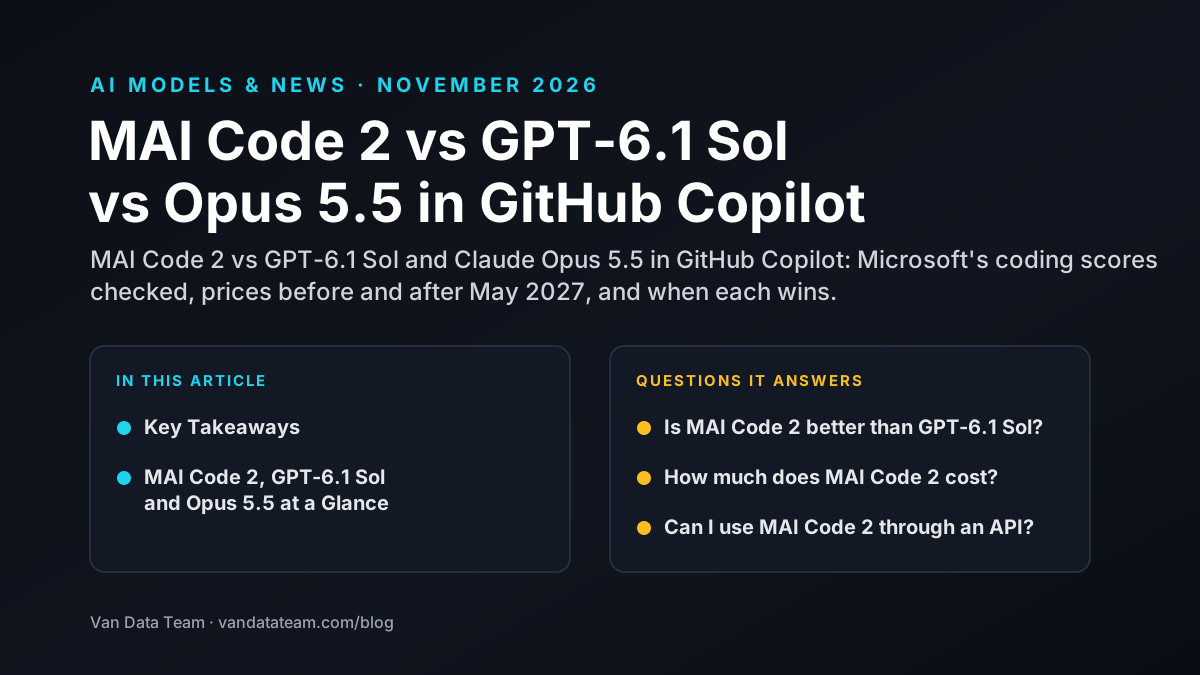
MAI Code 2 vs GPT-6.1 Sol vs Claude Opus 5.5
MAI Code 2 vs GPT-6.1 Sol and Claude Opus 5.5 in GitHub Copilot: Microsoft's coding scores checked, prices before and after May 2027, and when each wins.
Microsoft released MAI Code 2 and MAI Code 2 Flash on November 17, 2026: two coding models it trained from scratch and put straight into GitHub Copilot. Its pitch is price. On Microsoft's own tests, MAI Code 2 gets 98% of GPT-6.1 Sol's average score at about 40% of the cost per task, and 96% of Claude Opus 5.5's at about 5%.
This guide checks those claims against Microsoft's published numbers, shows where MAI Code 2 falls behind, and covers two things to know before you switch: the cost figures use a promotional price that ends on May 17, 2027, and the model is only in Copilot for now. Each pair links to a full side-by-side page in our AI model comparison tool.
Disclosure and scope: Van Data Team builds AI systems for clients on models from OpenAI, Anthropic, Google and others, and we have no paid ties to Microsoft, OpenAI or Anthropic. We drafted this with help from Anthropic's Claude, and Anthropic makes one of the models compared here. Every MAI Code 2 score below comes from Microsoft, which ran the tests; we say where independent results exist for the other models.
Key Takeaways
- Close to GPT-6.1 Sol on Microsoft's tests: 1.4 points behind on DeepSWE 1.1, 0.4 behind on Terminal-Bench 2.1 and 4.3 behind on SWE Atlas.
- Much cheaper per token: $0.50 and $2.50 per million in Copilot, a quarter of GPT-6.1 Sol's rates, until May 17, 2027. Then $1 and $5, half.
- Opus 5.5 still wins on SWE Atlas, 57.5% against 43.1%, a test of codebase questions, test writing and refactoring.
- Copilot only: there's no public API for MAI Code 2 yet.
- No independent scores yet: every MAI number comes from Microsoft's own runs.
- Flash undercuts the budget tier: half GPT-6 Luna's and Claude Haiku 5.5's token price during the promotion, and ahead of both on Microsoft's three tests.
MAI Code 2, GPT-6.1 Sol and Opus 5.5 at a Glance
| Model | Maker | Price per 1M tokens in Copilot (in / out) | Cached input | Context / max output | Also available |
|---|---|---|---|---|---|
| MAI Code 2 | Microsoft | $0.50 / $2.50 until May 17, 2027, then $1 / $5 | $0.025, then $0.05 | 1.05M / 128K | Copilot only |
| GPT-6.1 Sol | OpenAI | $2 / $10 | $0.10 | 1.05M / 128K | OpenAI API |
| Claude Opus 5.5 | Anthropic | $4 / $20 | $0.20 | 1M / 128K | Claude API and apps |
Prices come from GitHub's Copilot pricing page, per million tokens under usage-based billing; GitHub bills OpenAI models at OpenAI's list prices. GPT-6.1 Sol requests over 272,000 input tokens cost $4 and $15 for the whole request.
What Is MAI Code 2?
According to Microsoft's announcement and model card, MAI Code 2 is:
- A large mixture-of-experts model: 77 billion active parameters and about 2.8 trillion in total, pre-trained and post-trained by Microsoft
- Built for everyday enterprise coding: taking code to production, deep debugging, multi-file changes, repository-wide reasoning and UI work
- Long-context: a 1,050,000-token window with up to 922,000 input tokens and 128,000 output tokens, with text and image input
- Adjustable: reasoning effort from low to max, with training data up to August 2026
Microsoft is also clear about the limits. It says the model is not yet tuned for harder problems such as fundamental science research and very long agent runs. Its model card puts the model's alignment close to GPT-5.6 Sol's and below GPT-6's.
You'll find it in the Copilot model picker in VS Code, Visual Studio, the Copilot CLI, the cloud agent, the GitHub Copilot app, github.com and GitHub Mobile, on the Pro, Pro+, Max, Business and Enterprise plans (GitHub changelog). See the MAI Code 2 model page for every spec and source.
Microsoft's Numbers
Microsoft ran all three models on MSBench, its evaluation platform, inside the GitHub Copilot CLI without subagents, at max reasoning effort. Here are the results from its launch chart:
| Benchmark | MAI Code 2 | GPT-6.1 Sol | Claude Opus 5.5 |
|---|---|---|---|
| DeepSWE 1.1 | 73.2% | 74.6% | 69.0% |
| Terminal-Bench 2.1 | 84.6% | 85.0% | 78.7% |
| SWE Atlas | 43.1% | 47.4% | 57.5% |
| FrontierCode v1.1 (Artificial Analysis's run) | 52.0% | 49.4% | 56.0% |
| Average of the four | 63.2% | 64.1% | 65.3% |
| Average cost per task | $0.31 (promotional price) | $0.76 | $6.31 |
The FrontierCode scores and costs come from Artificial Analysis, not from Microsoft's own runs, so our MAI Code 2 model page records only the other three rows.
Checking Microsoft's Claims
The headline numbers hold up against Microsoft's own chart:
- 98% of GPT-6.1 Sol: 63.2% against 64.1% is 98.6% of the score, at $0.31 against $0.76, or 41% of the cost per task
- 96% of Opus 5.5: 63.2% against 65.3% is 96.8% of the score, at under 5% of Opus 5.5's $6.31
But the cost side uses MAI Code 2's promotional price, which is half the full rate. From May 17, 2027, if MAI Code 2 used the same tokens, its average cost per task would double to about $0.62: around 81% of GPT-6.1 Sol's and about 10% of Opus 5.5's (our math). Still cheaper, but the gap with GPT-6.1 Sol becomes small.
One more claim is worth reading closely. In a blind test with 258 annotators, reviewers preferred MAI Code 2's front-end apps to GPT-6 Sol's 64% of the time. That's against GPT-6 Sol, not GPT-6.1 Sol, and it covers user interfaces, games, data visualizations, 3D scenes and SVG graphics.
MAI Code 2 vs GPT-6.1 Sol
On Microsoft's tests these two are close: GPT-6.1 Sol is ahead on all three of Microsoft's own runs, by 0.4 to 4.3 points, and MAI Code 2 leads on the FrontierCode figures from Artificial Analysis, 52.0% against 49.4%. The real difference is price, a quarter of GPT-6.1 Sol's token rates until May 2027.
What GPT-6.1 Sol offers in return:
- An API: you can call it from your own code and tools, outside Copilot
- Independent results: Arena WebDev rates it 1742 and Epoch AI's Capabilities Index 168.5, while MAI Code 2 has no independent rating yet
- A newer sibling: GPT-6.2 Sol, released the same day at the same $2 and $10, beats GPT-6.1 Sol on all five public benchmarks in OpenAI's charts, and it's in Copilot too, on the Pro+ plan and above
That last point matters. Microsoft's charts don't include GPT-6.2 Sol, which came out the same day. Copilot users choosing today should also try it, since nobody has yet tested it against MAI Code 2. Our GPT-6.2 Sol guide covers it. Compare the first pair on the GPT-6.1 Sol vs MAI Code 2 page.
MAI Code 2 vs Claude Opus 5.5
This pair splits more clearly. MAI Code 2 leads on Terminal-Bench 2.1 (84.6% against 78.7%) and DeepSWE 1.1 (73.2% against 69.0%), two tests of finishing tasks in a terminal and fixing code until hidden tests pass. Opus 5.5 leads on SWE Atlas (57.5% against 43.1%), which mixes codebase questions, test writing and refactoring from 18 open-source projects, and on the FrontierCode figures (56.0% against 52.0%).
The price gap is the widest in this guide. Opus 5.5 costs $4 and $20 per million tokens, and in Microsoft's chart its average cost per task was about twenty times MAI Code 2's: $6.31 against $0.31. Some of that is Opus 5.5 using more tokens at max effort.
Opus 5.5 also has independent results: Arena WebDev rates it 1816, among the top scores in our catalog. Our read: keep Opus 5.5 for code questions, tests and refactors across a large codebase, and try MAI Code 2 for high-volume bug fixes and terminal tasks. See the Opus 5.5 vs MAI Code 2 page and the Opus 5.5 vs GPT-6.1 Sol page.
MAI Code 2 Flash vs GPT-6 Luna vs Claude Haiku 5.5
Microsoft also released a smaller model, MAI Code 2 Flash, with 12 billion active parameters and about 398 billion in total. It's built for explanations, targeted edits, routine fixes and fast iteration, and it's on every Copilot plan, Free and Student included. Microsoft compared it with the budget models from OpenAI and Anthropic:
| At max effort, Microsoft's runs | MAI Code 2 Flash | GPT-6 Luna | Claude Haiku 5.5 |
|---|---|---|---|
| DeepSWE 1.1 | 59.9% | 59.6% | 46.0% |
| Terminal-Bench 2.1 | 78.3% | 69.3% | 73.4% |
| SWE Atlas | 44.8% | 36.4% | 42.1% |
| Average cost per task | $0.052 (promotional price) | $0.080 | $0.319 |
| Price per 1M tokens (in / out) | $0.05 / $0.25, then $0.10 / $0.50 | $0.10 / $0.50 | $0.10 / $0.50 |
Flash leads all three tests, though only by 0.3 points over GPT-6 Luna on DeepSWE. It even edges past the bigger MAI Code 2 on SWE Atlas, 44.8% against 43.1%. When the promotion ends on May 17, 2027, its token price matches Luna's and Haiku's (Haiku 5.5's rate covers prompts up to 100,000 tokens). GitHub will retire the older MAI-Code-1.1-Flash on December 18, 2026, so Copilot users on it should move now. See the MAI Code 2 vs MAI Code 2 Flash page and the Haiku 5.5 vs GPT-6 Luna page.
Worked Example: A Month of Agent Tasks
Here's a simple cost model, using our own math and Copilot's list prices. Take 1,000 agent tasks a month, each reading 150,000 tokens and writing 8,000:
- MAI Code 2: $0.075 for input plus $0.02 for output, $0.095 per task, or $95 a month, and $190 after May 17, 2027
- GPT-6.1 Sol: $0.30 plus $0.08, $0.38 per task, or $380
- Claude Opus 5.5: $0.60 plus $0.16, $0.76 per task, or $760
These assume each model reads and writes the same amount, which it won't. In Microsoft's own chart, MAI Code 2's cost per task was about 2.5 times lower than GPT-6.1 Sol's, a narrower gap than the 4-to-1 token price, and about 20 times lower than Opus 5.5's, a wider gap than the 8-to-1 token price. Caching also changes the totals, since repeated context costs a fraction of the input rate on all three.
Which Model Should You Use?
| If you need | Start with | Why |
|---|---|---|
| High-volume bug fixes and terminal tasks in Copilot | MAI Code 2 | Close to GPT-6.1 Sol on Microsoft's tests at a fraction of the price |
| Code questions, tests and refactors across a big codebase | Claude Opus 5.5 | Leads SWE Atlas by more than 14 points |
| A model you can call from your own tools | GPT-6.1 Sol or GPT-6.2 Sol | MAI Code 2 has no public API yet |
| Cheap everyday help on any Copilot plan | MAI Code 2 Flash | Half the budget models' token price until May 2027 |
| Hard science or very long agent runs | Not MAI Code 2 | Microsoft says it isn't tuned for them yet |
Copilot makes switching easy, since every model sits in the same picker. Try MAI Code 2 as the default for a week on real tickets, keep a stronger model one click away, and compare how many changes each one gets merged.
What the Benchmarks Don't Tell You
- Microsoft's tests: Microsoft chose the tests, ran them in its own harness and published the results
- Promotional pricing: every MAI cost figure uses half the price you'll pay after May 17, 2027
- Copilot's harness: scores come from the Copilot CLI, so results in other tools may differ
- No outside check yet: Arena, Epoch AI and other independent testers hadn't scored MAI Code 2 when we wrote this
Use these numbers to decide what to try, then measure on your own repositories.
MAI Code 2: Our Take
MAI Code 2 is a credible new option in Copilot: within a few points of GPT-6.1 Sol on Microsoft's tests, at a quarter of the token price for the next six months. By Microsoft's own chart it isn't the strongest coder there: Opus 5.5 has the higher average and leads on codebase-wide work, and GPT-6.2 Sol now raises the bar on OpenAI's side. But for the large share of coding work that is routine, it can cut a team's Copilot bill sharply.
Our advice: try MAI Code 2 on routine tickets while the promotion lasts, keep Opus 5.5 or GPT-6.2 Sol for the hard ones, and recheck the math before May 2027. For the top-tier models, see our GPT-6.2 Astra vs Claude Fable 5.2 vs Gemini 4 Carbon comparison.
Van Data Team in practice
Should our developers use MAI Code 2, GPT-6.1 Sol or Claude Opus 5.5 in GitHub Copilot?
Choose per kind of task, measured on your own repositories. We build a small evaluation from real tickets in your codebase, run each model in the same agent setup, and compare tasks completed, review rework and cost per finished task. Routine fixes then go to the cheapest model that passes, and a stronger model stays on hand for multi-file and repository-wide work. We have built agent platforms that connect models to large tool sets, one with more than 70 MCP tool integrations.
70+ MCP tool integrations under one LangGraph Supervisor
AI Agents
Zeno Fitness and Habit PlatformMulti-provider routing across Claude 3 Haiku, OpenAI, and Gemini
AI Model Brief
The AI models worth knowing, once a week
What shipped, how it scores on independent benchmarks, what it costs per million tokens and what was deprecated, from the data behind our AI model benchmarks.
We use your address only to send the brief. See our privacy policy.
See this week’s brief
Founder of Van Data Team. Builds Vanaxity, the AI agent system for SEO, GEO, and AEO, and leads data engineering delivery for B2B teams.
About the authorAI model benchmarks
Models in this article
Current pricing, context window and independent scores for each model.
Article FAQ
Questions readers usually ask next.
These short answers clarify the practical follow-up questions that often come after the main article.
Need a similar system?
If this article maps to a workflow your team already operates, the next step is usually a scoped review of the system, constraints, and rollout path.
Consultation
Scope your next AI workflow.
Share the system and blockers. We will map fit, gaps, and the next step.