Overseas Data Center Ban: What Trump's Threat Means for AI
Trump's overseas data center ban threat explained: what he said, what is still unclear, who is exposed and what it means for AI teams that use cloud regions.
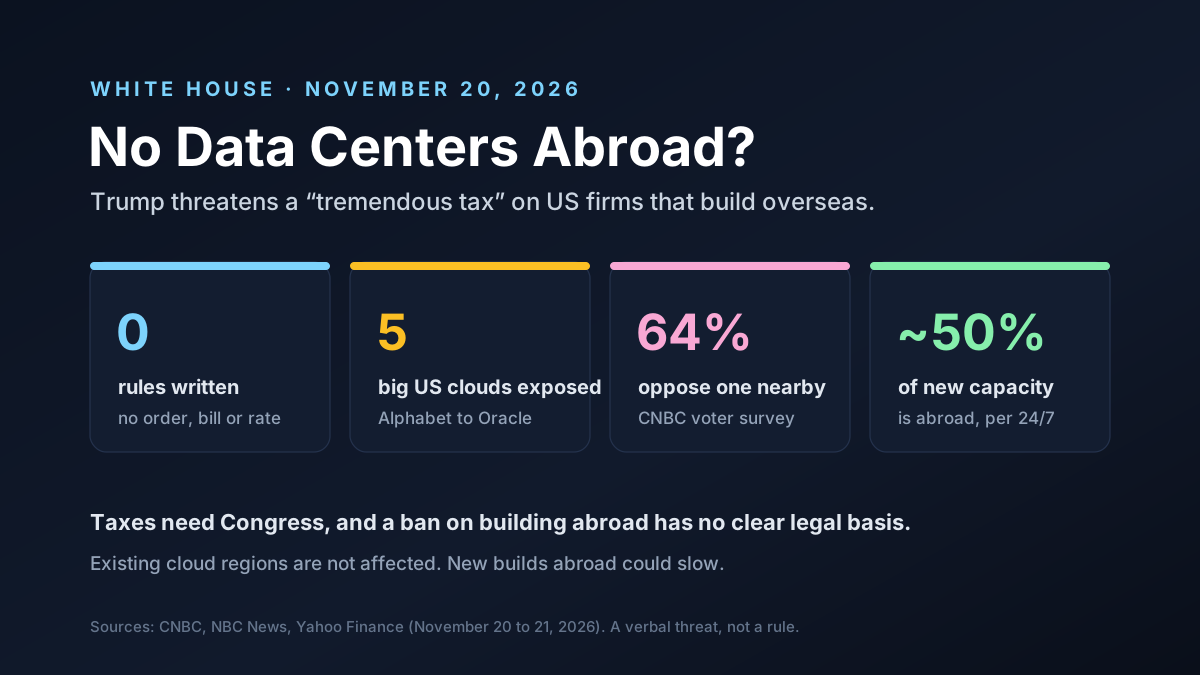
President Trump wants America's AI boom to stay in America. At a White House event on November 20, 2026, he said US companies won't be allowed to build data centers in other countries, and threatened a "tremendous tax" on those that do, as CNBC reported.
Then came the twist. "I haven't even said that to my people," Trump said.
So is an overseas data center ban real, and should anyone change plans? This guide covers what Trump said, what he left out, who has the most at stake and what it means for teams that run data and AI in cloud regions around the world.
Key Takeaways
- A verbal threat: Trump said US firms can't build data centers abroad and would face a tremendous tax if they do.
- No details: there's no rate, no date, no legal basis and no written order.
- Big names exposed: Alphabet, Amazon, Microsoft, Meta and Oracle all build abroad.
- Hard to enforce: taxes need Congress, and a ban on building abroad would face legal fights.
- Calm for now: existing cloud regions aren't affected, but plans for new ones could slow.
The Overseas Data Center Ban at a Glance
Here's what has been reported, as of November 21, 2026:
| Item | What's reported |
|---|---|
| Who said it | President Donald Trump |
| When and where | November 20, 2026, at a White House event |
| What he said | US firms won't be allowed to build data centers abroad |
| The penalty | A "tremendous tax" and "tremendous penalties" |
| Rate, date or legal basis | None given |
| Staff told in advance? | No, by Trump's own account |
| Status | A verbal threat, not a rule |
It's a big statement with almost no detail. That gap is the story.
What Trump Said on November 20
Trump spoke at a White House event, just back from a trip to Asia. His opening line was blunt: "We're not going to allow our companies to build data centers outside of our country."
He then mixed two ideas. "If they do that, they can't," he said, according to NBC News. "But we're going to put a tremendous tax on them if they do it." He also promised "tremendous penalties."
His reason was China. He compared data centers to chips, saying the US had let key industries move abroad and "it was very destructive to our country." Coverage summed up his view as a fear that data centers built abroad would end up helping China.
What Trump Didn't Say
The list of missing details is long:
| What Trump said | What he didn't say |
|---|---|
| Companies won't be allowed to build abroad | Whether that's a ban, a tax or both |
| There will be a tremendous tax | The tax rate or how it would be collected |
| Data centers abroad help China | Which countries would count |
| He hadn't told his staff yet | When any rule would start |
| Communities should make data centers pay | Whether existing sites abroad are covered |
Even the core idea is unclear. A ban means you can't build. A tax means you can, at a price. Trump said both in the same breath, and the press couldn't tell which he meant.
None of the big cloud firms has replied: Amazon, Google, Microsoft and Oracle didn't immediately respond to CNBC, and the White House didn't answer requests for more detail either.
Can the Overseas Data Center Ban Be Enforced?
That's the biggest open question. Under Article I of the US Constitution, Congress, not the president, has the power to set taxes. A new tax on building abroad would need a law.
A flat ban is harder still. US companies invest abroad all the time, and there's no clear law that lets a president stop a firm from building on foreign soil. Any attempt would almost surely end up in court.
A president does have other tools:
- Chip export rules: the US already controls where advanced AI chips can be shipped, and those rules could be tightened.
- Federal contracts: they can come with conditions on how vendors operate.
- Federal permits: approvals for big projects at home can carry terms too.
But Trump named none of these, so it's too early to say what, if anything, will follow.
Why Trump Is Pushing This Now
The threat didn't come from nowhere. Data centers have become a hot political issue:
- The midterms: voters backed limits on data centers in 40 of 41 local measures in November, as we covered in our post on the data center moratorium.
- Public mood: in CNBC's All-America Economic Survey, 64% of registered voters opposed an AI data center within 10 miles of their home, and only 13% would support one.
- Finland: in September, Trump criticized Google's plan to spend about $15 billion in Finland and urged it to rethink.
There's a tension here. Trump wants data centers built in the US, yet many US towns don't want them.
On Friday he told local leaders: "Make them pay you. Make them pay your community, but take advantage. Don't shut them off."
Who the Overseas Data Center Ban Would Hit
The biggest US cloud and AI firms all build abroad. Here are a few examples:
| Company | Examples of building abroad |
|---|---|
| Alphabet (Google) | About $15 billion planned in Finland, announced in September 2026 |
| Microsoft | Added 24 new data centers across five continents last quarter, per 24/7 Wall St. |
| Amazon (AWS) | Cloud regions on six continents, with new ones opened in Asia in recent years |
| Meta | Large data centers in Ireland, Denmark and Singapore |
| Oracle | Cloud regions in dozens of countries |
Data center landlords such as Equinix and Digital Realty build abroad too. So do AI labs, through deals with cloud partners.
The scale is large. 24/7 Wall St. estimated that about half of the world's data center capacity under construction is outside the US. A real ban or a heavy tax would touch a big share of the global AI infrastructure build.
How the Market Reacted
Cloud and data center stocks fell on Friday. But it was a terrible day for the whole market, so the threat's own effect is hard to measure:
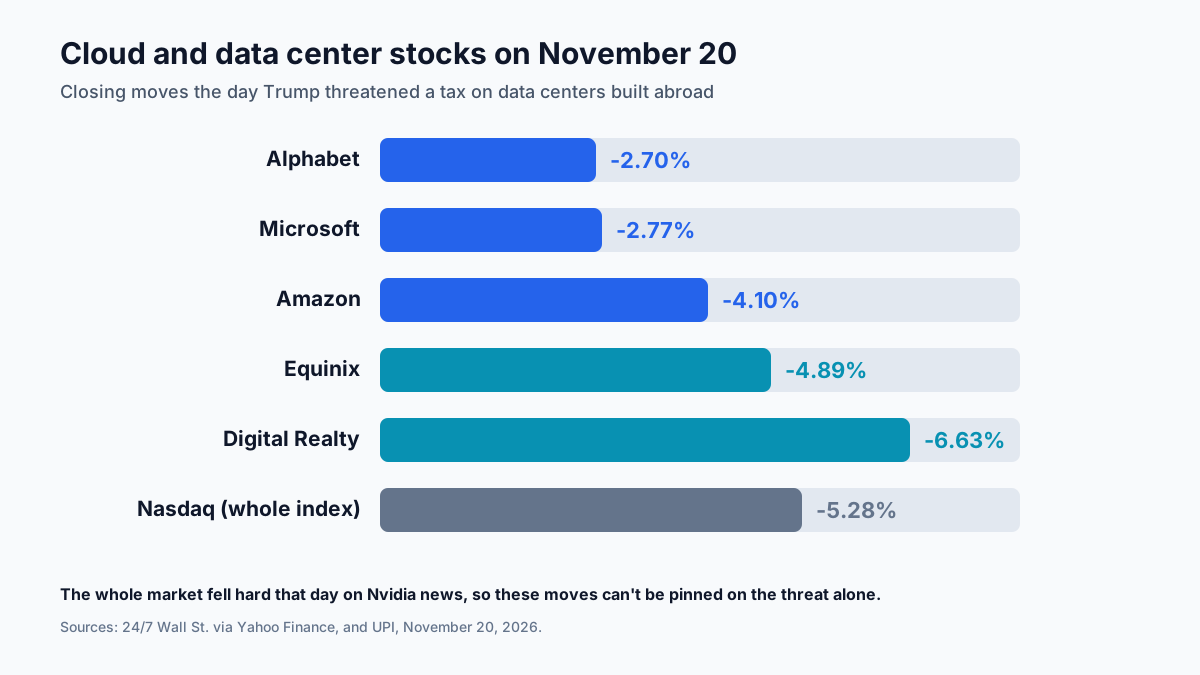
The Nasdaq fell 5.28% that day, mostly on news that the SEC's probe of Nvidia is looking at accounting issues, as we covered in our post on the Nvidia SEC probe. Next to that, Alphabet's 2.70% drop looks mild.
Digital Realty's 6.63% fall stands out, though. As a pure data center landlord with sites around the world, it's the most direct bet on global builds, and investors treated it that way.
Why Clouds Build Abroad in the First Place
To see why a ban would be costly, it helps to know why clouds build abroad at all. There are three big reasons:
- Speed: apps feel faster when servers sit close to users. A user in Jakarta notices the gap between a nearby server and one in Virginia.
- Law: many countries require some data to stay inside their borders.
- Power and permits: some places offer cheaper or cleaner power, and faster approvals than many US states.
AI adds a fourth: capacity. The world needs more computing power for AI than the US alone can build quickly, given limits on power and local pushback.
What It Could Mean for Southeast Asia
Southeast Asia has been one of the hottest markets for new data centers. Malaysia, Singapore, Thailand and Indonesia have all drawn large plans from US cloud firms in recent years. Vietnam has been courting them too.
If US firms paused new builds abroad, the region would feel it. Projects could slow, and local and Chinese providers could fill the gap. That's the opposite of what Trump says he wants, since the point of the threat is to keep China from gaining ground.
For now, nothing has changed on the ground. Announced projects are still going ahead, as far as public reports show.
What an Overseas Data Center Ban Would Mean for Data Rules
Here's a problem a ban can't solve. Many countries have data residency rules, which require that some data stay at home:
| Place | Rule that pushes data to stay local |
|---|---|
| European Union | GDPR limits transfers of personal data out of the EU |
| India | Payment data must be stored in India |
| Vietnam | Decree 53 requires some data to be stored in the country |
| China | Strict rules on moving important data abroad |
| Many governments | Public sector data often must stay in the country |
A US cloud firm that can't build in those places can't legally serve some of their customers. That would hand those customers to local or rival providers.
It would also squeeze US firms that sell abroad. A US software company with clients in Europe or Vietnam often needs to store their data locally. Today it rents space from a US cloud in that country, and without that option it would need a foreign provider or would lose the deal.
Three Ways This Could Play Out
Nobody knows where the Trump data centers threat goes next. Here are three broad paths, from most to least likely in our view:
| Path | What it would look like | What it means for teams |
|---|---|---|
| It fades | No order or bill follows, and the threat drops out of the news | Little changes, though some new builds abroad may wait for clarity |
| Chip rules tighten | The White House limits where advanced AI chips can go | AI capacity abroad gets tighter and pricier, while existing sites keep running |
| Congress acts | A law taxes or limits building abroad | Clouds slow new regions abroad, and local rivals grow |
The first path is the most common outcome for threats made without a plan. Still, the second is worth watching, because chip rules can change with little warning and no vote in Congress. The third would be a major shift and would take months, at least.
Would the Overseas Data Center Ban Help Anyone?
Some players could gain, at least on paper:
- US towns and states that want the jobs and tax revenue, if more capacity gets built at home.
- Non-US cloud providers, which could win customers who need data stored locally.
- US power and construction firms, if spending shifts home.
But the losers look bigger. US clouds would lose ground abroad, and US customers with global users would face slower apps and harder compliance. Allies could retaliate with taxes of their own on US tech firms.
What the Overseas Data Center Ban Means for AI Teams
For most data and AI teams, nothing changes this week. Your cloud regions keep running, and no rule exists yet.
The risk is in plans, not current systems. If you count on a cloud region that's announced but not open, or on fast growth in capacity abroad, build in some slack. A policy fight could slow both.
Teams outside the US should watch closely. If US clouds slow their builds in your country, prices for local capacity could rise, and you may want a second provider. We covered how to read this kind of shift in our post on AI capex.
A Cloud Region Risk Checklist
Use this checklist to see where you stand:
| Question | Why it matters | What to do |
|---|---|---|
| Where does our data live?. | Local rules decide where data can go, and they differ by country, by industry and sometimes by the type of customer. | List every region |
| Planned region? | New regions abroad could slow down. | Have a fallback region that is already open, and test that your setup can actually run there. |
| A local option? | Non-US clouds may gain ground in markets with strict data rules. | Know one |
| Can we move fast?. | Moving data later is slow and costly, especially for large AI training sets and logs that have grown for years. | Keep setups portable |
| Are prices fixed? | Tight supply abroad lifts prices. | Lock in key capacity for the next year or two if your usage is steady. |
The first row matters most. Many teams don't know where all their data lives, especially backups and AI logs. That's worth fixing whatever happens with this threat.
What to Watch Next
A few signals will show whether this goes anywhere:
- A written order or bill: until one appears, this is talk, not policy, and no company has to change anything it has already planned.
- Cloud firms' answers, especially at their next results in January.
- Paused projects, such as any change to Google's Finland plan or to big builds in Southeast Asia that were announced before the threat.
- Allies' reactions, including any talk of taxes on US tech.
- Chip export rules, the tool a president can use most easily.
Overseas Data Center Ban: Our Take
The overseas data center ban is a threat, not a policy. It has no rate, no date and no clear legal path, and the president hadn't told his own staff. That doesn't make it harmless. Even talk like this can slow investment decisions, and a bigger fight over where AI gets built is clearly coming.
For teams, the right move is calm homework. Know where your data and models run, know which local rules apply, and don't bet your roadmap on capacity that doesn't exist yet.
How Van Data Team Helps
We help teams plan where their data and AI run:
- Data pipelines that keep data in the right region, via data pipeline development.
- Cost reviews of cloud and AI spend across regions, through our cloud cost optimization service.
- AI agents built to run on more than one cloud, through AI agent development.
- Dashboards that show spend and data by region, through agentic BI reporting.
This article is based on reporting by CNBC, NBC News, Yahoo Finance and UPI, as of November 21, 2026.
It is not legal or investment advice. Van Data Team uses US cloud regions in several countries. Planning where your AI should run? Get in touch and we'll help you map it.
AI Model Brief
The AI models worth knowing, once a week
What shipped, how it scores on independent benchmarks, what it costs per million tokens and what was deprecated, from the data behind our AI model benchmarks.
We use your address only to send the brief. See our privacy policy.
See this week’s brief
Founder of Van Data Team. Builds Vanaxity, the AI agent system for SEO, GEO, and AEO, and leads data engineering delivery for B2B teams.
About the authorArticle FAQ
Questions readers usually ask next.
These short answers clarify the practical follow-up questions that often come after the main article.
Need a similar system?
If this article maps to a workflow your team already operates, the next step is usually a scoped review of the system, constraints, and rollout path.
Consultation
Scope your next AI workflow.
Share the system and blockers. We will map fit, gaps, and the next step.