Who Owns Anthropic? Amazon, Google and the IPO Stakes
Who owns Anthropic after its IPO? Amazon about 14.7% and Google 13.7%, but the founders keep control. The stakes, the caps and what it means for Claude buyers.
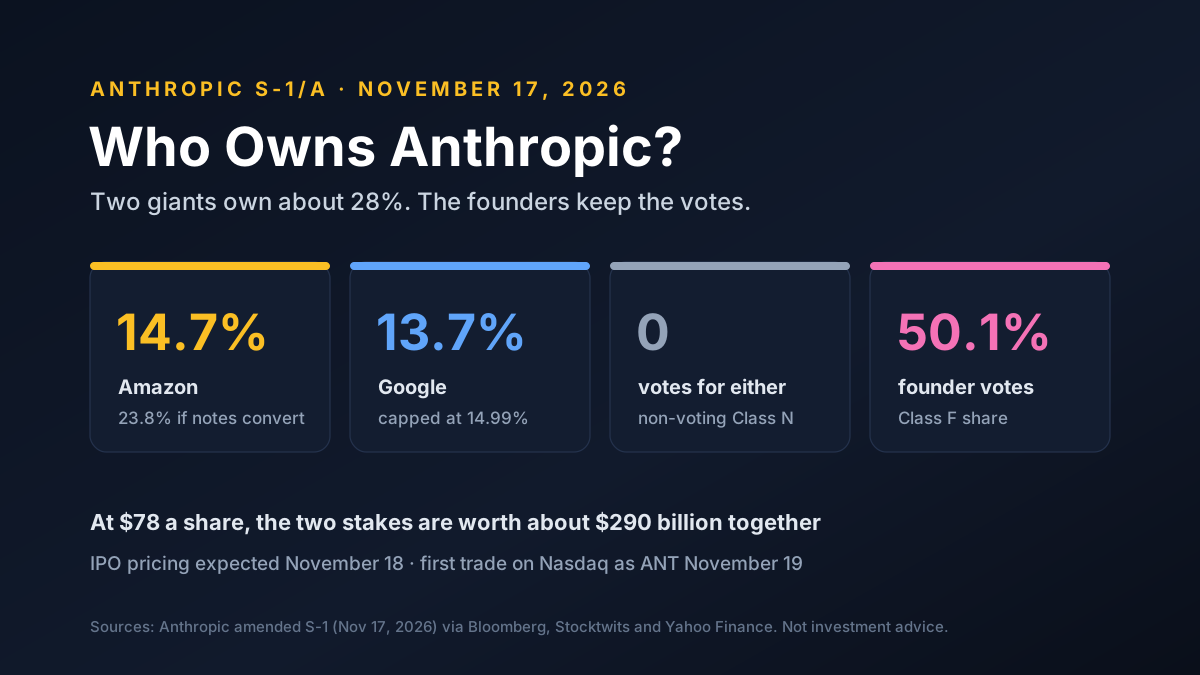
Who owns Anthropic? The answer just got much clearer. An amended IPO filing dated November 17, 2026 shows that Amazon and Google will own about 28% of the Claude maker once it lists on Nasdaq.
That's a big share for two of the world's largest tech companies, and both of them also sell Anthropic its computing power. But neither one gets to run the company. The founders keep voting control through a special share class.
Anthropic is expected to set its IPO price on the evening of Wednesday, November 18, US time, and start trading as ANT on Thursday. We covered the deal terms in our post on the Anthropic IPO pricing week. This guide answers a different question: who owns Anthropic, who controls it and why that matters for teams that buy Claude.
This is an explainer, not investment advice.
Key Takeaways
- Two giant owners. Amazon will hold about 14.7% and Google about 13.7%, for roughly 28% combined.
- No votes. Both stakes are non-voting Class N stock. The founders hold 50.1% of the votes.
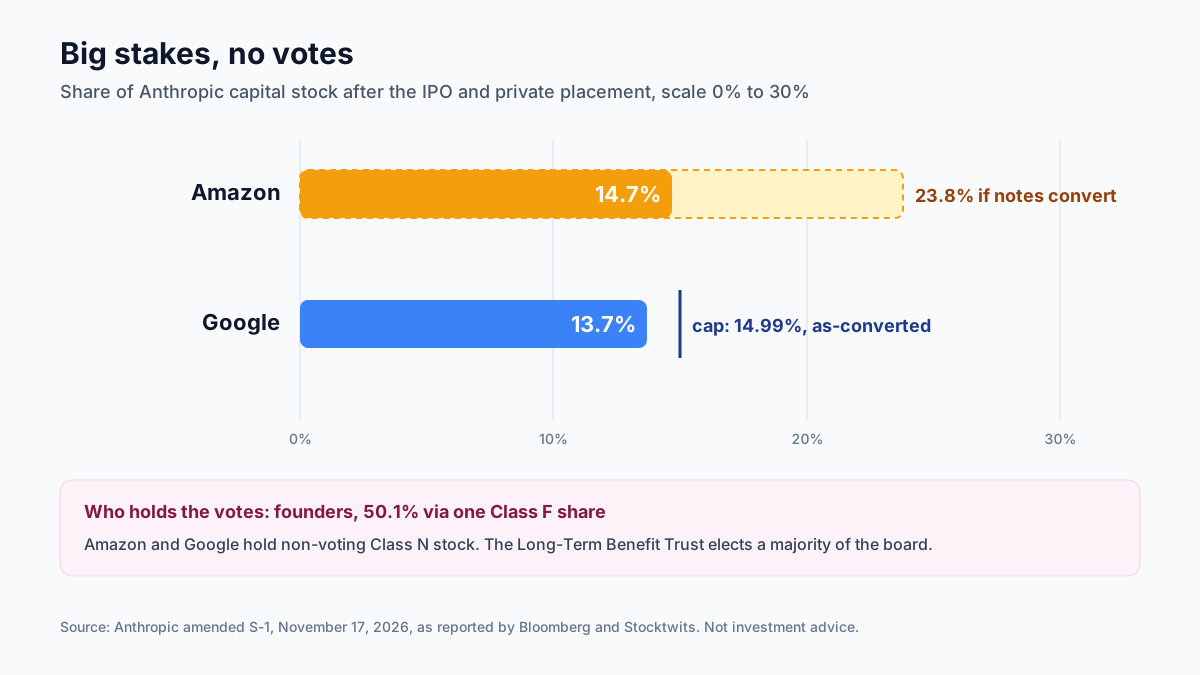
- Amazon could own more. Its convertible notes would lift it to about 23.8% if fully converted, but a 12% cap blocks that for now.
- Huge paper value. At $78 a share, the two stakes are worth about $290 billion together.
- Strong demand. Orders reached close to seven times the shares on offer, according to Bloomberg.
Who Owns Anthropic at a Glance
Here's the ownership picture from the November 17 filing, as reported by Stocktwits via Yahoo Finance:
| Holder | Stake after IPO | Votes |
|---|---|---|
| Amazon | About 14.7% | None, Class N stock |
| About 13.7% | None, Class N stock | |
| Amazon and Google together | About 28.4% | None |
| Founders | Not a majority of shares | 50.1% of votes via Class F |
| Public IPO buyers | 825 million Class A shares | Limited |
The rest of the company belongs to a wide group: founders, employees, venture investors, the seven strategic partners in the private placement and the new public shareholders.
How Amazon and Google Got Here
Both giants started backing Anthropic in 2023, when it was a young lab with a fraction of today's revenue.
- Amazon committed $8 billion across 2023 and 2024, and made AWS Anthropic's main cloud and training partner.
- Google put in about $3 billion between 2023 and early 2025, and supplied its TPU chips through Google Cloud.
Those early checks bought stakes now worth well over $100 billion each at the IPO range. Few venture bets in history have grown this fast. Both firms may have added money in later rounds, but the filing's percentages are what count now.
Amazon's Stake in Anthropic
Amazon is the biggest single outside owner. But the Amazon stake has an unusual twist:
| Item | What the filing shows |
|---|---|
| Stake after IPO | About 14.7% of capital stock |
| How it invested | Largely through convertible notes |
| Conversion limit | Notes convert only while the stake stays under 12% |
| Cap waived? | No, Amazon elected not to waive it |
| If fully converted | About 3.48 billion shares, or 23.8% |
| Value if converted | About $272 billion at $78 a share |
Here's what that means in plain terms. Amazon lent Anthropic much of its money through notes that can turn into shares later. Those notes come with a rule: they can only convert while Amazon's stake stays below 12%.
The filing says Amazon "has elected not to waive" that limit. Since its stake already sits above 12%, the notes can't convert for now.
So for now, Amazon holds about 14.7%, and the notes sit on the side. If they all converted someday, Amazon's stake would jump to about 23.8%, worth roughly $272 billion at the top of the range.
Google's Stake in Anthropic
Google's position is simpler. The Google stake will be about 13.7% of Anthropic after the IPO, according to the filing.
Google's stake is also capped. A separate agreement limits it to 14.99% of Anthropic on a fully converted basis unless that limit is waived. Google is also one of the seven partners buying stock in the private placement, putting in $10 billion at the IPO price.
Both caps point to the same goal. Anthropic wants big backers without letting any one of them get close to a controlling stake.
Who Owns Anthropic vs Who Controls It
Owning shares and running a company aren't the same thing here. Anthropic built its share structure to split the two:
- Class A: the shares sold to the public.
- Class F: held by the founders, with 50.1% of the votes, which is enough to win any shareholder vote on its own.
- Class N: non-voting stock held by Amazon, Google and other partners. Amazon owns 33.9% of this class, and Google 31.6%.
- The Long-Term Benefit Trust: an independent group that elects a majority of the board.
The result is a company where Amazon and Google own a lot and decide very little. For a public benefit corporation that talks a lot about AI safety, that's the point. For investors, it means less say.
What Amazon's and Google's Stakes Are Worth
The filing makes the stakes easy to value. Here's how they move with the share price:
| Holder | Value at $70 | Value at $78 | Per $1 move |
|---|---|---|---|
| Amazon | About $135 billion | About $150 billion | About $1.9 billion |
| About $125 billion | About $140 billion | About $1.8 billion | |
| Together | About $260 billion | About $290 billion | About $3.7 billion |
And here's how those stakes compare with the size of the parent companies, based on their market values at the November 16 close:
| Parent | Market value, Nov 16 | Anthropic stake as a share of it |
|---|---|---|
| Amazon | $2.79 trillion | 4.8% to 5.4%, or 8.7% to 9.8% if converted |
| Alphabet | $3.49 trillion | 3.6% to 4.0% |
That's a meaningful chunk of each parent. A big move in ANT shares will show up in Amazon's and Alphabet's own results, which is one reason both stocks may react to Anthropic's first day of trading.
Who Owns Anthropic: Why the Valuation Has More Than One Number
You may have seen Anthropic's value quoted as $1.4 trillion, $1.2 trillion or even close to $1 trillion. They can all be right, because they count different things.
- Fully diluted: about $1.404 trillion at $78. This counts every share that could exist, including options and convertible notes.
- Shares outstanding today: a lower number.
- Our rough math: if $1 moves Amazon's 14.7% stake by $1.9 billion, Amazon holds about 1.9 billion shares. That implies about 12.9 billion shares of capital stock, or roughly $1 trillion at $78.
Our math is an estimate built from reported figures, not Anthropic's own count. Most outlets use the fully diluted number, which is why $1.4 trillion shows up in nearly every headline about the deal.
The Latest on the Anthropic IPO
The deal has moved fast in the last few days. Here's where it stands, as of November 18:
| Item | Latest reported |
|---|---|
| Shares offered | 825 million Class A |
| Price range | $70 to $78 |
| Raised at the $74 midpoint | About $61 billion |
| Raised at $78 with the full greenshoe | About $74 billion |
| Private placement | $26 billion from seven partners |
| Demand | Close to 7 times the shares, per Bloomberg |
| Pricing and first trade | November 18 evening and November 19 |
Bloomberg reported on Sunday, November 15, that orders had reached close to seven times the shares available. Later reports said the company was guiding investors to expect a price at $78 or above, and The Wall Street Journal reported it could price above $80. None of that is final until the price is announced.
Underwriters also reportedly told buyers that Anthropic plans to favor its current backers when it hands out shares.
Who Owns Anthropic, and the Business They Bought
Big owners want a business that can grow into its price. Here are the latest figures, from Anthropic's filings as summarized by Renaissance Capital:
| Figure | Amount |
|---|---|
| Revenue, 12 months to September 30, 2026 | About $35 billion |
| Revenue, third quarter of 2026 | $17.0 billion |
| Customers paying $100,000 or more a year | More than 11,900 |
| Share of revenue that is usage based | 79% over nine months |
| Compute gross margin, third quarter | 42% |
Two numbers stand out. Revenue for the 12 months to September was about $35 billion, and most of it is usage based, meaning customers pay for what they use. That's great when usage grows. It's also why revenue can swing if big customers cut back.
We dug into the losses and the compute bill in our Anthropic S-1 post.
Who Owns Anthropic Also Sells It Compute
Here's what makes Anthropic's ownership unusual. Its biggest owners are also its biggest suppliers and sales channels:
- Amazon sells Anthropic computing power through AWS, and sells Claude to its own cloud customers through Amazon Bedrock.
- Google sells Anthropic computing power on Google Cloud, and offers Claude through its Vertex AI platform.
- Microsoft, Nvidia and others in the private placement also sell Anthropic chips, memory or cloud capacity.
That creates a three-way tie. Anthropic pays these companies for compute, they invest money back into Anthropic, and they earn money reselling Claude. When that works, everyone grows together. When it strains, the conflicts are easy to see.
What It Means for Teams That Buy Claude
If your company uses Claude, the ownership news is mostly reassuring, but worth a few checks:
- Choice of cloud should stay. With Amazon and Google both holding big stakes, neither has much reason to cut the other off from Claude.
- No single owner calls the shots. Voting control stays with the founders and the trust, not with a cloud giant.
- Prices may still change. Public shareholders and big owners will both want healthy margins.
- Your contract matters most. Data use, uptime and price terms come from your agreement, not from who owns the stock.
One money tip: if you buy Claude through Amazon Bedrock or Google's Vertex AI, check whether that usage counts toward your existing cloud spending commitments. It can make one path cheaper than buying from Anthropic directly.
The practical step is the same as with any key supplier. Know which cloud you buy Claude through, read the data terms for that path and keep a fallback model tested.
Can Amazon or Google Sell Their Anthropic Shares?
Not right away. Big holders in an IPO usually agree to a lockup, a period when they can't sell. Many lockups last about 180 days, though each deal sets its own terms.
Even after a lockup ends, a sale of this size would be hard to do quietly. A stake worth well over $100 billion can move the share price on its own. So both giants are likely long-term holders, at least as long as the partnership keeps paying off for their cloud businesses.
Risks and Open Questions
There's still a lot we don't know:
- The final price: whether it lands at, above or below $78
- Amazon's notes: whether Amazon ever converts them, and what happens to the 12% cap
- Lockups: when Amazon, Google and early investors are allowed to sell
- Conflicts: how Anthropic balances deals with owners who are also suppliers and rivals
- Governance tests: how the Long-Term Benefit Trust works under public market pressure
What to Watch Next
A few moments will show how this ownership setup plays out:
- Tonight's price, expected Wednesday evening US time, or Thursday morning in Vietnam
- The first trade, Thursday, November 19, on Nasdaq under ANT
- Amazon's and Alphabet's shares, which may move with ANT
- Future filings, including any change to Amazon's notes or Google's cap
- New cloud deals, which will show whether Anthropic stays neutral between its owners
Who Owns Anthropic: Our Take
Who owns Anthropic? Mostly a crowd, with two giants at the front. Amazon and Google will hold about 28% of the company, worth close to $300 billion at the top of the range. That's a remarkable result for two bets placed only a few years ago.
But the structure keeps them in the passenger seat. The founders and the trust hold the votes, and the caps stop either giant from creeping toward control.
For Claude buyers, that's a good balance. It makes it more likely that Claude stays available across clouds, and less likely that one partner bends the product to its own needs.
We'll update this post after the IPO prices.
How Van Data Team Helps
We help teams build on AI without getting locked into one vendor or cloud:
- AI agents that can switch between model providers, through AI agent development.
- Data pipelines that work across clouds, via data pipeline development.
- Spend dashboards that track AI costs by cloud and team, through agentic BI reporting.
- Cloud and AI cost reviews, through our cloud cost optimization service.
This article is based on Anthropic's amended S-1 of November 17, 2026 as reported by Bloomberg, Stocktwits and Yahoo Finance, plus Renaissance Capital and other coverage, as of November 18, 2026. It is not investment advice. Want to reduce your AI vendor risk? Get in touch and we'll help you plan it.
AI Model Brief
The AI models worth knowing, once a week
What shipped, how it scores on independent benchmarks, what it costs per million tokens and what was deprecated, from the data behind our AI model benchmarks.
We use your address only to send the brief. See our privacy policy.
See this week’s brief
Founder of Van Data Team. Builds Vanaxity, the AI agent system for SEO, GEO, and AEO, and leads data engineering delivery for B2B teams.
About the authorArticle FAQ
Questions readers usually ask next.
These short answers clarify the practical follow-up questions that often come after the main article.
Need a similar system?
If this article maps to a workflow your team already operates, the next step is usually a scoped review of the system, constraints, and rollout path.
Consultation
Scope your next AI workflow.
Share the system and blockers. We will map fit, gaps, and the next step.