Claude Ship: What Anthropic's PR Agents Mean for Dev Teams
Claude Ship explained: what Code Review, PR Steward and Claude Approvals do, how the policy file works, what it costs and how dev teams should roll it out.
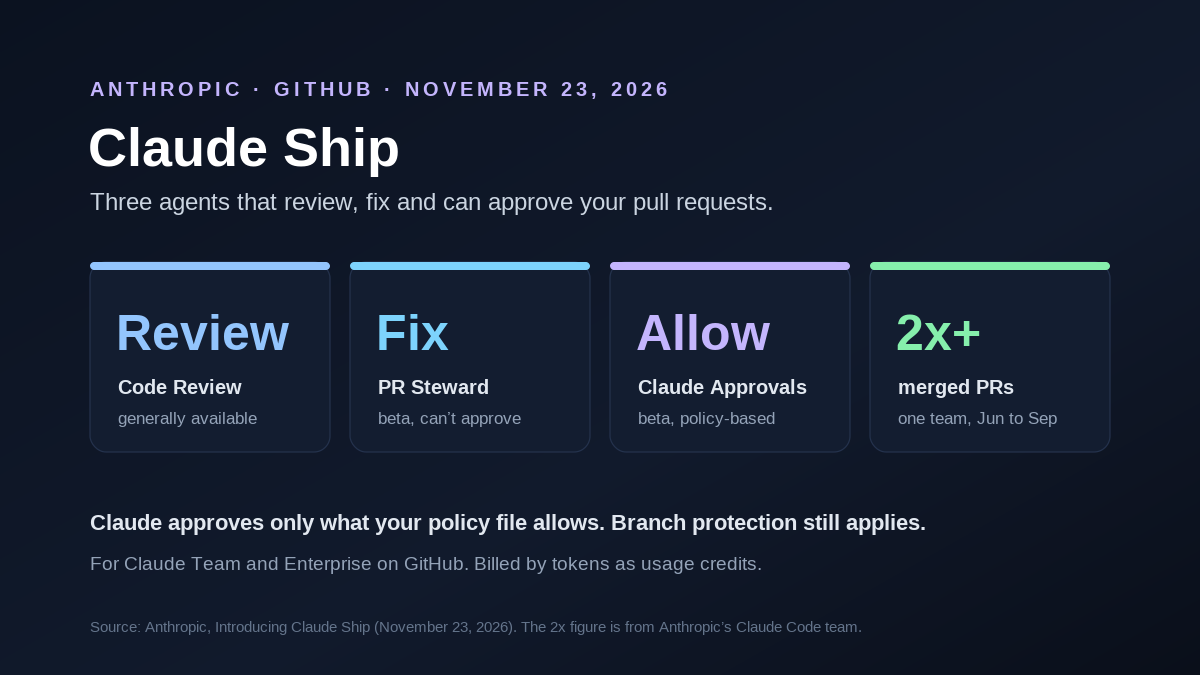
Writing code with AI got fast. Reviewing it didn't. That gap is what Anthropic is going after with Claude Ship, a set of agents that review, fix and can even approve pull requests on GitHub.
It launched on November 23, 2026. It's also one of the first big launches since Anthropic became a public company.
This guide covers what each part does, what Anthropic's numbers really say, what it costs, why many developers are wary, and how to roll it out without giving up control of your main branch.
Key Takeaways
- Three agents: Claude Ship bundles Code Review, PR Steward and Claude Approvals.
- Who gets it: Claude Team and Enterprise organizations on GitHub, in beta.
- The big change: Claude Approvals can approve a pull request when a policy file in your repo allows it.
- Anthropic's numbers: on its Claude Code team, merged pull requests more than doubled from June to September, and the share of reverted changes fell by more than 40%.
- The doubt: one community summary found only about 15% of reactions were positive. Many developers want a person to approve risky code.
- Our advice: start in observe-only mode, and keep humans on login, payments and migrations.
Claude Ship at a Glance
Here's the short version, as of November 25, 2026:
| Item | Details |
|---|---|
| Launched | November 23, 2026 |
| Who can use it | Claude Team and Enterprise organizations on GitHub |
| Status | Code Review is generally available, the two new agents are in beta |
| Parts | Code Review, PR Steward, Claude Approvals |
| Entry point | /ship in Claude Code and the desktop app |
| Pricing | Token-based usage credits, no flat price |
| Not available with | Zero Data Retention, HIPAA setup or customer-managed keys |
The main sources are Anthropic's launch post and its product docs. Where a detail comes only from news coverage, we say so.
What Is Claude Ship?
Claude Ship is a set of agents for the work after code is written. Anthropic's pitch has three parts:
- The problem: AI tools now write code faster than people can review it, so review is the bottleneck.
- The proof point: on the Claude Code team, the launch post says, "Claude writes most of our code."
- The fix: move AI code review, fixes and sign-off to agents, while people still set the rules.
The Three Parts of Claude Ship
Each part has a different job and a different level of trust:
| Part | What it does | Can it approve? |
|---|---|---|
| Code Review | Reviews a pull request against the codebase, checks its own findings and posts them as inline comments ranked by severity | No |
| PR Steward | Works on failing CI, merge conflicts and review comments, then pushes fix commits | No, by design |
| Claude Approvals | Reads a policy file in the repo and approves or routes each pull request | Yes, when the policy allows it |
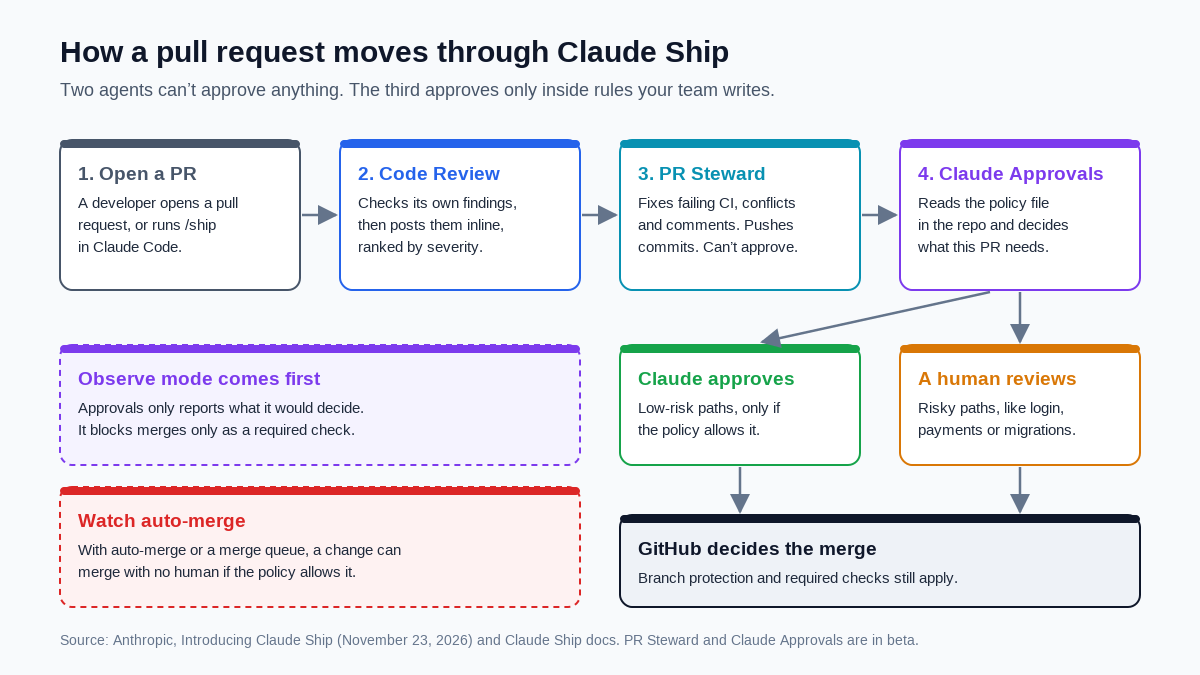
The split matters. Two of the three agents can't approve anything. Only Claude Approvals can, and only inside rules your team writes.
Code Review: The Part That Was Already Here
Code Review is the oldest piece and the only one that's generally available. It reads a pull request against the rest of the codebase, collects possible problems, then tries to prove each one wrong before it posts.
That last step is the useful bit. Anthropic says Code Review checks its own findings before posting them, which should cut down on noise. The findings land as inline comments, ranked by how serious they are.
Depth is your call:
- Quick: a fast pass for small changes.
- Standard: the default for most pull requests.
- Deep: a slower, more careful pass for risky work, such as changes to login code, billing or a shared library that many of your services depend on.
PR Steward: The Agent That Does the Chores
PR Steward picks up the boring work that keeps a pull request from merging. It works on failing CI checks, merge conflicts and review comments, whether they come from Code Review, other tools or teammates.
When it fixes something, it pushes a commit. After every push it leaves a comment that says what changed and how to undo it. You can steer it with @claude in a comment, or stop it with @claude stop.
Two limits stand out:
- It can't approve: Anthropic says it is "designed not to approve or merge."
- It starts on manual: by default it only acts when someone calls it with @claude steward.
Claude Approvals: The Part Everyone Is Talking About
This is the new idea. Claude Approvals reads a policy file in your repo and decides what each pull request needs.
Anthropic says it "works like a smarter CODEOWNERS file." CODEOWNERS is the GitHub file that says who must review which folders. Claude Approvals adds judgment on top of those rules.
A policy can say things like this:
| What a policy can say | Example in plain words |
|---|---|
| How many people must approve a path | Two reviewers for anything in billing |
| Where Claude may approve | Docs and tests only |
| Which signals count | No high-severity Code Review findings |
| Custom checks | A team classifier written in plain English, such as "touches login logic" |
The docs give the file path as .claude/approvals.yml. Anthropic's launch post only says "a file in the repository," so check the docs for the exact format before you write one.
Approvals starts once the policy file is on your default branch. An admin can turn it off.
How Claude Approvals Decides What Merges
The safety story depends on a few GitHub details:
- Observe mode first: at first, the Claude Approvals check reports what the policy would decide. It doesn't block anything.
- Opt-in gate: it only blocks merges when you make it a required GitHub check.
- Existing rules still apply: as The Register notes, approving isn't merging, and branch protection still applies.
The fine print matters too. Anthropic's docs warn that if you use GitHub auto-merge or a merge queue, a change can merge with no human approval at all, if your policy doesn't require one.
So the real control isn't the agent. It's the policy you write and the GitHub settings around it. If those are loose, Claude Ship can ship code no person looked at.
Here's how the pieces fit:
How /ship Works in Claude Code
Developers get a shortcut too. Run /ship in Claude Code on your own change, and Claude:
- Pushes the change and opens the pull request.
- Reviews it.
- Works through feedback and failing checks.
- Goes to merge if your policy allows pull request approval by Claude for that kind of change. If not, it waits for a person.
The command began rolling out in Claude Code and the desktop app on launch day. You may need to update Claude Code to see it.
What Claude Ship Costs
Anthropic hasn't published a flat price. Claude Ship is billed by tokens, as usage credits kept apart from your plan's normal usage:
| Part | How it's billed | Spend limit |
|---|---|---|
| Code Review | Tokens, as usage credits | Yes, set by admins |
| PR Steward | Tokens, as usage credits | Yes, but none until you set one |
| Claude Approvals | No base charge. Classifier runs and requested reviews are billed | Not stated |
| /ship | Counts as normal Claude Code usage | Your plan's limits |
Two details are easy to miss. PR Steward has no spend limit until an admin sets one. And observe mode isn't free, because classifier runs and the reviews a policy asks for are still billed.
There's a sweetener. Eligible Enterprise organizations can claim at least $10,000 in credits by January 15, 2027, to use within 30 days.
Anthropic's Numbers, Read Carefully
The headline claim comes from Anthropic's own Claude Code team. From June to September, merged pull requests "more than doubled," and the share of changes that later had to be reverted fell by more than 40%, according to the launch post.
That's a strong result, and the drop in reverts is the more telling half. More merges with fewer rollbacks suggests the extra speed didn't come at the cost of quality, at least on that team.
But read it for what it is:
- One team: these are figures from the Claude Code team, not all of Anthropic's engineers.
- Its own tools: that team builds the product and knows it well.
- Many changes at once: the post says Claude's review was "one layer of a broader process," so other changes in those months may have helped.
- No outside data: there are no bug counts, false alarm rates or review times.
What Is Known and What Isn't
Here's a cleaner split of the facts so far:
| Known | Not known |
|---|---|
| Merged pull requests on the Claude Code team more than doubled from June to September | Whether other teams see anything close |
| The share of reverted changes on that team fell by more than 40% | Bug rates, false alarms or review time |
| Approvals only gates merges as a required check | How often customers turn that on |
| Usage is billed by tokens | A typical monthly cost per repo |
| Eligible Enterprise customers get at least $10,000 in credits | When the beta ends |
We also couldn't confirm a claim in some coverage that Claude Ship is Anthropic's "first major product" since its IPO. TechCrunch calls Anthropic "the newly public AI company." Neither Anthropic nor the outlets we read used the "first" label. Our post on Anthropic's IPO pricing has the background.
Why Developers Are Wary of Claude Ship
The reaction has been cool. A daily.dev community summary put sentiment at about 15% positive, 45% mixed and 40% skeptical. It doesn't explain how it counted, so treat it as a rough read.
The worries fall into a few groups:
- Final say: many developers want a person to press the last approve button, above all for login, payments and database migrations.
- Losing the overview: an engineer quoted by The Register said that if Claude can rewrite Git history, "the devs will lose that overview and judgment opportunity."
- Self-review: if Claude writes the code and Claude approves it, who checked whom?
- Cost surprises: token billing makes monthly spend hard to predict.
Even Anthropic's own customers hedge. A TELUS engineering director quoted in the launch post said, "We keep a human in the loop." And Anthropic's own fine print says Claude Ship "may miss bugs, security vulnerabilities, or other issues."
Where Claude Ship Fits, and Where It Doesn't
Some changes are a good fit. Others aren't, at least not yet.
Good fits are routine changes where a mistake is cheap to undo:
- Docs fixes and test updates.
- Small dependency bumps.
- Lint and formatting fixes.
Poor fits are changes where a mistake is costly or slow to reverse. We'd keep a human on these no matter what the policy allows:
| Keep a human on | Why |
|---|---|
| Login and access code | A small slip can open the whole system |
| Payments and billing | Errors cost real money and are hard to undo |
| Database migrations | They can lose data and are slow to roll back |
| Infra and secrets | One bad change can take down every service |
| Public APIs | Breaking changes hit customers you can't see |
The New Stack gives a similar example: a change to a key billing service would still need two reviewers besides the author. That's the kind of rule a policy file is for.
How to Roll Out Claude Ship Safely
Anthropic suggests turning things on in order: Code Review, then PR Steward, then Claude Approvals. We'd add exit tests at each stage:
| Stage | What to turn on | Exit test |
|---|---|---|
| 1. Review | Code Review on two repos. | Findings are useful more often than noisy. |
| 2. Fix | PR Steward, manual mode. | Its fix commits pass review without rework, and nobody on the team has to clean up after it or redo its changes by hand. |
| 3. Observe | Approvals, observe only | It matches your reviewers. |
| 4. Low risk | Docs and tests only. | No reverts |
| 5. Widen | One path at a time. | Stop if reverts rise. |
Observe mode is the most useful stage. For a few weeks, compare what Claude Approvals would have done with what your reviewers did. If they disagree often, fix the policy before you let it approve anything.
Also check your GitHub settings before stage four. Turn off auto-merge on paths you haven't cleared, and make sure branch protection still requires a human where it should.
We cover the design side of this in our guide to AI agents with human review loops. For the security side, see our post on securing AI-generated code.
What Claude Ship Means for Engineering Leaders
For most teams, Claude Ship changes the question. It used to be "should AI write our code?" Now it's "who signs off, and on what?"
Three things are worth doing now, even if you never turn it on:
- Write down your review rules: most teams have unwritten norms about who reviews what. A policy file forces you to spell them out.
- Measure reverts: if you don't track how often merged changes get rolled back, start. It's the best check on any review process, human or AI.
- Decide who's accountable: when an agent approves a change that breaks production, someone still owns it. Name that person before it happens.
Agent permissions are a wider issue than code. Our post on AI agent permissions covers the same trade-off in other tools.
What to Watch Next
A few signals will show whether Claude Ship sticks:
- Outside results: data from customers outside Anthropic, especially revert rates.
- The beta's end: when PR Steward and Claude Approvals leave beta, and what changes.
- Pricing: clearer cost numbers.
- Rivals: whether GitHub and others ship their own approval agents.
- Incidents: the first public case of an AI-approved change that broke something, and how it's handled.
Claude Ship: Our Take
Claude Ship is a serious attempt to fix the real bottleneck in AI coding. Writing code isn't slow anymore. Review, fixes and sign-off are, and that's where these agents work.
The design is more careful than the headlines suggest. PR Steward can't approve. Claude Approvals starts in observe mode and only blocks merges when you make it a required check. Your branch rules still apply.
But the risk is real. With loose policies and auto-merge on, code can reach your main branch with no person ever reading it. The tool won't stop you from setting it up that way.
Our view: use Claude Ship to clear the routine work, and let it approve only what's cheap to undo. Keep people on the changes that can really hurt you. And judge it by your own revert rate, not Anthropic's.
How Van Data Team Helps
We help teams put AI agents into real workflows with the right checks:
- AI agents with clear permissions, review steps and logs, through AI agent development.
- Data pipelines that track reverts, incidents and review time, via data pipeline development.
- Dashboards that show what agents approved and what broke, through agentic BI reporting.
This article is based on Anthropic's November 23, 2026 launch post and Claude Ship docs, and on coverage by TechCrunch, The Register, The New Stack and daily.dev, as of November 25, 2026.
Van Data Team uses Claude and other AI tools in its own work but has no business relationship with Anthropic beyond that. Planning to let agents into your review process? Get in touch and we'll help you set the rules.
AI Model Brief
The AI models worth knowing, once a week
What shipped, how it scores on independent benchmarks, what it costs per million tokens and what was deprecated, from the data behind our AI model benchmarks.
We use your address only to send the brief. See our privacy policy.
See this week’s brief
Founder of Van Data Team. Builds Vanaxity, the AI agent system for SEO, GEO, and AEO, and leads data engineering delivery for B2B teams.
About the authorArticle FAQ
Questions readers usually ask next.
These short answers clarify the practical follow-up questions that often come after the main article.
Need a similar system?
If this article maps to a workflow your team already operates, the next step is usually a scoped review of the system, constraints, and rollout path.
Consultation
Scope your next AI workflow.
Share the system and blockers. We will map fit, gaps, and the next step.