Jensen Huang Reinstated: What Nvidia's $950B Swing Means
Jensen Huang reinstated as Nvidia CEO: what the board said, the record $950B day, the 5.86% drop, the Dec. 3 hearing and what it means for AI teams on GPUs.
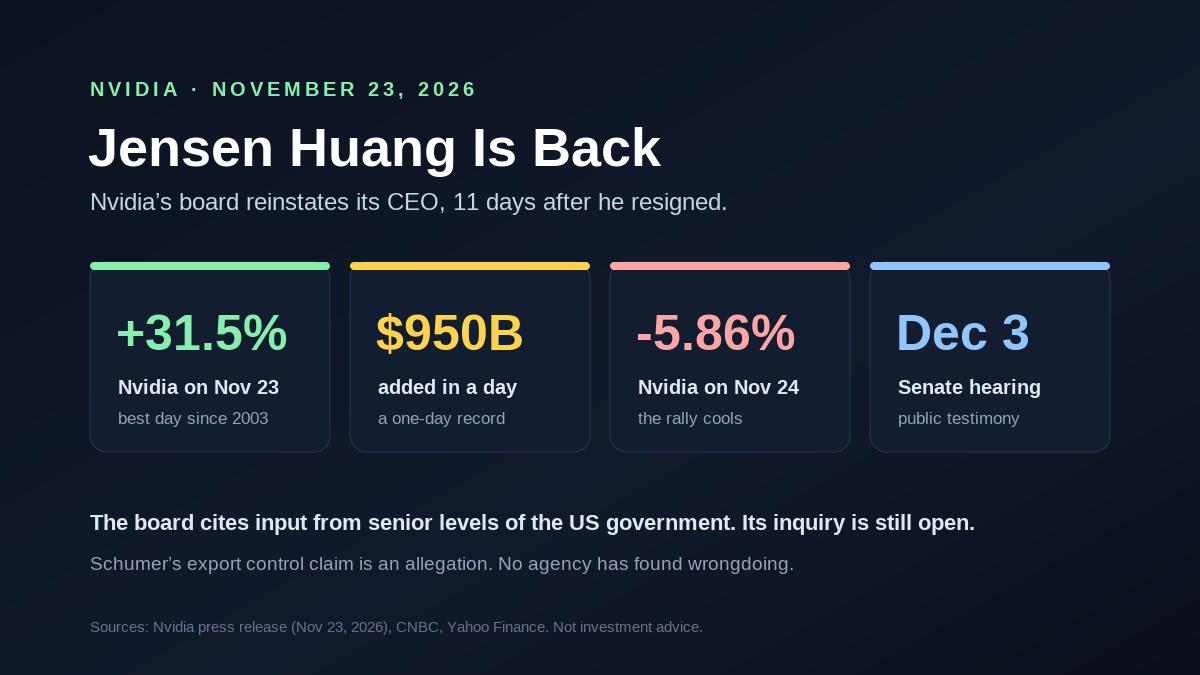
Eleven days after he resigned, Jensen Huang is back as Nvidia CEO. On November 23, 2026, Nvidia's board reinstated him as CEO, and the stock had the biggest one-day gain in value any company has ever posted.
Then it slipped. Nvidia fell the next day, a senior senator accused Huang of breaking export law, and chip stocks in Asia dropped hard.
This guide covers what the board said, what the numbers show, what is still unproven, and what Jensen Huang reinstated means for AI teams that run on Nvidia GPUs.
Key Takeaways
- The decision: Nvidia's board voted unanimously to bring Huang back as President and CEO, and as a board member.
- Washington's role: the board says it got input from senior levels of the US government. President Trump says he pushed for it.
- The record: Nvidia closed up about 31.5%, adding roughly $950 billion in value in one day.
- The reversal: the stock fell 5.86% the next day, and SoftBank lost 13.8% in Tokyo the day after.
- The scrutiny: Huang testifies in public before the Senate Banking Committee on December 3. Senator Chuck Schumer says he broke export law, a claim that hasn't been proven.
- For AI teams: GPU supply doesn't change with the share price, but export rules and GPU cloud finances deserve a closer look.
Jensen Huang Reinstated: The Facts at a Glance
Here's what we know, as of November 25, 2026:
| Item | Details |
|---|---|
| Announced | November 23, 2026 |
| Roles restored | President, CEO and board member |
| Board vote | Unanimous |
| Interim CEO | Colette Kress, who stays on as CFO |
| Monday move | Up about 31.5%, roughly $950 billion added |
| Tuesday move | Down 5.86% |
| Next date | Public Senate Banking hearing on December 3 |
The main source is Nvidia's press release, filed with the SEC. Market figures come from CNBC and Yahoo Finance.
One small correction to some early reports: Huang was restored as President and CEO, not as chairman. The board's chair is Harvey C. Jones, who is quoted in the release.
How We Got Here
The last two and a half weeks moved fast:
| Date | What happened |
|---|---|
| Nov 8 | Huang admits an affair and the board opens an inquiry |
| Nov 12 | Nvidia says he has resigned, with CFO Colette Kress as interim CEO |
| Nov 17 | Board chair Harvey Jones says the board does not intend to reinstate him |
| Nov 23 | The board reinstates him, and the stock closes up about 31.5% |
| Nov 24 | The stock falls 5.86%, and Schumer makes his export control claim |
| Nov 25 | SoftBank, Advantest and Lasertec fall sharply in Tokyo |
We covered the start of this in our posts on the board's investigation and on Huang's resignation. Those posts cover the reports linking the affair to US security concerns.
The speed of the reversal is the striking part. On November 17, during Nvidia's earnings call, the board said it didn't intend to bring him back. Six days later, it did.
What Nvidia's Board Said
The release is short, and it chooses its words with care. It says the board acted after "a series of discussions and meetings" with Huang.
Here's what it says, and what it leaves out:
| What the release says | What it leaves out |
|---|---|
| It got input from senior levels of the US government | Who gave it, or what they said |
| Huang's return poses no national security risk | How the board reached that view |
| The investigation will proceed to conclusion | A date or the scope of its findings |
| A new export control committee is being formed | Who sits on it |
| Nvidia is hiring a Chief Compliance Officer | When that person starts |
The key line is about Washington. The board says it "received input from senior levels of the United States government" and is confident Huang's return "poses no national security risk."
That's unusual language for a CEO change. It reads less like a governance decision and more like a security clearance.
Jensen Huang Reinstated: Trump's Role
President Trump has openly taken credit. He has said he spoke with board members "directly and indirectly" about Huang's return, and CNBC quotes him saying, "I made the deal."
That raises questions the board hasn't answered. As CNBC noted, the board "has not publicly detailed what it was told."
There's also a money angle. ABC News reported that Trump held at least $12 million in Nvidia shares at the end of 2025. The White House says a third party manages his accounts, and his current stake isn't public.
Critics in both parties have pushed back:
- Sen. Elizabeth Warren called the reinstatement "reckless."
- Rep. Pramila Jayapal said Huang "compromised our national security."
- Sen. Dave McCormick, a Republican, said Congress must get to the bottom of what happened, then strengthen export controls.
Jensen Huang Reinstated: The Record Day in Numbers
Wall Street's verdict on Monday was loud. Nvidia stock closed up about 31.5%, after rising as much as 36.6% during the day, according to reports.
Here are the moves across three days:
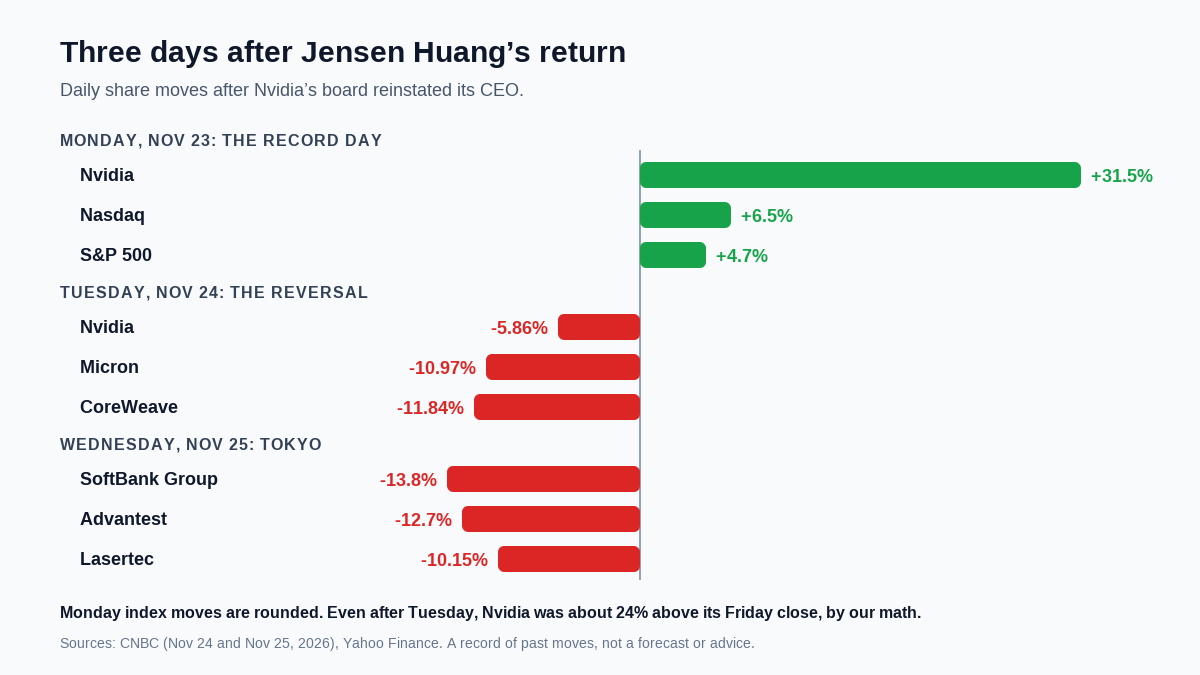
And the figures behind the chart:
| Day | Stock or index | Move |
|---|---|---|
| Mon, Nov 23 | Nvidia | Up about 31.5% |
| Mon, Nov 23 | Nasdaq / S&P 500 | Up about 6.5% / 4.7% |
| Mon, Nov 23 | CoreWeave and Nebius | Up more than 30% at points in the day |
| Tue, Nov 24 | Nvidia | Down 5.86% |
| Tue, Nov 24 | CoreWeave / Nebius | Down 11.84% / 10.74% |
| Tue, Nov 24 | Micron / AMD | Down 10.97% / 8.86% |
| Wed, Nov 25 | SoftBank / Advantest / Lasertec | Down 13.8% / 12.7% / 10.15% |
A few records fell at once:
- Biggest one-day gain in value: about $950 billion, more than any company has ever added in a session.
- Best day in 23 years: Yahoo Finance says it was Nvidia's best day since May 2003.
- Best day for the market since April 2025: both the Nasdaq and the S&P 500 had their strongest session in more than a year.
GPU cloud firms CoreWeave and Nebius rose more than 30% at points in the day. CNN reported CoreWeave closed up about 22%, so the closing gains were smaller.
How Big Was $950 Billion?
It's hard to picture. The old record, per Yahoo Finance, was Microsoft's gain of about $450 billion in July.
By our math, Nvidia's day was about 2.1 times that. One session, roughly double the old high.
Part of the jump was a rebound. Nvidia's stock had fallen sharply after Huang resigned, so some of Monday's gain simply made back earlier losses.
Jensen Huang Reinstated, Then the Reversal
The rally didn't last. On Tuesday, Nvidia fell 5.86%, CNBC reported, and the rest of the AI trade fell harder.
Chipmakers like Micron, AMD and Arm dropped between about 8.5% and 11%. GPU clouds that had soared on Monday, including CoreWeave, Nebius and Iren, gave back more than 10% each, which erased a good part of the gains that had made them Monday's other big winners.
A Bank of America note captured the mood: "Reinstatement should not be confused with the end of scrutiny."
Even after the drop, Nvidia was still well above where it started. By our math, a 31.5% gain followed by a 5.86% loss leaves the stock about 24% higher than its Friday close.
The Ripple in Asia
Tokyo felt it next. On Wednesday, according to CNBC:
- SoftBank Group fell 13.8%.
- Advantest, which supplies Nvidia with chip test equipment, fell 12.7%.
- Tokyo Electron fell 11.82%.
- Lasertec, which makes chip inspection tools, fell 10.15%.
- Samsung and SK Hynix, the two Korean memory makers whose high-bandwidth chips sit next to Nvidia GPUs inside most AI servers, each lost more than 7% in Seoul as the selloff spread.
CNBC tied the drop to renewed worries about the AI trade as a whole, including heavy spending, unclear returns and circular deals between AI firms. It also noted that Anthropic's shares had slipped below their IPO price, a sign that the doubts had spread past chipmakers and GPU clouds to the newest and most closely watched AI company listings on the market. Our post on Anthropic's IPO pricing has that background.
It wasn't just Huang. His return was the spark for Monday's rally. The doubts underneath it were already there.
Schumer's Export Control Allegation
On Tuesday, Senate Democratic leader Chuck Schumer went further than most critics. In a post on X, he wrote that Huang "shipped extremely advanced chips to China, violating US export control law."
Three things to keep in mind:
- It's a claim, not a charge. No court or agency has found that Huang broke the law.
- No evidence was shared in the post, as reported by HuffPost via Reuters.
- No response yet. Nvidia and the White House did not immediately comment.
Still, the claim lands on a sore spot. Nvidia already faces scrutiny over how its chips reach China, which we covered in our posts on the Megaspeed probe and the SEC probe.
The December 3 Senate Hearing
The next big date is set. Huang will testify on December 3 before the Senate Banking Committee in a public hearing, said the panel's chair, Sen. Tim Scott.
Before that, he's expected at a closed-door briefing with three House panels on December 1.
Expect questions on three fronts:
- China: whether Nvidia chips were diverted or smuggled, and what Huang knew.
- The board: what the government told it, and why it changed its mind in a week.
- Controls: whether export rules need to get tighter.
Sen. Jack Reed has also asked Treasury Secretary Scott Bessent and Commerce Secretary Howard Lutnick to appear before the same committee.
What Is Known and What Isn't
It's easy to read more into the headlines than the facts support. Here's a cleaner split:
| Known | Not known |
|---|---|
| The board voted unanimously to bring Huang back | Exactly what the government told the board |
| Trump says he pushed for the return | How much that weighed in the vote |
| Schumer says Huang broke export law | Any evidence made public so far |
| Huang testifies in public on December 3 | What he'll say, or what the Senate will do next |
| The board's inquiry is still open | When it ends or what it will find |
The open questions matter more than the stock chart. The board's inquiry is still running, and its findings could change the story again.
Is Jensen Huang Reinstated for Good?
Probably, but not certainly. The board's vote was unanimous, the government has signaled support, and investors clearly want him there.
But three things could shift it:
- The inquiry: the board's investigation hasn't reported yet.
- The hearing: a bad showing on December 3 could raise new pressure.
- Export law: if any agency opened a formal case, the board would face the same choice again.
Nvidia seems to know this. Creating a National Security and Export Control Committee and hiring a Chief Compliance Officer are steps a company takes when it expects to be watched closely for a long time.
What Jensen Huang Reinstated Means for AI Teams
For most AI and data teams, nothing changes this week. Your GPU orders, cloud prices and CUDA code work exactly as they did on Friday.
The real effects sit a level down:
- Export rules: if Congress tightens controls on chips, it could limit which regions and customers can get the newest GPUs. Our guide to China AI export controls explains how those rules work.
- GPU cloud health: CoreWeave and Nebius swung more than 30% up and more than 10% down in two days. That's a reminder that some GPU providers are financially fragile.
- Leadership risk: Nvidia showed it can lose and regain its CEO in under two weeks. Your vendor risk plan should assume more surprises like that.
A GPU Vendor Risk Checklist
If this week made you nervous about depending on one vendor, here's a short plan:
| Step | What to do | Why |
|---|---|---|
| Map your GPU exposure. | List every workload tied to Nvidia hardware or CUDA. | Size it first |
| Check your provider | Look at the finances and contract terms of any GPU cloud you rent from. | Their shares swung harder than Nvidia's, and a weak provider can raise prices or cut capacity. |
| Review export rules | Confirm where your GPUs and models are allowed to run. | Rules may tighten |
| Keep a second option. | Test one real workload on another chip or another cloud, from start to finish, so you know the true cost and effort of a move long before you ever need to make one. | A tested fallback beats a slide. |
| Don't trade on headlines. | Plan on contracts, not share prices. | Stock moves don't change supply. |
The point isn't to leave Nvidia. For most teams, it's still the default for good reasons. The point is to know what you'd do if prices, rules or a provider changed fast.
What It Means for GPU Clouds Like CoreWeave
GPU clouds rent out Nvidia chips by the hour. Their shares move with Nvidia's, only harder, because many carry heavy debt to buy those chips.
For teams that rent from them, a few habits help:
- Read the contract: check what happens to your capacity if the provider is sold or runs short of cash.
- Avoid long prepayments with a provider you haven't stress-tested.
- Keep your data portable, so a move doesn't mean a rebuild.
None of this means a provider is in trouble. It means you should plan as if one could be.
What to Watch Next
A few signals will shape the next few weeks:
- December 1: the closed-door House briefing.
- December 3: Huang testifies.
- The inquiry: whether the board publishes findings, and when.
- Export rules: any new limits on chips, regions or buyers.
- The new committee: who joins Nvidia's export control committee and who becomes its compliance chief.
Jensen Huang Reinstated: Our Take
Jensen Huang reinstated is a big governance story wearing a market costume. The $950 billion day will be remembered, but the more important line is the one about "input from senior levels of the United States government."
That line ties Nvidia's leadership more closely to Washington than ever. It may calm worries about national security. It also means future policy shifts, from export rules to politics, can reach Nvidia's boardroom.
For AI teams, the lesson is about planning. Nvidia's chips aren't going anywhere. But the rules around them, and the finances of the firms that rent them out, can change fast. Build your plans on contracts, tested fallbacks and clear export checks, not on this week's share price.
How Van Data Team Helps
We help AI teams plan for vendor and compute risk:
- AI agents and apps that can run on more than one model or provider, through AI agent development.
- Data pipelines that keep your data portable across clouds, via data pipeline development.
- Dashboards that track GPU spend and usage by provider, through agentic BI reporting.
This article is based on Nvidia's November 23, 2026 press release filed with the SEC, and on reporting by CNBC, Yahoo Finance, CNN, ABC News and Reuters via HuffPost, as of November 25, 2026.
It is not investment advice. Van Data Team builds on cloud GPUs, including Nvidia's, and has no business relationship with Nvidia beyond that. Worried about vendor risk? Get in touch and we'll help you map it.
AI Model Brief
The AI models worth knowing, once a week
What shipped, how it scores on independent benchmarks, what it costs per million tokens and what was deprecated, from the data behind our AI model benchmarks.
We use your address only to send the brief. See our privacy policy.
See this week’s brief
Founder of Van Data Team. Builds Vanaxity, the AI agent system for SEO, GEO, and AEO, and leads data engineering delivery for B2B teams.
About the authorArticle FAQ
Questions readers usually ask next.
These short answers clarify the practical follow-up questions that often come after the main article.
Need a similar system?
If this article maps to a workflow your team already operates, the next step is usually a scoped review of the system, constraints, and rollout path.
Consultation
Scope your next AI workflow.
Share the system and blockers. We will map fit, gaps, and the next step.