SpaceX Starmind: FCC Approves 1 Million AI Satellites
SpaceX Starmind explained: what the FCC approved for up to 1 million AI satellites, the 2033 to 2040 deadlines, the cooling problem and why rivals objected.
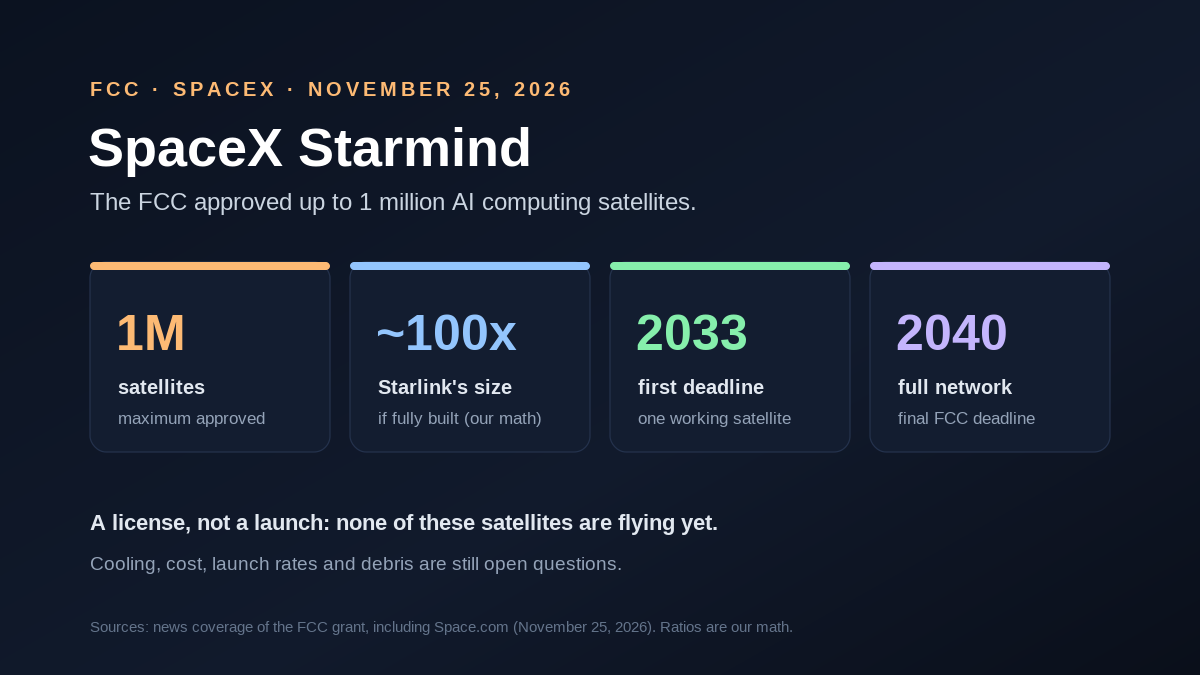
The U.S. just approved the biggest satellite plan ever filed. SpaceX Starmind, a constellation of up to 1 million solar-powered satellites built to run AI in orbit, got a green light from the FCC on November 25, 2026.
None of those satellites are flying yet. The license comes with deadlines, limits and hard engineering problems that nobody has solved at this scale.
Below: what the FCC approved, what it held back, the timeline, the doubts and what it means for teams that buy AI compute.
Key Takeaways
- The approval: the FCC cleared SpaceX to fly up to 1 million Starmind satellites that run AI.
- The limits: the grant covers altitudes of 500 to 1,002 km, and the FCC held back a waiver on how satellites above 600 km are disposed of.
- The deadlines: one working satellite by 2033, 10% by 2035, half by 2038 and the full network by 2040.
- The scale: Starlink has about 10,000 to 11,000 satellites today, so a full Starmind would be roughly 90 to 100 times larger.
- The doubts: cooling, launch rates, cost, debris and astronomy are all open questions.
- Our view: it's a long-term bet worth watching, not a source of compute to plan on this decade.
SpaceX Starmind at a Glance
Here's the short version, as of November 27, 2026:
| Item | Details |
|---|---|
| Announced | November 25, 2026, by FCC Chairman Brendan Carr |
| Company | SpaceX |
| Constellation | Starmind, solar-powered AI computing satellites |
| Approved size | Up to 1 million satellites |
| Approved altitudes | 500 to 1,002 km, per coverage |
| Application filed | January 30, 2026 |
| First SpaceX launch goal | Third quarter of 2027, on Starship |
| Final FCC deadline | November 25, 2040 |
Our main sources are Space.com's report on the approval and other news coverage of the grant. Where outlets disagree, we say so.
What Is SpaceX Starmind?
Starmind is a planned network of satellites that would work as data centers in orbit. Each one would carry chips, run AI and other heavy jobs, and send the results back to Earth.
The pitch rests on three ideas:
- Power: in the right orbit, sunlight is almost constant, so the satellites can run on solar panels with no power grid.
- Land: there's no need for a building, a permit fight or a local water supply.
- Scale: SpaceX already builds and flies satellites faster than anyone, thanks to Starlink.
The filing itself made big claims:
- Filed: January 30, 2026.
- The vision: a first step toward a "Kardashev Type II" civilization, one that uses all the energy of its star.
- The market: SpaceX sees $28.5 trillion of long-term demand, nearly $23 trillion of it in business AI, per Space.com. That's SpaceX's own estimate.
What the FCC Approved, and What It Held Back
FCC Chairman Brendan Carr announced the decision on X. "This action opens a bold new frontier for the computing infrastructure needed to power America's leadership and growth," he said, according to Space.com.
Two more points from the announcement:
- The AI race: Carr said compute campuses are key to keeping America's lead in "SI," his short word for superintelligence.
- A first: coverage calls this the first approval of its kind in U.S. history, a whole network built only for computing. We couldn't read the FCC order, so treat that as reported.
The grant isn't a blank check. Here's how it splits:
| What the FCC granted | What it held back or left out |
|---|---|
| Up to 1 million satellites | A waiver for disposal above 600 km without re-entry |
| Six orbital shells from 500 to 1,002 km | Final debris plans for satellites above 600 km |
| Sun-synchronous and 30-degree orbits | Optical astronomy concerns, ruled outside this case |
| A license to build and operate | Any guarantee that the satellites get built |
The key limit is about what happens when a satellite dies:
- The ask: SpaceX wanted to push some dead satellites above 600 km into higher orbits instead of letting them burn up.
- The answer: the FCC put that request on hold.
- The catch: before SpaceX flies any satellite that won't come back down, it must file a change to its license and make its case.
The SpaceX Starmind Timeline and Deadlines
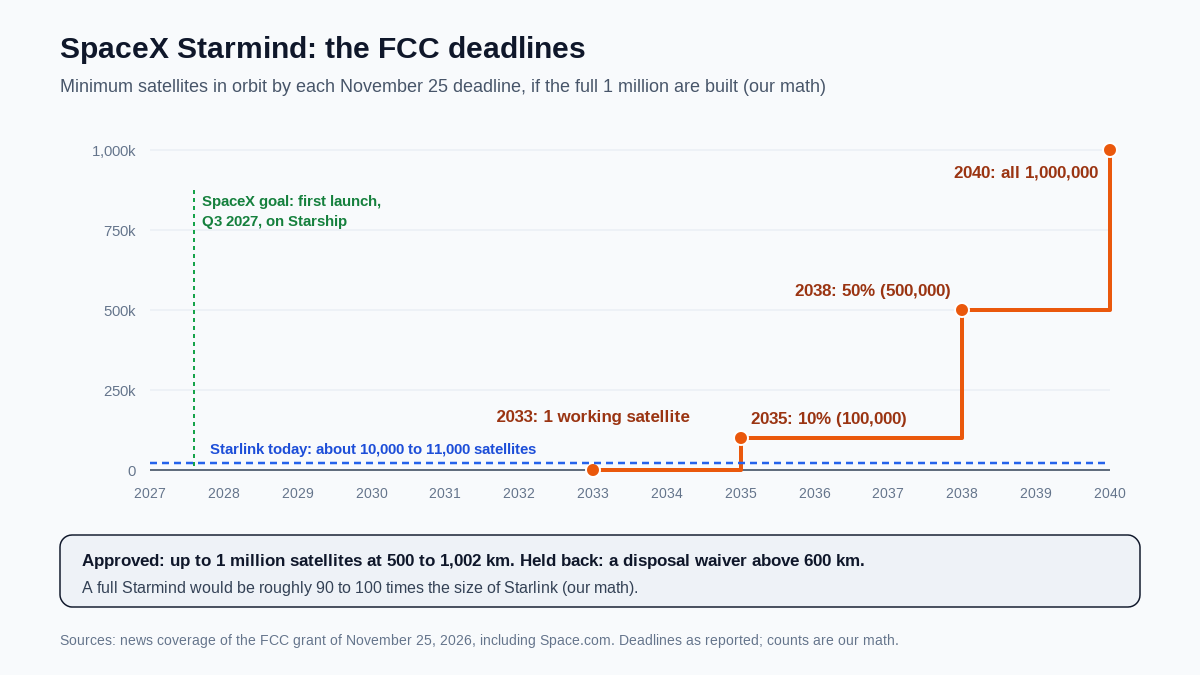
The FCC set four deadlines, all on November 25 of their year:
| FCC deadline | Requirement | Satellites, if fully built (our math) |
|---|---|---|
| November 25, 2033 | One working satellite | 1 |
| November 25, 2035 | 10% of the constellation | 100,000 |
| November 25, 2038 | 50% of the constellation | 500,000 |
| November 25, 2040 | Full deployment | 1,000,000 |
Three things to know about these dates:
- 100,000 isn't a rule: it's just 10% of a full 1 million, so the counts shrink if SpaceX builds fewer.
- Misses cost: under FCC rules, a company that falls short can lose the right to satellites it didn't launch.
- 2033 isn't the start: SpaceX says it aims to launch the first Starmind satellite in the third quarter of 2027, on Starship.
Here's the deadline curve next to Starlink's size today:
How Big Is One Million Satellites?
It's hard to picture, so here's a comparison:
| Network | Size | Status in late 2026 |
|---|---|---|
| Starlink (SpaceX) | About 10,000 to 11,000 satellites | In orbit, serving internet users |
| Project Sunrise (Blue Origin) | Up to 51,600 satellites | Filed with the FCC in March 2026 |
| Starmind (SpaceX) | Up to 1,000,000 satellites | Approved November 25, 2026, not built |
Starlink, the largest network in orbit, had passed 10,000 active satellites by late 2026, and Space.com counts about 11,000. One million is roughly 90 to 100 times that, depending on which count you use (our math).
Our math on pace is just as striking. Hitting 1 million between a first launch in late 2027 and the end of 2040 works out to about 75,000 satellites a year, or roughly 200 a day on average. Starlink has never come close to that rate.
Who Opposed the SpaceX Starmind Plan
The plan didn't sail through. Three groups objected in writing, according to news reports:
| Group | Main concern |
|---|---|
| Amazon (Amazon Leo) | The plan reads as an ambition, not a real plan, and could tie up orbits |
| Viasat | A long-running fight over how far Starlink-style networks should expand |
| American Astronomical Society | Streaks and light from a huge number of satellites in telescope images |
How it played out:
- Amazon: in a March 2026 petition, it asked the FCC to throw out the application and let SpaceX refile with a firmer plan. Amazon runs its own satellite network, Amazon Leo, so it has a stake in who gets which orbits.
- Carr: he pushed back hard at the time and said he didn't expect the petition to get far. He was right.
- Astronomers: coverage says the FCC ruled their concerns outside this case. The American Astronomical Society has warned for years that big networks leave streaks across telescope images.
The Hard Problems Starmind Still Has to Solve
A license doesn't solve physics. Scientists have raised the same doubts about orbital data centers since SpaceX filed, and none of them have gone away:
| Problem | Why it's hard | What to watch |
|---|---|---|
| Cooling | Space has no air, so chips can shed heat only through big panels. | Panel size and weight on the first real satellites, because they set how much compute each launch can carry. |
| Launch rate | A million satellites by 2040 means tens of thousands of launches' worth of payload. | How often Starship flies with a full load, and whether reuse brings the cost per kilogram down far enough. |
| Cost | Analysts think compute in orbit will cost a few times more than on the ground, at least at first, and maybe for much longer than SpaceX hopes. | Price per GPU-hour once early satellites are running. |
| Debris | Satellites above 600 km can stay in orbit for many years if they fail. | The final debris plan SpaceX must file. |
| Repairs | A broken chip in orbit can't be swapped by a technician. | Failure rates and how fast dead satellites are replaced. |
The numbers behind the two biggest doubts:
- Cooling: on Earth, air and water carry heat away. In orbit there's no air, so heat must radiate from big panels. IEEE Spectrum estimated one 700-watt Nvidia H100 chip needs about 1.4 square meters of radiator, so a 1-gigawatt site would need about 2 square kilometers (our math).
- Cost: IEEE Spectrum put a 1-gigawatt orbital data center at over $50 billion, about three times the ground version with five years of running costs. Other estimates run far higher.
- Launch price: Google has said launch costs must fall to about $200 per kilogram before space data centers make sense.
Space Debris and the Night Sky
Two concerns go beyond SpaceX's own balance sheet.
- Debris: low satellites that fail fall back and burn up within a few years. Above 600 km, a dead one can stay up for many years and raise crash risk for everyone. That's why the FCC held back the waiver.
- The sky: astronomers worry about streaks in images, glare at dusk and dawn, and radio noise.
- The air: some scientists ask what metals from burned-up satellites do to the upper air, and nobody has measured that for a network this size.
SpaceX Starmind vs Its Rivals
SpaceX isn't alone. Other firms want to put chips in orbit too:
| Project | Company | Where it stands |
|---|---|---|
| Project Sunrise | Blue Origin | Up to 51,600 satellites, filed March 2026, NASA objected in May |
| Project Suncatcher | Announced November 2025, prototype with Planet launched October 2026 | |
| Pathfinder satellites | Starcloud | An AI test satellite already launched |
| Starmind | SpaceX | Approved November 2026, first launch goal in 2027 |
- Closest match: Blue Origin's Project Sunrise, at about one-twentieth the size.
- Research track: Google's Suncatcher tests its own AI chips in orbit with Planet.
- The pattern: Carr praised SpaceX "and the many competitors" in his statement, so the rules set for Starmind will likely shape the next approvals.
What Is Known and What Isn't
Here's a clean split of the facts so far:
| Known | Not known |
|---|---|
| The FCC authorized up to 1 million satellites | How many will actually be built |
| Deadlines run from 2033 to 2040 | Satellite mass, power and chip count |
| The satellites run on solar power | How each satellite gets rid of its heat |
| Amazon, Viasat and astronomers objected | Whether anyone will challenge the grant |
| SpaceX aims for a first launch in 2027 | Price per hour of orbital compute |
What SpaceX Starmind Means for AI and Data Teams
For most teams, the honest answer is: not much yet. Even on SpaceX's own schedule, real orbital capacity is years away. The compute you need in 2027 to 2030 will come from ground data centers, and that market is already tight.
Three trends are worth watching, though:
- Power is the limit: the push to orbit shows how hard it is to find grid power and land for AI on the ground, as we saw in the data center moratorium votes.
- Compute is consolidating: SpaceX is building both the rockets and the chips' home. Our post on the neocloud shakeout covers what that kind of squeeze means for GPU buyers.
- Each task costs power: wherever the chips sit, every agent loop burns energy, as our piece on the hidden energy cost of AI agents shows.
Here's a quick guide by situation:
| If you are | What to do now |
|---|---|
| Buying GPU capacity for 2027 | Plan on ground data centers; orbit won't help this cycle |
| Planning a 2030 AI roadmap | Track the first Starmind results, but don't budget for them |
| Handling regulated data | Ask where orbital data would be processed and under which law |
| Running latency-sensitive apps | Assume ground regions stay faster for real-time work |
Orbit also adds a data-law puzzle. If a job runs on a U.S. company's satellite, which country's laws cover the data while it's up there? Nobody has a tested answer, so ask before any pilot.
SpaceX Starmind: Our Take
SpaceX Starmind is the boldest bet yet on moving AI off the planet, and the FCC has now given it legal room to try. That's real news, and SpaceX has a track record of doing things the industry said were too hard.
But a license is the easy part. The grant itself shows the gaps, because the FCC held back the disposal waiver, set deadlines that run to 2040, and left the hardest questions on cooling, cost and debris for later.
Our view: watch the first satellites closely, especially their radiator size and price per GPU-hour, because those two numbers will tell you more than any headline about a million satellites. Until then, plan your AI budget on the ground.
How Van Data Team Helps
We help teams plan AI compute that works today, with room to adapt:
- Cost checks on GPU and cloud bills, through cloud cost optimization.
- AI tools that run well on the chips you can buy now, via AI agent development.
- Data flows that keep private data where it must stay, through data pipeline development.
This article is based on news reports of the FCC's November 25, 2026 decision, including Space.com, and on reports of the earlier filings, as of November 27, 2026. For official FCC material, see the FCC Space Bureau.
Van Data Team has no business relationship with SpaceX, Amazon, Blue Origin or Google, and this article is not investment advice. Planning your AI compute for the next few years? Get in touch and we'll help you size it.
AI Model Brief
The AI models worth knowing, once a week
What shipped, how it scores on independent benchmarks, what it costs per million tokens and what was deprecated, from the data behind our AI model benchmarks.
We use your address only to send the brief. See our privacy policy.
See this week’s brief
Founder of Van Data Team. Builds Vanaxity, the AI agent system for SEO, GEO, and AEO, and leads data engineering delivery for B2B teams.
About the authorArticle FAQ
Questions readers usually ask next.
These short answers clarify the practical follow-up questions that often come after the main article.
Need a similar system?
If this article maps to a workflow your team already operates, the next step is usually a scoped review of the system, constraints, and rollout path.
Consultation
Scope your next AI workflow.
Share the system and blockers. We will map fit, gaps, and the next step.